Mist-Conceived.

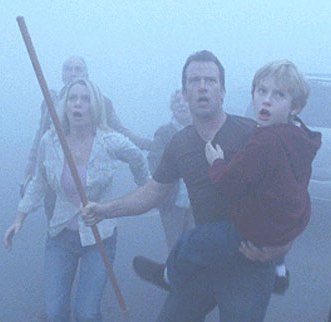
Going into the late-night showing of Frank Darabont’s version of Stephen King’s The Mist this evening, I was at best hoping for a good, scary B-movie — Prince of Darkness, The Thing — with perhaps a bit of choice sociopolitical grist (the Romero Deads, Invasion of the Body Snatchers, They Live) thrown in for good measure. (After all, the ominous poster and tagline of the film (“Fear changes everything”) pretty much announces there’ll be some post-9/11 commentary lurking amid the monsters.) Alas, The Mist fails on both fronts. Despite a good cast that do what they can with some woefully scripted material, the film is rarely very frightening — mostly because so many of the characters are so one-note that it’s hard to get all that concerned about their well-being. (The cheap FX don’t help.) Worse, Darabont’s attempts at allegory here come across as ponderous, ham-handed, and facile. The film aims to suggest that people in the grip of unyielding terror will do and fall for anything, which of course is a scary thought — one that not only resonates with our current political predicament, but permeates tons of horror movies from Night of the Living Dead to 28 Weeks Later. But, in its shrill, one-note portraits of religion and of “average” people (re: Red Staters), The Mist feels as elitist, hyperbolic, and echo chamber-y as a bad dKos talkback.
Set somewhere in Maine, as per King’s usual m.o., The Mist opens with several nods to what Darabont (probably correctly) assumed would be his core audience: the fanboy nation. For it turns out our protagonist David Drayton (Thomas Jane) is a movie poster artist a la Drew Struzan, and the first moments of the film feature him working in his studio on what’s obviously a poster of Roland the Gunslinger of Stephen King’s The Dark Tower. (The one-sheet from John Carpenter’s The Thing is also featured on the wall, and Drayton makes a quip early on about the standard two-face movie poster, pitched right at the AICN crowd.)

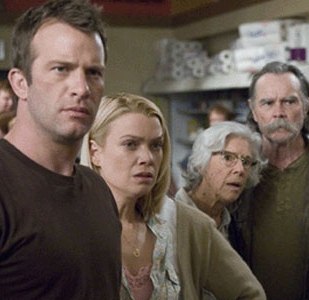
At any rate, after a particularly virulent storm, David, his son (the obligatory cute kid of the story), and his next-door neighbor, a hotshot lawyer from New York (Andre Braugher), all venture into town to get supplies. But, unfortunately for them, strange things are afoot at the Circle K: Very soon, an unnatural, unholy fog rolls in, and it becomes clear relatively quickly that staying exposed to it will get you killed in horrific fashion by large tentacles, winged insects, or other unspeakable Lovecraftian creatures from out of nowhere. And so the people at the supermarket hunker down for a long haul, but divisions quickly emerge among the ranks of the terrified. In the manner of horror films, Braugher’s lawyer character won’t believe anything that’s going on, and he and other denizens (Bill Sadler’s working-class stiff, for example) begin to take umbrage at imagined slights. Even more problematically, we have a true believer in our midst, the Bible-thumping spinster Mrs. Carmody (Marcia Gay Harden), and as the terror mounts and the Rapture looks nigh, she begins to relish her assigned role as Old Testament prophet, right down to the human sacrifices…
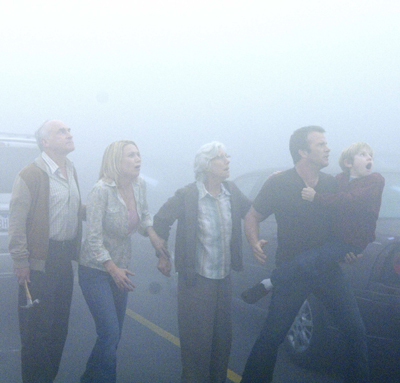
It’s been over fifteen years since my big King phase, so I barely remember the novella at all. (Of the Skeleton Crew stories, the ones that made the most impression on me were “The Jaunt” and “Survivor Type.”) But I presume some –probably even most — of the blame resides with King for Mrs. Carmody. (The End of Days psycho-Christian definitely seems in his wheelhouse.) Nevertheless, as written here, she’s way too over the top to be taken seriously, especially after Darabont starts layering on the post-9/11 stuff like a paste. (There’s a meeting held among the saner folk where they break down her appeal for the scared, in case you somehow missed the allegory thus far.) Worse, most of the people in the supermarket who fall under her spell — exemplified by Sadler’s malleable redneck — are so cardboard cut-out they might as well be carrying torches and pitchforks from the opening reel. You’d think given a apocalyptic situation like the one faced in The Mist that faith and religion might pop up in many forms. But there’s no nuance or depth at all to Darabont’s presentation, just evil religionists and their dupe followers.
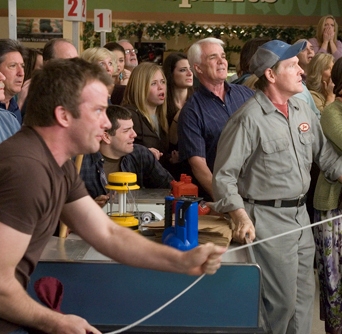
Then again, to be fair, none of the other characters are multi-dimensional either, and so I found myself rooting for actors instead. Thomas Jane is always a likable presence (he and Serenity‘s Nathan Fillion seem to be fighting it out for the mantle of the new Michael Biehn), and he’s solid enough here. Toby Jones (of the “other” Capote movie) is also stuck with a flat role — he’s Dignity Under Pressure — but makes an impression regardless. And it’s good to see Frances Sternhagen (a.k.a. the doctor from Outland) flitting about as a senior citizen not unwilling to smite false prophets with cans of peas. But, try as they might, they can’t raise the stakes here.

I’ll admit to liking a few brief flourishes in The Mist. At one point, a low-budget CGI tentacle hungrily crushes a bag of dog food, which is exactly the type of horrific-meets-the-mundane moment that King writes so well. Late in the game, the survivors of the tale to that point witness a truly Cthuhulian nightmare, all hooves and tentacles, one that’s nearly impossible to comprehend. And then there’s the ending…which I expect will be remembered for much longer than the rest of the film. I won’t give it away here, but I will say that, while admirable in its own way, it also felt like a Twilight Zone gimmick that came out of nowhere, felt unearned, and didn’t really hold up with the story to that point. (I can see an argument that ties it in to the rest of the film, but it’s a stretch.) Ultimately, The Mist isn’t as godawful as, say, Dreamcatcher, but it is yet another drab and mediocre King adaptation in a world full of them. If I were you, I’d wait for The Mist to clear.
Tapeheads.

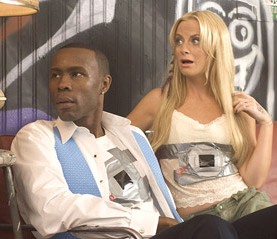
As seen in front of The Mist this evening, Jack Black and Mos Def (are forced to) star in lo-fi remakes of your favorite films in the new trailer for Michel Gondry’s Be Kind Rewind, also starring Danny Glover, Mia Farrow, and Melonie Diaz. This looks more than a little ridiculous, but, after Science of Sleep, Dave Chappelle’s Block Party, and especially Eternal Sunshine, I’ll check out whatever Gondry is up to. (And Mos Def is always watchable…but where are the Swanky Modes?)

His Back Pages.


A song will lift, as the mainsail shifts, and the boat drifts on to the shoreline.” If you’ve been reading this site for any length of time, you probably already know that I drank the Bob Dylan kool-aid a good while ago. So, more than likely, my opinion of Todd Haynes’ I’m Not There, which I raced down (on the D-train, no less) to catch at the Film Forum this morning, should be taken with at least a shaker of salt. And, to be honest, it’s hard to imagine how this film plays to people who aren’t all that into Dylan — If you don’t already have a basic sense of his story and his various periods, I could see it being as incoherent and irritating as Southland Tales (although it’s assuredly better-made.) But, if you do have any fondness for Bob, oh my. The short review is: I loved it. Exploding the conventional music biopic into shimmering, impressionistic fragments, Todd Haynes has captured lightning in a bottle here. The movie is clearly a labor of love by and for Dylan fans, riddled with in-jokes, winks, and nods, and I found it thoughtful, funny, touching, and wonderful. Put simply, while No Country for Old Men is right up there, I’m Not There is my favorite film of the year. I can’t wait to see it again.

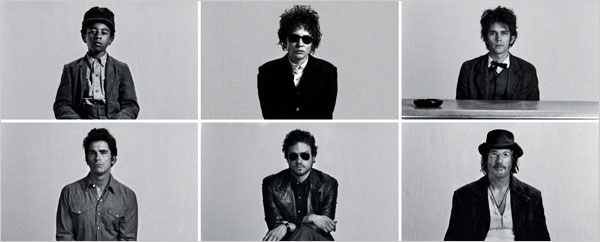
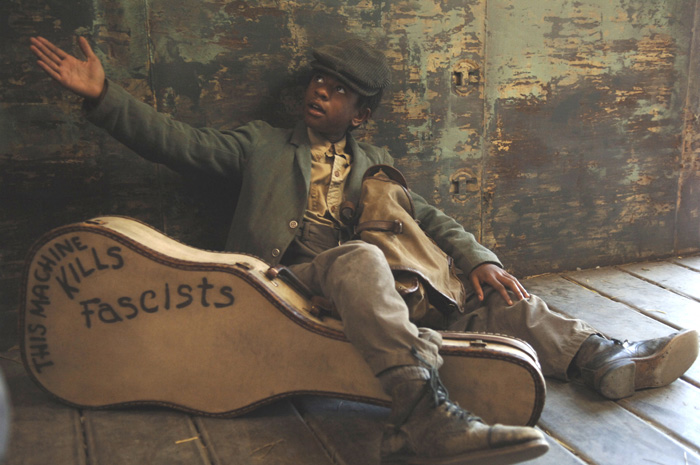
Like Navin Johnson, Bob Dylan was born a poor black child. (Marcus Carl Franklin) Ok, perhaps not. But Hayne’s movie doesn’t really aim to tell the story of one Robert Zimmerman of Hibbing, Minnesota. anyway. — He’s not there. Instead I’m Not There refracts Dylan through a prism of sorts, giving us multiple versions of the man (and myth) at various stages in his life and work. And, so, after a first person POV shot of “Dylan” (us?) taking the stage in ’66, and a title shot involving a potentially-momentous motorcycle, we are introduced to one Woody Guthrie (Franklin), an 11-year-old folk wunderkind traveling hobo-style along the rails, singing union songs and making up his past as he goes along. But the times they-are-a-changin’, and, as a kindly matron informs Woody, the old songs don’t necessarily do justice to the problems of 1959. Enter Jack Rollins (Christian Bale), an earnest young troubador who once lit Greenwich Village on fire with his ballads of social protest (“finger-pointin’ songs”), and, having rejected the folk scene and found Jesus, is now the subject of a No Direction Home-style documentary. (Julianne Moore does a Joan Baez impression here, straight out of Scorsese’s doc, which is pretty hilarious, and maybe even a little mean — note the business with the cat.)

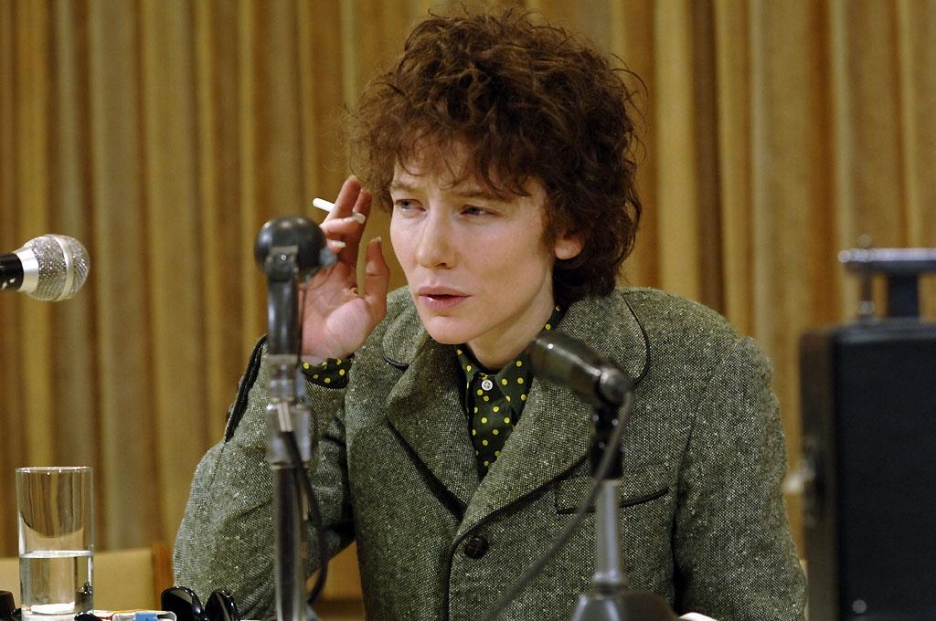
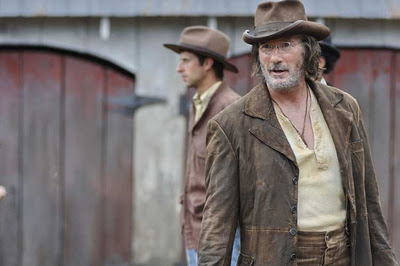
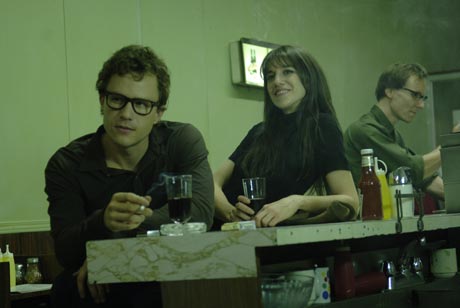
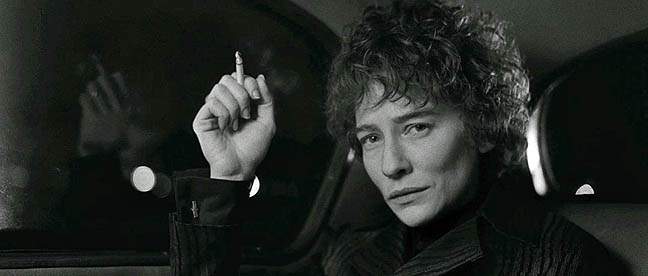
By now, you probably see where this is going. Post-Newport, Cate Blanchett shows up as Jude, a.k.a. the reedy, combative, drugged-out, and dog-tired Dylan of (blonde on) Blonde on Blonde and Don’t Look Back. (It takes a woman like her, to get through, to the man in him.) Ben Whishaw shares the load of society’s probing as Arthur Rimbaud, a Bob who spends most of the movie facing down some unknown interlocutors. Heath Ledger’s Robbie is the romantic and the womanizer, the Dylan who woos the heartbreakingly beautiful Claire (Charlotte Gainsbourg, playing an amalgamation of Suze Rotolo and Sara Lownds), looks for solace in a normal life outside Woodstock, and eventually stares into the abyss of Blood on the Tracks. And Richard Gere is Billy, an aging outlaw hiding out in Riddle, MO, part of the mythical American landscape conjured by Bob in “Bob Dylan’s 115th Dream,” “Desolation Row,” John Wesley Harding, The Basement Tapes, “Blind Willie McTell,” and countless other songs.

Each of this fellowship of Dylans does quality work in the role. Cate Blanchett is getting the most press these days, perhaps deservedly so, but I was as impressed with Bale, Whishaw, Franklin, and particularly Ledger — After seeing the extent of his range here, it’s pretty clear he’s going to kill as the Joker next summer. And other actors resonate here as well. I already mentioned Julianne Moore and the exquisite Charlotte Gainsbourg. (My crush on the latter, already simmering after The Science of Sleep, will no doubt grow by leaps and bounds now, particularly once you factor in her fragile, breathy version of “Just Like a Woman” on the soundtrack. With a face that’s at once honest, open, statuesque, and melancholy, she’s the perfect sad-eyed lady of the lowlands.) Also notable is David Cross, the spitting image of Allen Ginsberg, Michelle Williams invoking Factory Girl Edie Sedgwick, and a well-preserved Richie Havens delivering a Joe Cocker moment with his version of “Tombstone Blues.” Bruce Greenwood (of Thirteen Days, The Sweet Hereafter, and recently John from Cincinnati) does particularly impressive work as Jude’s nemesis, a BBC newsman who wants to pin both the mercurial singer and the meaning of his (her) music to the wall like a butterfly. Clearly, something is happening here, but he don’t know what it is…

Do you need to know a lot about Dylan going in? Well, it undoubtedly helps. I’m Not There is rife throughout with Dylanalia, and, yes, at times it’s dropped as blatantly as the groaners in Across the Universe: Jude mutters “Just like a woman!” at one point as a punchline, and an LBJ on the wall during a party strangely exclaims “It’s not yellow, it’s chicken.” But, others are more obscure, hidden in the fabric of the film like a crossword puzzle for Dylanophiles. Many of the strange denizens of Gere’s Riddle recall characters in songs or various Dylan incarnations, from the whitefaced troubador at Ms. Henry‘s funeral to the Union solders and passing Lincoln on stilts. As Robbie and Claire (Renaldo and Clara?) have one of those tired, terse phone discussions that signifies the end is near, a movie poster over her shoulder reads “CALICO” (i.e. “Sara,” the “calico sphinx in a scorpio dress (you must forgive me my unworthiness.)“) Or, in the scene accompanying one of Dylan’s masterpieces, “Visions of Johanna,” the Ledger Dylan, a movie star of sorts, is bored on the road and skirt-chasing one of his co-stars. As this goes down, we happen to see some elderly crones in neck braces (“the jelly-faced women all sneeze“), Ledger walking in a museum (“Inside the museum, Infinity goes up on trial“), the Mona Lisa (who “musta had the highway blues, you can tell by the way she smiles“), and the co-star he’s tailing, of course, is named Louise. (“Louise, she’s all right, she’s just near. She’s delicate and seems like the mirror. But she just makes it all too concise and too clear that Johanna’s not here.“)

If this all is starting to sound like two and half hours of insufferable inside-baseball for Dylanheads, well, I guess it might be. But I really don’t think it plays like that. (And I also don’t think that was the appeal for me either. Both Masked and Anonymous and Twyla Tharp’s The Times They Are-A Changin’ trafficked in similar inside gags, and I didn’t enjoy those anywhere near as much as this film.) Basically, I’m Not There is too vibrant and enthusiastic to feel smug, remote, or exclusive about its fondness for Dylan. It never purports to define the meaning of any particular song, showing instead that more often than not their beauty lies in their ambiguity. (For example, both defenders of the cultural Old Guard and the Black Panthers feel “Ballad of a Thin Man” is about them.) And it often pokes fun at the Dylanophiles among us, throwing in a number of disgruntled fans at various times (particularly after Bob plugs in) and having Jude get pestered by an overeager amateur Dylanologist after hanging with the Beatles (a very jolly cameo indeed.) Plus, for all the reverence, Dylan himself isn’t as whitewashed as he was in No Direction Home — His drug habit, his youthful arrogance and occasional thin skin, and some questionable views on women poets are all on display here.

A talented artist in his own right (case in point: Safe and Far from Heaven), Haynes employs all the magic of the movies to tell Dylan’s story. The Robbie-and-Claire scenes are filmed in color occasionally as riotous as in Hayne’s homage to Douglas Sirk, Jack’s social protest and Christian periods are told in faux-documentary fashion, and Jude’s England tour is all black-and-white cinema verite, a la Don’t Look Back. That’s why I’m pretty sure i’m Not There will work even for people who don’t know the first thing about Dylan. It remains visually interesting throughout, and never falls into the usual biopic rut, that standard, hackneyed rise, fall, and rise again narrative which tends to bring down even otherwise well-made entrants in the genre like Walk the Line.

And, of course, it benefits from having one of the better soundtracks out there, and Haynes has expertly weaved Dylan’s music (and some quality cover versions) into almost every moment of the film. Let me put it this way: Within the first five minutes, I’m Not There features some period NYC subway footage set to the irrepressibly toe-tapping “Stuck Inside of Mobile With the Memphis Blues Again.” (Also another visual pun — the subway folk are “stuck inside of mobile.”) From that moment on, the movie pretty had much me. In the end, I don’t know if non-Dylan folk will vibe into it or not, but I found I’m Not There a splendid gift from one Dylan fan to the rest of us, and assuredly one of the more inventive and captivating biopics in recent filmdom. “And the sun will respect every face on the deck, the hour that the ship comes in.

Say what you will about the tenets of National Socialism…

I’m talkin’ about friendship. I’m talkin’ about character. I’m talkin’ about – hell, Leo, I ain’t embarrassed to use the word – I’m talkin’ about ethics.” If you’re a cinephile of any sort, The House Next Door is probably already (or should be) on your reading list. Still in case it isn’t, Matt Zoller Seitz wrote a particularly intriguing essay on the Coens’ view of morality last week (which you absolutely should NOT read until after seeing No Country for Old Men — it gives away the whole game.) “Though they are habitually described as snotty formalists with nothing on their minds but cinematic gamesmanship, the Coens’ body of work is one of the most sneakily moralistic in recent American cinema. To some extent, all of their movies poses questions that supposedly deeper filmmakers have broached time and time again: if we cannot be certain of God’s existence; if there is a possibility that no one’s watching what we do; if, to reference Johnny Caspar in Miller’s Crossing, ‘morality and ethics’ are agreed-upon lies…then what’s the point of being good? Just because.Update: Also via THND, the Chicago Sun-Times‘s Jim Emerson offers up another quality dissection of No Country.

Drawn into Grendel’s Den.


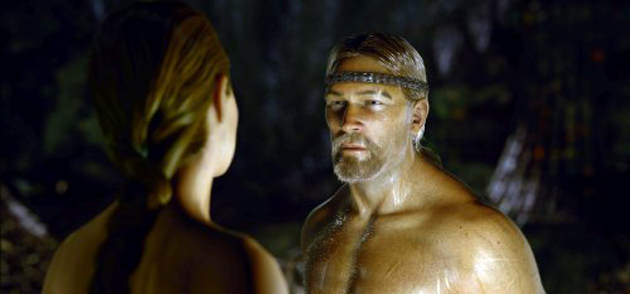
I am the ripper, the terror, the slasher. I am the teeth in the darkness! The talons in the night! My name is strength! And lust! And power! I AM BEOWULF!” Well, ok then. If Zack Snyder’s 300 last spring only whetted your appetite for cartoonish sword-and-sandal epics featuring hyperstylized gore and naked men bellowing, you’re in luck. For now arises Robert Zemeckis’ Beowulf, a rousing 3-D mo-capped glimpse into the future of filmmaking and the ancient past of storytelling. To be honest, it’s harder than usual for me to judge Beowulf on its own terms, since this was my first feature-length IMAX-3D experience (notwithstanding documentaries like Aliens of the Deep), so I can’t say if it’d have the same effect at your regular 2D cineplex. But, in three dimensions, Beowulf is pretty darned impressive, what with arrows, swords, and viking viscera flying in all directions…We’ve come a long way from Captain Eo. And, while the film is basically a pretty standard three-act summer action movie, I’ll give it points for daring to be both more bloody and more downbeat than your average animated fare. If you see one movie this Thanksgiving holiday, see No Country for Old Men…but, if you’re in the mood for it, Beowulf is well worth a look-see as well.

In late 5th century Scandinavia, as rumors of a new god, Christ Jesus, leak out of lands to the South, the Danes under the dissolute King Hrothgar (Anthony Hopkins) and his lovely Queen Wealthow (Robin Wright Penn) are just looking to have a good time. This they proceed to do in the manner of ancient peoples and Ren Faires immemorial, with ribald songs and lusty wenches, meat straight off the bone, and more mead than you can shake a spear at. But interrupting these hearty proceedings is an uninvited guest, an oozing, decaying nearby troll known as Grendel (Crispin Glover), who proceeds to wreck the mead hall, tear Danes limb from limb, and otherwise bring the party down. Seeking respite from Grendel’s gory visitations, King Hrothgar and his people need a Hero. They find one in the traveling Geat warrior Beowulf (Ray Winstone), who arrives via ship with his loyal lieutenant Wiglaf (Brendan Gleeson) and a band of battle-tested scoundrels, all seeking honor and glory. Beowulf is tough, Beowulf is fearless, Beowulf is…a bit of a braggart, as deduced by one of the local noblemen (John Malkovich). But that’s beside the point, as, having enlisted under Hrothgar’s standard, mighty Beowulf must now confront the demon Grendel whether he likes it or not…as well as his more powerful, more alluring mother (Angelina Jolie), who has certain feminine wiles in her arsenal that our Hero may find harder to resist.

If you read, or were forced to read, Beowulf back in school days, you’ll quickly find that screenwriters Neil Gaiman and Roger Avary have changed the story considerably — They’ve made it bawdier, they’ve completely rewritten the second and third acts, and they’ve emphasized the human fallibility of the characters rather than their epic heroism. (While I’m sure this is anathema to many, none of this bothered me very much, as I’ve actually never read Beowulf before…sad, I know.) Still, for what’s here, Beowulf works decently well, although a Faustian bargain is made at one point that doesn’t seem nearly as tragic and horrible as it’s made out to be. (Sure, regrets he’s had a few, but Beowulf seems to do pretty well by the deal, and you could argue he’s only undone once it is inadvertently broken, rather than as a consequence of consummating it in the first place.)

All that being said, in most eyes Beowulf is less likely to be judged for its capturing the nuances of the ancient poem than it is for its motion-capture, and here’s it’s going to be up to one’s personal aesthetics. Some reviewers are completely creeped out by the effect, but it didn’t bother me much at all. (The 3-D assuredly helped.) Sure, there were a few establishing shots — the viking ship, horses crossing a bridge — that screamed World of Warcraft cutscene, and the men, with their chiseled features and facial hair, still look more realistic than the women, whose faces often lack as much definition. But, all in all, I was rather impressed by the quality of the animation. And, besides, it’s animation — it was more important to me that Beowulf and Grendel seem part of the same world than that Beowulf looked exactly like someone I’d see at the deli. (And if this is what it takes to see Ray Winstone and Brendan Gleeson as the two leads in a buddy picture, so be it, although it still might be more fun to see them face off in a Sexy Beast II.)

So, yes, Beowulf is more a cartoonish action flick (see below) than a somber and faithful retelling of the epic poem. But, as far as cartoonish action flicks go, I thought it was pretty entertaining. (And if you have an IMAX 3-D theater near you, it’s pretty much a must-see.) And, while admittedly it may achieve nothing close to the heights of the original poem, I still admired the general sense of dread and melancholy at work through much of Beowulf. Even the greatest heroes in our canon, it seems, often have a failing for beauty and proud words.

Update: If you’re a first-time visitor arriving via The House Next Door today, welcome! (And, happy thanksgiving.) This way to the site’s front page, and down the hall on your left is the movie review archive. And, sorry, the turkey isn’t ready yet (unless you mean Southland Tales.)

The Monster and its Critic.

“Zemeckis took the oldest and most important text of our ur-language, and turned it into a 3-D Disneyland ride so cheesy he should have called it ‘Anglo-Saxons of the Caribbean.’…But the ‘Beowulf’ travesty is especially glaring, because of the obvious contrast with another work that mined the same ancient field: J.R.R. Tolkien’s ‘The Lord of the Rings.’” Taking issue with the “plastic entertainment‘ that is Zemeckis’ Beowulf much more than I did, Salon‘s Gary Kamiya movingly explains what Tolkien understood about the poem, and how it informed his own work. “Tolkien’s brilliant essay can be seen as a ringing defense not just of ‘Beowulf,’ but of the work he was soon to embark on, another great tower composed of ancient stones. And the themes of lateness, of heroic loss, being caught between one age and another (his world is not called ‘Middle-earth’ for nothing), are the deepest and most sublime parts of his own epic.

Not with a Bang but a Whimper.

Well, I guess nobody can doubt its commitment to Sparkle Motion. But, sadly, the sprawling, incoherent Southland Tales, the second film by Donnie Darko creator Richard Kelly, is a ghastly trainwreck, and easily the worst film I’ve seen in a theater since 2003’s Gods and Generals. As I said to my brother on the way out (and as David Edelstein also noted), it makes the excellent Donnie Darko look worse in retrospect (and goes a long way toward explaining why the needlessly expository Darko Director’s Cut is so much less satisfying than the original version.) A hackneyed, overwrought stoner mishmash of leaden political satire and borrowed apocalyptic sci-fi influences, Southland Tales is so terrible I left the theater irritated that it even got made. It’s not so-bad-its-good…it’s just bad. Really, how does a movie this lousy get filmed? How do the actors and everyone else involved not see they’re in the midst of a disaster? And why didn’t marginally more talented folks like Kevin Smith or Eli Roth take a break from their oh-so-cutesy cameos and give their boy a heads-up? As it is, Southland Tales basically feels like something composed in the back of a high school notebook, amid album cover doodles and lyrics about being misunderstood, after a long night at the bong.

As Southland Tales begins in the near-future of 2005 (which should give you a sense of how long this film was stuck in development hell), a family barbeque in Abilene, Texas is disrupted by nuclear devastation, and WW3 begins in earnest. As then explained in voiceover by a disfigured Iraq vet (Justin Timberlake) over an impressive infotainment presentation (probably the best thing about the film), the US is now at war with Dubya’s entire Axis of Evil (and Syria to boot); the world is facing a global oil shortage which may be alleviated by a newly-created hydrothermal energy source known as Fluid Karma; the Department of Homeland Security has taken NSA wiretaps to the next level and fashioned an Orwellian nightmare known as USIdent; “Neo-Marxist” (really?) cells have sprung up around Venice Beach, CA to fight Big Brother; and the crucially important election of 2008 pits the staid Democratic ticket of Clinton/Lieberman against the sinister Republican team of Eliot/Frost (both poets which Kelly quotes throughout like they’re going out of style –They’re not.)

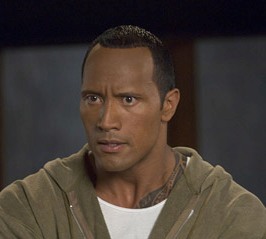
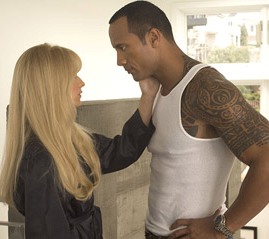
Finally, to kick off our story (which is apparently Part IV of a larger, presumably even more boring saga), we learn that an impressively-tattooed, Schwarzeneggerian movie star with top GOP connections (The Rock) has shown up in the middle of the desert suffering from amnesia, and has been taken under the wing of talk show hostess/porn star Krysta Now (Sarah Michelle Gellar) and her drug dealer roommate (Will Sasso). Got all that? We also discover along the way that the GOP and the Fluid Karma gurus (more on them in a second) might be in cahoots, that the NeoMarxist underground is basically run by former SNL alums (and poor, poor Avon Barksdale (Wood Harris) — guess he won’t be making fun of McNulty anymore for 300), that — paging Mr. Darko — there may be a time travel aspect to all of this, and that the secret to everything may rest on a pair of twin brothers (Seann William Scott), who find themselves getting drugged and/or knocked out a lot. Oh, and since JT keeps quoting Revelations over various scenes, its a solid presumption that the End of the World is more than likely on hand too…Bummer.

If this all sounds splendidly bizarre, well, it’s not. Southland Tales‘ strained attempts to come off as surreal might have worked if they had seemed effortless, but sadly they always feel here as if they required Herculean labor. Too much of the dialogue is drowning in exposition or weighed down by ponderous nods to Eliot, Frost, Revelations, etc. (I fear Kelly defenders will cite these to argue the film has hidden depths, when really they just expose how often Tales languishes in the shallows. But, admittedly, they might seem profound if you were completely baked out of your gourd.) Kelly has also clearly tried to give this project some weirdness cachet by dint of offbeat casting — the film is overloaded with C-grade celebrities and former ’80s icons. Case in point: Early in the film, we meet the team behind Fluid Karma, and they’re — I kid you not — composed of Wallace Shawn (best known for his “inconceivable” rants in The Princess Bride), Bai Ling, Zelda “Poltergeist” Rubenstein, Beth “Sparkle Motion” Grant, and Curtis “Booger” Armstrong. This sort of thing is good for a chuckle every so often, but after awhile — John Larroquette plays Karl Rove, Christopher Lambert drives an ice cream truck — it all just seems glommed on and irritating, particularly since Kelly seemingly expects the sheer presence of these people to do all the heavy lifting.

So what’s good about Southland Tales? Lordy, not much. As I said earlier, the satirical CNN of the near-future is well-constructed. The cast do what they can with what they’ve got, and most of ’em rise above the material: The Rock is charismatic enough to jet by, Seann William Scott at least seems like he’s trying, and Justin Timberlake redeems himself with one of the better scenes in the film, a lip-synched video to The Killers’ “All These Things That I’ve Done” (which nonetheless comes off as a Big Lebowski ripoff set to ski-ball, and mirrors quite closely the “Happiness is a Warm Gun” routine from Across the Universe earlier this year.) But these brief moments are by no means enough to recommend this dismal misfire of a film. Let me put it this way: I really liked the original version of Donnie Darko (note the rotating header), I really like cutting political satire and big-think sci-fi (for a classic example of how to do it right, see Brazil), I really like seeing semi-forgotten actors find work (see my post on Matt Frewer and Watchmen earlier this week) and I hated — hated — this film. You’d be hard pressed to find someone more likely to give Richard Kelly and Southland Tales a larger benefit of the doubt than I did going in, but this movie is rambling, incoherent, puerile, and, worst of all, tedious. Revelation 3:16: So then because thou art lukewarm, and neither cold nor hot, I will spue thee out of my mouth.

Blackjack, Bigfoot, Binomials [and Beast.]

In the trailer bin, which should be teeming over soon with Thanksgiving upon us: Did Bosworth break up the band? Across the Universe‘s Jim Sturgess forgoes the Beatles for a blackjack team in the trailer for Robert Luketic’s 21 (a.k.a. Ben Mezrich’s Bringing Down the House), also starring Kevin Spacey, Kate Bosworth, and Laurence Fishburne. Nature documentarian Steve Zahn goes on the trail of Bigfoot in the so-so trailer for Fred Wolf’s Strange Wilderness, also with Allen Covert, Mac Guy, Jonah Hill, Ernest Borgnine, Jeff Garlin, and Joe Don Baker. And Frodo (Elijah Wood) and (animated) Aragorn (John Hurt) team up to solve a string of horrific math-tinged crimes in the Spanish-language trailer for Alex de la Iglesia’s The Oxford Murders, from the book by Guillermo Martinez. Doubt I’ll see any of these, but you never know. Update And another: Don’t say Lovecraft didn’t try to warn us…something Huge, Malevolent, and (hopefully) Cthulhuian stalks the streets of New York in the new trailer for JJ Abrams’ monster movie Cloverfield.