
No, Mr. Bond, I expect you to Dive…Mathieu Amalric is confirmed as Daniel Craig’s next nemesis in Bond 22.
Category: Cinema
Caspian See.
Timed to release with The Golden Compass this Friday, the trailer for Andrew Adamson’s The Chronicles of Narnia: Prince Caspian is now online. Liam Neeson and the kids are back again (if a little older), while replacing Tilda Swinton, James McAvoy, and Ray Winstone in the support department are Ben Barnes (of Stardust), Warwick Davis, and Peter Dinklage (of The Station Agent.)
Savage Love.
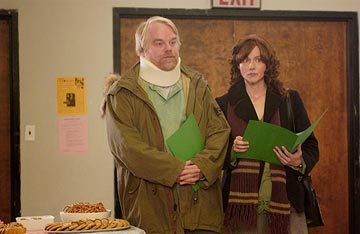 Emerging from Julian Schnabel’s Diving Bell, I had all of two or three minutes — basically, as long as the creepy Freelancers’ Union ad shown before every film at the Angelika — to decompress before entering Tamara Jenkins’ The Savages, a dramedy about two siblings confronting the onset of dementia in their estranged dad. And, in the early going, after a rather twee opening and some leaden scenes of Laura Linney writing a grant proposal and kvetching with her married boyfriend, I started to feel like I’d made a tactical error following Schnabel’s ambitious film so quickly with such a conventionally quirky, small-scale indy flick. But The Savages is a grower, and by the last reel, I was very glad I’d made the trip. Admittedly somewhat inconsistent — and I could have done with less Linney and more Hoffman — Savages is also at turns hilarious, bleak, and even rather moving (although I’m guessing I’m more of a sucker for the final moments than others might be.) And, in some ways, it was the perfect nightcap to Diving Bell (and, in its bickering siblings, to Margot at the Wedding the night before.) For Jenkins’ film is a grimly funny reminder that Bauby’s condition isn’t necessarily as exotic as it first seems. Eventually (if we’re even lucky enough to stick around that long), we all sink under the weight of the diving bell — it’s just a matter of time. A grisly insight, to be sure, but you could do worse than contemplating it here with The Savages.
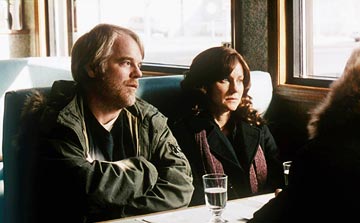 Jenkins’ movie opens with a sun-drenched Broadway-style musical number (Peggy Lee’s “I Don’t Want to Play in your Yard“) in the Retirement Heaven of suburban Arizona, the type of warm, happy, golf-cart-heavy environment one generally expects — given all the conventional portrayals of the Golden Years — to spend one’s waning days. But Lenny Savage (Philip Bosco), who lives therein, is beginning to act erratic (namely by finger-painting with his own feces), and after his aged girlfriend dies, he is cast out of this Grandpa’s Paradise. Enter his children (who haven’t heard from him in years), Wendy and Jon Savage — no relation to Wendy and John Darling of Peter Pan, as people are definitely growing old around these parts. Wendy (Laura Linney) is a failed playwright in Manhattan, working as a temp and sleeping with her married, horndog neighbor (Peter Friedman). Her older brother Jon (Philip Seymour Hoffman) is an obviously miserable academic in wintry Buffalo, working on a tome about Bertolt Brecht and sleeping with his laptop and a small reference library. (This detail rang uncomfortably true, as did the organized chaos of book piles strewn around his apartment.) So, with Lenny increasingly showing unmistakable signs of dementia, it now falls to Wendy and Jon to find a place for him, be it a retirement community, assisted living, or most likely, an institutional-gray nursing home in deepest, darkest Buffalo, and — in the tried-and-true tradition of quirky independent films — maybe learn to get along as a family in the process.
 The family-bonding, one-to-grow-on aspects of this project, admittedly, are where a good deal of the clunky stuff in The Savages emerges. The Savages bond over an unlikely neck injury suffered by Jon, all of which feels a little TV movie-ish. (Hoffman almost saves it with some good physical humor, though — watch him put his mail away.) And The Wire‘s Gbenga Akinnagbe shows up as a Nigerian nursing home worker who has a platonic relationship with Wendy, which all felt entirely too “Bagger Vance” for my taste. (i.e. He’s a convenient saintly African-American plot device used to move the white people’s stories forward.) But, other moments work better. There’s a running competition between the siblings over grant money which — having done the grant rigamarole — I thought was pretty funny. And, Hoffman in particular has a few memorable rants (outside the nursing home, for example), which are well worth the price of admission. Since I saw Before the Devil Knows You’re Dead a few weeks ago and Boogie Nights on TV since then, I feared Hoffman might come across as overexposed to me, a la Scarlett Johansson, Owen Wilson, Ben Stiller, or Janeane Garofolo. But he’s really great here, and comes across as a qualitatively different (if equally self-loathing) person than Before the Devil‘s older brother in question.
Perhaps most impressively, The Savages never really attempts to make Lenny all that huggable, or to softpedal his malady. In even his lucid moments, which are few, Lenny is a cantankerous old sort, and you can see why his kids have kept away from him for years. But Bosco brings a pathos to the role that is earned — you can also tell at various points that Lenny has brief inklings of what’s ahead of him — to wit, not much at all. In short, what Six Feet Under is to dying, The Savages is to the final stages of aging. It’s something we don’t really want to think about, but it’s there, somewhere over the last ridge. If we’re going to dwell on this subject, it’s probably best to confront that fact with the mordant humor of The Savages (while keeping in mind that, however inevitable that final end, it’s never too late to teach an old dog some new tricks.)
It Takes a Carnival.
The promotional machine for Christopher Nolan’s The Dark Knight continues to ramp up. As you may have noticed below, I’ve been posting several additional new photos of Heath Ledger’s Joker to the entry of a few days ago. Also, the online viral marketing has continued apace: First an edition of the Gotham Times was released, and, in keeping with the Dark Detective meme, that’s led to all kinds of spinoff sister sites and more municipal tangents than The Wire (Gotham Police Dept. (and Internal Affairs), Gotham National Bank, Gotham School District, Gotham’s DA hotline, Gotham City Rail, Gotham Cab, Acme Security Systems, Gotham Victim Advocate Organization, Remembering Gina, and a Jokerized version of the paper.) Whatsmore, at the original viral Joker site, you can now take a personality profile or try to open a vault for further clues. (Set your clock for 7:38am to do so.) Finally, both the trailer and the first seven minutes of the film will be released on December 14, before the IMAX version of Will Smith’s Omega Man-update I Am Legend. To the IMAXcave, Robin! Update: Another countdown, set for noon on Tuesday. The trailer, perhaps? Update 2: Nope. After some shenanigans involving local bakeries (the NYC ones were over in Yorktown), it’s a new one-sheet.
In the Blink of an Eye.
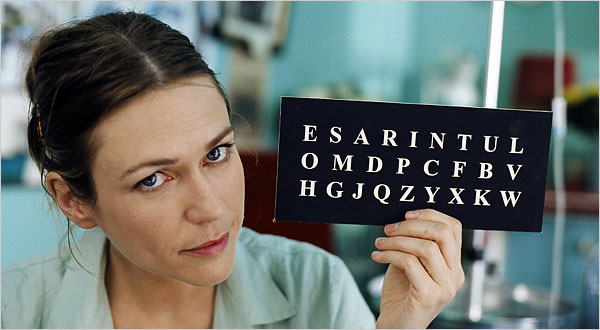
“Euh ess ahh err eee enn teh veh, ell, oh…” Suffice to say, I’m so glad I’m not writing this entry letter-by-letter (and in French to boot.) The first half of a powerful Saturday afternoon double-feature at the Angelika, Julian Schnabel’s The Diving Bell and the Butterfly, from the painstakingly-crafted memoir by Jean-Dominique Bauby, is an impressive and heartfelt depiction of how one man’s personal Hell becomes, through love, will, memory, and imagination, at least a barely endurable purgatory. At first glance, a film about being almost completely immobilized in a hospital bed for months and years on end may not seem like your cup of tea — I wasn’t sure it would be mine. But, despite the inherent sadness to Bauby’s story, Diving Bell is in fact overflowing with humor and even joie de vivre in the face of horrific tragedy. Yes, it says, you don’t know what you’ve got until it’s gone. But, even if you’ve lost everything, including basic motor function…well, all you have to do is dream.
The Diving Bell and the Butterfly begins in a blur. Blue-gray blobs fade in and out of vision, ultimately rectifying into institutional decor and men in white coats. We’re in a hospital room, but we, and our narrator Jean-Do Bauby (Mathieu Amalric, of Munich) don’t know why or how we got there. Worse, while we hear our narrator perfectly fine, nobody else can. It seems Bauby can no longer speak. Nor can he do anything else for that matter, except look around the room in abject horror and blink. Eventually, one of the doctors explains that Bauby has had a stroke, is emerging from a coma after several weeks, and now suffers from a rare medical condition known as “locked-in syndrome,” for which there may not be any cure. If this sounds like a fate worse than death, well, it seems so to Bauby at first too. But, when trapped in yourself, body your holding cell, it definitely helps to have a bevy of French beauties around to look after you, including the estranged mother of Bauby’s children (Emanuelle Seigner) and two therapists at the hospital (One, Olatz Lopez Garmendia, is Schnabel’s real-life wife. The other, Marie Josee-Croze (also of Munich), is the spitting image of Naomi Watts and, needless to say, also very easy on the one working eye.)
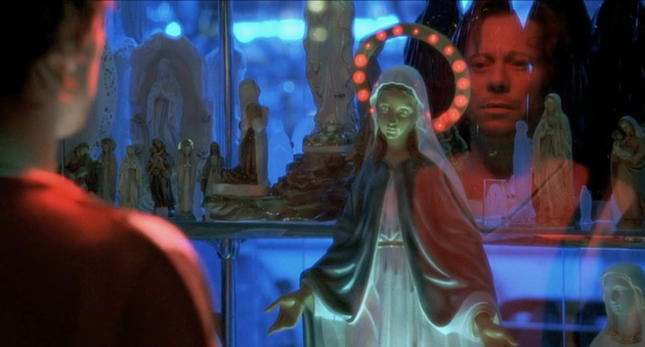
With the latter’s help, Bauby eventually grows used to a lengthy but workable system of communication whereby he blinks when the letter he wants to employ is named from a list (from most-used to least-used), thus piecing together words, sentences, and paragraphs after long hours of toil. As he becomes accustomed to his condition and this new system, Bauby, formerly an editor at Elle magazine, dwells on his recent past — say, shaving his elderly father (Max Von Sydow) the week before the incident, or taking a trip to Lourdes with his most recent love (Marina Hands), who is now afraid to visit him. In addition, he starts taking imaginative flights of fancy from his bodily prison (Enter Emma de Caunes of The Science of Sleep), and ultimately decides he’s going to write a book about the entire experience, blink by painstaking blink (thus bringing another beautiful woman into the equation, his new assistant (Anne Consigny). I mean, I know being a completely paralyzed invalid in any hospital is a horrible, horrible experience…but really, aren’t there any unattractive orderlies or assistants in France?)
If you’ve taken an art or film theory class in the past thirty years, somewhere amid viewings of Metropolis, 8 1/2, and/or Blade Runner you more than likely came across the concept of the “male gaze.” Diving Bell‘s clever conceit is to make that concept literal: For much of the film, the camera is Bauby’s POV. We are trapped in Jean-Do’s body for at least the first thirty minutes of the movie and experience everything from his perspective, from the grisly horror of having one’s eye sewn shut to the tantalizing triangle of exposed neck revealed by his lovely therapists. (At one point, around twenty minutes in, I turned to look at the audience, and everybody in the theater (also) had their head cocked uncomfortably to the left.) It is testament to Schnabel’s skill here that this effect, while assuredly feeling claustrophobic, never becomes oppressive to the point of being unwatchable. (There are some great, humorous touches to leaven things, such as when Jean-Do’s new winter cap ends up obscuring some of his/our view.) And, when the camera later forsakes the diving bell world of flesh and frailty for the butterfly realm of memory and imagination, we feel the same exhilarating sense of liberation Bauby describes in voiceover. By finally soaring out of the confines of Bauby’s body and roaming the world with abandon, Diving Bell offers a visceral reminder of the power of film, and of imagination.
There are moments I might quibble with in Diving Bell — The recap of his accident comes rather late in the movie, and feels slightly unnecessary there (I assume this is where it might have fallen in the book — I haven’t read it, although I more than likely will now.) And the film is undeniably slow at times. (But that’s by design, of course. Given the sheer amount of effort Bauby must expend to compose a single word, a faster-moving film would have been untrue and unfair to the proceedings.) Nevertheless, particularly for a film about something as nightmarish as locked-in syndrome, The Diving Bell and the Butterfly is truly transporting. It reminds us that there’s a certain miraculous magic to the power of sight, and that experiencing even the daily mundanities of the world is something we shouldn’t ever take for granted.
Dysfunction Junction.
 I’m guessing there must be a lot of awkward silences around the Baumbach household during the holidays. For, if you thought Jeff Daniels’ misfit academic Bernard Berkman was insufferable in The Squid and the Whale, Noah Baumbach’s semi-autobiographical recounting of his famous parents’ divorce, you ain’t seen nothing yet. Margot at the Wedding, which I caught at the Angelika Friday night, is basically a claustrophobic family reunion of damaged, needy, unlikable people, and none more than Nicole Kidman’s monstrous Margot, a brittle, self-absorbed Manhattanite who wreaks emotional havoc on everyone around her despite herself.
I have mixed feelings about Margot. On one hand, as in Squid, Baumbach displays a talent for making sharp, withering observations about people and their foibles, and at its best moments the film captures harsh truths about all of us at our grasping, rationalizing worst. But, these are only moments, and unlike Squid, Margot never really coalesces into a film, playing more as an episodic, occasionally diverting, and mostly repellent string of character observations. More problematic, the tone of the film toward its characters is uneven — some are portrayed as nuanced and multifaceted, but other seem to be around for cheap gags and blunt caricature. While I can’t say I’m sorry I saw Margot — it’s an interesting failure — I also don’t feel like I can recommend it. Hard to sit through in any event, given the people we’re trapped with, Margot ultimately seemed too indulgent and unfocused to warrant paying for. Alas, I thought it might all work out, but the Wedding‘s off. Call it irreconcilable differences.
As the film begins, an androgynous teenager named Claude (Zane Pais) shambles down a crowded train aisle and plops down next to a sour-faced brunette he thinks is his mother Margot (Kidman, solid despite a slipping accent), a successful short-story writer. It’s not — she’s three rows up, much prettier on the outside, and (presumably) much uglier within. Margot and Claude, we soon discover, are headed to the old family homestead somewhere on the Eastern seaboard to attend the wedding of Margot’s estranged sister Pauline (Jennifer Jason Leigh, also Baumbach’s wife) and her new beau Malcolm (Jack Black, which obviously suggests he might not be the best of catches). The trouble ostensibly begins when Margot takes an immediate disliking to Malcolm, an overweight, unemployed schlub with an ironic moustache, a seething jealousy toward U2’s Bono, and an (admittedly somewhat seductive) slacker philosophy. (His advice to Claude on wanting to be famous: “Make sure you can handle rejection. I can’t. For me, expectation just turns to disappointment. So, ultimately I’d rather not try. It’ll all go black for us soon enough anyway.“)
 But, Malcolm or no, trouble was inescapable. In effect, Margot is Godzilla in a floppy pink hat, and everyone else is Japan. As her long-suffering son well knows, the only way Margot knows how to express affection is by running people into the ground, and in any case, everyone at the family gathering is damaged, self-diagnosed, and medicated within an inch of their lives. (Pauline’s pre-teen daughter from a previous marriage — which Margot basically destroyed with a revealing short story in The New Yorker — is convinced she suffers from “adult ADD.”) Throw in a few more randoms — Margot’s gallant husband Jim (John Turturro), Margot’s new boyfriend Dick (Ciaran Hinds), his voluptuous teenage daughter Maisy (Halley Feiffer) (who just got into Harvard early — Barnard grad Margot is not impressed), and the next-door neighbors (the Voglers, whom Squid‘s Bernard might charitably call “philistines”) — and simmer. Let’s just say an awkward toast at the nuptials would be the least of this gang’s problems.
At its best, Margot at the Wedding feels both impressively and uncomfortably real. Even if everyone here (as in Squid) treat their children like therapists, which is a tic I’m can’t say I’m accustomed to, Baumbach has a keen sense for the rhythms of innocuous conversation, and how they can suddenly and disastrously go wrong. (I also liked well-observed moments such as when Margot, on a dare, gets stuck in a tree — at first, she’s feeling great about it, and admiring the altered perspective from above, then the bugs start to come out.) And, perhaps due to the semi-autobiographical nature of Squid, there’s some interesting rumination at times about using one’s life to write “fiction.” But, as the film progresses, a divide emerges between the more well-rounded characters (such as Margot and Pauline) and the one-note caricatures, most notably the ridiculously rednecky Voglers next-door, who make Billy Baldwin’s joke of a tennis instructor in Squid seem profound. Their kid in particular comes off as an unholy cross between Cletus the Slack-Jawed Yokel and the green-eyed kid from A Christmas Story.
 And then there’s Malcolm, who starts off reasonably enough but becomes little more than a punch line as the movie goes on. (Note the scene of him running down the stairs, for example, or the rather unnecessary nude shot, which basically seemed thrown in to let the audience laugh in disgust at Jack Black’s ass, love handles, and tighty-whities.) Speaking of which, there’s a late turn in the plot involving an indiscretion by Malcolm that threw me out of the film to some extent. His failing is sad, pathetic, and reprehensible, but I also thought the reactions of the other characters seemed so disproportionate to what he was admitting to that I got confused about some Polaroids shown earlier in the film, and had to read the script when I got home to make sure I’d seen things right the first time.
At first, there’s some tension between Margot’s impression of Malcolm (“He’s so coarse, he’s like guys we rejected when we were sixteen“) and the actual character, whom Pauline and Claude seem to like well enough. But he finishes the movie a blubbering, simpering joke. Granted, nobody else in the film is very likable either, but his character in particular reflects Baumbach’s tendency in Margot to get ham-handed and cartoonish at just the wrong time. (See also the rat in the pool, the pig carving, the “family bond” bracelets, any of several Oedipal moments, and other capital-S Symbols that slap you in the face every so often throughout.)
In short, Margot at the Wedding isn’t terrible, but it definitely feels like a misfire for Baumbach after Squid and the Whale (and isn’t much fun to sit through in any event). Hopefully, he won’t have to plumb too deep into his own familial id to get back into form next time ’round.
Trip Like He Does.
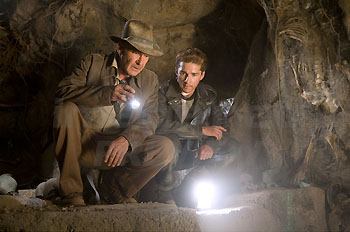
Quite a few new movie images popping up on the grid today…Then again, it’s that time of year, when the mags roll out the 2008 previews. Here, it appears to be Take Your Son (Shia LaBoeuf) to Work Day for Henry Jones, Jr., PhD (Harrison Ford). Steven Spielberg’s Indiana Jones and the Crystal Skull is slated to arrive May 22, 2008, and it, like The Dark Knight, should have a trailer kicking around relatively soon. (A few more pics of Indy looking suitably grizzled are over here at AICN.)
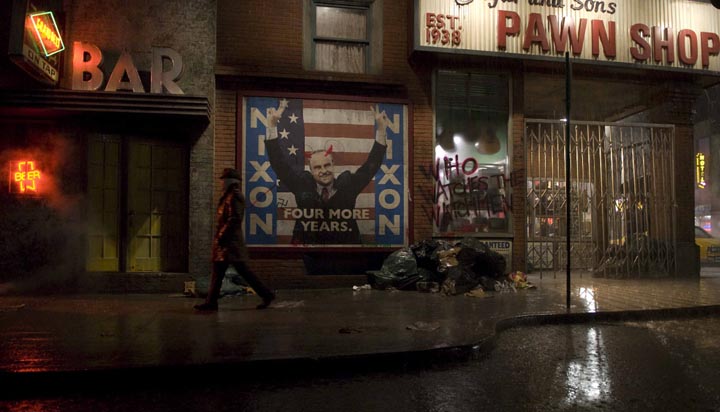
Streets stank of fire.
Pencils Ready?
“‘It’s already done, basically,’ the insider describes.” Is the Hollywood writers’ strike, now entering its fourth week, close to resolution? According to one report, definitely maybe. “I was told not to expect an agreement this week. But my source thought it was possible that the strike could be settled before Christmas.“
Patchwork Prankster.


What do Berkeley and the fanboy nation have in common this week? They both get really excited about socks…Empire Magazine makes a game of their slow reveal of their Heath Ledger Joker cover. Update: As you can now see, the cover’s been leaked. Update 2: And another, from the cover of Wizard. Looking better and better. Update 3: And yet a few more, from what look to be merchandising proofs. I don’t like these nearly as much, but then again it’s hard to sell anything comic-booky with a stark white background.
