The promotional machine for Christopher Nolan’s The Dark Knight continues to ramp up. As you may have noticed below, I’ve been posting several additional new photos of Heath Ledger’s Joker to the entry of a few days ago. Also, the online viral marketing has continued apace: First an edition of the Gotham Times was released, and, in keeping with the Dark Detective meme, that’s led to all kinds of spinoff sister sites and more municipal tangents than The Wire (Gotham Police Dept. (and Internal Affairs), Gotham National Bank, Gotham School District, Gotham’s DA hotline, Gotham City Rail, Gotham Cab, Acme Security Systems, Gotham Victim Advocate Organization, Remembering Gina, and a Jokerized version of the paper.) Whatsmore, at the original viral Joker site, you can now take a personality profile or try to open a vault for further clues. (Set your clock for 7:38am to do so.) Finally, both the trailer and the first seven minutes of the film will be released on December 14, before the IMAX version of Will Smith’s Omega Man-update I Am Legend. To the IMAXcave, Robin! Update: Another countdown, set for noon on Tuesday. The trailer, perhaps? Update 2: Nope. After some shenanigans involving local bakeries (the NYC ones were over in Yorktown), it’s a new one-sheet.
Tag: Cinema
In the Blink of an Eye.
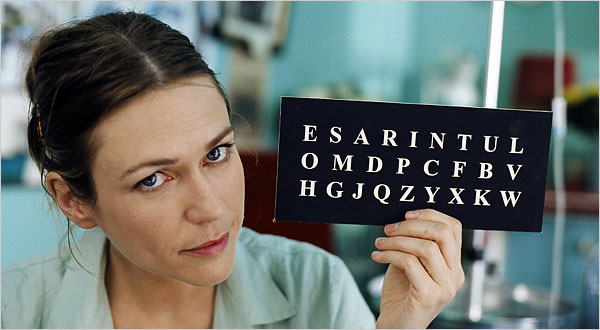
“Euh ess ahh err eee enn teh veh, ell, oh…” Suffice to say, I’m so glad I’m not writing this entry letter-by-letter (and in French to boot.) The first half of a powerful Saturday afternoon double-feature at the Angelika, Julian Schnabel’s The Diving Bell and the Butterfly, from the painstakingly-crafted memoir by Jean-Dominique Bauby, is an impressive and heartfelt depiction of how one man’s personal Hell becomes, through love, will, memory, and imagination, at least a barely endurable purgatory. At first glance, a film about being almost completely immobilized in a hospital bed for months and years on end may not seem like your cup of tea — I wasn’t sure it would be mine. But, despite the inherent sadness to Bauby’s story, Diving Bell is in fact overflowing with humor and even joie de vivre in the face of horrific tragedy. Yes, it says, you don’t know what you’ve got until it’s gone. But, even if you’ve lost everything, including basic motor function…well, all you have to do is dream.
The Diving Bell and the Butterfly begins in a blur. Blue-gray blobs fade in and out of vision, ultimately rectifying into institutional decor and men in white coats. We’re in a hospital room, but we, and our narrator Jean-Do Bauby (Mathieu Amalric, of Munich) don’t know why or how we got there. Worse, while we hear our narrator perfectly fine, nobody else can. It seems Bauby can no longer speak. Nor can he do anything else for that matter, except look around the room in abject horror and blink. Eventually, one of the doctors explains that Bauby has had a stroke, is emerging from a coma after several weeks, and now suffers from a rare medical condition known as “locked-in syndrome,” for which there may not be any cure. If this sounds like a fate worse than death, well, it seems so to Bauby at first too. But, when trapped in yourself, body your holding cell, it definitely helps to have a bevy of French beauties around to look after you, including the estranged mother of Bauby’s children (Emanuelle Seigner) and two therapists at the hospital (One, Olatz Lopez Garmendia, is Schnabel’s real-life wife. The other, Marie Josee-Croze (also of Munich), is the spitting image of Naomi Watts and, needless to say, also very easy on the one working eye.)
With the latter’s help, Bauby eventually grows used to a lengthy but workable system of communication whereby he blinks when the letter he wants to employ is named from a list (from most-used to least-used), thus piecing together words, sentences, and paragraphs after long hours of toil. As he becomes accustomed to his condition and this new system, Bauby, formerly an editor at Elle magazine, dwells on his recent past — say, shaving his elderly father (Max Von Sydow) the week before the incident, or taking a trip to Lourdes with his most recent love (Marina Hands), who is now afraid to visit him. In addition, he starts taking imaginative flights of fancy from his bodily prison (Enter Emma de Caunes of The Science of Sleep), and ultimately decides he’s going to write a book about the entire experience, blink by painstaking blink (thus bringing another beautiful woman into the equation, his new assistant (Anne Consigny). I mean, I know being a completely paralyzed invalid in any hospital is a horrible, horrible experience…but really, aren’t there any unattractive orderlies or assistants in France?)
If you’ve taken an art or film theory class in the past thirty years, somewhere amid viewings of Metropolis, 8 1/2, and/or Blade Runner you more than likely came across the concept of the “male gaze.” Diving Bell‘s clever conceit is to make that concept literal: For much of the film, the camera is Bauby’s POV. We are trapped in Jean-Do’s body for at least the first thirty minutes of the movie and experience everything from his perspective, from the grisly horror of having one’s eye sewn shut to the tantalizing triangle of exposed neck revealed by his lovely therapists. (At one point, around twenty minutes in, I turned to look at the audience, and everybody in the theater (also) had their head cocked uncomfortably to the left.) It is testament to Schnabel’s skill here that this effect, while assuredly feeling claustrophobic, never becomes oppressive to the point of being unwatchable. (There are some great, humorous touches to leaven things, such as when Jean-Do’s new winter cap ends up obscuring some of his/our view.) And, when the camera later forsakes the diving bell world of flesh and frailty for the butterfly realm of memory and imagination, we feel the same exhilarating sense of liberation Bauby describes in voiceover. By finally soaring out of the confines of Bauby’s body and roaming the world with abandon, Diving Bell offers a visceral reminder of the power of film, and of imagination.
There are moments I might quibble with in Diving Bell — The recap of his accident comes rather late in the movie, and feels slightly unnecessary there (I assume this is where it might have fallen in the book — I haven’t read it, although I more than likely will now.) And the film is undeniably slow at times. (But that’s by design, of course. Given the sheer amount of effort Bauby must expend to compose a single word, a faster-moving film would have been untrue and unfair to the proceedings.) Nevertheless, particularly for a film about something as nightmarish as locked-in syndrome, The Diving Bell and the Butterfly is truly transporting. It reminds us that there’s a certain miraculous magic to the power of sight, and that experiencing even the daily mundanities of the world is something we shouldn’t ever take for granted.
Dysfunction Junction.
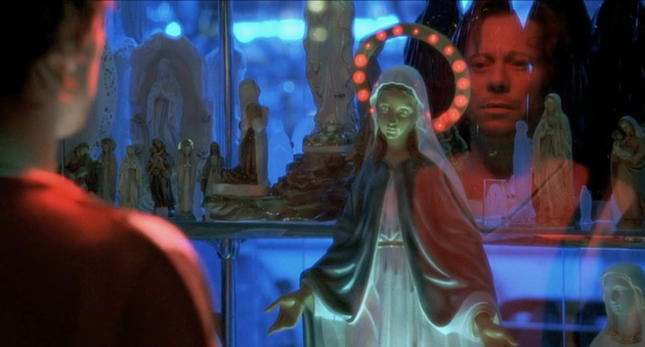
 I’m guessing there must be a lot of awkward silences around the Baumbach household during the holidays. For, if you thought Jeff Daniels’ misfit academic Bernard Berkman was insufferable in The Squid and the Whale, Noah Baumbach’s semi-autobiographical recounting of his famous parents’ divorce, you ain’t seen nothing yet. Margot at the Wedding, which I caught at the Angelika Friday night, is basically a claustrophobic family reunion of damaged, needy, unlikable people, and none more than Nicole Kidman’s monstrous Margot, a brittle, self-absorbed Manhattanite who wreaks emotional havoc on everyone around her despite herself.
I have mixed feelings about Margot. On one hand, as in Squid, Baumbach displays a talent for making sharp, withering observations about people and their foibles, and at its best moments the film captures harsh truths about all of us at our grasping, rationalizing worst. But, these are only moments, and unlike Squid, Margot never really coalesces into a film, playing more as an episodic, occasionally diverting, and mostly repellent string of character observations. More problematic, the tone of the film toward its characters is uneven — some are portrayed as nuanced and multifaceted, but other seem to be around for cheap gags and blunt caricature. While I can’t say I’m sorry I saw Margot — it’s an interesting failure — I also don’t feel like I can recommend it. Hard to sit through in any event, given the people we’re trapped with, Margot ultimately seemed too indulgent and unfocused to warrant paying for. Alas, I thought it might all work out, but the Wedding‘s off. Call it irreconcilable differences.
As the film begins, an androgynous teenager named Claude (Zane Pais) shambles down a crowded train aisle and plops down next to a sour-faced brunette he thinks is his mother Margot (Kidman, solid despite a slipping accent), a successful short-story writer. It’s not — she’s three rows up, much prettier on the outside, and (presumably) much uglier within. Margot and Claude, we soon discover, are headed to the old family homestead somewhere on the Eastern seaboard to attend the wedding of Margot’s estranged sister Pauline (Jennifer Jason Leigh, also Baumbach’s wife) and her new beau Malcolm (Jack Black, which obviously suggests he might not be the best of catches). The trouble ostensibly begins when Margot takes an immediate disliking to Malcolm, an overweight, unemployed schlub with an ironic moustache, a seething jealousy toward U2’s Bono, and an (admittedly somewhat seductive) slacker philosophy. (His advice to Claude on wanting to be famous: “Make sure you can handle rejection. I can’t. For me, expectation just turns to disappointment. So, ultimately I’d rather not try. It’ll all go black for us soon enough anyway.“)
 But, Malcolm or no, trouble was inescapable. In effect, Margot is Godzilla in a floppy pink hat, and everyone else is Japan. As her long-suffering son well knows, the only way Margot knows how to express affection is by running people into the ground, and in any case, everyone at the family gathering is damaged, self-diagnosed, and medicated within an inch of their lives. (Pauline’s pre-teen daughter from a previous marriage — which Margot basically destroyed with a revealing short story in The New Yorker — is convinced she suffers from “adult ADD.”) Throw in a few more randoms — Margot’s gallant husband Jim (John Turturro), Margot’s new boyfriend Dick (Ciaran Hinds), his voluptuous teenage daughter Maisy (Halley Feiffer) (who just got into Harvard early — Barnard grad Margot is not impressed), and the next-door neighbors (the Voglers, whom Squid‘s Bernard might charitably call “philistines”) — and simmer. Let’s just say an awkward toast at the nuptials would be the least of this gang’s problems.
At its best, Margot at the Wedding feels both impressively and uncomfortably real. Even if everyone here (as in Squid) treat their children like therapists, which is a tic I’m can’t say I’m accustomed to, Baumbach has a keen sense for the rhythms of innocuous conversation, and how they can suddenly and disastrously go wrong. (I also liked well-observed moments such as when Margot, on a dare, gets stuck in a tree — at first, she’s feeling great about it, and admiring the altered perspective from above, then the bugs start to come out.) And, perhaps due to the semi-autobiographical nature of Squid, there’s some interesting rumination at times about using one’s life to write “fiction.” But, as the film progresses, a divide emerges between the more well-rounded characters (such as Margot and Pauline) and the one-note caricatures, most notably the ridiculously rednecky Voglers next-door, who make Billy Baldwin’s joke of a tennis instructor in Squid seem profound. Their kid in particular comes off as an unholy cross between Cletus the Slack-Jawed Yokel and the green-eyed kid from A Christmas Story.
 And then there’s Malcolm, who starts off reasonably enough but becomes little more than a punch line as the movie goes on. (Note the scene of him running down the stairs, for example, or the rather unnecessary nude shot, which basically seemed thrown in to let the audience laugh in disgust at Jack Black’s ass, love handles, and tighty-whities.) Speaking of which, there’s a late turn in the plot involving an indiscretion by Malcolm that threw me out of the film to some extent. His failing is sad, pathetic, and reprehensible, but I also thought the reactions of the other characters seemed so disproportionate to what he was admitting to that I got confused about some Polaroids shown earlier in the film, and had to read the script when I got home to make sure I’d seen things right the first time.
At first, there’s some tension between Margot’s impression of Malcolm (“He’s so coarse, he’s like guys we rejected when we were sixteen“) and the actual character, whom Pauline and Claude seem to like well enough. But he finishes the movie a blubbering, simpering joke. Granted, nobody else in the film is very likable either, but his character in particular reflects Baumbach’s tendency in Margot to get ham-handed and cartoonish at just the wrong time. (See also the rat in the pool, the pig carving, the “family bond” bracelets, any of several Oedipal moments, and other capital-S Symbols that slap you in the face every so often throughout.)
In short, Margot at the Wedding isn’t terrible, but it definitely feels like a misfire for Baumbach after Squid and the Whale (and isn’t much fun to sit through in any event). Hopefully, he won’t have to plumb too deep into his own familial id to get back into form next time ’round.
Trip Like He Does.
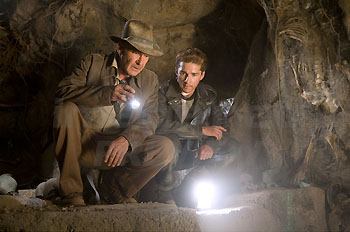
Quite a few new movie images popping up on the grid today…Then again, it’s that time of year, when the mags roll out the 2008 previews. Here, it appears to be Take Your Son (Shia LaBoeuf) to Work Day for Henry Jones, Jr., PhD (Harrison Ford). Steven Spielberg’s Indiana Jones and the Crystal Skull is slated to arrive May 22, 2008, and it, like The Dark Knight, should have a trailer kicking around relatively soon. (A few more pics of Indy looking suitably grizzled are over here at AICN.)
Streets stank of fire.
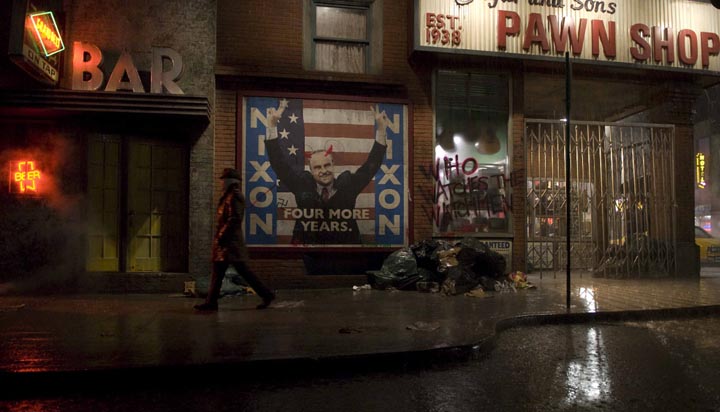
Pencils Ready?
“‘It’s already done, basically,’ the insider describes.” Is the Hollywood writers’ strike, now entering its fourth week, close to resolution? According to one report, definitely maybe. “I was told not to expect an agreement this week. But my source thought it was possible that the strike could be settled before Christmas.“
Patchwork Prankster.


What do Berkeley and the fanboy nation have in common this week? They both get really excited about socks…Empire Magazine makes a game of their slow reveal of their Heath Ledger Joker cover. Update: As you can now see, the cover’s been leaked. Update 2: And another, from the cover of Wizard. Looking better and better. Update 3: And yet a few more, from what look to be merchandising proofs. I don’t like these nearly as much, but then again it’s hard to sell anything comic-booky with a stark white background.

Mist-Conceived.
 Going into the late-night showing of Frank Darabont’s version of Stephen King’s The Mist this evening, I was at best hoping for a good, scary B-movie — Prince of Darkness, The Thing — with perhaps a bit of choice sociopolitical grist (the Romero Deads, Invasion of the Body Snatchers, They Live) thrown in for good measure. (After all, the ominous poster and tagline of the film (“Fear changes everything”) pretty much announces there’ll be some post-9/11 commentary lurking amid the monsters.) Alas, The Mist fails on both fronts. Despite a good cast that do what they can with some woefully scripted material, the film is rarely very frightening — mostly because so many of the characters are so one-note that it’s hard to get all that concerned about their well-being. (The cheap FX don’t help.) Worse, Darabont’s attempts at allegory here come across as ponderous, ham-handed, and facile. The film aims to suggest that people in the grip of unyielding terror will do and fall for anything, which of course is a scary thought — one that not only resonates with our current political predicament, but permeates tons of horror movies from Night of the Living Dead to 28 Weeks Later. But, in its shrill, one-note portraits of religion and of “average” people (re: Red Staters), The Mist feels as elitist, hyperbolic, and echo chamber-y as a bad dKos talkback.
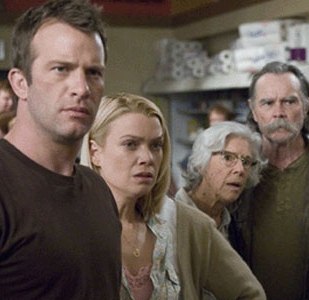 Set somewhere in Maine, as per King’s usual m.o., The Mist opens with several nods to what Darabont (probably correctly) assumed would be his core audience: the fanboy nation. For it turns out our protagonist David Drayton (Thomas Jane) is a movie poster artist a la Drew Struzan, and the first moments of the film feature him working in his studio on what’s obviously a poster of Roland the Gunslinger of Stephen King’s The Dark Tower. (The one-sheet from John Carpenter’s The Thing is also featured on the wall, and Drayton makes a quip early on about the standard two-face movie poster, pitched right at the AICN crowd.)
At any rate, after a particularly virulent storm, David, his son (the obligatory cute kid of the story), and his next-door neighbor, a hotshot lawyer from New York (Andre Braugher), all venture into town to get supplies. But, unfortunately for them, strange things are afoot at the Circle K: Very soon, an unnatural, unholy fog rolls in, and it becomes clear relatively quickly that staying exposed to it will get you killed in horrific fashion by large tentacles, winged insects, or other unspeakable Lovecraftian creatures from out of nowhere. And so the people at the supermarket hunker down for a long haul, but divisions quickly emerge among the ranks of the terrified. In the manner of horror films, Braugher’s lawyer character won’t believe anything that’s going on, and he and other denizens (Bill Sadler’s working-class stiff, for example) begin to take umbrage at imagined slights. Even more problematically, we have a true believer in our midst, the Bible-thumping spinster Mrs. Carmody (Marcia Gay Harden), and as the terror mounts and the Rapture looks nigh, she begins to relish her assigned role as Old Testament prophet, right down to the human sacrifices…
 It’s been over fifteen years since my big King phase, so I barely remember the novella at all. (Of the Skeleton Crew stories, the ones that made the most impression on me were “The Jaunt” and “Survivor Type.”) But I presume some –probably even most — of the blame resides with King for Mrs. Carmody. (The End of Days psycho-Christian definitely seems in his wheelhouse.) Nevertheless, as written here, she’s way too over the top to be taken seriously, especially after Darabont starts layering on the post-9/11 stuff like a paste. (There’s a meeting held among the saner folk where they break down her appeal for the scared, in case you somehow missed the allegory thus far.) Worse, most of the people in the supermarket who fall under her spell — exemplified by Sadler’s malleable redneck — are so cardboard cut-out they might as well be carrying torches and pitchforks from the opening reel. You’d think given a apocalyptic situation like the one faced in The Mist that faith and religion might pop up in many forms. But there’s no nuance or depth at all to Darabont’s presentation, just evil religionists and their dupe followers.
 Then again, to be fair, none of the other characters are multi-dimensional either, and so I found myself rooting for actors instead. Thomas Jane is always a likable presence (he and Serenity‘s Nathan Fillion seem to be fighting it out for the mantle of the new Michael Biehn), and he’s solid enough here. Toby Jones (of the “other” Capote movie) is also stuck with a flat role — he’s Dignity Under Pressure — but makes an impression regardless. And it’s good to see Frances Sternhagen (a.k.a. the doctor from Outland) flitting about as a senior citizen not unwilling to smite false prophets with cans of peas. But, try as they might, they can’t raise the stakes here.
I’ll admit to liking a few brief flourishes in The Mist. At one point, a low-budget CGI tentacle hungrily crushes a bag of dog food, which is exactly the type of horrific-meets-the-mundane moment that King writes so well. Late in the game, the survivors of the tale to that point witness a truly Cthuhulian nightmare, all hooves and tentacles, one that’s nearly impossible to comprehend. And then there’s the ending…which I expect will be remembered for much longer than the rest of the film. I won’t give it away here, but I will say that, while admirable in its own way, it also felt like a Twilight Zone gimmick that came out of nowhere, felt unearned, and didn’t really hold up with the story to that point. (I can see an argument that ties it in to the rest of the film, but it’s a stretch.) Ultimately, The Mist isn’t as godawful as, say, Dreamcatcher, but it is yet another drab and mediocre King adaptation in a world full of them. If I were you, I’d wait for The Mist to clear.
Tapeheads.
As seen in front of The Mist this evening, Jack Black and Mos Def (are forced to) star in lo-fi remakes of your favorite films in the new trailer for Michel Gondry’s Be Kind Rewind, also starring Danny Glover, Mia Farrow, and Melonie Diaz. This looks more than a little ridiculous, but, after Science of Sleep, Dave Chappelle’s Block Party, and especially Eternal Sunshine, I’ll check out whatever Gondry is up to. (And Mos Def is always watchable…but where are the Swanky Modes?)
His Back Pages.
“A song will lift, as the mainsail shifts, and the boat drifts on to the shoreline.” If you’ve been reading this site for any length of time, you probably already know that I drank the Bob Dylan kool-aid a good while ago. So, more than likely, my opinion of Todd Haynes’ I’m Not There, which I raced down (on the D-train, no less) to catch at the Film Forum this morning, should be taken with at least a shaker of salt. And, to be honest, it’s hard to imagine how this film plays to people who aren’t all that into Dylan — If you don’t already have a basic sense of his story and his various periods, I could see it being as incoherent and irritating as Southland Tales (although it’s assuredly better-made.) But, if you do have any fondness for Bob, oh my. The short review is: I loved it. Exploding the conventional music biopic into shimmering, impressionistic fragments, Todd Haynes has captured lightning in a bottle here. The movie is clearly a labor of love by and for Dylan fans, riddled with in-jokes, winks, and nods, and I found it thoughtful, funny, touching, and wonderful. Put simply, while No Country for Old Men is right up there, I’m Not There is my favorite film of the year. I can’t wait to see it again.
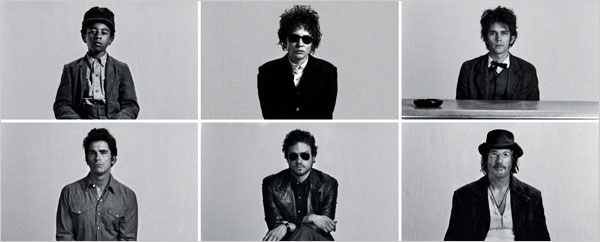
 Like Navin Johnson, Bob Dylan was born a poor black child. (Marcus Carl Franklin) Ok, perhaps not. But Hayne’s movie doesn’t really aim to tell the story of one Robert Zimmerman of Hibbing, Minnesota. anyway. — He’s not there. Instead I’m Not There refracts Dylan through a prism of sorts, giving us multiple versions of the man (and myth) at various stages in his life and work. And, so, after a first person POV shot of “Dylan” (us?) taking the stage in ’66, and a title shot involving a potentially-momentous motorcycle, we are introduced to one Woody Guthrie (Franklin), an 11-year-old folk wunderkind traveling hobo-style along the rails, singing union songs and making up his past as he goes along. But the times they-are-a-changin’, and, as a kindly matron informs Woody, the old songs don’t necessarily do justice to the problems of 1959. Enter Jack Rollins (Christian Bale), an earnest young troubador who once lit Greenwich Village on fire with his ballads of social protest (“finger-pointin’ songs”), and, having rejected the folk scene and found Jesus, is now the subject of a No Direction Home-style documentary. (Julianne Moore does a Joan Baez impression here, straight out of Scorsese’s doc, which is pretty hilarious, and maybe even a little mean — note the business with the cat.)
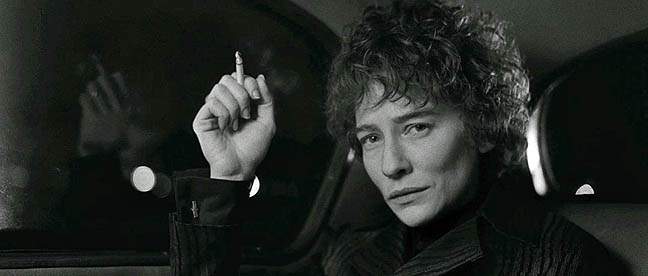
 By now, you probably see where this is going. Post-Newport, Cate Blanchett shows up as Jude, a.k.a. the reedy, combative, drugged-out, and dog-tired Dylan of (blonde on) Blonde on Blonde and Don’t Look Back. (It takes a woman like her, to get through, to the man in him.) Ben Whishaw shares the load of society’s probing as Arthur Rimbaud, a Bob who spends most of the movie facing down some unknown interlocutors. Heath Ledger’s Robbie is the romantic and the womanizer, the Dylan who woos the heartbreakingly beautiful Claire (Charlotte Gainsbourg, playing an amalgamation of Suze Rotolo and Sara Lownds), looks for solace in a normal life outside Woodstock, and eventually stares into the abyss of Blood on the Tracks. And Richard Gere is Billy, an aging outlaw hiding out in Riddle, MO, part of the mythical American landscape conjured by Bob in “Bob Dylan’s 115th Dream,” “Desolation Row,” John Wesley Harding, The Basement Tapes, “Blind Willie McTell,” and countless other songs.
 Each of this fellowship of Dylans does quality work in the role. Cate Blanchett is getting the most press these days, perhaps deservedly so, but I was as impressed with Bale, Whishaw, Franklin, and particularly Ledger — After seeing the extent of his range here, it’s pretty clear he’s going to kill as the Joker next summer. And other actors resonate here as well. I already mentioned Julianne Moore and the exquisite Charlotte Gainsbourg. (My crush on the latter, already simmering after The Science of Sleep, will no doubt grow by leaps and bounds now, particularly once you factor in her fragile, breathy version of “Just Like a Woman” on the soundtrack. With a face that’s at once honest, open, statuesque, and melancholy, she’s the perfect sad-eyed lady of the lowlands.) Also notable is David Cross, the spitting image of Allen Ginsberg, Michelle Williams invoking Factory Girl Edie Sedgwick, and a well-preserved Richie Havens delivering a Joe Cocker moment with his version of “Tombstone Blues.” Bruce Greenwood (of Thirteen Days, The Sweet Hereafter, and recently John from Cincinnati) does particularly impressive work as Jude’s nemesis, a BBC newsman who wants to pin both the mercurial singer and the meaning of his (her) music to the wall like a butterfly. Clearly, something is happening here, but he don’t know what it is…
 Do you need to know a lot about Dylan going in? Well, it undoubtedly helps. I’m Not There is rife throughout with Dylanalia, and, yes, at times it’s dropped as blatantly as the groaners in Across the Universe: Jude mutters “Just like a woman!” at one point as a punchline, and an LBJ on the wall during a party strangely exclaims “It’s not yellow, it’s chicken.” But, others are more obscure, hidden in the fabric of the film like a crossword puzzle for Dylanophiles. Many of the strange denizens of Gere’s Riddle recall characters in songs or various Dylan incarnations, from the whitefaced troubador at Ms. Henry‘s funeral to the Union solders and passing Lincoln on stilts. As Robbie and Claire (Renaldo and Clara?) have one of those tired, terse phone discussions that signifies the end is near, a movie poster over her shoulder reads “CALICO” (i.e. “Sara,” the “calico sphinx in a scorpio dress (you must forgive me my unworthiness.)“) Or, in the scene accompanying one of Dylan’s masterpieces, “Visions of Johanna,” the Ledger Dylan, a movie star of sorts, is bored on the road and skirt-chasing one of his co-stars. As this goes down, we happen to see some elderly crones in neck braces (“the jelly-faced women all sneeze“), Ledger walking in a museum (“Inside the museum, Infinity goes up on trial“), the Mona Lisa (who “musta had the highway blues, you can tell by the way she smiles“), and the co-star he’s tailing, of course, is named Louise. (“Louise, she’s all right, she’s just near. She’s delicate and seems like the mirror. But she just makes it all too concise and too clear that Johanna’s not here.“)
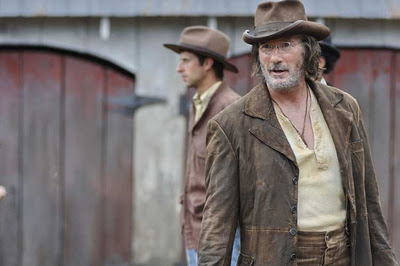 If this all is starting to sound like two and half hours of insufferable inside-baseball for Dylanheads, well, I guess it might be. But I really don’t think it plays like that. (And I also don’t think that was the appeal for me either. Both Masked and Anonymous and Twyla Tharp’s The Times They Are-A Changin’ trafficked in similar inside gags, and I didn’t enjoy those anywhere near as much as this film.) Basically, I’m Not There is too vibrant and enthusiastic to feel smug, remote, or exclusive about its fondness for Dylan. It never purports to define the meaning of any particular song, showing instead that more often than not their beauty lies in their ambiguity. (For example, both defenders of the cultural Old Guard and the Black Panthers feel “Ballad of a Thin Man” is about them.) And it often pokes fun at the Dylanophiles among us, throwing in a number of disgruntled fans at various times (particularly after Bob plugs in) and having Jude get pestered by an overeager amateur Dylanologist after hanging with the Beatles (a very jolly cameo indeed.) Plus, for all the reverence, Dylan himself isn’t as whitewashed as he was in No Direction Home — His drug habit, his youthful arrogance and occasional thin skin, and some questionable views on women poets are all on display here.
 A talented artist in his own right (case in point: Safe and Far from Heaven), Haynes employs all the magic of the movies to tell Dylan’s story. The Robbie-and-Claire scenes are filmed in color occasionally as riotous as in Hayne’s homage to Douglas Sirk, Jack’s social protest and Christian periods are told in faux-documentary fashion, and Jude’s England tour is all black-and-white cinema verite, a la Don’t Look Back. That’s why I’m pretty sure i’m Not There will work even for people who don’t know the first thing about Dylan. It remains visually interesting throughout, and never falls into the usual biopic rut, that standard, hackneyed rise, fall, and rise again narrative which tends to bring down even otherwise well-made entrants in the genre like Walk the Line.
And, of course, it benefits from having one of the better soundtracks out there, and Haynes has expertly weaved Dylan’s music (and some quality cover versions) into almost every moment of the film. Let me put it this way: Within the first five minutes, I’m Not There features some period NYC subway footage set to the irrepressibly toe-tapping “Stuck Inside of Mobile With the Memphis Blues Again.” (Also another visual pun — the subway folk are “stuck inside of mobile.”) From that moment on, the movie pretty had much me. In the end, I don’t know if non-Dylan folk will vibe into it or not, but I found I’m Not There a splendid gift from one Dylan fan to the rest of us, and assuredly one of the more inventive and captivating biopics in recent filmdom. “And the sun will respect every face on the deck, the hour that the ship comes in.“