
“If I grew up in a farm, and I was retarded, Bruges might impress me. But I didn’t, so it doesn’t!” As seen in front of Juno, two Irish gangsters hide out in deepest, darkest Belgium in the trailer for Martin McDonagh’s crime-comedy In Bruges. Ralph Fiennes may be overdoing Ben Kingsley’s Sexy Beast schtick just a bit, but I do like the idea of a Colin Farrell-Brendan Gleeson buddy movie, and it looks like Clemence Poesy (i.e. Fleur Delacour) and Ciaran Hinds (of Munich and Margot) are skulking about as well.
Tag: Cinema
Little Miss Sonshine.
Update 1/7/08: If you’re visiting from Electrolicious, Ypulse, or elsewhere today, welcome. In case you’re interested, the main site is here, and the other collected movie reviews are here (including the best of 2007 list.)
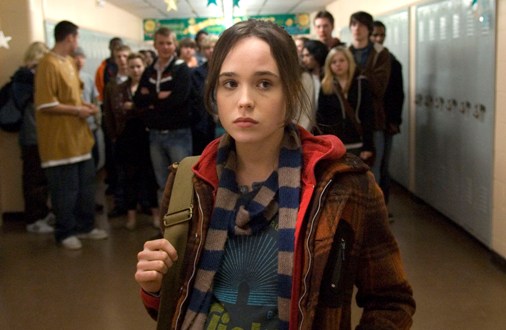
“That ain’t no etch-a-sketch. That’s one doodle that can’t be un-did, homeskillet.” If you find people talking in such overstylized hipster-speak for ninety minutes witty and/or adorable, you’ll probably enjoy Jason Reitman’s Juno quite a bit more than I did. While it’s not a bad film, and it has the advantage of clever repartee and appealing performances across the board, Juno — like everyone’s favorite indy comedy last year, Little Miss Sunshine — is, IMHO, being significantly overpraised. Suffering from dialogue that’s been stylized within an inch of its life, and with every scene festooned with kitschy pop culture bric-a-brac and scored to uber-sensitive indy rock, I came to find Juno cloying to the point of claustrophobia. (And hearing The Kinks (“A Well-Respected Man”) and those overlords of twee, Belle & Sebastien (“Piazza, New York Catcher”), at various points on the soundtrack only confirmed the sensation that I’d somehow wandered into a Wes Anderson after-school special.) Speaking of Wes, I feel about this film much as I did about The Darjeeling Limited — if this is your sort of thing, have at it. But I for one eventually grew exhausted and even somewhat annoyed with Juno, even as I found myself in sympathy with its denouement.
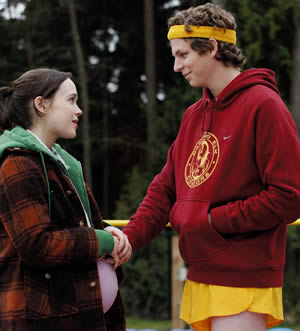 Juno begins with a chair. A recliner at a yard sale, in fact, which is being eyed by a Sunny D-chugging teenager named Juno MacGuff. (Ellen Page of Hard Candy and X3 — This role will no doubt cement her status as the new sassy, quick-witted, adorable-but-approachable brunette that middle-school fanboy types will crush over, a la Princess Leia, Winona Ryder, and Natalie Portman in their day.) As it turns out, this chair has a special meaning for Ms. MacGuff, since it was one quite like it where she and her nerdy best friend Paulie Bleeker (Michael Cera of Arrested Development and Superbad, in his wheelhouse and terrific) lost their virginity in a fit of (what’s being billed as) boredom. And now, two months later, Juno is, as the sayings go, knocked up, preggers, in the family way, with a bun in the oven. (She later memorably deems herself “the cautionary whale.”) What to do?
At first, Juno considers “procuring a hasty abortion,” but something about the waiting room at Women Now! gives her the heebie-jeebies. And so, after some discussion with her best friend (Olivia Thirlby of United 93, an appealing presence), Juno decides to go for it and have the baby. She informs her parents (J.K. Simmons and Allison Janney, both excellent) and finds a baby-craving couple on the right side of the tracks (Jason Bateman and an impressive Jennifer Garner — she and Cera are the best parts of the film) to handle her spawn in its post-born phase. But, of course, it’s never that easy. For one, it turns out the Lorings may not be as ideal a couple as they first appear. (The wedding pics everywhere should be a tip-off, as they were in In Good Company.) For another, Juno slowly comes to discover that certain things — bearing a child, falling in love — are actually much harder than they’re made out to be on the TV and the Internets, and all the clever comebacks in the world aren’t going to protect you when life takes a painful turn.
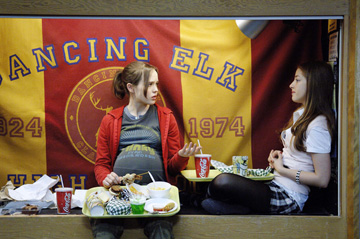 Now, some caveats. First, Ellen Page’s Juno is basically a pop-culture variant of the hyperliterate teenagers you find in Whit Stillman’s Metropolitan or Wes Anderson’s Rushmore, and, as I’ve said before, I am really not a big fan of that genre. Page is as good as she can be in the role, but the character as written is drowning in self-conscious quirk. Now, as my brother pointed out, so was Ferris Bueller back in the day, so perhaps I’m just getting old. Still, every time Juno emotes wildly over seventies punk rock acts like Iggy and the Stooges or namedrops Dario Argento movies, all I heard was screenwriter Diablo Cody unrealistically foisting her own pop culture bona fides on a sixteen-year-old character. (I had the same problem with Scarlett Johansson karaokeing Roxy Music and The Pretenders in Sofia Coppola’s Lost in Translation.) To borrow from I’m Not There, “Live your own time, child.“
 For another, and as Lauren Wissot pointed out at THND, every character in the film — with the exception of Jennifer Garner’s earnest yuppie mom-wannabe, who is defined mostly by its absence — speaks with the same arch, cynical, highly referential voice, spewing forth peppy bon mots and pop-culture zingers that tend to read a lot better on the page than they sound on screen. “Silencio, old man,” “I have to pee like Seabiscuit,” “The baby looks like a Sea Monkey right now,” “Thundercats are go!” Everyone from Juno’s parents to her girlfriend to her lab partners to Rainn Wilson at the Circle K indulge in this hyperstylized quipping to the point of exhaustion, including the director. (Check out the “jocks really love goth librarians” scene, for example.) Now, this is the exact same problem I have with most of Joss Whedon’s output and particularly Buffy the Vampire Slayer, so undoubtedly fans of the latter may have more of a tolerance for Juno‘s endless string of impeccably-crafted, unrealistic-as-delivered witticisms. Still, Juno eventually reminded me of the exchange in Fight Club when Ed Norton makes the crack about people on planes being “single-serving friends.” Says Pitt: “Oh I get it, it’s very clever. How’s that working out for you? Being clever. Great, keep it up then…“
 Now, this reaction posed a bit of a quandary for me, since, as y’all probably know, Juno is not the first unplanned-pregnancy-for-a-hipster-parent comedy to come down the pike this year. And when musing on Knocked Up over the summer, I put its many knowing pop-culture references — jokes involving Matthew Fox and Robin Williams’ knuckles, for example — in the plus column. So why can’t a 16-year-old girl make the same sort of wry cultural asides to her friends as a 23-year-old man-child? I guess the main difference is that I don’t remember Knocked Up being so wall-to-wall with the punchy quips, or the dialogue feeling so writerly or artificial throughout. (For example, there’s nothing that feels as true-to-life in Juno as the automobile argument in Apatow’s film.) Until I see Knocked Up again, that’s my story and I’m sticking to it.
Also, while Juno is being billed in some corners as the female response to Knocked Up, it is and it isn’t. Obviously, the parent drenched in pop-culture irony this time is female, but in other ways the films are rather similar in their gender portrayals: The relationship dynamic between Garner and Bateman for example, plays quite a bit like the one between Leslie Mann and Paul Rudd in Knocked Up — She’s the Voice of Responsiblity, he wants to keep playing with his toys. At any rate, while I prefer the former, Knocked Up and Juno would probably make a quality double-feature in the future. If nothing else, they’ll help pop-culture aficionados of both sexes figure out what to expect when they’re expecting. Just make sure you have insulin or ipecac handy in case the overwritten, indy-pop sentimentalism of Juno proves too sugary-sweet, as it did for me.
Ink-Stained Wretches.
As seen in front of The Golden Compass, Brendan Fraser and daughter (Eliza Bennett — no, not that one) accidentally unleash the evil of Andy Serkis upon the world in the new trailer for Iain Softley’s Inkheart, from the fantasy novel by Cornelia Funke. Even I’m getting fantasy fatigue at this point, particularly given what New Line just wrought with Compass. Still, this one does have a fun cast: Also along for the ride are Paul Bettany, Helen Mirren, Jim Broadbent, and Jamie Foreman.
Stripped Bear.
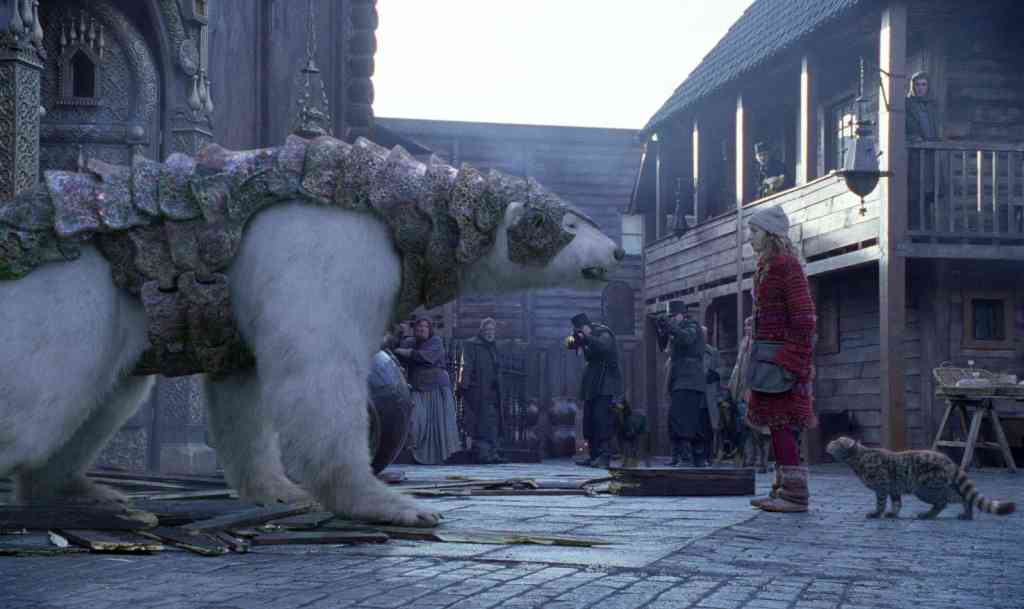
“If you was to crack it open, you’d find no living thing in there. No animal nor insect at any rate. There’s a clockwork running in there, and pinned to the spring of it, there’s a bad spirit with a spell through its heart.” So the mentorly Gyptian scholar Farder Coram (Tom Courtenay) tells young Lyra Belacqua (Dakota Blue Richards) of a robotic wasp that’s tracked her down, at the behest of the villainous Mrs. Coulter (Nicole Kidman). Alas, the same could be said of Chris Weitz’s disappointing version of Philip Pullman’s The Golden Compass. The film looks nice enough, but it’s ultimately a plodding and mechanical take on Pullman’s fantasy, one missing its own inner daemon, if you will. And the mischievous, anarchic spirit that drives Pullman’s story has been so thoroughly confined in Hollywood drek and by-the-(Box-Office)-numbers banality that it barely resonates at all.
I was rooting for Weitz here: I quite enjoyed About a Boy and In Good Company (which he produced), and thought his leaving the film for awhile suggested he was aware of the epic scope the project required. And, while Pullman can be a stunningly self-inflated and ungracious sort, I thought the first book of His Dark Materials, before the trilogy bogged down in its own self-importance and anti-religious fervor, was a particularly good fantasy yarn. Alas, the movie as presented — I get the sense we may see another cut of it someday — does Pullman and Compass a severe disservice. All the subversiveness has been drained away from the story, and what we’re left with is virtually indistiguishable from any other B-level Rings clone. It’ll probably just be remembered the one with the polar bears.
Compass establishes its debt to Peter Jackson’s Rings films early — Like The Fellowship of the Ring, Compass begins with a “world as we know it” establishing prologue, setting up the conceits, the McGuffin, the good guys and bad guys, before keying in on one happy-go-lucky youngster who’s the focus of our story. The child in question is one Lyra Belacqua (Richards, good with what she’s given, and she avoids the cute-kid trap very well), an orphan living at Jordan College (i.e. the alternate-dimension version of Oxford). Lyra spends her days frolicing with the town children and getting into trouble with her daemon Pantalamion (Freddy Highmore) — In this world, you see, every person has their own animal-spirit companion which reflects their nature, following them around, sharing their pleasure and pain, and offering advice and conversation as needed. (This is quite different from our world, where my animal companion spends his days chasing his tail, barking at evil, and passing out on the couch.)
But Lyra’s world is about to come undone: Her free-thinking uncle, Lord Asriel (Daniel Craig, also quite good given the circumstances), has upset the ruling order of the Magisterium (Think the Vatican, except with Simon McBurney, Derek Jacobi, and Christopher Lee in tow) by arguing not only that parallel worlds exist, but that they might be accessible through the omnipresent interstellar medium known as Dust. And, when Asriel — now that the whole world looks Dusted — decides to continue his research in the polar North, Lyra herself gets caught up in the great events, particularly after an undercover agent of the Magisterium, one Mrs. Coulter (Kidman, seeming somewhat lost — she was better in Margot last week), takes a shine to her, and it is determined Lyra can read an ancient and powerful device known as an alethiometer, which invariably speaks truth to power. Is Lyra that child, the one prophesied to come by the witches of the North? Well, definitely maybe…
There are some elements of The Golden Compass that work rather well. As I said, Richards is an appealing presence, and it’s hard to imagine a better Lyra than her. Daniel Craig and especially Sam Elliot, as the aeronaut-cowboy Lee Scoresby, breathe much-needed life into the story in their brief moments onscreen. The daemons are for the most part cleverly handled, with particular plaudits for Mrs. Coulter’s vicious golden monkey (It really seems like it leapt off the page.) And most of the polar bear sequences, featuring Ian McKellen as the deposed bear-king Iorek Byrnison and Ian McShane as the evil usurper of the throne, Ragnar Sturlusson, are as good as one could hope for.
But McKellen’s inherently Gandalfian qualities further cement a comparison which doesn’t work in Compass‘s favor. If anything, Weitz’s film proves how important composer Howard Shore (like production designer Alan Lee) was to the success of the Rings trilogy. In Compass, as in Rings, characters are prone to describe places they’ve arrived at with a burst of description and a musical flourish. (“Svalbard, kingdom of the ice bears!“) But Alexandre Desplat’s score is so leaden and overbearing that it makes these bouts of exposition seem like, well, exposition. As a result, there’s much less magic in Compass than there should be — Like Chris Columbus’ first two installments of the Harry Potter series, Weitz’s film at best feels like a book on tape.
Or does it? Daemons and polar bears aside, the thing that made Compass an interesting read was Pullman’s subversive intent. In fact, I’ll admit to being more than a little curious as to how the heck The Subtle Knife and especially The Amber Spyglass, with its overtly Miltonic war against “the Authority” (i.e. God), was ever going to translate into a Christmas blockbuster. The answer the studio suits came up with, it seems, was to disembowel the film almost completely. Perhaps, given his haughty disdain for other authors’ fantasy works, Pullman even deserved to see his Golden Compass turned into an eviscerated Disney ride — Polar bears without the Coke. But fans of the book sure didn’t. Somewhere, somehow, somebody at New Line clearly decided that Compass needed to be more upbeat if it was going to make any money.
As a result, the ending of the movie, which cuts off a few chapters early (despite scenes of the Northern Lights in the trailer), was such a flagrant sucker-punch to the audience that I left completely disgusted with the film. If you’d never read The Golden Compass, you’d be hard-pressed to follow what’s going on anyway, or to give the overarching story the benefit of the doubt when it’s so often drowning in exposition. If you have read The Golden Compass, then you know how it ends, or will remember as it goes along, and don’t expect to see anything different. But, no, in keeping with its resolute ambition throughout not to offend anyone, Compass is (currently) given a syrupy, platitudinous ending before Lyra et al reach the Crack in the World. It’d be as if the Coens transformed the end of No Country for Old Men, or Joe Wright his new version of Ian McEwan’s Atonement, just to make it feel more upbeat and “viewer-friendly” and thus improve the box office. (In fact, if anything, it reminded me of the disrepect George Sluizer showed his audience with the feel-good American version of The Vanishing, which recently came up over at THND.) I was on the fence, leaning negative, about The Golden Compass up to that point. But those closing moments encapsulate most of what’s wrong with this saccharine adaptation. Say what you will about Philip Pullman — He’s definitely more fun with claws.
Hail to the Kingdom.
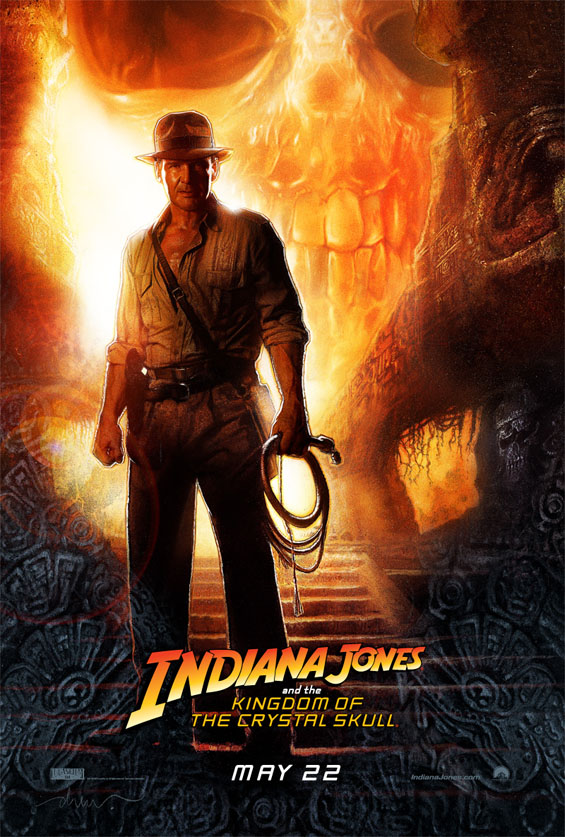
If nostalgia has a name, it must be Drew Struzan. It looks like the famous poster-painter survived The Mist after all, as he’s turned in this throwback teaser poster for Indiana Jones and the Kingdom of the Crystal Skull, making the rounds of the coming attractions sites today. Not bad at all. I assume there’ll be a later version, of the floating-head variety, with Shia LaBoeuf, Ray Winstone, Cate Blanchett, John Hurt, and Karen Allen…
I can smile in the face of mankind.
“Most of the time, I’m halfway content. Most of the time, I know exactly where it all went.” Maybe it’s the impending holidays. Maybe it’s dissertoral stress. Or maybe it’s the weather, or something like that. Still, it was one of those weekends…So, in light of that, Bob Dylan’s “Most of the Time” meets Eternal Sunshine of the Spotless Mind. I never would have chosen this sort of hermit life for myself. But, given this is the hand I’m currently playing, at least there’re great movies and great music on my side.
Speed Kills.
The brothers Wachowski return to the fold with a bizarre new trailer for their live-action Speed Racer, starring Emile Hirsch, Christina Ricci, Matthew Fox, John Goodman, and Susan Sarandon. Ouch, my brain hurts…Not sure I see myself sitting through two hours of this one, even with the Wachowski imprimatur.
Blink your way out of this, Bond.
No, Mr. Bond, I expect you to Dive…Mathieu Amalric is confirmed as Daniel Craig’s next nemesis in Bond 22.
Caspian See.
Timed to release with The Golden Compass this Friday, the trailer for Andrew Adamson’s The Chronicles of Narnia: Prince Caspian is now online. Liam Neeson and the kids are back again (if a little older), while replacing Tilda Swinton, James McAvoy, and Ray Winstone in the support department are Ben Barnes (of Stardust), Warwick Davis, and Peter Dinklage (of The Station Agent.)
Savage Love.
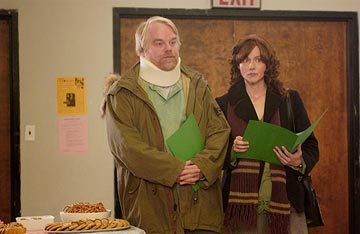 Emerging from Julian Schnabel’s Diving Bell, I had all of two or three minutes — basically, as long as the creepy Freelancers’ Union ad shown before every film at the Angelika — to decompress before entering Tamara Jenkins’ The Savages, a dramedy about two siblings confronting the onset of dementia in their estranged dad. And, in the early going, after a rather twee opening and some leaden scenes of Laura Linney writing a grant proposal and kvetching with her married boyfriend, I started to feel like I’d made a tactical error following Schnabel’s ambitious film so quickly with such a conventionally quirky, small-scale indy flick. But The Savages is a grower, and by the last reel, I was very glad I’d made the trip. Admittedly somewhat inconsistent — and I could have done with less Linney and more Hoffman — Savages is also at turns hilarious, bleak, and even rather moving (although I’m guessing I’m more of a sucker for the final moments than others might be.) And, in some ways, it was the perfect nightcap to Diving Bell (and, in its bickering siblings, to Margot at the Wedding the night before.) For Jenkins’ film is a grimly funny reminder that Bauby’s condition isn’t necessarily as exotic as it first seems. Eventually (if we’re even lucky enough to stick around that long), we all sink under the weight of the diving bell — it’s just a matter of time. A grisly insight, to be sure, but you could do worse than contemplating it here with The Savages.
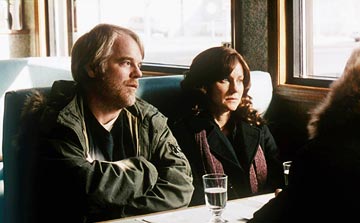 Jenkins’ movie opens with a sun-drenched Broadway-style musical number (Peggy Lee’s “I Don’t Want to Play in your Yard“) in the Retirement Heaven of suburban Arizona, the type of warm, happy, golf-cart-heavy environment one generally expects — given all the conventional portrayals of the Golden Years — to spend one’s waning days. But Lenny Savage (Philip Bosco), who lives therein, is beginning to act erratic (namely by finger-painting with his own feces), and after his aged girlfriend dies, he is cast out of this Grandpa’s Paradise. Enter his children (who haven’t heard from him in years), Wendy and Jon Savage — no relation to Wendy and John Darling of Peter Pan, as people are definitely growing old around these parts. Wendy (Laura Linney) is a failed playwright in Manhattan, working as a temp and sleeping with her married, horndog neighbor (Peter Friedman). Her older brother Jon (Philip Seymour Hoffman) is an obviously miserable academic in wintry Buffalo, working on a tome about Bertolt Brecht and sleeping with his laptop and a small reference library. (This detail rang uncomfortably true, as did the organized chaos of book piles strewn around his apartment.) So, with Lenny increasingly showing unmistakable signs of dementia, it now falls to Wendy and Jon to find a place for him, be it a retirement community, assisted living, or most likely, an institutional-gray nursing home in deepest, darkest Buffalo, and — in the tried-and-true tradition of quirky independent films — maybe learn to get along as a family in the process.
 The family-bonding, one-to-grow-on aspects of this project, admittedly, are where a good deal of the clunky stuff in The Savages emerges. The Savages bond over an unlikely neck injury suffered by Jon, all of which feels a little TV movie-ish. (Hoffman almost saves it with some good physical humor, though — watch him put his mail away.) And The Wire‘s Gbenga Akinnagbe shows up as a Nigerian nursing home worker who has a platonic relationship with Wendy, which all felt entirely too “Bagger Vance” for my taste. (i.e. He’s a convenient saintly African-American plot device used to move the white people’s stories forward.) But, other moments work better. There’s a running competition between the siblings over grant money which — having done the grant rigamarole — I thought was pretty funny. And, Hoffman in particular has a few memorable rants (outside the nursing home, for example), which are well worth the price of admission. Since I saw Before the Devil Knows You’re Dead a few weeks ago and Boogie Nights on TV since then, I feared Hoffman might come across as overexposed to me, a la Scarlett Johansson, Owen Wilson, Ben Stiller, or Janeane Garofolo. But he’s really great here, and comes across as a qualitatively different (if equally self-loathing) person than Before the Devil‘s older brother in question.
Perhaps most impressively, The Savages never really attempts to make Lenny all that huggable, or to softpedal his malady. In even his lucid moments, which are few, Lenny is a cantankerous old sort, and you can see why his kids have kept away from him for years. But Bosco brings a pathos to the role that is earned — you can also tell at various points that Lenny has brief inklings of what’s ahead of him — to wit, not much at all. In short, what Six Feet Under is to dying, The Savages is to the final stages of aging. It’s something we don’t really want to think about, but it’s there, somewhere over the last ridge. If we’re going to dwell on this subject, it’s probably best to confront that fact with the mordant humor of The Savages (while keeping in mind that, however inevitable that final end, it’s never too late to teach an old dog some new tricks.)