Farewell, Khaaaaaaaaan.

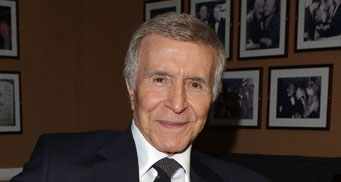
“‘Working with Ricardo was a joy,’ Spelling, who died in 2006, wrote in ‘Aaron Spelling: A Prime-Time Life,’ his 1996 memoir. ‘Ricardo made good scripts better and not-so-good scripts work. I don’t remember him ever doing any rewrites. He set a perfect example for the rest of the cast.’” Veteran stage and screen actor Ricardo Montalbán, 1920-2009.

“He will always be Captain Kirk’s finest foe…Montalbán’s magnetic, robust presence; that voice that sounded like a ride over rolling hills — he made Khan Noonien Singh the worst kind of despot: the kind you’re pretty sure you’d die for.” In memoriam, EW’s Marc Bernadin pens an appreciation of Montalbán’s Khan.

The Car that Goes Boom.

Neither as resonant as Letters from Iwo Jima or Mystic River nor as atrocious as Million Dollar Baby or Flags of our Fathers, Clint Eastwood’s Gran Torino is a solid, decently engaging, and even well-meaning two hours of cinema, despite the seemingly endless tirade of dated ethnic slurs issuing from Eastwood’s mouth therein. (Like Alvy Singer, Eastwood’s Walt Kowalski is a bigot, but for the left.) Its goofy and often didactic racists-have-a-heart-too messaging aside, Torino — or, as my dad accurately labeled it, Dirty Old Man Harry — pretty clearly attempts to be the coda and meta-commentary on Eastwood’s famous vigiliante films that Unforgiven (more successfully) was to his westerns.

Yet, even if it’s clunky and heavy-handed at times, and even if its over-the-top ending seems lifted straight out of your average Mel Gibson movie (you’ll know what I mean if/when you see it), I still ended up feeling reasonably charitable towards Torino in the end, perhaps because it’s good to see Eastwood, aged and wizened but with a undeniable twinkle in his eye, still willing to draw outside the lines of his cinematic legacy. (And perhaps because, speaking as someone of the Caucasian persuasion — or at worst a “mick” — we get off easy. I could imagine feeling much less sanguine about listening to a mostly-white audience chuckle and guffaw their way through the litany of racial slurs here, if they felt directed at me or my kids.)

If you saw any of the trailers for Gran Torino, you’re pretty much up to speed. The 1972 muscle car in question is the MacGuffin of this particular tale, and, with the passing of his wife, one of the three things left in this world still loved unconditionally by retired autoworker and Korean war vet Walt Kowalski (Eastwood) — the other two being his aging golden retriever and watery American beer. Basically written off by his biological family as a cantankerous, curmudgeonly funeral-waiting-to-happen (his granddaughter is particularly one-dimensional in this regard — she reminded me of Hillary Swank’s redneck family in MDB), Walt is for all intent and purposes an island unto himself in his Michigan neighborhood, which is now mostly populated by Hmong emigrants. His only friends are the other (white) retirees down at the local, with whom he occasionally shares a drink or three, and his “dago” barber (John Carroll Lynch), with whom he occasionally engages in what passes for witty ethnic repartee.

But when the boy-next-door Tao (Bee Vang) is enticed by the local gang to steal Walt’s Gran Torino as part of his initiation, and the girl-next-door Sue (Ahney Her) gets pawed walking home from school by some local African-American youths (Walt would use another term), Kowalski becomes increasingly drawn into the life of the Hmong community all around him despite himself. And soon, in full defiance of his oft-professed contempt for “gooks” and “zipperheads,” Walt takes it upon himself to educate Tao in the ways of true American manhood (which apparently is comprised of being good with tools and ethnic banter — who knew?) Still, that aforementioned gang ain’t going anywhere, and — worse for Walt, Tao, and particularly these hapless gang members — they don’t seem to have ever watched Dirty Harry. Clearly, somebody in the neighborhood is going to have to stand up to this crew…but, at his advanced age, laying down the law with the barrel of a big gun just doesn’t make Walt’s day quite like it used to.

In the end, Torino actually reminded me less of the glory days of Harry Callahan than of another film I happened to catch last week (on Blu-Ray), Tom McCarthy’s The Visitor. Gran Torino and The Visitor play like the (aging) McCain and Obama voters’ guides to 21st Century Immigrants respectively. In both films, an older white guy in a rut has his heart opened and life transformed by America’s spunky newest arrivals, until he gets a first-hand taste of the downside of new-immigrant life. (In one case, ethnic gangs; in the other, the INS.) Both are commendable films anchored by impressive and even nomination-worthy lead performances (in The Visitor‘s case, by Richard Jenkins)…but both exude more than a whiff of Bagger Vance-ish sentiment in their storytelling. (See also Gbenga Akinnagbe’s character in the otherwise solid The Savages.) In other words, the immigrants in question often feel like static plot points to move the white fellow’s story arc forward rather than full-fledged characters themselves.

Now, there’s no one in Torino as galling in this regard as Haaz Sleiman’s ridiculously friendly Syrian drummer in The Visitor, but the feeling persists nonetheless, particularly in the way Walt’s Hmong neighbors continually just shrug off the voluminous stream of bile emanating from his mouth. Eastwood or no, it’s hard to shake the sense that Walt’s blustery bravado would’ve at the very least cut back on the respectful offerings he’s given and Asian barbeques to which he’s invited during the film, and more than likely quite justifiably would’ve gotten his teeth kicked in a few times before the events shown here. Of course, in the world according to Gran Torino, physical violence is ultimately never the answer. So what the hell are we supposed to use, man? Harsh language?

“Deal with It, Cate Blanchett!”

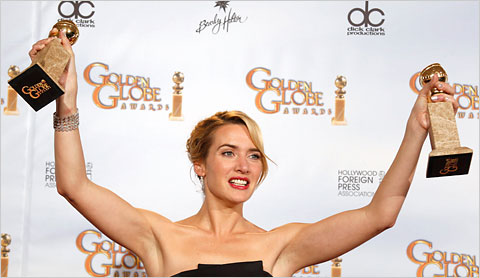
“We really weren’t expecting to be here in America at all at one time so it’s just amazing to be standing here.” As you probably know, the HFPA doled out the Golden Globes last night, with Kate Winslet, 30 Rock, and Slumdog Millionaire the big winners of the evening. (Heath Ledger also picked up a much-deserved posthumous award for The Dark Knight.)

The highlights of the evening: Best Actor winner for The Wrestler and comeback kid Mickey Rourke giving credit where it’s due: ““It’s been a very long road back for me…Sometimes when you’re alone, all you got is your dog and they meant the world to me.” (Amen, brother.) The out-of-left-field Tracey Morgan riff referenced in the post title. (“I am the face of post-racial America. Deal with it, Cate Blanchett!“) And Ricky Gervais, pint in hand, riffing on Holocaust films — “See, Kate? I told you!” — and deftly skewering the whole process. “I can’t believe I’m not nominated. What a waste of a campaign. Today is the last time I have sex with 200 middle-age journalists. It was horrible. Really. A lot of them didn’t even speak English. Europeans with wispy beards. The men were worse.

As far as the GitM 2008 write-up goes, it’ll be a few weeks yet, as I’m still waiting for Frost/Nixon, The Wrestler, and Revolutionary Road to open here. But, sorry, y’all — I’m taking a pass on Slumdog Millionaire. I’m sure it’s as wonderful and uplifting as everyone says, but that game show, for reasons I’m not going to go into here, conjures up very specific memories of one of my more painful break-ups, and I know enough about the film to know that at the moment, much like Sideways or Punch-Drunk Love, I’m just going to end up tremendously irritated by it.

Besides, when it comes to works of fantasy, I tend to prefer stories of elves, superheroes, vampires, and the like to tales of ordinary people-like-you-and-me achieving stupendous, wildly unlikely victories against the odds. Because, at least in the former case, you won’t usually leave the theater thinking elves and vampires might actually exist, while tales of improbable good fortune, imho, tend to encourage misguided notions about the world. In other words, see enough movies about ridiculously lucky people (however tempered, as I hear it is in this case, by Mumbai back-alley nightmares) and your expectations about life will get all kinds of screwed up. I’m just not in the mood for it.

In His Secret Life.

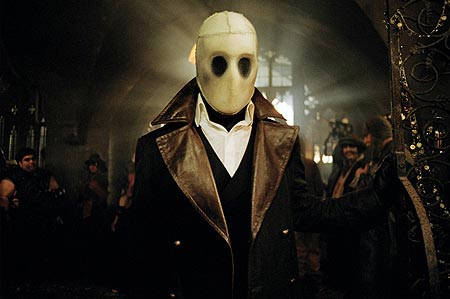
Dark City meets Cool World and/or Inkheart by way of Alice in Wonderland? AICN points the way to the trailer for a bizarre and intriguing British import, Franklyn, starring Eva Green, Bernard Hill, Control‘s Sam Riley, and Ryan Phillippe as apparently some kind of steampunk Rorschach. Well, I like the art direction, if nothing else.

Even a stopped Watch is right twice a day.

Speaking of the costumed vigilante in question, it looks like the recent lawsuit by Fox to put a hold on WB’s Watchmen is now well on the way towards settlement. “Attorneys for both studios disclosed Friday that they had achieved progress toward an accord and agreed to delay a federal court hearing until today in order to continue settlement talks.” So, reset the Doomsday Clock for March 6, 2009.

Dangerous Habits.

Well, I never saw the Broadway play, so I can’t evaluate if the source material played any better on stage. But John Patrick Shanley’s half-baked Doubt is one mess of a movie, and I eventually went from mildly intrigued to bored to actively irritated by it. A grab-bag of timely hot-button issues and Oscar-minded lip-quivering, the film is stagy, often contrived, and fundamentally confused, and as a treatise on doubt in all its manifestations, it’s basically all over the place. Worse, it suffers from a glaring oversight at its core — more on that in a bit — that effectively killed the entire movie for me.

Now, I should probably say upfront that, unlike some critics who’ve responded very favorably to the film, I am neither a practicing Catholic nor aggressively ex-Catholic — my family worked all that out in generations prior — and thus I have no personal feelings and/or axes to grind with the church or the accompanying Catholic school experience. As an agnostic if I’m anything, I’d say I’m actually pretty comfortable living in doubt, so it wasn’t the movie’s purposeful lack of resolution that rankled me. As a filmgoer, tho’, I have to give an amen to Salon‘s Stephanie Zacharek, who basically nailed this film to the wall: “Nothing in ‘Doubt’…is certain, definitive or clear. Least of all the filmmaking.

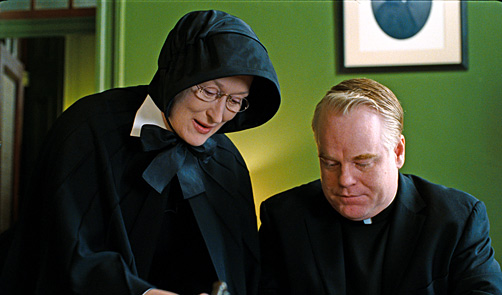
The year is 1964, Kennedy’s assassination still clouds the nation in gloom, and, in the Bronx working-class neighborhoods that comprise the parish of St. Nicholas (as in Colin Hanks’ parish a few boroughs over), the times-they-are-a-changin’. Representing this tolerant — some might say permissive — new era of Beatlemania and Vatican II is one Father Flynn (Philip Seymour Hoffman, good as always but let down by the material.) Flynn is an amiable fellow who’s seemingly won the hearts and minds of both his flock and the boys at the parish school, but he has his enemies — namely the principal of St. Nick, Sister Aloysius (Meryl Streep, hammy and, like Nicholson or Pacino these days, seemingly playing herself playing the part.)

A seriously old-school nun who talks like a Brooklyn street tough and sees it as her divinely ordained mission to keep the kids in a perpetual state of fear, Sister Aloysius doesn’t cotton at all to Father Flynn’s long fingernails and new-fangled ways. (I mean, Christ on a stick, the man even uses a ballpoint pen.) And when the well-meaning, preternaturally innocent Sister James (Amy Adams, making Julie Andrews in The Sound of Music look like Anais Nin) happens to notice some strange, potentially troubling interactions between Father Flynn and the school’s only black student, Donald Miller (Joseph Foster II), Sister Aloysius has all the evidence she needs to embark on a one-woman crusade against her pastor. What really happened between the man and the boy, and are there any mitigating circumstances that should be taken into account? Well, in the good sister’s eyes, of course not — After all, doubt is a luxury one can ill afford in service of the Lord.

At the film’s opening (and to make sure we all have the study notes), Father Flynn gives us a brief sermon on doubt — how, rather than isolating and dividing us, it can in fact be as sustaining and unifying as faith. Hmm, that sounds interesting…but what kind of doubt does he mean? Doubt as in a state of personal despair? Or does he mean — a pretty dodgy area for a Catholic priest to go in 1964 — doubt in one’s faith, and/or the divinity of Christ? Is he referring to doubts we might have about the intentions of others, or doubts we should have about our own preconceived certainties about them? Should we doubt the circumstantial evidence before us in the Flynn case (and if so on, on what grounds), or should we doubt Flynn’s professions of innocence?

In Shanley’s film, the answer seems to be yes, all of the above. Whenever the movie seems like it’s beginning to dole out a certainty — say, for example, that Sister Aloysius is very definitely the “bad guy” here (after all, nobody expects nor likes the Spanish Inquisition) — it quickly scrambles over to the other side of the deck to keep us guessing. (But she is very solicitous towards the older nuns!) This tendency reaches either its apex or nadir — how’s that for maintaining doubt? — when Sister Aloysius confronts Donald’s mother (Viola Davis, in a justifiably praised turn) about the possible inappropriate touching incident. Even when we think we’ve got a lock on this one — moms don’t usually look kindly on potential child predators — Doubt zags the other direction (The upshot: Surprisingly, she’s ok with it, if it means Donald can still graduate.)

That scene with Viola Davis, probably the most powerful in the film, inadvertently points toward what I thought was the key problem with Doubt, and why after awhile it began reminding of the interminable and (to me) insufferable post-structuralism seminars I sat through in early grad school. (The subaltern cannot speak!) Here’s the problem: Amid all the weeping and teeth-gnashing and rending of garments (by the privileged white folk in positions of authority) about what might or might not have happened here, nobody ever seems to think to ask Donald about the incident. (This is despite the fact that the film makes a joke out of how often children who act out-of-turn are sent up to the hellish confessional that is Sister Aloysius’ office.)

Now, as a friend of mine pointed out when I mentioned this, if somebody had asked Donald, that would more than likely remove all doubt from the equation, and thus ruin the movie and its intellectual purpose. Well, maybe so. But if your story is such a house of cards that it can be brought down by such an obvious and central lacuna, then maybe it should just go back to rewrites. Now, I’m in general sympathy with Shanley’s relativistic vision here — Don’t ever think you know anything for sure, because you don’t. But when such obvious, real-world empirical evidence about the problem at hand is basically ignored so people can continue to fret about Doubt, Unknowability, and Other Big Important Ideas, then the whole movie starts to feel like a long, empty intellectual exercise.

So, in brief, if you want to see a play-turned-movie that flirts with Big Ideas, while engaging the question of whether a potential pedophile can be a good teacher and/or worthy human being, skip Doubt and rent The History Boys. And if you want to catch a well-made, well-acted film about living with the exquisite agonies of inescapable unknowability, skip Doubt and rent David Ficher’s Zodiac. Either way, this movie is eminently missable.

Box Office Liquidity.

“Summer blockbusters and holiday hits make up the bulk of box office revenue each year, while contenders for the Oscars tend to attract smaller audiences that build over time. Here’s a look at how movies have fared at the box office, after adjusting for inflation.” From last February and by way of Lotta, the NYT graphically represents the past 22 years of box office receipts as a series of waves, so you can easily determine both the intensity and duration of each flick’s performance. And it’s searchable by individual film too — Note the Titanic tsunami.

Gizmos and Dynamos.

In fanboy casting news, Tr2n (now just Tron) gets a lead in Garrett Hedlund, formerly of Troy and Friday Night Lights. “Hedlund will play the lead, a man who finds himself pulled into the world of a computer and retracing the steps of a character from the original movie named Kevin Flynn.” (That would be Jeff Bridges.) And also coming along for the ride, Tron himself, Bruce Boxleitner.

Meanwhile, Jon Favreau’s Iron Man 2, which is currently still being written by actor Justin Theroux, may have locked down its villains in Sam Rockwell and Mickey Rourke. Rockwell seems to be up for Stark’s industrialist rival Justin Hammer, while Rourke will reportedly suit up as the Crymson Dynamo.

Rorschach/Nixon.

Strangelove much? The Japanese trailer for Zack Snyder’s Watchmen is now on the tubes, which contains some spoilery-type new footage if you haven’t read the graphic novel. (Note also the new Minutemen featurette on the official site.) Interesting that this trailer foregoes all the Dr. Manhattan-exemplifying-American-might stuff in favor of more emphasis on the alternate history and Cold War doomsday clock.