
“He was awake one moment, and in the next breath, he was gone.” Pat Hingle, a veteran character actor probably best known as Commissioner Gordon in Tim Burton’s Batman, 1924-2009.
Tag: Cinema
Mutiny in the Wehrmacht.
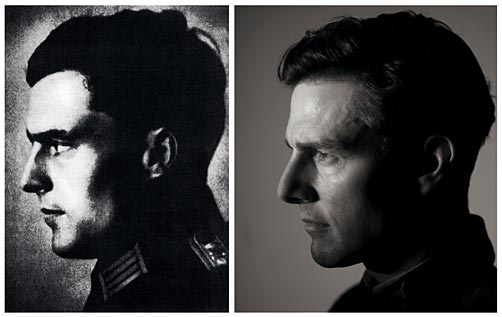
In mid-1944, the shadow of failed artist-turned-meglomaniacal psychopath Adolf Hitler still falls heavy across the continent, and, even as the Allies gather in North Africa, Italy, and the coast of Normandy, the Fuhrer maintains an iron grip over the oppressed peoples of Europe. As most everyone remembers from school days, Hitler was able to retain his power base in Germany, even amid the darkening gloom on both fronts, by ruthlessly organizing and consolidating the nation’s elite cadre of disgruntled character actors. Some of these character actors (Kenneth Cranham, Tom Hollander) rejoice in their servitude, and serve their Nazi master with an obsequious relish. Some of them (Tom Wilkinson, Thomas Kretschmann, Eddie Izzard) just look to keep their head down (for fear of losing it) and basically play go-along-to-get-along. But some character actors resisted. And as the likes of Kenneth Branagh, Bill Nighy, and Terrence Stamp see their various attempts to unseat Hitler fail due to bad luck, poor timing, or compromised plotters, it becomes abundantly clear what they need to achieve their goal of regime change: a lead actor.
Enter Tom Cruise, otherwise known as Count Claus von Stauffenberg, a Catholic aristocrat who’s been shipped off to the now-doomed North African front for his free-thinking transgressions. (The Fuhrer’s resident character actor in charge there is Bernard Hill, a.k.a. Theoden king, and he still can’t run a battle without timely lead actor advice.) Horribly wounded in an Allied bombing raid, Cruise/von Stauffenberg loses an eye, a hand, and several fingers, but — for his service (and his very reputable name) — gains access to the Fuhrer himself, after some machinations by the plotters. As such, leadership of the proposed coup eventually falls out of the hands of the character actor conspiracy and upon him. “I am involved in high treason with all means available to me,” he tells one aide at his job interview, “Can I count you in?” In other words, enough monologuing already! What Germany need now is emoting and stunt work.
If it seems I’m being a bit glib about a story that indirectly involves millions of deaths, untold destruction, and (tho’ it’s only obliquely mentioned at the beginning) systematic genocide, well I apologize. Along with the Titanic-type sensation of continually “waiting for the iceberg” throughout Valkyrie, it’s really hard to sit through the film without recollecting the ubiquitous and consistently funny Bruno Ganz in Downfall meme. (See also the Cowboys, Warcraft, Burning Man, eBay, Wikipedia, Ronaldo, Youtube, etc.) It could be worse, I suppose: For the many citizens out there who see Tom Cruise and now can’t stop thinking “Scientology,” I can safely report that he’s fine in the role — it helps that both he and his character both answer to a higher power (and have a touch of the zealot about them) — and that the accent problem is handled smoothly (a la Hunt for Red October.)
I should say, before this “review” degenerates any further into pop culture musings, that the real historical facts of this story are fascinating. The plotters of this assassination attempt aren’t really visionary idealists or radical bomb-throwers — Hitler had already rounded up or murdered most of them — but the conservative-leaning remnants of the military and aristocratic hierarchies displaced by the Nazi regime. (The 20 July plot is basically crafted by generals and led by Junkers.) And the engine of their coup attempt is ingenious: The plotters almost succeed in converting Operation Valkyrie, Hitler’s last-ditch plan to stay in power should the roof cave in, into the machinery of his demise. Finally, these German patriots get sooo close to their goal that, had any one of several tiny contingencies played out even slightly differently, the history of the war (and its aftermath) would have been irrevocably transformed. As happens surprisingly often, it seems, the fate of the world is a game of inches.
All that being said, I found all of this information equally fascinating while watching the History Channel special after the film, so I’m not sure it really recommends the movie itself in the end. Singer’s Valkyrie is a smart, well-meaning two hours of cinema, and I was reasonably edutained by it, but at best I’d say it’s one for the Netflix queue.
Button-Mashing.
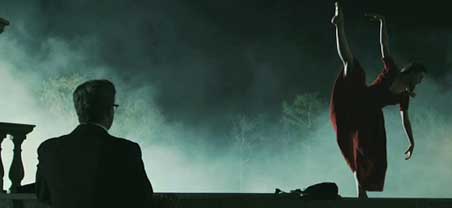
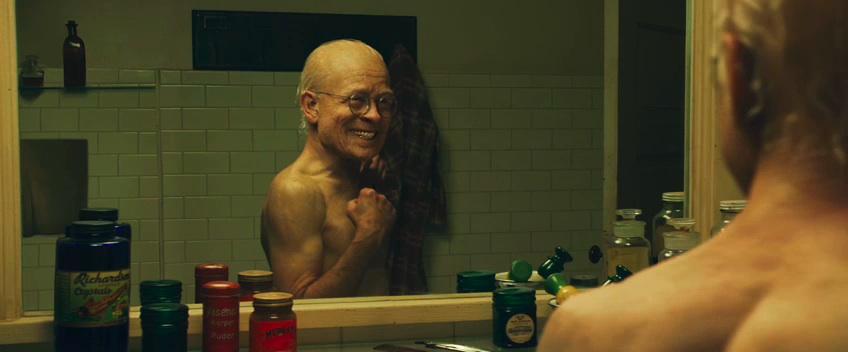
To switch up metaphors, Button is a dazzling contraption at times, to be sure…but a contraption it remains. Unlike Milk, which felt alive in every moment of its run, the stately, strangely inert Button — despite trying to wring emotion from more death scenes than your average season of Six Feet Under — moves to a tidy, mechanical, and clockwork pulse that ultimately feels pretty far removed from the messy emotions and drawing-outside-the-lines sensations of real life. Fincher, the actors (particularly Brad Pitt, Cate Blanchett, and Taraji P. Henson), and the special effects team put forth an undeniably impressive effort, but as the movie progresses, it starts to feel more and more like what it in fact is: well-made but sloppily written Oscar bait. And the more you think about Button, the less it holds together.
Trade out feathers for hummingbirds, and The Curious Case of Benjamin Button is, for all intent and purposes, Forrest Gump. (Indeed, while Button began as a Fitzgerald short story, the two films share a screenwriter in Eric Roth. It shows.) After a Katrina-era framing device is established, involving an old, terminally ill woman sharing her last few moments with her daughter (Julia Ormond) in a New Orleans hospital, we head back to 1918 and the end of World War I, as Benjamin Button begins to recount his tale…with a Gumpish southern drawl, no less. Born “under unusual circumstances” and left at the doorstep of the local old folks’ home, Button (Pitt, good but something of a cipher), as you probably know by now, ages backwards — He begins life as a very old baby and grows younger over time, like Dick Clark or the Bob Dylan song. (I’ve skipped over a short story involving Teddy Roosevelt and a distraught clockmaker (Elias Koteas) which, with the final visual payoff of the Katrina angle, may actually be the most beautiful and affecting part of the film.)
The central conceit established, Button’s life then proceeds to follow a surprisingly Gumpian course. Raised by his take-no-guff, God-fearin’ mama (Taraji P. Henson, a much-needed breath of life throughout) and considered a “special child” by all around him, Button eventually embarks on a series of grand adventures. He hooks up with a gruff but lovable sea captain (Jared Harris, nothing at all like Lt. Dan) who teaches him the ways of the world. He eventually finds himself in the midst of war, and spends several years traveling by himself all around the globe. And throughout his days, he finds himself continually drawn to his childhood friend turned free spirit, Jenny…uh, Daisy (Blanchett, graceful, alluring and thoroughly unDylanesque). But Daisy, like the rest of us, is aging along the usual lines. (Indeed, given that Daisy is a prima ballerina, her window of time seems that much shorter and more precious.) How can Benjamin and Daisy forge anything lasting when they’re at best two ships passing in the night? However happy they are at any given moment, time is against them and they know it. And time, whether one ages backwards or forwards, has a way of inexorably marching on.
There are scenes (such as Daisy trying to seduce Benjamin through dance one midsummer night) and vignettes (such as Benjamin and Tilda Swinton in their own version of Lost in Translation) that are eminently engaging throughout, and yet The Curious Case of Benjamin Button ultimately seems to add up to less than the sum of its parts. (This is particularly true of the last hour, where it begins to devolve into an interminably long Abercrombie & Fitch ad.) Part of the problem is that the script starts beating its central thesis — “time keeps slipping, slipping, slipping into the future” — into the ground after awhile. But, even allowing for that, there are clumsy plot holes throughout. Ben and Daisy (well, Ben) reach a decision near the end of the film that makes zero sense from any perspective, other than to add further poignancy to their romance. Characters are created (Benjamin’s sister, Julia Ormond’s dad) that seem to have no other purpose than to drive the story along, and disappear as soon as it’s convenient.
Taking a step back from the basic plot mechanics, Button often seems confused about what it really wants to say. At times, it veers in the direction of “No fate but what we make“…ok, I’m all for free will. Later, in the middle going, it digresses in Paris for a visually arresting but totally-out-of-left-field Amelie-style reverie on the cruel vagaries of luck. (Which seems clever, until you realize that the entire sequence makes no sense given that we’re meant to have been reading from Button’s diary the whole time.) But if free will and/or randomness is the order of the day, then why do Ben and Daisy seem to keep circling each other all their lives (and why do so many second-tier characters seem to hold down the same jobs their parents did?) Is it…fate? I wasn’t expecting Button to come up with a unified theory of the universe or anything — Life sure doesn’t have one that I’m yet aware of. (Ok, other than “life is a box of chocolates,” etc. etc.) But the movie is so emphatic and precise about the short term points it’s making that, taken as whole, it all seems a bit poorly thought through.
Now, The Curious Case of Benjamin Button isn’t a disaster by any means. In fact, it’s one of the most sumptuously filmed movies I’ve seen this year. Still, as I walked out of the theater — and even more in the days since — I found the film wanting. At first, I assumed the problem was Fincher, who’s a quality director (Zodiac, Fight Club) but whose style might’ve been too cool, clinical, and remote for this particular project. But, the more I think about it, it was probably Fincher’s distance and reserve that prevented Button from becoming an unwatchable schmaltzfest. (Roth seems the real culprit.) In any case, Benjamin Button is a likable lad who shows occasional flashes of real potential. But, other than that whole aging-young thing, he unfortunately doesn’t end up seeming all that special.
Press Play.
Disheveled journalist Russell Crowe finds that the story of a murdered intern leads him (naturally) to a darker conspiracy in the new trailer for Kevin MacDonald’s State of Play. Based on the John Simm/David Morrissey/Bill Nighy BBC series, it also stars Ben Affleck, Rachel McAdams, Helen Mirren, Robin Wright Penn, Jason Bateman, Jeff Daniels, Harry Lennix…and neither Brad Pitt nor Edward Norton.
Regarding Harvey. | (And Rick.)
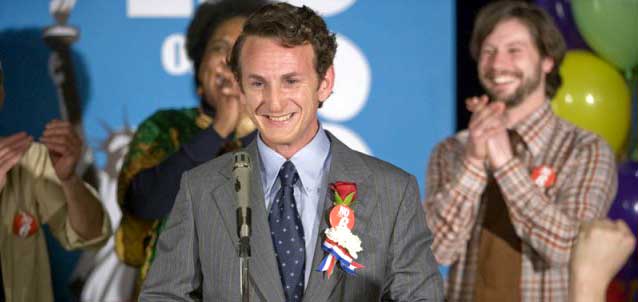
“My name is Harvey Milk, and I want to recruit you.” So began the oft-repeated speel of the San Francisco city supervisor and “Mayor of Castro Street,” who, in 1977 and after several attempts, became the first openly gay official elected to office in the US. But, seven years before those heady days, Milk (Sean Penn) was just a 40-year-old insurance man (and Republican, even), living a closeted life of quiet desperation in NYC. After a chance encounter and illicit proposition becomes an impromptu birthday party, Milk and new beau Scott Smith (James Franco) fall in love, talk about starting over, and decide to go West. Life is peaceful there…or is it? Even as Milk’s camera shop in the gay-friendly Castro district becomes a salon of artists, thinkers, and free spirits, bigotry is rampant even in the streets of San Francisco, and the cops at best turn a blind eye to — and at worst actively participate in — antigay violence. No more, says Milk. Taking a page from the ethnic political machines of an earlier century, he organizes Castro’s gays and lesbians into first a protest movement and then an organized voting and boycotting bloc. And when a redistricting plan emphasizing community self-rule in San Francisco is put into effect, Milk becomes an actual, legitimate political wheeler-and-dealer, with all the benefits and aggravations attending. (For more on the man and the movement, see the 1984 documentary The Times of Harvey Milk, now on Hulu for free.)
But, even as Harvey Milk rises to power in San Fran, a parallel movement stirs amid the churches and suburbs of Orange County. Led by former beauty queen, singer, and orange juice shiller Anita Bryant, the ever-so-Christian “Save Our Children” campaign gathers steam across the nation in its quest to roll back what meager protections gays and lesbians have managed to establish over the years. And when conservative state senator John Briggs (Denis O’Hare, seemingly forever destined to play assholes) brings the fight west in the form of Proposition 6, an initiative that would ban gays and lesbians from public schools, the battle for California is on. And even as Milk becomes the poster boy against Prop 6 and for recognizing gays and lesbians as full citizens and fellow human beings, he has to contend with trouble on the homefront — not only in his personal life (his new boyfriend Jack (Diego Luna) is more than a little erratic) but in his political backyard, where supervisor Dan White (Josh Brolin), from the Catholic, working-class district next door, is starting to act increasingly unstable. (But, I guess this is what happens when society is so permissive as to let a man get all hopped up on twinkies.)
Which reminds me: A word of appreciation for Josh Brolin’s work here. Sean Penn is garnering kudos across the board, and a likely Oscar nod, for his portrayal of Milk, and they’re very well-deserved. It’s really an astonishing transformation Penn accomplishes here — not so much because he’s playing someone who’s gay (homosexual), but because he’s playing someone who’s gay (happy).This is the same guy who sulked through Mystic River?) And, while Brolin will likely — and, imho, justifiably in the end — get edged out for Best Supporting Actor by Heath Ledger for The Dark Knight, his work here suggests he’s got some serious chops. At first it seems as if Brolin will just be coasting on his recent Dubya impression — another good-natured, hard-hearted conservative fratboy for the resume. Then, just as you think Brolin’s endangering himself in terms of typecasting, it’s suggested Dan White might also be a deeply repressed closet case. (I tend to find the argument that all frothing-at-the-mouth homophobes are in reality trapped in the closet to be too simplistic by half, but apparently there’s some grounding for it in White’s story. In any case, Brolin underplays it beautifully ) As Milk progresses, we begin to sense other reasons why White is such a strange and ultimately homicidal bird — he’s envious of Harvey, he feels personally screwed over by him, he’s something of a friendless wonder, he’s not the brightest bulb on the tree anyway, he feels trapped by, and powerless before, the authority figures in his life (his wife, his cop buddies, his church). Brolin lets all of this play out without tipping his hand in any one direction. It’s a subtle, complex, and very worthwhile performance, and it’s a testament to the film’s heart that it extends such empathy even to its ostensible antagonist.
Speaking of empathy, this isn’t at all a surprise coming from Gus Van Sant, always a very humanistic director, but it should be noted regardless: When it comes to full recognition of gays and lesbians, Milk laudably practices what it preaches. Jonathan Demme’s Philadelphia was good for its time, but nowadays (it’s on heavy rotation on AMC) it gives off a distinctly Guess Who’s Coming to Dinner? vibe. And, as I said when it came out, Ang Lee’s Brokeback Mountain often seemed “as somber, restrained, and delicate as Kabuki theater.” By contrast, the couples of Milk are passionate — both physically and emotionally — messy, flawed, and alive. Of course, there have been other well-rounded depictions of gays and lesbians in film in the past — in Van Sant’s earlier work, in the films of other gay directors like Todd Haynes, John Cameron Mitchell, and Kimberly Peirce, and in countless others. Still, Milk feels like an event of sorts. Unlike many of its forebears, it’s a mainstream Oscar-caliber movie that just takes its characters’ sexuality at face value and without apology. In that sense, it feels like a film whose time has come.
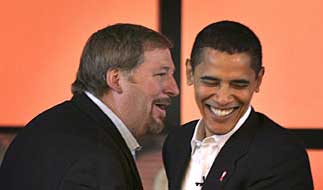
Which brings us to that Wal-Mart of spirituality, Rick Warren, who as you all know will be delivering the invocation at Obama’s inauguration this month, and who has said all manner of intemperate things about gays and lesbians (as well as jews, pro-choice voters, and others) in the past, even going so far as to campaign for Prop 8 in California two months ago.
Now, when the Rick Warren pick first came out, I didn’t say anything here for two reasons. One was deeply selfish: That was the week I was finishing up my speechwriting app, and it didn’t seem like the most opportune time to be too critical of the administration around here at GitM. (In the end, it didn’t matter anyway, of course.) More importantly, though, I am — and still partly remain — of the mind that the bigger picture needs to be kept in mind here. If it keeps the right-wing fundies relatively happy and docile, and helps them to buy into the notion of a post-partisan Obama presidency, then Rick Warren can give all the one minute ceremonial speeches he wants, so long as Obama ultimately shows himself a friend to gay and lesbian rights in his presidential actions.
But, there’s a sequence in Milk that brought me around a bit. When Dan White mentions the “issue” of gay rights in one crucial scene, Harvey replies: “These are not issues, Dan. These are our lives we’re fighting for.” And, put that way, the calculus changes. To straight progressive folk such as myself, one can easily — too easily — get to thinking of gay rights as an “issue” among many. But, for gays and lesbians all around the country, this is their lives. And, when considered thusly, the president of these United States — least of all a president who ran and won on a campaign of hope — should not be legitimizing bigotry, such as that continuously expressed by Warren without apology, in any kind of forum, let alone the most portentous and culturally significant inauguration in at least fifty years, perhaps ever.
In an eloquent column last week, the NYT‘s Frank Rich articulated basically where I stand on Obama’s decision at this point: His choice of Warren is “no Bay of Pigs. But it does add an asterisk to the joyous inaugural of our first black president. It’s bizarre that Obama, of all people, would allow himself to be on the wrong side of this history.” Let’s hope that Obama doesn’t follow in the footsteps of the last Democratic president, who very quickly started backpedaling on gay rights once in office, vis a vis “Don’t Ask, Don’t Tell.” And, while I’m sure he’s pretty busy these days, the president-elect (apparently a movie buff of sorts) could do worse than spend a few hours to reflect on the story of another community-organizer who believed in the transformative power of hope, who carried the hopes of his constitutents into higher office…and who faced unflinching and unwavering contempt from an irreconcilable opposition once he got there.
Twelve for ’09.
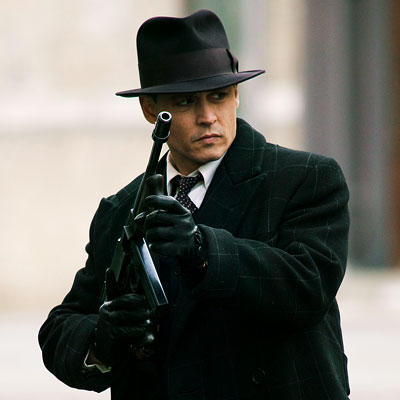
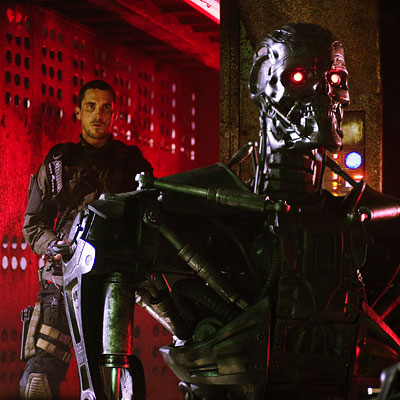
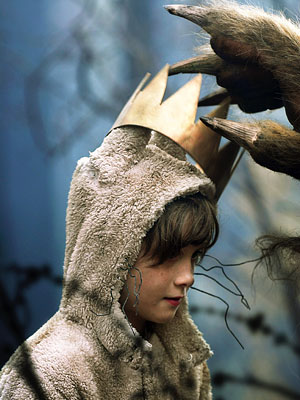
On the occasion of the new year, EW previews some of the more-anticipated films of 2009, including Michael Mann’s Public Enemies, Terminator: Salvation, Spike Jonze’s’ long-awaited Where the Wild Things Are, Harry Potter and the Half-Blood Prince, Pixar’s Up, Harold Ramis’ Year One, The Taking of the Pelham 1-2-3 (again), Wolverine, and Watchmen.
Before Xenu, Ronnie.
“[N]ote a curious fact about his career: It maps perfectly onto the 25-year bull market in stocks that, like Cruise, is starting to show its age. Nascent in the early ’80s, emergent in 1983, dominant in the ’90s, suspiciously resilient in the ’00s, and, starting in 2005, increasingly prone to alarming meltdowns. For both Cruise and the Dow Jones, more and more leverage is required for less and less performance. Place Cruise next to Nicholson, Newman, and Tracy, and he is a riddle. Place him next to Reagan, and he is not so confounding at all.“
In an extended meditation on the overlooked merits of Risky Business, Slate‘s Stephen Metcalf argues for Tom Cruise as an exemplar of the 80’s, Reaganism, and the boom-and-bust market. “More so than any of his contemporaries, Cruise brought to ’80s cinema an aura that corresponded to the novel tonalities of Reaganism.“
Hrm…
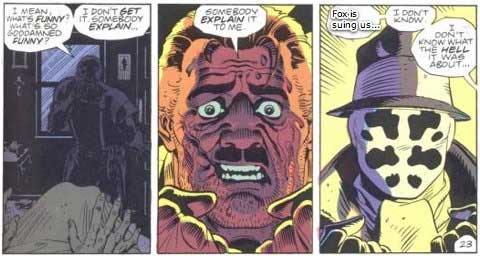
“The bottom line: Warner Bros. had absolutely no right to roll film on Zack Snyder’s adaptation of the Alan Moore/Dave Gibbons superhero classic.” Forget the watchmen for a sec: Who’s watching Larry Gordon? A judge rules that Fox’s lawsuit over Watchmen does indeed have merit, and that former Fox, now WB exec Larry Gordon never actually secured all the necessary distribution rights to make Watchmen at his new home studio. “In his ruling, Feess concludes that Gordon never properly presented Fox with the option to produce and distribute the version of Watchmen developed by director Zack Snyder. He also makes it clear that neither Gordon nor Warner Bros. had bought out Fox’s interest before Warner Bros. went into production.“
What this means for the movie is still up in the air, although a release delay of several months isn’t out of the question. When a similar incident happened with The Dukes of Hazzard, a case that involved the same judge, WB eventually just settled and ponied up before the release date.
Well, here’s hoping this gets worked out in short order. I’m guessing Snyder’s film is going to have some serious problems, but I’d still like to see it next to immediately. (Watchmen image above via The Nerd of Her.)
Luhrmann Hatches an (East) Egg.

Defiant and almost combative about the cinematic merits of Australia (“A lot of the film scientists don’t get it“), director Baz Luhrmann announces he’s moving right ahead on a new film version of The Great Gatsby. “If you wanted to show a mirror to people that says, ‘You’ve been drunk on money,’ they’re not going to want to see it. But if you reflected that mirror on another time they’d be willing to…People will need an explanation of where we are and where we’ve been, and ‘The Great Gatsby’ can provide that explanation.‘”
Stop-Motion Alphabet.
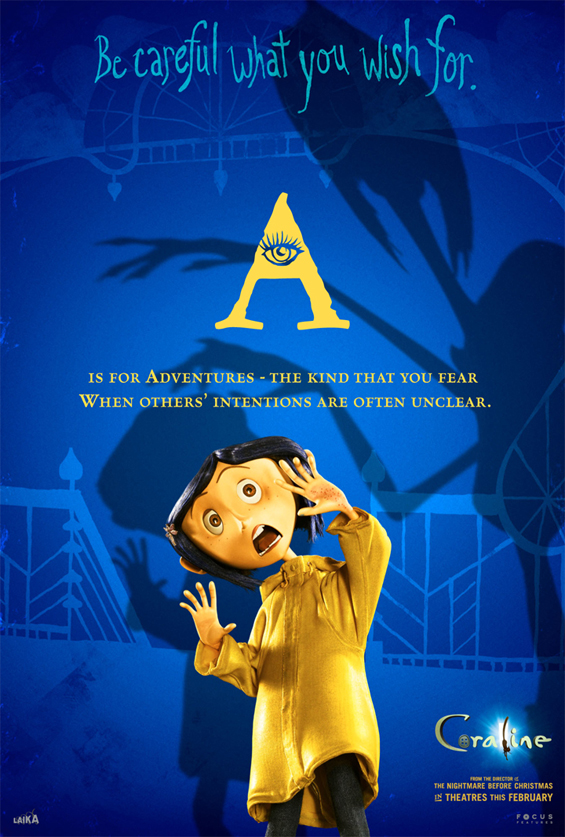
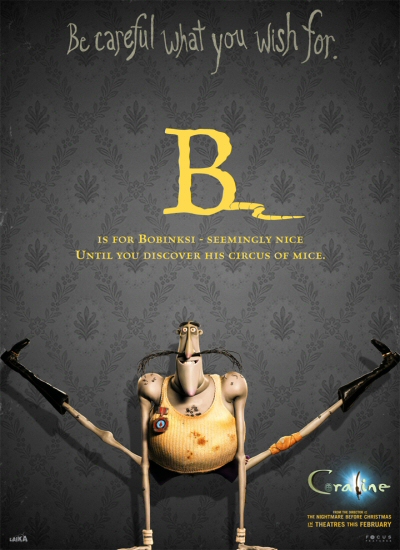
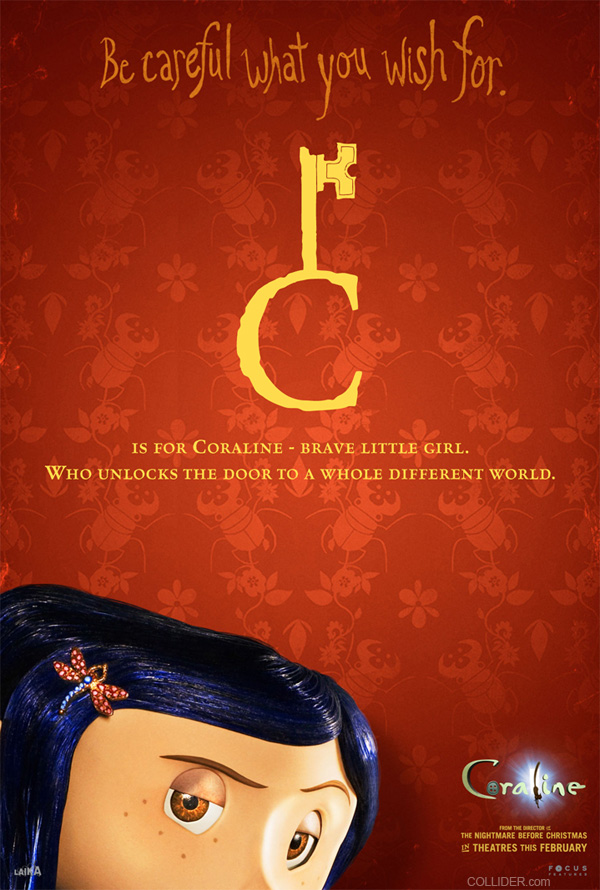
As part of the launch of the official site (and taking a page from Edward Gorey’s Gashlycrumb Tinies), twenty-six unique alphabet-themed posters are released across the web for Henry Selick’s version of Neil Gaiman’s Coraline (in stop-motion and 3D, no less), coming February 6, 2009. If, like me, you haven’t read the book, “it’s about a girl that walks through a secret door in her home and discovers an alternate version of her life. On the surface, this parallel reality is eerily similar to her real life – only much better. But when the new world turns dangerous, and her counterfeit parents try to keep her forever, Coraline must find a way to get home and save her real family.“