After the Thrill is Gone.

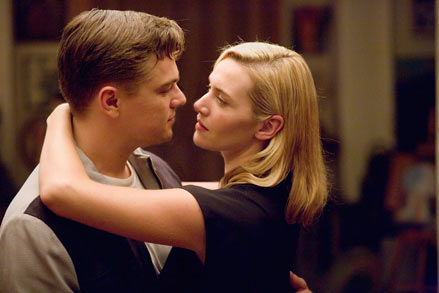
And you thought the iceberg was cold. After watching Kate Winslet and Leonardo di Caprio flail about and suffocate in the suburban purgatory of Sam Mendes’ Revolutionary Road, you get the sense that Leo might’ve actually caught a lucky break by going down with the ship. In any event, blessed with award-caliber performances, sober purpose, and stately production values, Road is unfortunately a dry and somewhat lifeless film in the end, one that probably works best as an extended meta-comment on the sadly untenable Titanic vision of romance. If it wins Winslet that long-deserved Oscar, so be it, but otherwise Revolutionary Road is pretty missable.

If you haven’t seen the trailer, the setup is thus: Slumming-it longshoreman Frank (di Caprio) and aspiring actress April (Winslet) meet at a party, fall in love, and get married. So far, so good. (The movie covers this very quickly, since it correctly presumes we all saw Titanic.) But when, following the rules of the game, Frank takes a sales job at his father’s place of work, the Wheelers buy a house in the Connecticut suburbs from the unsinkable Molly Brown (Kathy Bates), and the two have a few (exceedingly well-behaved, given how much grief they cause) kids, the unmistakable whiff of decay starts to set in.

Weren’t these two meant to travel the world and stay forever enthralled with each other? I mean, the suburbs are great and all for “average” people (say, Shep and Millie, the couple next door), but the Wheelers? And now the only throes of passion these two indulge in are screaming matches about relatively innocuous subjects, like April’s stab at community theater. (Suffice to say, Frank, who starts sleeping with at least one of his secretaries out of boredom, doesn’t much feel like King of the World anymore.) So when April comes up with a plan for the family to move to Paris and start over, they both lunge for it like a liferaft, one last-ditch chance to escape their desperate circumstances. But is venturing across the pond — this time, with no iceberg along the way, presumably — really a feasible plan, and will it change anything anyway? After all, wherever you go, there you are…and that same old spouse is sitting right next to you.

Part of the problem with Revolutionary Road is that, although Richard Yates’ 1961 novel was ahead of its time (no less than Kurt Vonnegut called it his generation’s Gatsby), by now we’ve seen all this before. We saw director Sam Mendes lambast the oh-so-stifling confines of suburbia in 2000’s overripe American Beauty. We saw Kate Winslet wither on the suburban vine in Todd Field’s Little Children. And we can watch beautiful, self-medicating people grapple with suburban ennui, marital boredom, outdated gender roles, and the postwar workplace every week on Mad Men. So, at this point, Road no longer feels all that revolutionary.

The other main problem is Mendes. While word is the man is an excellent stage director, I can’t say I’ve much cared for any of his movies (American Beauty, Road to Perdition, Jarhead.) And, here, Mendes’ stagy reserve helps undo the film. For whatever reason, Revolutionary Road often feels as cold, sterile, and clinical towards its characters as a boy pinning down butterflies. (This is particularly surprising given that Winslet is Mendes’ real-life wife.) When Leo frets and sulks in his fifties suits, and the tendrils of smoke from his cigarette dance to some mournful period tune or another, it’s impossible not to think of Wong Kar Wai’s In the Mood for Love or 2046, heartfelt movies that almost burst at the seams with melancholy and ache. But here, everything feels distant and removed, like a reverie on, well, an iceberg. And, when you don’t feel particularly involved with the characters, it’s hard not to notice how slack the film goes in its final third, as we all wait patiently for one of the Wheelers to follow through on the decision they clearly made half an hour before. (And when it finally happens, as Stephanie Zacharek and others have noted, the moment is over-stylized to the point of becoming ludicrous anyway.)

Still, there are small things to admire about Revolutionary Road despite its many flaws. The last two scenes in the movie (one between Shep and Millie, the other involving Kathy Bates and her husband) help to drive home a point which makes the movie considerably more interesting. Namely, that it’s not really the drabness of the suburbs driving the Whee(d)lers bonkers, but their own innate character flaws and inability to comprehend how adult, lifelong relationships often work. Winslet’s self-absorbed April can’t ever get over the fact that she didn’t turn out to be a unique and beautiful snowflake — welcome to the real world, Mrs. Wheeler — and di Caprio’s anxiety-ridden, constantly needy Frank just can’t stop poking at the sleeping dogs in his midst. (Like R.E.M.’s The Apologist, he’s at his most monstrous when he’s just trying “to work things out.”)

And then there’s Michael Shannon’s character, who shows up in the middle going as a dinner-guest who’s been through some electroshock therapy, and the guy so crazy he must be sane. The part is a cliche through and through, and (like most truth-tellers, I guess) Shannon overstays his welcome. (I preferred his random “howdy, chico” turn in Before the Devil Knows You’re Dead.) But, at least for a few moments, he breaks through the pall of stultifying stateliness otherwise cast over this dark corner of the suburbs.

Spy vs. Spy.

As seen several times over the weekend, Clive Owen and Julia Roberts play cloak-and-dagger in the world of corporate espionage — and cat-and-mouse with each other — in the trailer for Tony Gilroy’s Duplicity, also starring Tom Wilkinson, Paul Giamatti, Denis O’Hare, and Tom McCarthy. (Gilroy’s last project, Michael Clayton, was good enough to give this a run, even if it does look a bit Mr. & Mrs. Smith-ish.)

Bell Tolls for Tintin. | Unicorn Rising.


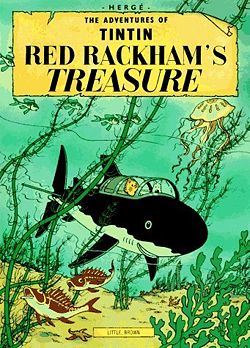
Word comes down today that (as rumored way back in 2004) Jamie Bell will replace Thomas Sangster as Tintin, and Daniel Craig will play the fearsome Red Rackham, in Steven Spielberg’s forthcoming The Adventures of Tintin: The Secret of the Unicorn, first of the planned mo-cap trilogy. Moreover, Shaun of the Dead scribe Edgar Wright has given Stephen Moffat’s script a polish. (As reported earlier, Andy Serkis is Captain Haddock and Wright’s usual brothers-in-arms are Thomson and Thompson respectively.)

Hmm. With Spielberg’s first film likely covering Unicorn and Rackham, I wonder if PJ’s contribution will involve Destination Moon/Explorers on the Moon or The Seven Crystal Balls/Prisoners of the Sun. And Toby Jones is now among the cast too, it seems…Professor Calculus?

Why So Sockious?

“Did I ever tell you how i got these sock-monkeys?” I guess this post probably isn’t in my best interest, as y’all will just further diminish my slim chances of scoring this year’s exceedingly cool victory swag, but nevertheless: Web Goddess’s annual Oscar contest is now live, and check out this year’s prizes! Huzzah to Kris on this pair of Gotham’s finest. (It’s just too my bad my grim view of Slumdog will probably kill my entry this year.)

Little Miss Slumdog.

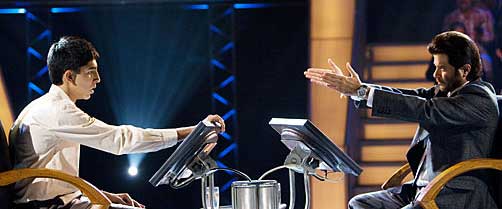
Next up on the weekend bill, Danny Boyle’s sadly overrated Slumdog Millionaire. (Yes, I know I said I’d be skipping this one, but it just fit too perfectly between two other movies I was trying to see that day. Besides, fear is the mind-killer and all that.) Now, lest anyone think I just went into the film with a closed mind, I see movies all the time that I expect to be lousy and discover in fact to be really good. (Letters from Iwo Jima and In the Valley of Elah come to mind.) Still, while I suspected I might have to grit my teeth through some of the more implausibly “romantic” parts of Slumdog, I never expected that I’d be so bored by it.

Partly a Dickensian travelogue through the horrors of Mumbai slum life, partly a generous heaping of third-world-despair pr0n leavened with a very first-world cherry on top (A game show can change your life!), Slumdog Millionaire is in essence a feel-good, less resonant version of Fernando Meirelles’ City of God. If you can remain relatively ambivalent about cartoonish, over-the-top villains, characters who make random decisions solely to further the plot, a lot of chase scenes set to (admittedly catchy) bhangra, and, of course, a thoroughly implausible saccharine-sweet ending, Slumdog Millionaire may be more up your Mumbai back-alley than it was mine. For everyone else, do not pass go, do not collect $200. Make no mistake: As cloying as Little Miss Sunshine at times, this is really the Crash of this year’s Oscar crop (and, very possibly, the worst million-related Best Picture winner since Million Dollar Baby in 2004.)

Slumdog Millionaire begins, improbably enough, with a torture scene. Having gotten within one question of the big payday in India’s version of Who Wants to Be a Millionaire?, our hero Jamal (Dev Patel, an appealing presence) has been strung up at the local police precinct in Mumbai and hooked to a rusty car battery. His crime? Why, cheating, of course — there’s no way an itinerant slum kid and chaiwalla (tea carrier) could’ve known all the answers…could he? Since Jamal won’t break under the juice, the local sergeant (Irrfan Khan, the most recognizable actor in the film for western audiences) gives him a chance to recount his story. And what a story it is, involving religious riots and narrow escapes and rape and child mutilation and brotherly betrayal and swimming through a river of feces…uh, did I mention this was a feel-good movie?

As it turns out, the torture scene that starts the film is both a feint and a taste of things to come. It’s a feint because, however grisly the opening, Slumdog ultimately plays out in a very different world than it originally suggests, one where bad guys invariably get their comeuppance, love conquers all, and the truth really does set you free. People have been using the “Dickensian” label to compliment this film as a social novel of the city of Mumbai, but, to be honest, it works both ways. The villains of the piece, gangsters and orphan-nabbers and such, are cartoonish enough to make Fagin and Bill Sykes blush. Like any number of Dickens’ supporting casts, most of the characters are paper-thin and plot-determined (I’m thinking particularly of Jamal’s brother, who waxes on and off from scene to scene depending on what the story requires of him.) And the movie takes some ridiculous jags throughout — the last few scenes, for example — that reminded me of nothing more than ole Pip’s jailbird benefactor in Great Expectations. Yeah, it’s Dickensian alright, and not in a good way.

In any event, that kick-off torture scene works as foreshadowing too, as it turns out that Jamal has learned the answer to every single question (in order, to boot) as a side benefit of experiencing something truly nightmarish in his life. What is the name of Lucy Van Pelt’s younger brother? Why, I dressed up as Linus on that same Halloween the house burned down. Who’s the 27th president of the United States? That’s funny, a guy with a William Howard Taft t-shirt shot my dog. Even notwithstanding the screwed up moral economy of this notion — don’t fret if god-awful things happen to you, you might just win some money from it some day! — and the weird voyeurism involved in this story — oof, third world poverty is grotesque and horrifying, isn’t it? But don’t worry, we give the kid a happy ending! — it all gets to be a bit ridiculous over time. I mean, thank god Jamal didn’t get any questions about astronomy, or the poor kid might’ve gotten walloped by a meteor.

Are there things I enjoyed about Slumdog? Well, yes. Like all of Danny Boyle’s films (Trainspotting, The Beach, Sunshine) it’s sleek and propulsive and well-made. As I said above, Patel, Khan (a.k.a. India’s own Chiwetel Ejiofor), and a few others are engaging here. And I particularly liked the scene where Jamal gets fed an answer by the show’s host (Anil Kapoor)…sort of. But, as for the rest of it, I found myself looking at my watch more often than not. For those of you who’ve seen the film, I think Slumdog Millionaire could’ve at least “stuck the landing” for me if, in the final scene, [highlight to read] Latika had answered the phone, told him she was safe, she loved him, etc. etc., and then they both happily blew off the final question. So Jamal didn’t get the money, but he got the girl, and wasn’t that what he was in it for anyway? But, as it ends here — have your cake and eat it too, Jamal — it just reminded me once again how stilted, manipulative, and implausible this movie turned out to be. And by the time an impromptu Bollywood number broke out with the credits, I had my very own bhangra-scored running scene…out the door.

King of Kings.

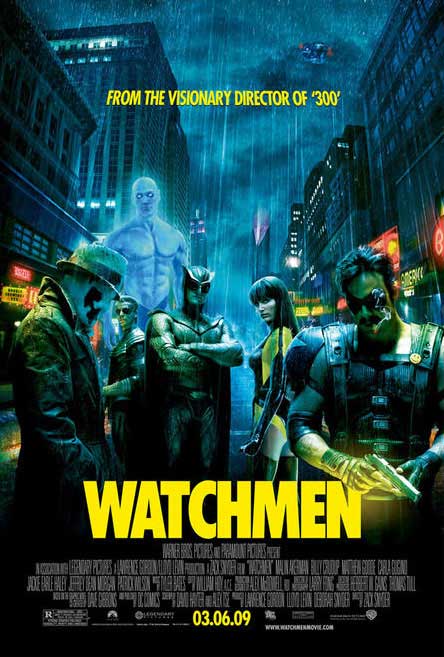
“It doesn’t take a genius to see the world has problems. We can do so much more. We can save this world…with the right leadership.” If you haven’t been by there recently, the official site for Zack Snyder’s Watchmen has added extensive quotes and mini-trailers for each of the main characters. It’s particularly good to see/hear more of Ozymandias — Except perhaps Doc Manhattan, Matthew Goode as Veidt was the character I’ve had the most worries about.

Also of note, Jackie Earle Haley’s Rorschach delivers his first journal entry (“Dog carcass in alley this morning. Tire tread on burst stomach…“), and the oft-quoted line from the trailer — “the world will look up and shout ‘save us!’” — has been restored to its original form.

Update: The final poster is released. Bit of a cut-and-paste photoshop job, to be honest. But I suppose it’ll do until the trouble gets here.

Mano-a-Mano.

Ron Howard’s version of Peter Morgan’s Frost/Nixon, the first of many 2008 prestige films I caught over this past weekend, is a solid two hours of decently diverting edutainment. It’s not an earth-shattering, must-see film or anything, and Morgan (and Michael Sheen)’s last recent “mini-history,” The Queen, is ultimately a more memorable moviegoing experience. Still, Ron Howard’s film has its merits. It’s much better about opening the space and feeling less play-like than John Patrick Shanley’s recent reimagining of Doubt. And it has considerably less of the dry, “Will this be on the test?” feel of much of Bryan Singer’s Valkyrie, which sometimes seemed designed as a go-to staple for high school history teachers feeling under the weather. Throw in two highly watchable performances by the main sparrers in this tale, Frank Langella and Michael Sheen as Nixon and Frost respectively, and some scene-stealing buffoonery by Oliver Platt and Sam Rockwell in the margins (Think Rosencrantz/Guildenstern), and you’ve got a keeper here with Frost/Nixon. And, fwiw, it’s probably Howard’s best film since Apollo 13, perhaps ever.

As you might expect, the movie begins with a brief recap of the Watergate crisis, culminating in the memorable departure of Richard Nixon (Langella, beady-eyed and furtive) from the White House grounds on August 9, 1974. And, while the mid-Seventies unwind, Nixon licks his wounds, and Rocky Balboa trains on the stairs of the Philadelphia Museum of Art for his one shot at Apollo Creed, another challenger — this time from across the pond — begins his own preparations for taking on the champ. In this case, the challenger is David Frost (Sheen), a talk show host and television personality whose American show failed in syndication and who has since been relegated to covering stupid-human-tricks Down Under. Hungry to get back into the Stateside game, Frost sees immediate opportunity in a series of interviews with Nixon, and, by dint of sheer ambition, manages to rope in his BBC producer friend (Matthew MacFadyen of Pride and Prejudice), two down-and-out researchers (Platt and Rockwell), and a leggy brunette he meets on the plane (Rebecca Hall of The Prestige and Vicky Christina Barcelona) into his audacious proposal.

At first, it seems, Frost is in luck. When not dying a slow death on the lecture circuit, the former president has been languishing in San Clemente, and he and his handlers (most notably Kevin Bacon) have been looking for a way to get back in the game themselves. So after Nixon’s agent (Toby Jones) extracts from Frost a price the television “performer” can’t really afford, and it is deemed by all involved that Frost is a certifiable lightweight, who can be molded as needed to fit the president’s new media strategy, the interviews are agreed upon. In the early rounds — and rounds they are, with points scored, corner men, sweat towels (no 1960 redux for Nixon this time) and the like — everything proceeds according to plan, with Nixon pontificating presidentially and Frost (and his increasingly exasperated researchers) completely hemmed in. Will this spirited but out-of-his-depth newsman manage to break out of the corner and land a few punishing blows himself? I dunno, but we’ll definitely need a montage

To be honest, I don’t think Frost/Nixon ever really succeeds in selling us on the purported importance of the Frost interviews. Granted, I’m too young to remember how they played at the time — I was sorta more focused on Electric Company and Star Wars right around then. But for all the talk of much-needed national catharsis throughout the film, the world-historical stakes here seem rather small. Coming after all the investigations into the break-in and subsequent cover-up, the congressional hearings on Watergate, the ultimate resignation of the president, and the pardon by Ford, it’s hard to see these 1977 talks as much more than a coda to the main event. And, while Langella is exemplary as the 37th president and definitely deserves his recent Oscar nod, I actually think Oliver Stone’s Nixon did a better job of humanizing Tricky Dick and animating his demons. (In fact, there’s a midnight drunk-dialing episode here in Frost/Nixon (an obviously fabricated event) which wouldn’t seem out of place in Stone’s film.)

Still, once you move past its historical pretensions and realize that, for all intent and purposes, Frost/Nixon is basically just the political debater’s version of a boxing movie, there’s still some good fun to be had here. And, hey, he may now seem like a piker when compared to the intelligence-falsifying, torture-happy shenanigans of 43 — can we expect Lauer/Dubya just around the corner? — but at least we’ll always have Nixon to kick around some more.

Update: David Frost, Michael Sheen, and others talk about the film here.

The Curious Case of Benjamin’s Oscar Love.

The powers-that-be announce the nominees for the 81st Academy Awards, with The Curious Case of Benjamin Button garnering 13 nominations (it helps when your Oscar Bait is FX-heavy), Slumdog Millionaire grabbing ten, and Milk and The Dark Knight notching eight apiece. (That being said, TDK was frozen out of the main awards, Ledger’s inevitable Supporting Actor bid notwithtanding.)

Also in the running for major stuff: The Reader (picture, actress, director), The Wrestler (actor, supporting actress), Doubt (actor, screenplay, actress, supporting actress), Frost/Nixon (director, actor, screenplay), and WALL-E (screenplay, animated film). And the happy semi-surprises: Richard Jenkins for The Visitor and Robert Downey, Jr. for Tropic Thunder.

I’ll make my picks with the GitM 2008 list, which should be coming up within the next week or two. (The movies I’ve been waiting for — Frost/Nixon, Revolutionary Road, and The Wrestler — all open here tomorrow.) And, don’t worry, 2009 isn’t being slighted all that much: I highly doubt Paul Blart: Mall Cop was going to make the cut anyway.

Tales of the New Frontier.

Taking a page from all the viral shenanigans accompanying The Dark Knight, the WB marketeers recreate Rorschach’s favorite mag, the New Frontiersman, for Zack Snyder’s forthcoming Watchmen. Hrm. It doesn’t seem nearly as right-wing as I remember. Must investigate further.

Update: As part of the site above, a March 1970 NBS news broadcast celebrates 10 years of Dr. Manhattan.

Delivered from the Blast.

The clock is ticking: As expected, Fox and WB have settled their dispute over Zack Snyder’s Watchmen, thus clearing the way for the March 6 release. “Fox…will emerge with an upfront cash payment that sources pegged between $5 million and $10 million…More importantly, Fox will get a gross participation in “Watchmen” that scales between 5% and 8.5%, depending on the film’s worldwide revenues. Fox also participates as a gross player in any sequels and spinoffs, sources said.

Sequels and spinoffs? I don’t think so…how awful would those be? Then again, I’m still trying to wrap my mind around the forthcoming prequelish Watchmen: The End is Nigh Double Dragon game and, as the graphic novel predicted, the inevitable Watchmen action figures. (Archie and Bubastis sold separately.)