Village of the Damned.


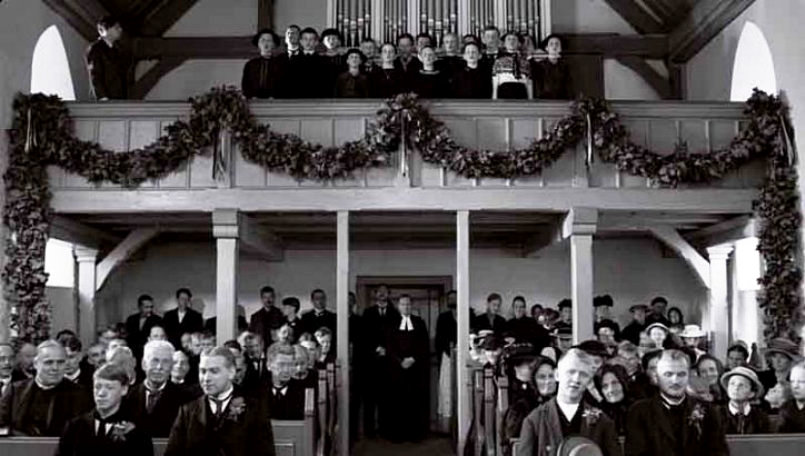
The kids are alright? Not hardly. As the second half of a Saturday double-feature with Daniel Ellsberg: The Most Dangerous Man in America, I caught the Oscar favorite for Best Foreign Film this year, Michael Haneke’s The White Ribbon. Alas, meine freunde, I found it underwhelming.

Put briefly, and while adding a frisson of Funny Games‘ Aryan youths-gone-wild to the mix, The White Ribbon attempts to do for the rise of the Nazis in Germany what Haneke’s Cache did for the French-Algerian conflict. But, at least for me, lightning didn’t strike twice. Perhaps it’s due to either knowing the trick this time ’round or having a greater familiarity with the history at hand, but I thought the allegorical content of Ribbon started out rather didactically, and only got more obvious and belabored at the movie churned along. And, shorn of its historical musings, the story here doesn’t really hold up on its own — It’s mostly just long, meandering takes of (usually) unfortunate things happening to German peasants.

First, the story. The year is 1913, and in the (fictional) village of Eichwald, a German doctor (Rainer Bock) is thrown from his horse and gravely injured, apparently due to a tripwire someone — one of the Black Hand? — placed across his path. And before this event can even be fully processed, another tragedy takes place: A worker for the local Baron (Ulrich Tukur) falls through some rotted boards to her death. Yep, Eichwald is having a frozen run of luck like you read about.

As suspicions and recriminations deepen throughout this hamlet, more troubling events ensue. An aggrieved farmer ruins the harvest festival by slaughtering all the Baron’s cabbages. The Baron’s young son is taken by unknown parties and brutally horsewhipped (for some reason, and as in Doubt, nobody ever thinks to ask the kid who did this to him.) Fires are set, folks disappear (or leave while they still can), birds are mutilated, and, perhaps most frightening, even souls are in peril: For example, the son (Leonard Proxauf) of the local reverend (Burghart Klaubner) puts his eternal salvation in doubt by indulging in a nasty habit of onanism. To be sure, this evil must be beaten out of him, and his siblings, as soon as possible. In other words, we must destroy these children in order to save them.

Narrating this tale throughout (as an old man, years on) is the local schoolteacher (Christian Friedel), who, as a relatively young newcomer to the village, stands between its feuding generations. When not courting the Baron’s young nanny (Leonie Benesch), he watches the events unfolding in town with growing unease, and tries to figure out who is responsible for all the incidents driving the citizens of Eichwald mad. The problem is, he’s already tipped what’s actually going on in the very first scene of the movie, when he says something along the lines of “This is not just the story of a random German village, but the story of my nation.” Ooh, really? Allegory time.

Pretty soon thereafter, we are regaled with a scene where the Reverend’s children are taken to the proverbial woodshed and unduly punished for their transgressions, real and imagined. Given both the time I’ve spent on this subject in recent years and the schoolmaster’s “time to play German History Jeopardy!” warning in the first scene, this set off Versailles Conference bells and alarms right away, and especially so once these children are then forced to wear white ribbons as symbols of purity. Hmm…who else in 20th century German history ran around wearing armbands? Let me think on it.

The rest of the story pans out as you might expect. For various reasons, predominant among them the Sins of the Father(s), these kids go terribly wrong, eventually even going so far as to attack a developmentally disabled boy (i.e. the local minority in their midst.) Also, for some reason, the movie is constructed like a mystery, even tho’ — even if you didn’t pick up on all the hints in the last paragraph — one of the kids basically confesses to the schoolteacher what’s going on in the first reel. Uh, can we speed this along? Bitte?

I’d like to say The White Ribbon remains engaging despite all of its allegorical ambitions. But it doesn’t, really. When you’re not playing spot-the-German-history as it goes along — Is the Baron supposed to be Kaiser Wilhelm? Are we gonna get a Beer Hall Putsch? Hey, look, Pius XII! — Ribbon mostly just offers long, intermittently interesting digressions on agrarian village life, like harvest festivals, courting carriage-rides and the cruelest break-up of the German pre-war period. (Some of this plays a bit like Todd Haynes’ Far from Heaven — A period film, told in period (B&W) style, with then-taboo subjects like incest, sexual assault, and the aforementioned onanism now thrown in.)

Simply put, there’s not enough story to sustain interest in this enterprise without the allegorical content that’s driving the movie. And, since this allegory was tipped in the opening half-hour, I pretty much just spent most of The White Ribbon waiting for all the various little Nazi shoes to drop. Without either the ambiguity or the open-endedness of Cache, I found The White Ribbon on the pedantic and stultifying side, and I can’t really recommend it. It’s not terrible or anything, but it is rather long and uninvolving, and I have to think one of the other Foreign Film contenders probably puts on a better show.

The Patriot.

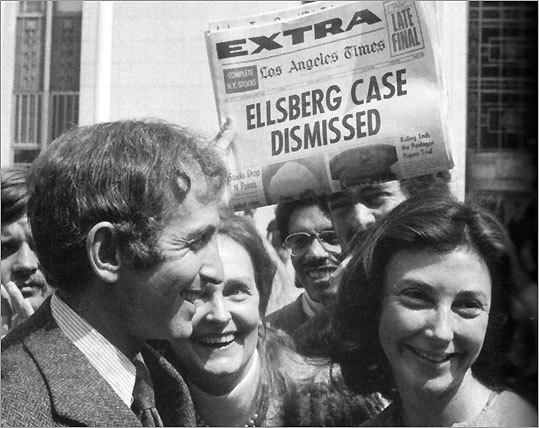
As gripping in its own way as a cloak-and-dagger thriller or John Grisham procedural, Daniel Ellsberg: The Most Dangerous Man in America, by co-directors Judith Erlich and Rick Goldsmith and about the famous Rand analyst turned Pentagon Papers whistleblower, is a smart, tautly-made conjuring of recent American history that’s well worth the trip. And, fortunately for me, it’s also a perfect movie to contemplate and write about this President’s Day.

On one hand, the film makes for an interesting moral counterpoint to The Fog of War: Ellsberg’s actions put the lie to a lot of McNamara’s convenient post-hoc rationalizing therein — clearly, SecDef could’ve done more at the time to end the war in Vietnam.) On the other, Ellsberg also works as a prequel of sorts to All the President’s Men — to say nothing of a generation of seventies paranoia epics like The Parallax View and Three Days of the Condor. But in the end, The Most Dangerous Man in America probably works best as an eloquent testament to the words of the late Howard Zinn (who appears here as an old friend of Ellsberg): “Dissent is the highest form of patriotism.

Like Man on Wire, Ellsberg starts here in media res, and at the scene of the history-making crime. Furtive eyes scan back and forth as an old-school Xerox copier whirrs in the dark, its green light illuminating maps of Southeast Asia and the ominous words “Top Secret” from below. With no zip drives or electronic files to speak of, analyst Daniel Ellsberg is forced to copy the 7000 pages of the Pentagon Papers page by painstaking page. It’ll take months (and eventually he enlists the aid of his kids.) As the Xerox churns, we get up-to-date on the ramifications of the document being processed — bombs fall from the sky over North Vietnam and Cambodia, weary troops patrol the hot, fetid jungle, and Nixon and Kissinger obsess over the leaks in their war machine (with Kissinger giving Ellsberg his moniker: “the most dangerous man in America.”)

Cut back to several years earlier, when the future leaker of the Pentagon Papers seemed quite a different man indeed. A fresh-faced young ex-Marine with a crisp, no-nonsense Kennedy era haircut, Ellsberg began his tenure in government as one of the Best and the Brightest, with an enthusiasm for his 80-hour workweek matched only by his hawkishness. As one of McNamara’s boys, Ellsberg concedes to helping massage the data to create a casus belli for the war. His first day on the job is the Gulf of Tonkin incident that wasn’t, and he spends subsequent weeks trying to dredge up some, any, horrible atrocities in the region that might involve Americans.

But, over time, the scales fall away from Ellsberg’s eyes. In part because he makes the acquaintance of a luminous lefty-leaning journalist named Patricia, who eventually becomes his fiancee…twice. (Ellsberg has a great line about a guy he meets at a peace rally who’s a Trotskyist. He asks this fellow how in Hell he ever became a Trotskyist. The answer: “The same way anybody becomes anything. I met a girl.”) And in part because, driven with an analyst’s overriding compulsion to find the right answer, he starts going to Vietnam himself to lead recon missions on the side and get a better sense of the situation on the ground. Simply put, the Ground Game is not going well.

The rest, as they say, is history. Moved to throw a shoe into the gears of the war machine he had helped nurture into existence, Ellsberg goes rogue and decides to publish the top-secret history of the war. But, even if you feel like you know the story of the Pentagon Papers pretty well, and I thought I did, there are some fresh and intriguing insights here. For example, I’m not really one for Freudianism or overthinking coincidences, but it turns out Ellsberg suffered a tragedy at the age of 15 that made him uniquely primed to play the role in history he ended up playing. (His father fell asleep at the wheel during a road trip, prompting a crash that sheared the car in two and killed Ellsberg’s mother and sister. In other words, watch the authority figures at the wheel verrry carefully.)

And then there’s the man himself, who’s an engaging presence throughout (if perhaps with a touch of monomania — I could see him being a hard guy to get along with.) If The Most Dangerous Man in America has a flaw, it’s that the movie is quite one-sided in the end — Ellsberg even narrates much of the story, and you get the sense at various points there may well be some whitewash being applied. (Ellsberg has an ex-wife, and kids, that aren’t even mentioned for the first 45 minutes or so.) Still, I’m inclined to give Ellsberg — and Ellsberg — the benefit of the doubt (and not just because the man loves his movies.) Ever since George and the cherry tree, we’ve been smoothing the edges of our patriotic tales. And, whatever his misdeeds as a man, Daniel Ellsberg, the film makes clear, is a patriot, through and through.

I use this Cornel West quote rather often, but that doesn’t make it any less true: “To understand your country, you must love it. To love it, you must, in a sense, accept it. To accept it as how it is, however is to betray it. To accept your country without betraying it, you must love it for that in it which shows what it might become. America – this monument to the genius of ordinary men and women, this place where hope becomes capacity, this long, halting turn of the no into the yes, needs citizens who love it enough to reimagine and remake it.

Daniel Ellsberg is one of those citizens. He saw an obvious crime being perpetrated by our government across multiple presidencies, and he did his part to help put a stop to it. In many ways, the story told in The Most Dangerous Man in America seems quaint: Johnson actually asked Congress for authority to bomb Vietnam? The press wasn’t rolling over like a lapdog in the wake of obvious propagandistic lies? (In fact, the media types who show up late in Ellsberg clearly possess some of the narcisstic sense of self-entitlement that has been our undoing of late. Ellsberg the civilian sweats blood and tears to get this 7,000-page document out in public, and the press poobahs act like they’re both the knowing gatekeepers and the heroes of the story.)

But just because Ellsberg’s brand of patriotism has fallen out of fashion in the era of Judith Miller and the chattering class doesn’t make this story any less relevant. It makes it more relevant. If we’re going to keep our young republic through its third century, we need more men and women of Ellsberg’s stripe. Men and women who will buck the trend, risk the ridicule and wrath of their well-connected peers, and stand up against injustice done under our collective name when they are party to it.

Presidents will get their due on this and every subsequent Presidents Day to come. But, now and again, it’s good to honor those patriots who, through non-violent principle and sheer, dogged determination, help to keep our leaders in check when the separation of powers fails — ordinary folks like you, me, and Daniel and Patricia Elllsberg.

Bad Moon Rising.


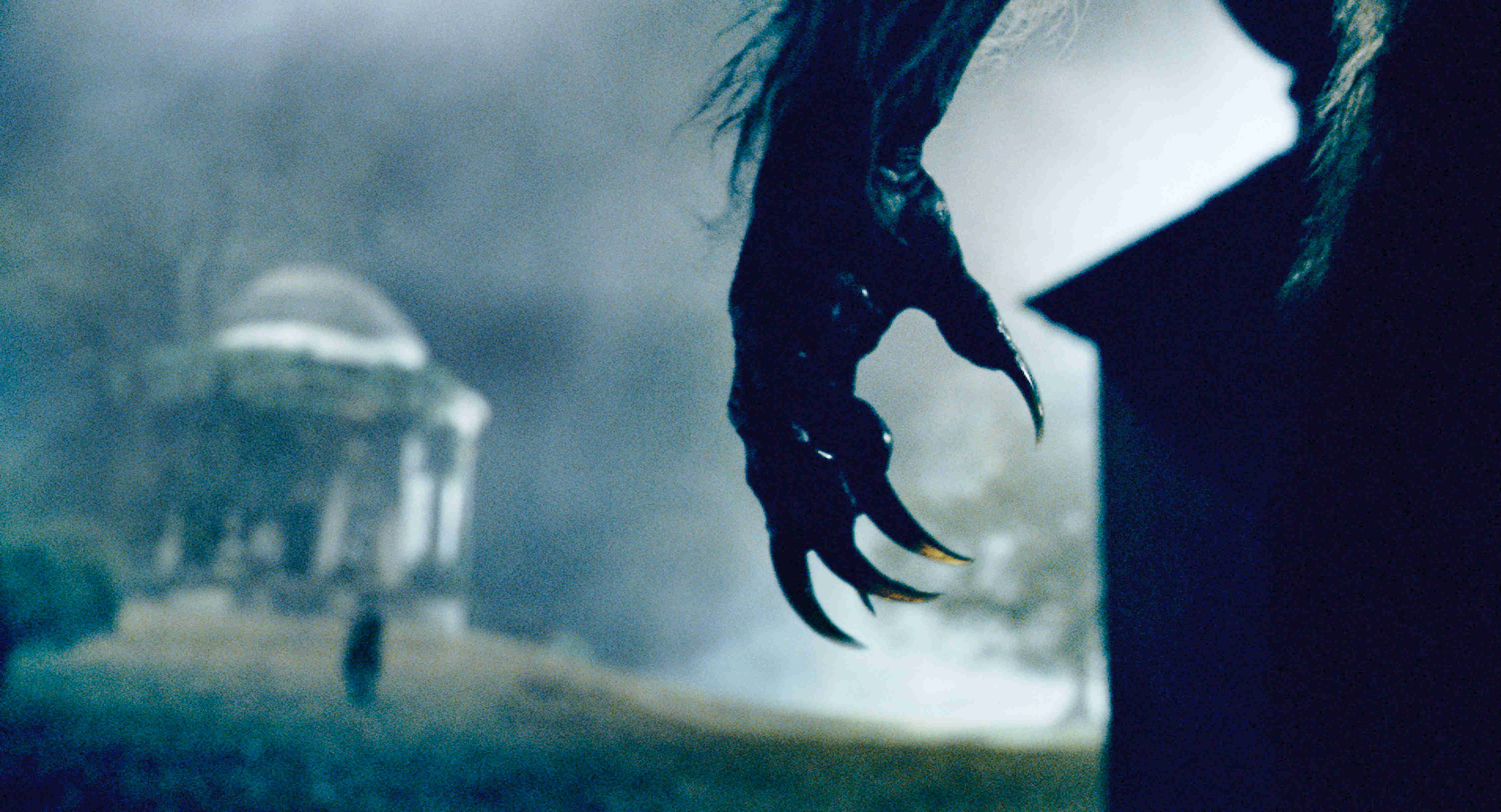
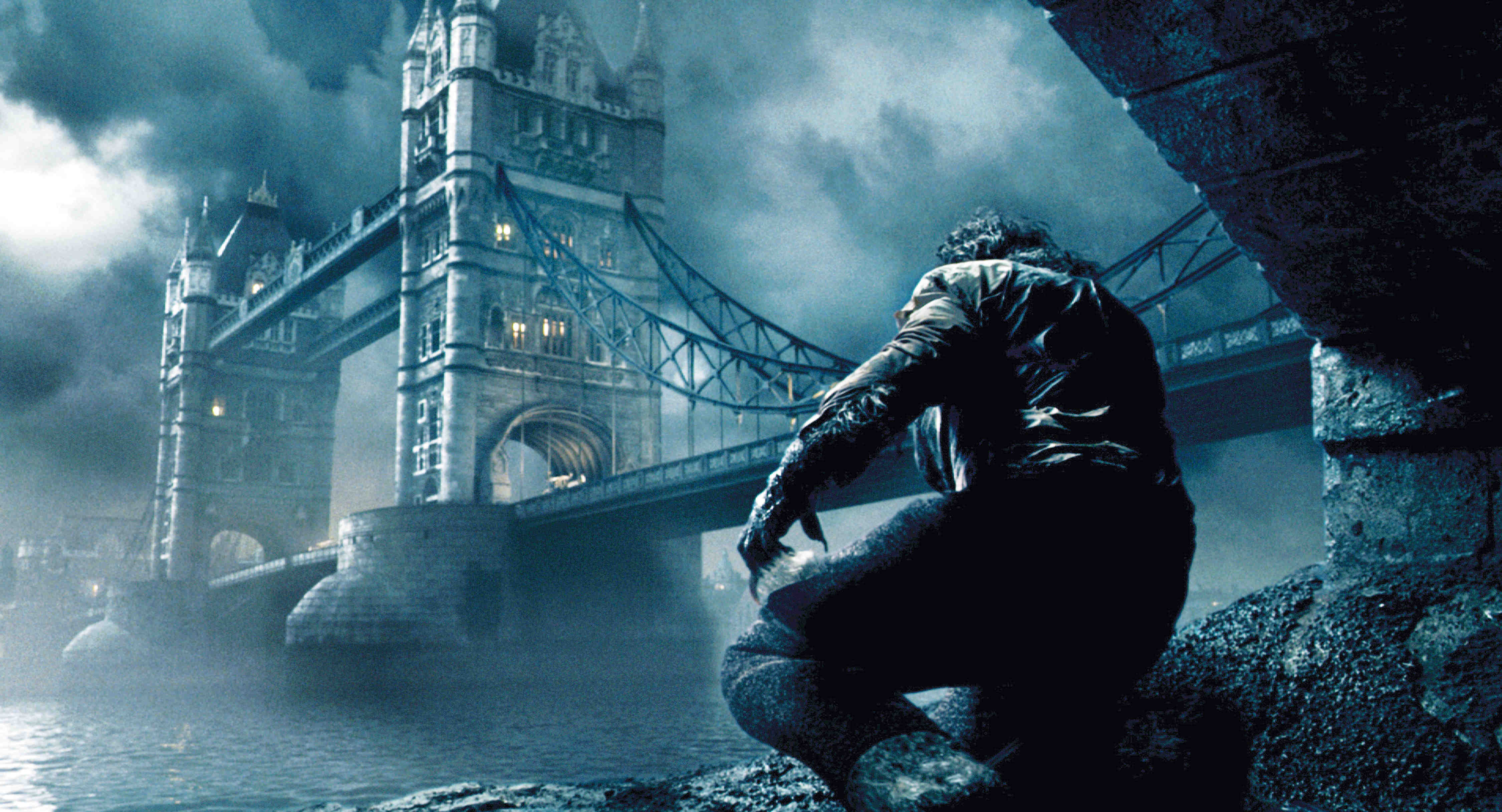
Well, I was just riffing on Nick Lowe’s “The Beast in Me” in my review of 44 Inch Chest a few days ago, and perhaps I should’ve saved it for this film, which takes the same idea all too literally. And yet, Lowe’s exemplary tune deserves better than to be linked to this severely flawed retread, so I probably made the right call. With all due respect to my man Berkeley — no offense intended, l’il buddy — sadly, Joe Johnston’s take on The Wolfman is a bit of a dog. In short, it’s exactly the sort of big budget, never-gelling misfire one would expect to get dumped in mid-February. (Let’s hope the same doesn’t hold true of next week’s Shutter Island.)

I should say up front that, while I’m the first to admit the vampire genre is completely played out at this cultural moment, I’m usually more of a Team Edward man when it comes to the classic movie monsters. With the notable exception of An American Werewolf in London and arguably that saucy, vaguely spastic Shakira video, I’ve never really been one for the lycanthropes. So, when it came to this top-of-the-line, period-faithful reboot of the werewolf fable, I wasn’t really looking for anything more than a passably entertaining B-movie out of the affair. (Put another way, I had no real wolf in this fight.)

Unfortunately, Joe Johnston’s Wolfman doesn’t get the job done even by that measly standard. I was hoping it would at least possess some of the ribald, over-the-top, campy fun of Francis Ford Coppola’s Dracula, which also featured Anthony Hopkins — there at his absolute hammiest. But this somehow turned out more like Kenneth Branagh’s Frankenstein — staid, stilted, and dull. This is in no small part due to the sloppy Andrew Kevin Walker/David Self script (the former of Se7en and Sleepy Hollow, the latter of Road to Perdition), which seems to be missing quite a bit of connective tissue — The movie just jumps haphazardly from beat to beat.

Moreover, as per Walker’s m.o. in particular, everybody’s far too grim-faced through this retelling. Ok, sure, if done well, this would be a horror story through and through. But this Big Bad Wolf is never once frightening, and all the entrails and viscera attending each graphic disembowlment can’t make up for that unfortunate fact. And yet, the movie doesn’t swing far enough in the other direction either. I mean, we have Anthony Hopkins and his Sikh manservant here, for Pete’s sake. And yet, even when the story moves to a Victorian-era asylum run by a Paul Reubens lookalike, there is no Joy in Mudville — it’s all sloppy dream sequences and abject medical horrors out of From Hell or a Cronenberg movie. So the film fails to find its camp side either.

Part of the overarching problem with The Wolfman is the stakes are unclear. Who exactly are we meant to be rooting for here? On one hand, we have thespian Lawrence Talbot (Benicio del Toro — he’ll flip ya for real), who — at the behest of his late sibling’s fiancee (Emily Blunt, phoning it in) — has returned from America to the moors to investigate his brother’s horrible death, and maybe reconcile with his whos-more-grizzled father (Hopkins) in the process. Spoiler — Talbot eventually becomes the wolfman (as back in 1941), and is none too happy about his midnight prowlings.

But then we have Detective Abberline of Scotland Yard (Hugo Weaving), who missed out on the Ripper and now wants to stop this rumored beast before he kills again. But he’s just enough of a jerk, particularly later on in the story, that one kinda wouldn’t mind seeing him on the wrong end of the fangs regardless. Other than that, and aside from Geraldine Chaplin showing up to offer a touch of class to the proceedings, there’s just a bunch of peasants and villagers out of stock British casting — sometimes even with torches and pitchforks in hand — who are basically little more than werewolf fodder.

The upshot being, every time the wolf must feed, there’s no real fear or excitement to be had, since we’re not particularly concerned about anyone’s well-being here. So, to review: The film isn’t scary, it isn’t fun, and it isn’t even exciting. And by the time [sizable spoiler, albeit one fully indicated by the trailers] it turns out Pa Talbot has a touch of the moon-madness too, the overarching story has become quite stupid. In fact, the final lobo-a-lobo — think Ang Lee’s Hulk — may constitute a new low for the werewolf kind, were it not for Underworld and likely whatever embarrassing shirtless shenanigans are going on over in the Twilight-verse.

So, anything good here? Well, the gaffers definitely brought their A-game, and power to them for that. (I’m not even being flippant — there’s some great work with shadows here.) Even the lighting aside, the movie does look quite good, although the recent Sherlock Holmes reboot stole much of The Wolfman‘s Victorian-era thunder in that regard. Joe Johnston nicely frames some very iconic shots of the werewolf in question (even if, sadly, the CGI and Rick Baker make-up often don’t mesh so well), and I liked that the movie played up the “lunatic” angle — the moon is a harsh mistress here, no doubt.

Finally, while I expected going in that Hopkins would be in full-on Pacino mode in terms of scenery-chewing here, and that Weaving would turn out to be the film’s secret weapon, it turns out I was quite wrong. Frankly, Weaving seems bored here, even coasting somewhat. While Hopkins, to his credit, actually even underplays his thankless role at times. Unlike most everyone else involved, he sometimes manages to give this otherwise-forgettable iteration of The Wolfman real claws.

God Help the Beasts in Us.


Take one low-rent apartment on the wrong side of London. Add the two most woefully underused actors in Indiana Jones and the Last Crusade. Throw them together with the two most libertine Americans in Paris, circa 1784. Then add a sizable dollop of (Big Gay) Al Swearingen and what do you get? Why, enough bottled-up testosterone to kill a small horse, naturally.

Well, that and Malcolm Venville’s very theatrical-seeming 44 Inch Chest, a play-like disquisition on primal, wounded masculinity-in-early-winter brought to you by Louis Mellis and David Scinto, the writers of Sexy Beast. (In fact, by the transitive property of fandom, I could’ve opened this review instead with 2/3rds of Beast + 2/3rds of Paris, 1784 + a very ornery Winston Smith, most definitely post-Julia, and the math still works out.) Put in brief, this film was aptly summed up by David Edelstein in one sentence: “It starts to feel less like a thriller than an actors’ workshop.” That’s very true, but, ah, what actors they are.

Edelstein is entirely correct that 44 Inch Chest is mostly all dressed up with no place to go. More than anything, this film just tries to convey a mood of wallowing in the wounded male id for 90 minutes, and the movie ultimately has so little to do that it eventually starts adding random, ill-thought-out dream sequences and clips from the 1944 version of Samson & Delilah just to pad the running time. Still, much like The Men Who Stare at Goats, I’m inclined to forgive a movie some serious flaws if I enjoy the company of the actors involved. And, in that sense, I’ll concede to having a better time at 44 Inch Chest than it probably deserved.

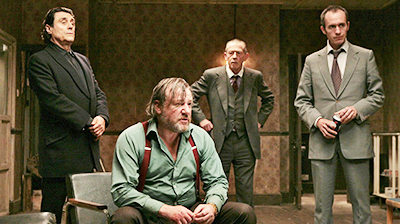
The story here is very simple: Colin Diamond (Ray Winstone) is a broken man. His beloved wife of 21 years (Joanne Whalley) has not only fallen out of love with him, but betrayed him with a handsome French waiter (Melvil Poupaud, who took the same situation much more sanguinely in A Christmas Story.) And now he’s a weeping, blubbering, suicidal, homicidal mess. So much so that his four best mates — amiable Archie (Tom Wilkinson), suave Mal (Stephen Dillane), the happily out Meredith (Ian McShane), and the vindictive Old Man Peanut (John Hurt) — decide to take drastic action.

They capture “Loverboy,” throw him in a wardrobe in the aforementioned rundown flat, and wait around for Colin to exact his revenge. And if he won’t “man up” enough to get the dirty deed done, well, somebody else will have to step in to do it. Because, in this day and age, and men being what they are, cuckoldry is a crime against nature that simply cannot go unavenged. As this crew tell us time and time and time again, usually using even more colorful language, “you just don’t f**k another man’s wife.” But, to paraphrase the inimitable Lloyd Dobler, if these guys know so much about women, how come it’s 3am at the London equivalent of the Gas-and-Sip, and there are absolutely no females around?

If this all sounds like a Harold Pintery, foul-mouthed cockney version of those egregiously mook “men under the gun” Superbowl ads we were regaled with last weekend, well, maybe we’re sorta in the same ballpark. But I would qualify that. First off, just as NIN’s Pretty Hate Machine or, say, (500) Days of Summer capture some of this angst on the young-man side, 44 Inch Chest is really less about misogyny as a dubious lifestyle choice and more just about Men of a Certain Age being burned alive in the horrible flames of thwarted love. Put another way, this movie is a pretty exact cinematic equivalent of Tom Waits’ towering “Make it Rain” or Nick Lowe’s “The Beast in Me” — which, as you know if you have one, is “restless by day, and by night, rants and rages at the stars…(God help the Beast in Me.)

And speaking of the Beasts in Us, the Sexy Beast influence is pretty strongly felt throughout this movie, and not just because Winstone, McShane, and countless iterations of the C-word are back. Most obviously, John Hurt is now in the over-the-top Ben Kingsley role (also appropriated by Ralph Fiennes in In Bruges), and he has a good deal of fun with it. But other elements of Sexy Beast also came to mind throughout Chest — the dream sequences (better executed in Beast), the men-writhing-underwater bank heist (surely a good visual metaphor for the delving into the male id here), and, maybe most notably, Gal’s memorable profession of love over the phone from London: “I love you like a rose loves rainwater, like a leopard loves its partner in the jungle, like…I don’t know what like.” (And, come to think of it, Sexy Beast has a cuckolding subplot too, with Aitch, Don, and Jackie.)

To be clear, Sexy Beast is, by all accounts, a much better and more interesting film. (It made #29 on my Decade top 100.) But, even though this movie doesn’t really work on its own, I enjoyed 44-Inch Chest as sort of an extended, actors-studio riffing on the same themes. For all the posturing machismo in both movies, Chest and Beast are really both about closet romantics bottling up their feelings behind a tough guy veneer, and the awful consequences that arise when those feelings finally, irrevocably spill out. (In addition, both films feature crimes of passion, and here Winstone is even more tortured by his horrible deed as he is his initial predicament.) To put it another way, 44-Inch Chest is Sexy Beast with its leg caught in a coyote trap, gibbering and howling into the wind in primal misery.

Now, if you haven’t seen Sexy Beast, and don’t much feel like dwelling at length about the similarities, I’ll leave it at this: 44 Inch Chest is basically a filmed play about manliness-gone-sour that’s far too meandering after awhile, and it completely loses the thread in its last half-hour. Still, to my mind, there are worse ways to pass the time than seeing Ray Winstone sweat out several choice monologues, a snarling John Hurt getting to chew the scenery for once, Ian McShane deadpanning a few choice quips, and Stephen Dillane stealing several scenes just by his very presence. (Wilkinson, for his part, should’ve been given more to do.)

This, by the way, is the same trick Dillane often pulled on poor Paul Giamatti in John Adams. Give Mr. Jefferson his due — he might just be operating at a Tony Leung threshold of cool right now. The guy needs more parts and stat…and he’d make a great Doctor when Matt Smith retires the police box

Roman Holiday…

…or not. Also in the trailer bin, Michael Fassbender, Dominic West, Noel Clarke (i.e. Doctor Who‘s Mickey Smith), and a host of other Roman legionnaires find themselves behind enemy lines and surrounded by angry Picts of some kind in the new trailer for Neil Marshall’s Centurion, also with Olga Kurylenko (who really should’ve gotten Scarlett Johannson’s part in Iron Man 2.) Well, ok then. Here’s hoping Marshall squeezes in a good Asterix and Obelix cameo.

Time Waits for No Toy.

Old toys never die, they just lose their accessories. In the trailer bin, Buzz, Woody and the gang suffer the inevitable indignities of castoffhood in the brand-new trailer for Lee Unkrich’s Toy Story 3. So far, so good, and Pixar hasn’t really led us astray yet. Still, it could be the concussion talking, but I’m finding the pastel color palette of this flick really rather headache-inducing.

The Sweet Hereafter.

That other “vaguely religious-themed movie” I mentioned I saw between The Book of Eli and Legion? That would be Peter Jackson’s well-meaning, meandering adaptation of Alice Sebold’s The Lovely Bones. And in all honesty, given the atrocious reviews it received, The Lovely Bones was better and more enjoyable than I had feared going in. Still, it works better as What Dreams May Come-style eye candy than as a movie on its own terms.

Put simply, the main problem here is the source material. Even more than John Hillcoat’s take on The Road, which I thought was an admirable adaptation of a so-so tome, The Lovely Bones the movie is, imho, about a good a film as you could make from such a lousy and overrated book. Now, I understand Sebold’s novel has spoken to a lot of people. But I am not one of those people. I found it to be ghastly, overwritten. Oprahesque nonsense, and finishing the durned thing felt like a chore. And even with PJ at the helm, sadly, The Lovely Bones remains several hours of mostly needless despair-pr0n.

If you haven’t read the book, the gist is this: It’s early December, 1973, and our 14-year-old narrator, Susie Salmon (here, a very good Saiorse Ronan, formerly of Atonement), one day makes the mistake of following her creepy neighbor (Stanley Tucci) into his newly-constructed evil underground lair. There, she is raped and murdered. (This grisly event takes us to about page 20, iirc.) Susie goes to Heaven — or a Heaven-like Limbo, in any event — while her family grieves and gnashes and laments and wails for 300 pages. Oh, and eventually there’s some ghost sex. Yes, really.

Fair enough, but how do they gnash and wail? Well, Ma Salmon (Rachel Weisz) refuses to deal with the loss and its consequences — She turns Susie’s room into an untouched tomb, has an escapist affair with the detective on the case (Michael Imperioli), and eventually runs off to pick grapes somewhere. Pa Salmon (Mark Wahlberg) handles it even worse — The murder upsets his primal sense of order about the universe, and he obsessively tracks down the killer on his own for years to come. Grandma (Susan Sarandon) moves in to try to fill the void left by the distant parents, when she’s sober. And Susie’s siblings, Lindsey (Rose McIver) and Buckley (Christian Thomas Ashdale), grow up and live their lives, although Lindsey has some sneaking suspicions about the creep next door…

Peter Jackson and his LotR writing team (Fran Walsh and Philippa Boyens) have made a few changes here and there. Most notably (and very thankfully), Susie’s rape is now only vaguely implied rather than shown. (To those who question this change, I’m with Ronan: What in blue blazes is wrong with you?) Here, Susie’s murder is quite gracefully handled, although I could’ve done with less spider-toying-with-the-fly type stuff before the horrible deed is committed. And Ma Salmon’s romance with the detective is gone — now it’s just occasional long looks. Otherwise, they follow what I remember of the book pretty closely here.

Which is a lot of the problem. Like the book, The Lovely Bones is mostly inchoate and shapeless. As in the novel, there’s no real through-line or sense of momentum in the story. It moves without purpose — Time passes, stuff happens. Look, Susie is playing in her beautiful heaven…oh wait, she’s sad…hey, let’s have a grandma montage…ok, Tucci is still creepy…hey, look, more heaven….oooh, Marky Mark is on the warpath…and so on. I suspect folks who complain about the last thirty minutes of Return of the King will not have much fun with this one — the whole movie has that languid, meandering, “oh and another thing” feel to it.

That being said, The Lovely Bones is quite pretty to look at. (Thanks, Team WETA!) Despite the awfulness of the subject matter, Bones has a very crisp and colorful presentation that soothes the eye even as the story bogs down. And the performances are all pretty good here — especially Ronan — with one minor exception. His Oscar nod aside, Stanley Tucci is probably the weak link here. Like Peter Sarsgaard in An Education, he’s way too much of an off-putting mouth-breather to take seriously. Playing the killer as more sociable and self-assured — like Bernard-Pierre Donnadieu in the original version of The Vanishing — would’ve added a lot more menace to this thankless character.

So, given what he had to work with here, I thought Peter Jackson et al actually turned in a pretty quality product. (The real problem was trying to adapt Sebold’s book in the first place.) So, no harm, no foul, so to speak: The Lovely Bones is by no means a bad movie — It just sorta is. If you really want to see Peter Jackson tackle a story involving fantastical visions, teenage girls, and unspeakable acts of murder, I’d recommend his earlier classic, Heavenly Creatures. As for Bones, my thoughts on it are pretty much akin to my sneaking suspicions about a film I haven’t yet seen, Lee Daniels’ Precious. In this world, sadly, really horrible things happen to good and innocent people every single day…but that doesn’t mean we have to wallow in the fact.

Na’vi vs. the IEDs.

Y’all are probably on top of this by now, but the 2010 Oscar nominations were announced this morning, and the big fight of the evening looks to be blue cats versus bombs: Avatar and The Hurt Locker led the pack with nine nominations each. (Before the meme sets in, it should be noted that former married couple James Cameron and Kathryn Bigelow have been very supportive of each other’s films from the start.) Anyway, some quick thoughts:

  • Best Picture: Avatar. Out of the ten nominees, it’s a two-movie race, and this particular picture didn’t even make my personal top 20 for last year. There might even be a King of the World backlash after Titanic running the table in 1998. But I’m guessing, given its box office, that Dances With Thundersmurfs (in 3D) will win this pretty easily. Still, it’s nice to see A Serious Man and District 9 get their due. The biggest WTF here is The Blind Side. C’mon now, really?

  • Best Actor: Jeff Bridges, Crazy Heart. Oscar got four out of five right (Jeff Bridges, Colin Firth, George Clooney, Jeremy Renner), and of those, I’d probably go with both Firth and Renner over Bridges. But, if I had my druthers, Sam Rockwell would have been nominated and won for Moon. (He should’ve taken Morgan Freeman’s Invictus spot.) Anyway, I’m guessing Bridges is a lock.

  • Best Actress: Carey Mulligan, An Education. Unless voters factor in her youth against her, I’m going with Sally Sparrow. I haven’t seen any of the other films in contention in this category, but I’m guessing Helen Mirren (The Last Station) and particularly Meryl Streep (Julie & Julia) will be considered already amply rewarded, and Gabourey Sidibe (Precious) will lose votes on account of…

  • Best Supporting Actress: Mo’Nique, Precious. I haven’t seen the film, but from what I can gather, this is a lockity-lock. Given that the Up in the Air vote will split between Vera Farmiga and Anna Kendrick, the only real competition is Maggie Gyllenhaal for Crazy Heart. (Consensus seems to be Penelope Cruz (Nine) has been nominated for the wrong film, and she should be here for Broken Embraces.)

  • Best Supporting Actor: Christoph Waltz, Inglorious Basterds. Like the rest of the categories above, this seems pretty set to me already. With the possible exception of Woody Harrelson for The Messenger, it’s hard to imagine any of the others getting close.

  • Best Director: Kathryn Bigelow, The Hurt Locker. The consolation prize to losing Best Picture to Avatar, this Oscar will be richly deserved.

  • Best Animated Film: Up. Again, seems like a lock, given that it’s the only nominee also listed in the Best Picture category. Still, I’d rather see this go to Coraline or The Fantastic Mr. Fox.

  • Writing (Adapted Screenplay): This one’s more of a toss-up, and I get the sense it will probably end up being my bracket-buster. I kinda feel like I have to pick In the Loop, my favorite movie of 2009. But I could also see this being where District 9 or Up in the Air get their recognition for the evening. (Precious too might be a contender, but, again, will likely lose some votes on account of the Mo’Nique lock.)

  • Writing (Original Screenplay): Mark Boal, The Hurt Locker. I’m glad to see the Coens on here, but they’ve won this before, as has Quentin Tarantino.

  • Documentary Feature: The Cove. I want to see several of these, particularly Daniel Ellsberg: The Most Dangerous Man in America. But all word seems to point to dolphins in peril.

  • Foreign Language Film: The White Ribbon. Haven’t seen it yet, but I haven’t heard any other contender mentioned as often.

  • Music (Original Song): “The Weary Kind,” Crazy Heart. Take it to the bank.

  • Music (Original Score): Probably Up. It won the Globe, and it’s the only one of these films whose score I can even vaguely remember.

  • Costumes: It sounds like a two-movie race between Coco Before Chanel and Bright Star, although I personally wouldn’t mind seeing this go to Imaginarium of Dr. Parnassus.

  • Make-up: Really weird category this year. Of these three, I’ll guess The Young Victoria edges out Star Trek.

  • Technical Stuff: With the possible exception of Editing and maybe Cinematography (The Hurt Locker), I’m thinking all of this goes to Avatar.

They Kick Ass for the Lord!

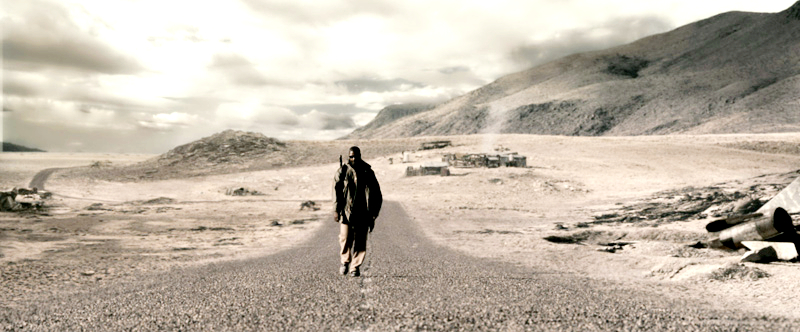
(With all apologies to Father McGruder.) Yes, y’all, the End of Days has come. There is a hole in the sky. John Cusack is off floating on his ark. Hobo Viggo and son are somewhere on I-95, “carrying the fire.” And, for their part, bad-ass evangelist Denzel Washington is apparently the last Jehovah’s Witness on Earth, and the fallen angel Paul Bettany is trying to take his broken wings and learn to fly again. (Did you know that every time a bell rings, an angel is shooting somebody in the face?)

In any event, I saw Allen and Albert Hughes’ The Book of Eli and Scott Stewart’s Legion on subsequent weekends (with another vaguely religious-themed movie in between, which I’ll get to in a bit), and they seem like they merit discussing together. Both are post-apocalyptic B-movies, and, weirdly enough, that’s B as in Bible: Both use Judeo-Christian themes as a pretext for ninety minutes or so of Matrix-y ass-kicking. And neither are as smart, entertaining or satisfying in their B-movieness as the Spierig’s recent Daybreakers. Of the two, Legion probably comes closer to finding that popcorn movie groove, just because it makes no bones about being unabashedly dumb — but it too slips off the rails in the final half-hour.

More on that in a bit. Let’s take the Hughes’ Book of Eli first. I should start by saying that I’m glad to see the Hughes brothers making a movie again, although I wish it was one a good deal better than this goofy drek. Their assured, eminently quotable 1993 debut Menace II Society is one of my favorite films of the nineties, and in a perfect world it should have gotten all the many props that went to John Singleton’s more Hollywood’y Boyz n the Hood of 1991. (“Now O-Dog was America’s worst nightmare: Young, black, and don’t give a f**k.“) And their take on From Hell in 2001 was laudably strange and decently compelling — It’s definitely not the worst Alan Moore adaptation out there, by a long shot.

To their credit, the Hughes give this post-apocalyptic America a bleached-out, Big Sky look that’s eye-catching…for the first half-hour of so. (After awhile, there get to be way too many slo-mo hero shots of Denzel and his eventual protege, Mila Kunis.) And, during that opening half-hour, it seems like Book of Eli might make for a pretty solid spaghetti western or samurai flick. There are two kinetic six-or-seven-on-one melees in particular, wherein a motley assortment of Borderlands-style goons and Mad Max castoffs meet the business end of Denzel’s machete, that suggest The Book of Eli will make for a pretty fun B-movie ride.

But then it all starts falling apart, mainly as a result of terrible writing. For it soon becomes clear that Denzel, a.k.a. Eli, is attracting attention in this World Gone Wrong because he is carrying — I kid you not — the Last King James Bible on Earth. Yes, somehow — only thirty years after the nukes fell — every single bible out of every single house, apartment, bookstore, mega-mart, and motel room on the planet has been destroyed…but one. This is apparently, it is said, because the survivors blamed the Bible for the End Times coming and destroyed them all. How the few remaining survivors managed to relay this message all around the world after communications had stopped is left unexplained. Nor do they show the poor irradiated schmoes who were forced to wander from burnt-out church to broken-down motel over those thirty years, scouring the Earth for the estimated 7.5 billion copies of the world’s most reproduced book. And they only missed one!

But that’s not all. So, Denzel is toting around that last Good Book, and the Big Bad of the local Bartertown — Gary Oldman — wants its immense persuasive power for his own. I forget the exact wording, but he does some monologuing to the effect of: Only with that bible in my possession will I have the words to exert my domination over the remnants of humankind! So, in other words, if he gets the Book under his thrall, Oldman will be the new prophet-king of social control. To which I say…huh? First off, at the risk of offending certain readers’ religious sensibilities — move along, Tom Cruise — hasn’t Oldman’s character ever heard of L. Ron Hubbard or Dianetics? (Or seen Zardoz, for that matter?) If you want to set up a new religion with yourself at its center, you don’t really need a KJV bible to do it. Second, it’s made abundantly clear that Oldman knows the bible pretty well from his early days anyway. He can’t just…wing it? How much more would you need other than the stories, which everybody knows, and a few choice excerpts like the Lord’s Prayer?

Not to give the game away, but The Book of Eli also suffers from a truly dumb Shyamalan ending which I will not disclose here. (Suffice to say, A Clockwork Orange notwithstanding, Malcolm McDowell showing up in the late going of any film isn’t usually a mark of quality. And if you really want to know the final turn, I’ll give a hint in spoiler-vision: “What do Rutger Hauer and Zhang Ziyi have in common?“) Now, to be fair to The Book of Eli (and as an AICN commenter pointed out), a lot of sci-fi and fantasy B-movies have plot devices that make it hard to sustain disbelief — time-traveling robots from the future, for example. True, Eli‘s central conceit is roughly similar to the plot of the very good A Canticle for Leibowitz (although that book takes place centuries after the nuclear holocaust, and the Catholic priests involved aren’t trying to preserve the Bible per se.) And, even the next movie I’m about to discuss makes less sense up front than Book of Eli‘s goofy “all the Bibles are gone!” schtick.

The difference is, in those other movies (Legion aside), once you accept the premise that robots can time-travel, Earth is now populated by damn dirty apes, vampires have taken over or whathaveyou, the rest of the story makes decent sense in that world, and is pretty darned entertaining to boot. The Book of Eli…not so much. For one, Denzel’s character is too superhuman throughout — After the first few fracases, there’s no sense at all that he ever might be in danger. More problematically, perhaps realizing that fundamental problem, the screenwriter (Gary Whitta) instead decides to punctuate pretty much every scene with women in sexual peril, a decision which is supremely lazy and, after awhile, borderline misogynistic. (Were you to play a drinking game involving one beverage for every time Mila Kunis, Jennifer Beals, or any other woman in The Book of Eli is threatened with rape or violence, or those threats are acted upon, you may just end up drunk enough to stop wondering what the hell is wrong with Gary Whitta.)

Anyway, all that aside, there are a few small glimmers of entertainment here and there in the later going, although they’re mostly meta moments: Michael Gambon and Frances De La Tour escape Hogwarts long enough to show up as gun-totin’ redneck cannibals, and both play it like they’re on some kind of dare. And Dracula does get to share another scene with his Renfeld, the inimitable Tom Waits. (Oldman and Washington are professionals anyway — neither condescend to this lousy material.) In the end, though, The Book of Eli is a bad movie with a dumb premise that doesn’t even seem to understand how bad or dumb it is. And that ultimately just makes it worse.
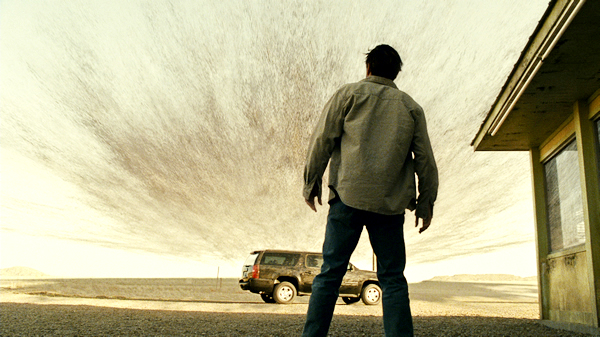

Now Scott Stewart’s Legion, on the other hand, wears its B-movie badness like a badge of honor, and that gets some points from me. I mean, Dennis Quaid and Charles Dutton as two short-order cooks, fending off demons in their middle-of-nowhere diner (in a place called Paradise Falls, no less)? These guys are hardened veterans of this sort of thing. They know the score, and they help bring the right sense of proportion to the rest of the survivors, including Adrianne Palicki, Tyrese, Kate Walsh, Willa Holland, and the underrated Lucas Black (who, on Sling Blade alone, really should’ve played Jake Lloyd’s part in The Phantom Menace.) In every scene they’re in, Quaid and Dutton manage to wordlessly convey their understanding that: Look at best, we’re making Tremors here, people.

In Legion, the End of Days wasn’t a man-made screw-up this time. Rather, in a fit of Old Testament wrath, our Father who art in Heaven decides that the whole mankind experiment has totally and utterly failed (maybe He caught wind of the whole reality-TV thing) and thus sends down a few plagues — locusts, angels, and whatnot — to smote us all into oblivion. Fortunately for us, the archangel Michael (Paul Bettany) isn’t down with the new program, and so he clips his wings, dons some choice duds and a ridiculous amount of firepower, and becomes humankind’s protector, or at least the protector of an unborn child that apparently will be some kind of second Messiah. (Think John Connor, but biblical.) And if he can save a few diner patrons while he’s at it, well the more the merrier.

So, in other words, if The Book of Eli was a post-apocalyptic western — a Stranger comes to Town and all that — Legion is really more of a zombie movie. It’s a bunch of random strangers thrown together by crisis, trying to survive against impossible supernatural odds without killing each other. Or, in other words, it’s The Prophecy meets Night of the Living Dead meets The Terminator meets Assault on Precinct 13. (At times, it also feels a lot like the considerably better Prince of Darkness, but without Alice Cooper around to play the possessed folk.) And, even more than with Eli, I vibed into its flagrant b-movieness for the first hour or so of its run.

The problem is, Stewart and co-writer Peter Schink don’t really seem to know where they want to take this thing. You know that old saw about throwing a bunch of characters together in a room and pretty soon they start to write themselves? Well, if Legion is any indication, sometimes they don’t. And so the movie starts to lose its early head of B-movie steam by the middle going, as the various survivors pair off and spin their wheels with “character-building” conversations that go nowhere. There are a few funny exchanges, most of which made it into the ubiquitous trailer. (“I don’t even believe in God!” “That’s ok, He doesn’t believe in you either.“) But even more than in most of these flicks, I found myself sitting around waiting for the next attack just to get things moving once more.

And that brings us to the other big problem. The ground rules here don’t make a whole lot of sense. So these zombies are angels? Clearly, gunfire cuts through them like butter, so they don’t seem any different from, you know, zombies. And why are they attacking in waves like this? What’s the plan here? I know the Lord works in mysterious ways, but…is He really one for acid-drenched booby traps? Schink and Stewart have one clever conceit here — that the most innocuous-looking people around are the ones you’ll really need to worry about to go bugnuts evil at the drop of a hat. But they just keep reusing it. When an old lady attacks (again, as per the trailer), it’s a clever reversal of expectations. But when little kids and the ice cream man later do the same, it all gets a bit redundant.

By the time the archangel Gabriel (Kevin Durand, seeming, in all honesty, pretty straight-to-video) shows up in the last half-hour, Legion just gives up any pretense of coherence. I can barely explain anything that happens after the remaining few souls scramble out of the diner, other than to say it really isn’t worth trying to explain anyway. To its credit, Legion may not suffer from the dreary self-seriousness of The Book of Eli, but the last reel is just as convoluted and nonsensical. And, as such, both movies end up feeling a bit like the lurid daydreams of an ADD-afflicted teenager, one who’s fallen asleep after way too much Red Bull, Bible Study, and Modern Warfare 2. It’s time to wrap this up, so if you’ll forgive a really terrible pun: Lacking conviction and passionate intensity, sadly, neither of these flicks are worth a second coming.


The Biggest Loser(s).

Ok, so there definitely is a Plan B. In the trailer bin this week, the Comedian, Stringer Bell, Johnny Storm, and Neytiri, among others, give The A-Team a run for their money in the trailer for Sylvain White’s The Losers, based on the DC comic and starring Jeffrey Dean Morgan, Idris Elba, Chris Evans, Oscar Jaenada, Columbus Short, Zoe Saldana, Jason Patric, and Holt McCallany.

And, speaking of big losers, Gordon Gekko has done his time and wants back in the big game — maybe with a new cellphone — in the teaser for Oliver Stone’s Wall Street 2: Money Never Sleeps, also with Shia LaBoeuf, Carey Mulligan, Josh Brolin, Eli Wallach, Susan Sarandon, Vanessa Ferlito, Frank Langella, and — word has it — Charlie Sheen. Might have to give the first one another whirl beforehand.