For Once, Accountability.

“‘This case is a message from the people of the state of Texas that they want – and expect – honesty and ethics in their public officials,’ said Travis County District Attorney Rosemary Lehmberg. ‘All people have to abide by the law.‘”

Some heartening news that dropped over Thanksgiving vacation: A jury of his peers found Boss DeLay guilty of money-laundering. “Punishment for the first ranges from five years to life in prison, but the former congressman from the Houston suburb of Sugar Land could receive probation…Reporters in the courtroom described DeLay as stunned by the verdict, which came after 19 hours of deliberation.

At this point, I’m cynical enough to think that DeLay will eventually find a way to get this conviction overturned on appeal — particularly given the fact that his defense began with a huge blunder. Still, at least for one day, it was great to hear that Boss DeLay was finally called out for his crimes.

Nowhere is Safe.


When reading the seventh and final Harry Potter tome in 2007, my sense was it felt more like a scriptment than a novel, and, tho’ often clunky as a book, it would probably work better as a movie a few years down the road. And, hey, I was right! (At least so far.) Even though it’s only half the story, and the leisurely camping half at that, David Yates’ Harry Potter and the Order of the Phoenix Part I is easily one of the best films in the series — perhaps the best, if you prefer your Potter relentlessly dark. (I know Cuaron’s Azkhaban has a following, but for me the real competition is Mike Newell’s Goblet of Fire.)

A hardy veteran of Dumbledore’s army at this point — this is his third Potter film in a row after Order of the Phoenix and the Half-Blood Prince — Yates has taken the often-unwieldy wanderings of the first half of Hallows and fashioned a lean, tense, and gripping fugitive story out of them. Better yet, he’s brought a much more palpable sense of danger and darkness to the proceedings. When I read the book, I missed Hogwarts most of the time and wondered why our heroes had to spend so much time camping. Here, the lack of Hogwarts goes unnoticed, and it’s abundantly clear why Harry, Ron, and Hermione spend so much time on the lam — They’re totally under the gun…er, wand.

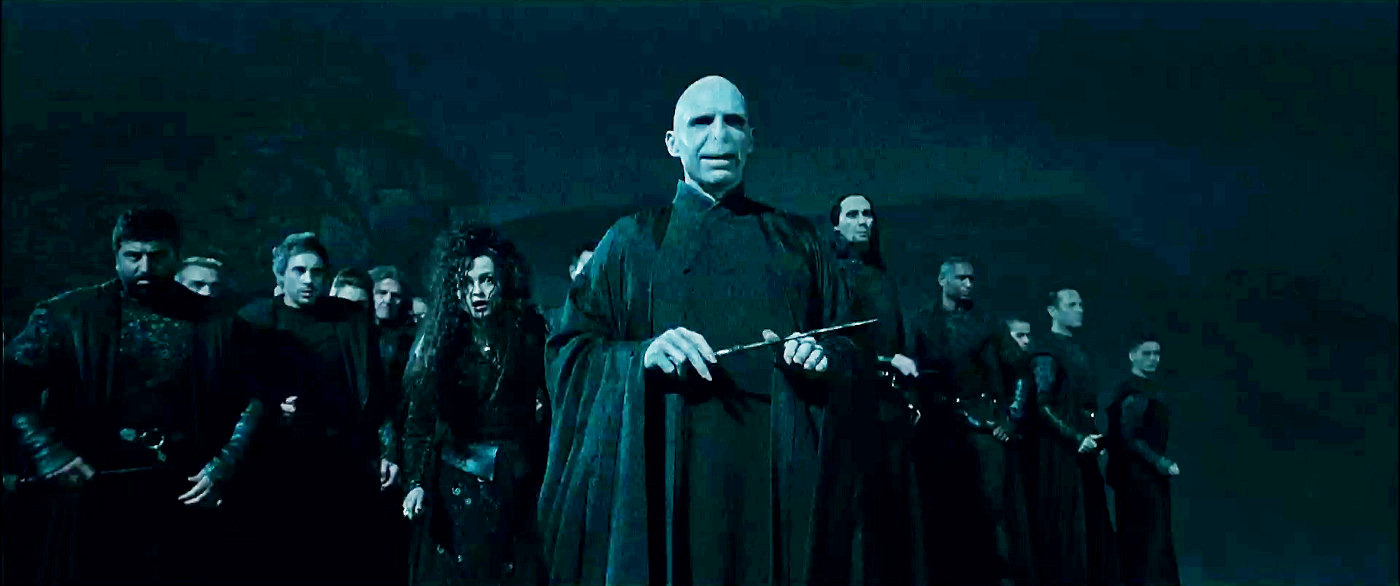
That may be the part that rankles some of the youngest viewers out there, or their parents — From the creepier-than-usual Warner Brothers card on, the gloom here is unrelenting, and almost sadistic. Hallows begins with a Great Eye — that of the Minster of Magic (Bill Nighy), who’s making a Churchillian attempt to rally the wizarding world against the encroaching forces of Voldemort. (Good luck with that.) The Dark Lord (Ralph Fiennes), meanwhile, is entertaining his Death Eater shock-troops with a banquet at the Malfoys — one punctuated by the torture and eventual murder of Hogwarts’ Professor of Muggle Studies. She dies pleading for clemency from her former colleague, Severus Snape. (Clearly, she was new to academe.)

The Big Three are no happier. Harry (Daniel Radcliffe) is packing up and hiding the Dursleys somewhere safe from harm — It’s gotten so bad that he’s even nostalgic about his old room under the stairs. Hermione (Emma Watson) has resorted to wiping her Muggle parents’ minds of her existence. And Ron (Rupert Grint)…well, ok, like his older brothers, Ron is still a bit of a goof (at least until his arm almost gets ripped off in a freak disapparating accident later on.) And this, Ron’s injury notwithstanding, is all before Mad-Eye Moody (Brendan Gleeson) shows up at 4 Privet Drive with an army of returning cast members — or, as anyone who’s read the book knows, cannon fodder.

Granted, these supporting characters aren’t exactly Redshirts — we know most of them from the first six movies. Still, here is one of the situations where, to my mind, the movie rubs up against the limitations of the source material. There’s a line in Red Letter Media’s worthy evisceration of The Phantom Menace where the narrator makes the very valid point: “Qui-Gon Jinn and Obi-Wan Kenobi should have been combined into one character named…Obi-Wan Kenobi.” The same goes for the Potterverse.

By here in Book 7, several thousand pages into the tale of young Mr. Potter, the story is now totally crufted over with narrative stuff. Dozens of characters are running around already, and yet Hallows seems to pile on more every time our heroes get in a jam. (For example, Harry gets a tip from an old journalist friend of Dumbledores, whom we’ve never met, to go visit an old historian friend of Dumbledore’s, whom we’ve never met. Couldn’t one of these just have been Jim Broadbent’s Slughorn, from Book Six?)

We’re equally overstuffed here with magical Maguffins — Seven horcruxes and three hallows, not to mention three gifts from Dumbledore and various other wonderful toys, like Harry’s watchful mirror, Hermione’s infinite knapsack, and a steady supply of Polyjuice Potion. With so many magical items in play, the ground rules get fuzzy, and the sense of danger takes a hit. (Then again, they’re fuzzy anyway — Where can and can’t House elfs go again? And why aren’t our team using that highly convenient Room of Requirement from Book 5 to solve all of their problems?)

Still, one definite bright side of having so many populating the Potterverse is that the series continues to be a welcome full-employment program for British thespians. Bill Nighy and Rhys Ifans (as Xenophilius Lovegood, Luna’s dad) are the most prominent additions to the cast, but there are other fun faces joining the party this time, including David O’Hara (Braveheart) as Harry’s face in the Ministry, Guy Henry (Extras, Rome‘s Cassius) as Voldemort’s puppet minister, and Peter Mullan (Children of Men, Red Riding) as the Death Eater head of security.

On this front, the series is now an embarrassment of riches. When the likes of John Hurt and Miranda Richardson have all of fifteen seconds of screen time, and even the House elves are voiced by names like Simon McBurney (The Last King of Scotland, The Ghost Writer,) and Toby Jones (as Kreacher and Dobby respectively), you know you’ve got a heck of a cast on your ends. And the three kids have grown up to be no slouches in this department either. I can’t tell if they’re great actors, but they’re definitely very good at being Harry, Ron, and Hermione at this point.

So, in the end and despite its narrative over-packing, Deathly Hallows is an entertaining and scary ride with some very memorable setpieces. There’s an animated sequence late in the film that’s as beautiful and entrancing as anything we’ve seen in all seven movies thus far. And I was also fond of Harry, Ron, and Hermione’s assault on the Ministry, packed as it was sly allusions to Terry Gilliam’s Brazil. (Note the big statue, the gaggle of hangers-on breezing by, and Mullan being a man consumed with paperwork.) There’s still a lot of camping here, sure, but at least this time it feels less like aimless meandering and more like an urgent necessity. Let’s hope Yates and co. can land this magical bird in as fun a fashion next July.

Story Matters on A(TV)C.


All in all, these AMC series remind me of American movies made in the early-to-mid-’60s, when Puritanical content restrictions were starting to break down and commercial films were embracing a new frankness, but filmmakers hadn’t yet gone into the ‘anything goes’ mode that dominated the final quarter of the 20th century…[A]s mid-’60s American film demonstrated, there’s more than one way to be ‘adult.’ AMC seems to have realized this and embraced it, and it’s one of the reasons the channel is flourishing.”

Salon‘s Matt Zoller Seitz (formerly of The House Next Door), sings the praises of AMC, home to Mad Men, Breaking Bad, The Walking Dead and Rubicon. I watch all of those except Rubicon, which is still languishing on the DVR for the time being. (Now that it’s canceled, unfortunately, I may never get around to uncorking it. This was also the fate of Carnivale.) As for The Walking Dead, it’s seriously overwritten at times — the sisterly pow-wow about fishing at the top of Episode 4 was just embarrassing — but I’ll stick around through the first season at least.

Countess Dracula Sleeps.


The bats have left the bell tower. The victims have been bled, red velvet lines the black box. Actress (The Wicker Man, Doctor Who), blogger, Den of Geek columnist, and seminal Hammer horror siren Ingrid Pitt is dead, 1937-2010. “She was partly responsible for ushering in a bold and brazen era of sexually explicitly horror films in the 1970s, but that should not denigrate her abilities…All fans of Hammer and of British horror are going to miss her terribly.

A Life in Development.

Next week, Foreign Policy magazine and its editor-in-chief Susan Glasser will be releasing its 2nd annual roster of the world’s greatest thinkers and doers in foreign policy. I have seen the list — and it’s impressively creative and eclectic. There is one name that is not on the FP100 who should be — and that is Chalmers Johnson, who from my perspective rivals Henry Kissinger as the most significant intellectual force who has shaped and defined the fundamental boundaries and goal posts of US foreign policy in the modern era.

The Washington Note‘s Steve Clemons remembers one of his friends, colleagues, and mentors: Asia scholar, critic of empire, and coiner of the “developmental state,” Chalmers Johnson, 1931-2010. (See also James Fallows’ remembrances on his passing.) Argued Johnson in 2009: “Make no mistake – whether we’re being bled rapidly or slowly, we are bleeding; and hanging onto our military empire will ultimately spell the end of the United States as we know it.”

Crime of the Century.


A tale of two financial crimes: After the Savings and Loan Crisis of the late 80’s and early 90’s — a clear consequence of Reagan-era deregulation, by the way — had run its course, 1852 S&L officials were prosecuted, and 1072 of them ended up behind bars, as did over 2500 bankers for S&L-related crimes. But, when a similarly-deregulated Wall Street plunged the US economy into a much steeper recession two decades later…nobody (with the notable exception of Bernie Madoff) went to jail — In fact, it was barely even admitted by the powers-that-be that serious crimes had even occurred at all. So what happened?

That is the stark question driving Charles Ferguson’s well-laid-out prosecutorial brief Inside Job, which works to explain exactly how we ended up in the most calamitous economic straits since the 1930s. If you’ve been keeping up on current events at all, even if by comic books, stick figures, or Oliver Stone flicks, then you won’t be surprised by the frustrating tale Inside Job has to tell. But unlke the more inchoate and disorganized Casino Jack and the United States of Money earlier this year, which ultimately let its subject wriggle off the hook, Inside Job tells its sad, sordid story clearly, concisely, and well.

The central through-line of the financial crisis by now is well-known. Basically, Wall Steet banksters — relying heavily on “market innovations” (i.e. unregulated toys) like securitization, collaterized debt obligations (CDOs) and credit default swaps — spent the first decade of the 21st century engaged in a trillion-dollar orgy of avarice, criminality, and fraud. And, a few prominent casualties like Lehman Brothers and Bear Stearns aside, the perpetrators of these financial misdeeds mostly walked away unscathed from the economic devastation they wrought. In fact, they’re doing better than ever.

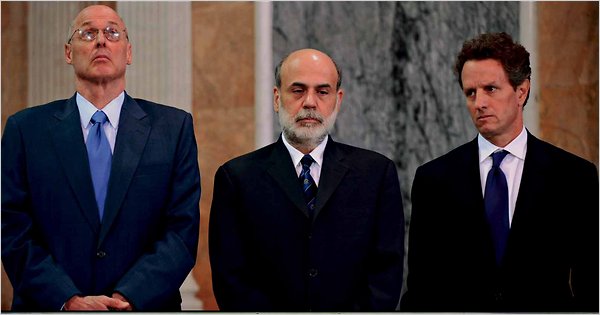
Said banksters got away with this from start to finish mainly becauset they could, thanks to thirty years of deregulation and an absolute bipartisan chokehold on the political process. So, when the bill came due in 2008, these masters of the free market just got the Fed to socialize their losses, thus handing the damage over to the American taxpayer by way of Secretary of the Treasury Hank Paulson (former Chairman and CEO of Goldman Sachs) and his successor, Tim Geithner (no stranger to Wall Street himself.)

As I said recently, my thoughts on the relative necessity of TARP have shifted a good deal since 2008, but, surprisingly, Ferguson doesn’t really get into that debate here. Inside Job is more broad in its focus: It aims instead to show how Wall Street has systematically corrupted both our political process and our economics departments over the course of decades, and nobody is safe from its wrath. Sure, it was probably a tremendously bad idea to let an Ayn Rand acolyte like Alan Greenspan call the shots for the American economy for so long, but he’s just the tip of the iceberg. There are other fish to fry.

After all, it is President Clinton and his financial lieutenants, Robert Rubin and Larry Summers, who preside over the death of Glass-Steagall, the original sin that precipitates all the later shenanigans. It is also they who work to keep prescient regulators like Brooksley Born from sounding the alarm. And, after the house of cards has collapsed in 2008, and President Obama steps up to the plate promising “change we can believe in,” who does he pull out of the bullpen to lead us but…the irrepressibly porcine Larry Summers and Tim Geithner, the Chair of the New York Fed? Meet the new boss, same as the old boss. (But remember, folks, Obama is really an anti-business socialist.)

What goes for the US government goes for the academy as well. As Ferguson shows, Milton Friedman aficionadoes and Reagan/Bush policy guys like Marty Feldstein of Harvard and Glenn Hubbard of Columbia, who now find themselves atop prestigious Ivy League economics departments, are all too happy to give an academic imprimatur to bad bankster behavior, as long as they see a piece of the cut. (Nobody gets it worse than Columbia prof and former Fed governor Frederic Mishkin, who appears here to have walked into a battle of wits completely unarmed.)

In the meantime, Ferguson fleshes out the documentary with related vignettes on the financial crisis and those who brought us low — some work, some don’t. The movie begins with the cautionary tale of Iceland, about as pure a real-time case study into the abysmal failures of deregulation as you can ask for. (If that doesn’t do ya, try Ireland.) But the film ends as badly as it starts well, with an overheated monologue about the way forward, cut to swelling music and images of the Statue of Liberty — a cliche that serves to dissipate much of the pent-up anger of the last 90 minutes. (Perhaps Inside Job should’ve used the lightning strike.)

What’s more, at times Ferguson seems to try too hard to frame guilty men, and never more so than when he has a former psychiatrist-to-the-bankster-stars opine about cocaine abuse and prostitution all over the Street. Sure, it’s unsavory, and I see the ultimate point here — that these petty crimes could’ve been used to flip the lower-level traders if anyone had had tried to bring a RICO case against these jokers. But this sort of bad behavior, however frat-tastically douchey, is extraneous to the real crime at hand, and it seems really out of place when you’re using fallen crusader Elliot Spitzer as a witness for the prosecution.)

Still, overall, Inside Job is a very solid documentary that manages to capture its elusive quarry, and in a better world it would result in more serious consequences for the banksters who put us in this mess. Make no mistake — this is a crime story. As Massachusetts rep Michael Capuano observes in the trailer, and as Woody Guthrie put it many moons ago, “some rob you with a six-gun, and some with a fountain pen.” Thing is, when Pretty Boy Floyd or John Dillinger robbed banks back in the day, they got shot. When the banks rob you…well, that’s apparently another thing entirely.

This used to be my Playground.


That’s great, it starts with an earthquake…On its 6th anniversary, and a little over two years after Wrath of the Lich King, the World of Warcraft is shattering into pieces this morning to make way for Cataclysm on December 7th. [Cinematic.] In other words, the original 2004 release is being completely revamped and updated, and the Old World that I and 12 million other people have been traipsing about in for the past several years is disappearing forever.

(This posed a poignant question for long-time players last night — Where do you go when the world ends? I myself parked my undead rogue on the grave where he was “born” four years ago, atop a hill in Tirisfal Glades, so he could watch the decline from a hazy distance.)

As usual, I’ve got a lot of games on my plate at the moment — CoD: Black Ops, Fallout: New Vegas, Civ 5, Starcraft 2, and DJ Hero 2. I’m still only halfway through Red Dead Redemption, and everything I’ve seen from the Kinect (and particularly Dance Central) suggests it’s a game-changing device in its own right. Still, for what hours I consign to gaming, I usually just keep coming back to WoW. It’s a quality production, through and through.