Snake Oil Salesmen.

“The recent attacks by Republican leaders and their ideological fellow-travelers on the effort to reform the health-care system have been so misleading, so disingenuous, that they could only spring from a cynical effort to gain partisan political advantage. By poisoning the political well, they’ve given up any pretense of being the loyal opposition. They’ve become political terrorists, willing to say or do anything to prevent the country from reaching a consensus on one of its most serious domestic problems.

You know the GOP has gone too far when they start ticking off the business columnists: The WP’s Steve Pearlstein reads Republicans the riot act for their shameless lying on health care reform. (See also USA Today‘s attempt to set the record straight this morning, and Politifact’s evisceration of Sarah Palin’s bizarre “death panel” claim.)

I’m not going to get into all the current Democratic in-fighting over health insurance reform here (although I will say that I’m none too happy about this Billy Tauzin deal.) But, notwithstanding the Republicans’ recent penchant for astroturf (see also the 2000 Brooks Brothers riot and last April’s teabaggery), we already watched them road-test this reprehensible strategy — riling up scared, angry, and occasionally nutty people to alarm with hatred and patent untruths — last October. This is just more of the same, and I have every expectation it will backfire massively as it did then — hopefully before any serious violence breaks out.

A Republic, If You Can Keep It.

“‘An investigation that focuses only on low-ranking operators would be, I think, worse than doing nothing at all,’ said Tom Malinowski, Washington advocacy director for Human Rights Watch.” Per both the WP’s recommendation and an earlier trial balloon of a few weeks ago, Attorney General Eric Holder announces he’s considering a ridiculously abbreviated investigation into the Dubya era torture regime, one that will focus only on “‘whether people went beyond the techniques that were authorized’ in Bush administration memos that liberally interpreted anti-torture laws.

In other words, Attorney General Holder’s big plan appears to be snag a Jack Lint (re: Lynndie England) or two, while retroactively legitimizing the real criminals who set these thoroughly un-American torture policies in motion, and then call it a day. This is not justice, nor is it change we can believe in.

Civil libertarians across the board are livid at today’s news, and for good reason. Worse, this is just the most recent chapter in the Obama administration’s blatantly terrible record on civil liberties issues over these past six months. The President’s nudge, nudge, wink wink stance on all this last April — these aren’t “really” our policies” — looks ever more mealymouthed and insulting with each new revelation. That dog won’t hunt anymore.

Whatever happens with health insurance reform, and let’s hope it passes with real teeth, the president’s civil liberties record thus far counts as a real moral failure for this administration. Their enthusiastic continuation of Dubya-era policies on this front does violence not only to the reasons why many of us voted for Obama in the first place, but to the founding principles of our increasingly aggrieved republic. For shame.

Something Wild.

Wild Thing, I think I love you: The full trailer for Spike Jonze’s Where the Wild Things Are is now online. It’ll be hard to sustain the mood of this trailer for two hours, I’d think, but this looks just about perfect.

Some Kind of Wonderful.

Life moves pretty fast. You don’t stop and look around once in a while, you could miss it.John Hughes, 1950-2009.

Update: “None of the films that he made subsequently had the same kind of personal feeling to me. They were funny, yes, wildly successful, to be sure, but I recognized very little of the John I knew in them, of his youthful, urgent, unmistakable vulnerability. It was like his heart had closed, or at least was no longer open for public view. A darker spin can be gleaned from the words John put into the mouth of Allison in ‘The Breakfast Club’: ‘When you grow up … your heart dies.‘” By way of Listen Missy, Molly Ringwald remembers John Hughes in the NYT. An interesting companion piece to Alison Byrne Fields’ pen pal blog entry making the rounds soon after the untimely news.

Heavenly Creature.

A murdered Saiorse Ronan settles into her own personal Heaven — as her family languishes in purgatory — in the long-awaited trailer for Peter Jackson’s The Lovely Bones, also with Mark Wahlberg (not Ryan Gosling), Rachel Weisz, Susan Sarandon, Stanley Tucci, Rose McIver, Amanda Michalka, and Michael Imperioli. I wasn’t a fan of the Alice Sebold novel, to be honest, but I’m very curious to see what PJ & Fran (& Brian Eno) have come up with here.

Space Oddity.

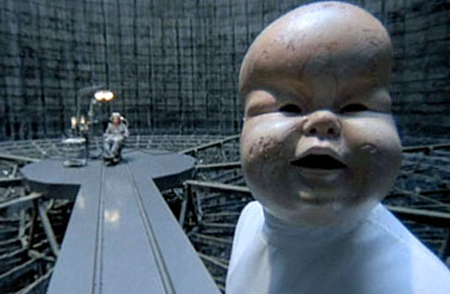
Granted I tend to be a sucker for these sorts of films, which are far too rare nowadays. (If you don’t count Eternal Sunshine of the Spotless Mind, which is kind of its own rare beast, the only recent, halfway-decent ones I can think of offhand would be Andrew Niccol’s Gattaca and Shane Carruth’s Primer.) Nevertheless, I found Duncan Jones’ low-key, hard-sci-fi rumination Moon to be really, really great — exactly the sort of small-budget “big think” science fiction production that it feels like you used to see a lot more of back in the day. (Silent Running, Outland, even stuff like Capricorn One and Soylent Green.)

Not much stuff blows up real good in Moon, which seems to have irked a few critics out there — Mick LaSalle of the San Francisco Chronicle called it “agonizingly, deadeningly, coma-inducingly, they-could-bury-you-alive-accidentally boring.” and Peter Rainer of the Christian Science Monitor argued “It just may be the most boring movie ever made – period.” (Note: don’t click through to those reviews if you know nothing about the movie — they gave away a key plot point, which I knew going in, but which is probably best left as a surprise.)

But, frankly, those guys are bonkers — I don’t normally say this of critics, because, obviously aesthetic opinions will always differ. But I can’t believe, particularly in this economy, these guys are actually still paid to write about film. (In his review, Rainer also says 2001 is “the greatest boring movie ever made,” which suggests, to say the least, that we come at the hard sci-fi genre quite differently.) Well, whatever. Sure, I probably saw this film under ideal conditions for the subject matter — by myself at the 11:45pm showing — but I was riveted by it. And if you’re a science fiction fan (or a fan of Sam Rockwell, who’s showcased here to great effect), Moon is a must-see.

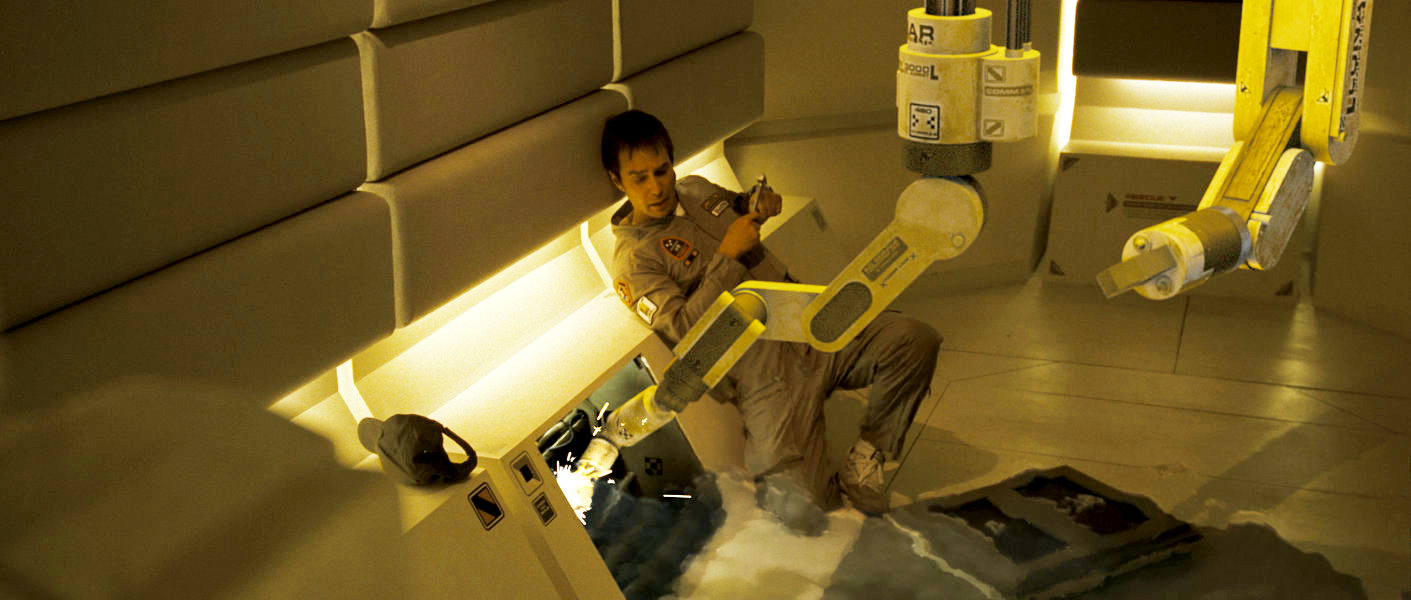
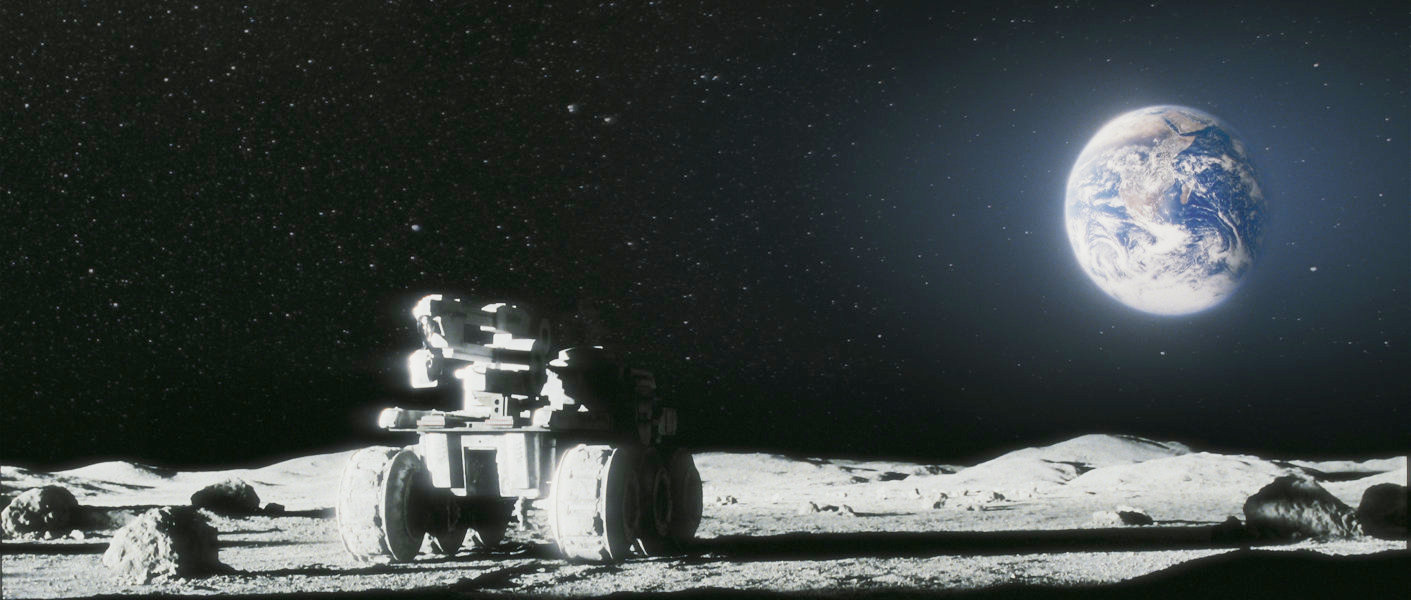
If I’m talking more about the critics than the movie here, it’s because Moon feels like a film it’s best to know very little about going in. I will say this: In what seems like the near-future, some sort of miracle energy source has been discovered in the sunlight encased within lunar rock. As such astronaut Sam Bell (Sam Rockwell) is finishing up a three-year solo stint on the far side of the moon, monitoring four big lunar harvesters for some Big Energy Company. With no one to keep him company but Gertie, the resident HAL 9000-like AI (Kevin Spacey), and the very-occasional time-delayed message from his wife and daughter, Sam is getting dangerously close to cracking out of sheer loneliness. (If you ever played old Infocom games, you’ll remember the occasional warning: “Talking to yourself is a sign of impending mental collapse.” — If so, Sam here is in a heap of trouble. Let’s just say the protein pills clearly aren’t working so hot.)

In any event, one day (or is it night?) Sam, suffering from delusions at this point, inadvertently wrecks his moon jeep while making his rounds. He awakens in the base several hours — or days — later, being tended by Gertie. But how did he get back from the accident? Why is Gertie now keeping him on lockdown? (Very possible answer: He’s “got to keep the loonies on the path.”) And who’s that rascally robot talking to when Sam’s back is turned — or is he still just hearing voices?

If this sounds like I am Legend with a robot instead of a dog, well, it starts out that way. But, soon, Sam finds himself facing one of those classic science fiction quandaries, and the mind games begin in earnest. What I found particularly impressive about Moon is that never once does Sam seem to do anything just to move the plot forward — everything here seems surprisingly well thought-out. I only have one minor complaint, and that is, at the very end, [Spoiler — Highlight to read…and see the movie first!] why send the harvester to knock out the jamming tower as Sam-Prime is leaving the station? I know he’s trying to help out Sam-Prime-Prime and every iteration thereafter, but doesn’t it ruin all the secrecy the Sams have been trying to establish for the past hour, and won’t it assuredly be fixed by the repair guys who just showed up?

That quibble aside, Moon is a rare treat for hard sci-fi fans, and suggests there’s a lot more to Duncan Jones than just “David Bowie’s kid.” If you get a chance, definitely check it out. (And remember: There is no dark side of the moon, really. As a matter of fact, it’s all dark.)

Hurts so Good.

Last of the past weekend’s offerings was Kathryn Bigelow’s lean, gripping The Hurt Locker. A taut, minimalist “men-in-combat” thriller that immediately goes up on the top shelf of Iraq flicks next to HBO’s Generation Kill (and, if you’re counting Gulf War I, Three Kings), The Hurt Locker is also that rare thing in the summer of Terminator: Salvation, Transformers, and GI Joe: a war movie for grown-ups. Very highly recommended.

As The Hurt Locker opens, we meet a three-man Explosive Ordnance Disposal (EOD) team out of Bravo Company doing what they do best: locating, examining, and disposing of an Improvised Explosive Device (IED) in the streets of Baghdad. Even on a run-of-the-mill call like this, and despite the jaunty banter among team members — the temperature is rising, the tension is thick, and the situation is life-or-death. For the IED in question could blow at any moment and take out everybody around…or it could be triggered by any one of the onlookers gathered, perhaps innocuously, perhaps not, to watch the soldiers work. Well, in this particular case of somebody-setting-us-up-the-bomb, things happen to go terribly awry. And, only six weeks out from the end of Bravo Company’s deployment, a crucial spot opens up on this EOD team.

Enter Staff Sgt. William James (Jeremy Renner), an amiable, reckless, possibly suicidal fellow who, not unlike Harry Tuttle, “came into this game for the action, the excitement. Go anywhere, travel light, get in, get out, wherever there’s trouble, a man alone.” (It’s this same devil-may-care attitude and notable lack of self-protective instinct, presumably, that eventually got him reassigned to zombie-stricken London.) Particularly showing up as he does so close to Bravo Company’s ship-out date, James’ cowboy moxie in the field causes huge headaches for his teammates (Anthony Mackie, Brian Geraghty), who even at one point contemplate fragging the guy. But, just as Jimmy McNulty is startlingly good po-lice despite his many disastrous personal foibles, Staff Sgt. James turns out to be surprisingly in his element whenever the situation deteriorates. And, amid the alleyways, warehouses, dust, and rubble of the Emerald City, the situation tends to deteriorate pretty much constantly.

The Hurt Locker isn’t really a commentary on our Iraq excursion like other movies in the genre we’ve seen of late. (Grace is Gone, Lions for Lambs) Like Generation Kill, it aims mainly to recreate the visceral experience of the war by getting us into the headspace of the men on the front lines. Inasmuch as there is a wider moral to this tale, it’s found in the epigram — “war is a drug” — taken from Chris Hedges’ War is a Force that Gives Us Meaning. Or, if you’d prefer, the same point is found in the first ten minutes of Apocalypse Now: “When I was home after my first tour, it was worse…I hardly said a word to my wife, until I said ‘yes’ to a divorce. When I was here, I wanted to be there; when I was there, all I could think of was getting back into the jungle.

Scratch a little deeper, tho’, and you can find glimmers of a wider critique of the Iraq fiasco in Bigelow’s film — indeed, you could argue that these moments have more force because they’re so throwaway. After a Iraqi cabbie breaks a cordon, stares down the EOD team for unclear reasons, and is summarily carried away after finally backing down, James quips, “Well, if he wasn’t an insurgent, he sure is one now.” Later, David Morse briefly appears as some high-ranking muckety-muck akin to Godfather who has little regard for Geneva niceties, and Ralph Fiennes and Jason Flemyng also show up as British operatives looking to make some easy quid as bounty hunters on the side.

These small moments notwithstanding, The Hurt Locker is mostly apolitical, focusing mainly on the men (and it’s just men here) who find themselves deep in the midst of the suck. And, on that level, it’s a rousing success. In all honesty, the film cheats a bit by giving this EOD team a wider set of experiences than I think is probably likely — at various points they are forced into sniper and resource extraction missions by the course of events. But, that’s a quibble — for the most part Hurt Locker is as tense a thriller as I’ve seen in years.

Bigelow understands intuitively what far too many action directors these days miss: It’s not the size of the explosion or the volume of bullets fired that determine the quality of an action flick, but the slow, remorseless buildup to the potentially deadly events. In vignette after vignette, The Hurt Locker ratchets up the suspense by degrees, until you find yourself — like the EOD team we’re following — living out each moment in a heightened state of tension, endlessly waiting for the other shoe to drop. It’s an impressive moviemaking feat, and it helps to make The Hurt Locker one of the best films of the year.


21st Century Fox.

Also in today’s trailer bin, stop-motion proves an art remarkably adaptable to the usual Wes Andersonisms in the trailer for the Wes-directed adaptation of Roald Dahl’s The Fantastic Mr. Fox, with George Clooney, Meryl Streep, Owen Wilson, Jason Schwartzman, and Bill Murray. Well, maybe.

Srs Bsns.

“Well, breakdowns come and breakdowns go — what are you gonna do about it, that’s what I’d like to know.” For Larry Gopnik (Michael Stuhlbarg), a physics professor in the Midwest circa 1967, it’s decision time in the “striking” brand-new trailer for Joel and Ethan Coen’s A Serious Man, also starring Sari Lennick, Richard Kind, Fred Melamed, Aaron Wolff, Jessica McManus, and Adam Arkin. Always good to see the brothers back in town.

Teenage Wasteland.

Second on the weekend bill was David Yates’ Harry Potter and the Half-Blood Prince, the sixth installment of the series (and Yates’ second directorial outing after 2007’s Order of the Phoenix.) On one hand, this year at Hogwarts is a deftly-made piece of work, and probably the most accomplished and filmic of the Potter movies (tho’ I still prefer Goblet of Fire overall.) But, on the other hand, Yates and the assembled cast are just gathering steam right as the source material is petering out. I racked my brains before the movie trying to remember anything about Half-Blood Prince the novel, and basically came up with the ending, “Slughorn,” “Harry’s Potions book,” and “Dumbledore drinks the crap.” These four things do not a movie make, particularly not a 150 minute movie like this one. You can pad it out with Quidditch and/or various adenoidal episodes on the Big Three’s part, but Half-Blood Prince — the movie like the tome — still feels somewhat overlong, unnecessary, and redundant.

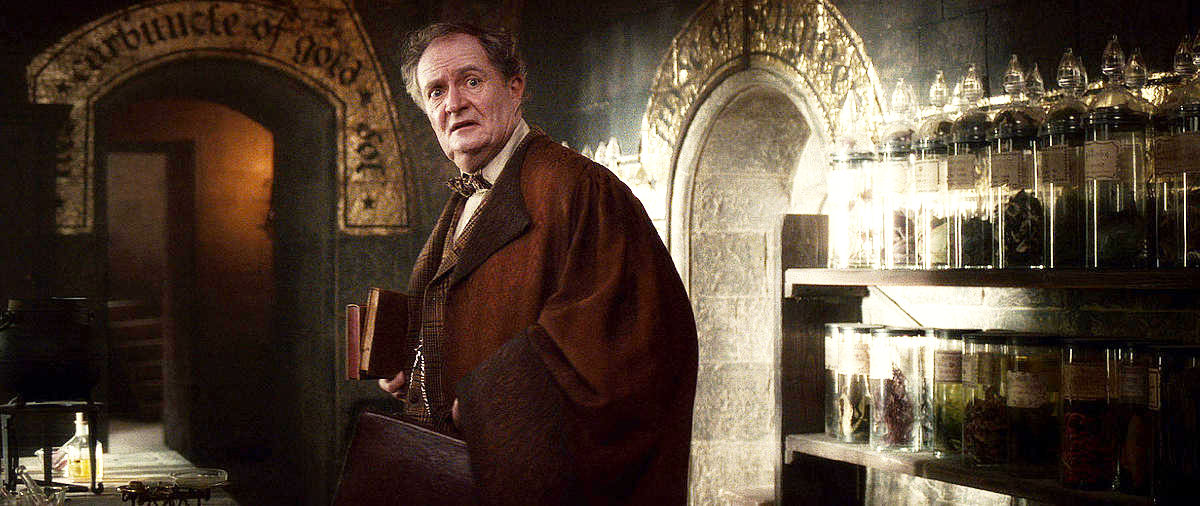
Part 6 of the Harry Potter saga starts in media res — so much so that it feels like Yates & co. have basically given up on the non-readers — with a trio of the Dark Lord’s Death Eaters openly attacking London Muggles in broad daylight. Yes, it’s gotten that bad. But the potential Chosen One (Daniel Radcliffe) has his mind on other matters at the moment — mainly, getting to know the cute waitress at the local station cafe once her shift ends. Alas for Harry, Albus Dumbledore (Michael Gambon) apparates into the scene and bigfoots that plan relatively quickly — Instead, he enlists young Potter in an scheme to entice former Prof. Horace Slughorn (Jim Broadbent) back into the Hogwarts fold. (Slughorn is an inveterate namedropper, and thus susceptible to Harry’s influence. That being said, the dance of seduction here all seems a bit more unsavory when viewed rather than read.)

Anyway, soon Harry — and Slughorn — and the rest of the gang have all returned to Hogwarts (with the exception of those schoolboys in disgrace, the Weasley twins, who are now making a mint in Diagon Alley.) But the darkness all around has now seeped even into Fortress Dumbledore — students become bewitched, various assassination attempts go awry, and the scion of Slytherin in particular, Draco Malfoy (Tom Felton), seems to be under more strain than usual. Perhaps worse still for the gang, the trickle of teenage sensuality seen in Goblet and Order has swollen to a torrent, and Harry, Ron (Rupert Grint), and Hermione (Emma Watson) are now in the full hormone-fueled throes of adolescence. Honestly, after all the pregnant looks, strange urges, and attempted snoggings in the first hour, I half-expected Harry to whip out an ID named “McLovin'” and try to score some butterbeer.

The kids all acquit themselves well enough given the modicum of plot this time around. Still, with all due respect to the teens, the secret weapon of the Potterverse on film remains the long and growing list of distinguished British thespians on hand. From the starting cast (Alan Rickman, Maggie Smith, Robbie Coltrane, Warwick Davis, David Bradley, Mark Williams and Julie Walters) to the later pick-ups (Michael Gambon, David Thewlis, Helen McCrory, Evanna Lynch), Half-Blood Prince is stocked to the gills with well-done character turns. The only person who noticeably stuck out as bad was Helena Bonham Carter — She’s wayyy over the top (again) and may be refining her Queen of Hearts here. (I also would’ve liked to have seen He Who Must Not Be Named at some point over the film, but I suspect he’ll be back for the next two installments.)

That being said, the best thing about Half-Blood Prince is probably Jim Broadbent’s turn as Slughorn. At first, he just seemed to be doing a slightly toned-down variation of his “snip, snip, slice, slice” cameo in Brazil. But Broadbent manages to infuse the character with a melancholy I never took away from his more glad-handing, Falstaffian persona in the book. This should’ve been the “Half-Blood Prince’s” movie, really (or Dumbledore’s, for that matter) — but, particularly given the notable absence of the high adventure or puzzle-solving plot dynamics of earlier Potter tales, it’s Broadbent’s haunted sense of regret here that leaves a mark after the credits roll.