
It Never Rains (in Southern California).

Noah Baumbach’s surprisingly entertaining Greenberg begins with a long, sun-drenched appreciation of the luminous Greta Gerwig, about as languid and loving a tribute a director has paid an actress since Pam Grier’s “Across 110th St.” entrance in Jackie Brown. And, if that isn’t a weird enough beginning to a film by the notoriously misanthropic Baumbach, Gerwig’s character, Florence Marr, is quickly established as a kind, sweet, and unassuming soul — which, if you’ve seen any other Baumbach movie, makes you feel as if you’re about to watch a small child skip through a mine field. In other words, one quickly gets the sense that this is all gonna end very badly.

The mine field soon to enter this particular tale is the titular Roger Greenberg (Ben Stiller), a caustic OCD burnout, mental case, and semi-professional carpenter who’s come all the way out to LA from New York to wreak havoc on both his old friends and his brother’s milieu. (Florence happens to be his brother’s personal assistant.) We’ll get to Roger in a bit. But one of the reasons I found the film surprisingly entertaining is that it manages to sidestep so many of the Bouncing Betties I expected would derail the flick for me from jump street. For one, we’ve basically seen this exact same story — “hurt people hurt people,” as Florence puts it at one point — before from Baumbach, both in his magnum opus, The Squid and the Whale, and particularly in the considerably less-successful Margot at the Wedding.

For another, Greenberg makes no secret of relying on two of my least-favorite movie tropes going. One, the goofy hipster man-child who refuses to grow up and expects the universe to cater to his whims and idiosyncrasies. Probably done best in Knocked Up, the Apatowish “Omega male” — so coined by Slate‘s Jessica Grose — has been ubiquitous in recent years, as The New Yorker‘s David Denby noted back in 2007. And, truth be told, Greenberg the movie is at its most aggravating when it revels in the character’s man-child tics, a la Jack Black’s doofus husband in Margot, such as Roger obsessively applying Chapstick or writing strongly-worded irate customer letters to various corporate conglomerates.

The second irritating trope in play here is one I’ve complained about several times before, from Sideways to A Single Man. And that’s the very cinematic notion that an irascible, ornery, and/or depressed protagonist will invariably meet a smart, beautiful, and long-suffering significant other who really just wants to save him from himself — in this case, Gerwig’s Florence — and he will soon thereafter fall ass-backwards into a relationship he has absolutely no business being in. Um, no. Life doesn’t work that way, nor should it really. And every time Florence, 25, and Greenberg, 41, start falling backwards towards each other here, you kinda want to scream at her to get the heck out of Dodge and find a guy who isn’t, y’know, certifiably bugnuts crazy.

So why does Greenberg work anyway? For several reasons. Perhaps most importantly, it, like all of Baumbach’s films, feels exceedingly well-observed. As a writer, Baumbach has a particularly good ear for dialogue, and gets how a conversation can bring people together or, by tortured increments, spin disastrously out of control. (See, for example, Greenberg’s varied ruminations with his old bandmate Ivan (Rhys Ifans, as good as I’ve ever seen him) or his star-crossed date with his long-ago ex-girlfriend Beth (Jennifer Jason Leigh, Baumbach’s real-life wife.) And, unlike in Squid, with Billy Baldwin’s “philistine” tennis coach, or Margot, with its slew of one-note unneighborly rednecks, this attention to character detail, and even a sense of magnanimity, applies to every person in the film.

Greenberg also benefits from quality performances across the board. I’ve already mentioned Gerwig, who’s an exceptionally low-key, honest, and appealing presence here. (She’s sort of the anti-Scarlett Johansson, an actress who, to my mind, seems to radiate self-entitlement and condescension in most every role.) But Stiller too is quite surprising here. Yes, Roger Greenberg can sometimes seem a collection of very Stillerish tics — the whiny letters and all that. But Stiller sells the character regardless. He doesn’t wink at the audience or let himself off the hook, even when Roger is being totally insufferable (which is basically most of the time.) If I thought the on-and-off love story here should have ended up a lot more off than on by the final reel, it’s a testament to how unlikable and uncompromising Stiller and Baumbach made their central character.

And, who knows? My failure to buy into the love story here probably speaks worse of me than it does of the movie. Sure, Florence ends up stepping on a few nasty mines over the course of this story as expected (one major one, in fact, happens before we even meet her.) But the very fact that Baumbach ends Greenberg on an ambiguous, even hopeful note suggests that maybe one of the more talented misanthropes in Hollywood right now learned a thing or two from the too-bleak Margot, and is getting a little less curmudgeonly in his middle age. And, hey, if he can change, maybe we all can change.

An Encore (Already) for Simon’s Nola.

I can’t think of another show that is more emblematic of what we aspire to be as a network than TREME…We are thrilled that the press has recognized the profound artistry and intelligence of this show and are eager to see where David and Eric take us in a second season.Looka! I haven’t yet boarded the Treme train which left the station this past Sunday — no Home Box Office ’round these parts just yet. Nonetheless, HBO has already ordered up a second season, and I can’t wait to catch up.

Ghosts, Writers.

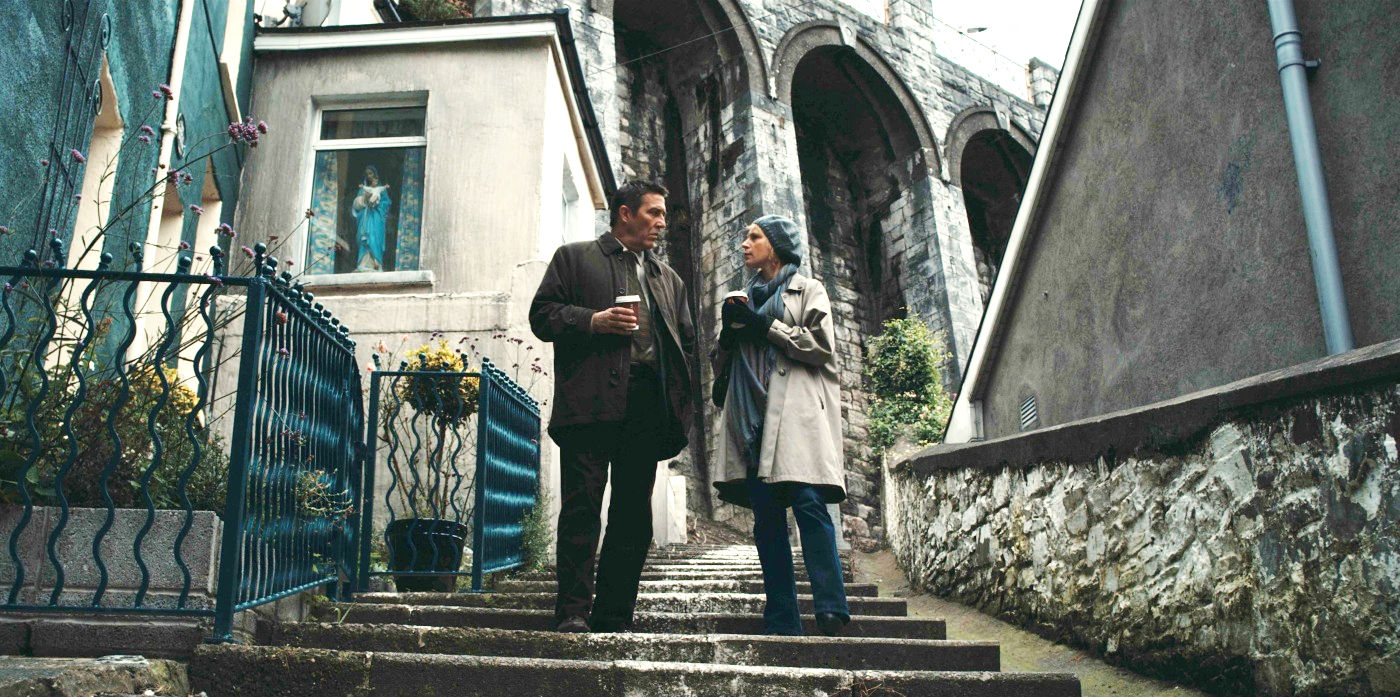
Much as the lousiness of Alice in Wonderland drove me right into Antoine Fuqua’s Brooklyn’s Finest last month, I quickly tried to wash out the bad taste of Clash of the Titans this past Sunday with a showing of Conor MacPherson’s moody Irish ghost story The Eclipse. And I’ll give it this — It’s a right strange little movie.

I haven’t seen any of McPherson’s previous films, although my sis and I did catch his play The Seafarer on Broadway a few years ago, about an Irishman (David Morse), his blind older brother (Joe Norton), and their friends (Conleth Hill, Sean Mahon) visited by the Devil (Ciaran Hinds) one gloomy Christmas eve in Dublin. This film — broader and better executed than that rather larky evening of theater, although also somewhat aggravatingly open-ended — carries over some of the same cast (Hinds, Norton), as well as the supernatural goings-on in the Old Country.

And like Seafarer (and, from what I’ve heard of McPherson’s other works, like The Weir), it’s a bit of a strange genre mishmash — part horror flick, part adult romance, part relationship thriller. I can’t say the movie successfully coalesces into anything more than the sum of its parts, but it has the benefit of some likable actors — not only Hinds and Norton but also Iben Hjejle of High Fidelity and Aidan Quinn — and it makes for a decently compelling character piece and Gaelic travelogue for a few hours. Its pleasures may be mostly ephemeral, sure, but I’ve sat through worse ghost stories in my day.

As the film begins, the year is 2008, and in the scenic Irish seaport of Cobh, the locals are preparing for their yearly writing festival, where authors come by to hobnob, do readings, and discuss their latest works. Among the volunteers hosting this event is one Michael Farr (Hinds) a recent widower, shop teacher, and father of two who, late one night, seems to encounter a ghostly intruder in his house. The trick is, the person he thinks he saw — his father-in-law Malachy (Norton) — is still among the living, although he’s definitely withering on the vine in a nearby rest home. Can you see the ghost of someone who isn’t even dead yet?

Before Michael can wrap his mind around this quandary, events at the festival start to consume his attention. Namely, the visit by two authors who happen to share a brief, awkward history: The popular but exceedingly abrasive American writer Nicholas Holden (Quinn), and a lovely but distracted writer of ghost stories, Lena Morelle (Hjejle). Despite his continued grieving for his lost wife — or perhaps because of it, given their mutual interest in apparitions — Michael finds himself drawn to Lena, causing much consternation for Holden, who’s nursing the volatile combination of a giant-sized ego, a drinking problem, and a broken heart. But, quite frankly, angry writers are the least of Michael’s worries — Did I mention this widower has a ghost problem? And they are not going gently into the good night.

To its credit, The Eclipse gets a lot of little things right. The burgeoning romance between Lena and Michael seems natural and unaffected. McPherson subtly underlines the themes of ghosts, memory, and loss by emphasizing empty rooms, empty chairs, and the timelessness of life in Cobh. (The staff at the hotel hosting the festival dress in nineteenth century garb, helping to convey the sense that the spirits of centuries past still inhabit these climes.) And Hinds in particular is compelling throughout, even when the story he’s a part of is not altogether believable.

All that being said, The Eclipse has some problems with tone. It’s not just the sudden lurches from haunted house malevolence to 2nd-chance-at-love-type-stuff back over to unabashed Raimi-esque horror that throw everything off, although they don’t really help that much. (They do keep you on your toes, tho’.) The other issue is Nicholas, who’s written far too broadly compared to everyone else on hand. Michael and Lena seems like real, multi-faceted , and plausible adults, while Nicholas — the best efforts of Aidan Quinn notwithstanding — is basically just an one-dimensional ambassador from the planet Douche, and the movie loses a step whenever it tries to get us to take him seriously.

I also have some quibbles with the ending of the movie, in that the initial haunting aspect is sorta just dropped without explanation. (But, then again, how can you explain ghosts anyway? Maybe this was the best way to go about it.) Still, for all its bizarre shifts in tone, The Eclipse at least has the virtue of originality in its quiver. The Sixth Sense meets Terms of Endearment meets Something Wild in coastal Ireland? I can’t say I’ve ever seen that before.

Looking the Other Way in Chile.

In the Sept. 16, 1976 cable, the topic of one paragraph is listed as “Operation Condor,” preceded by the words “(KISSINGER, HENRY A.) SUBJECT: ACTIONS TAKEN.” The cable states that ‘secretary declined to approve message to Montevideo’ Uruguay ‘and has instructed that no further action be taken on this matter’…The Sept. 16 cable is the missing piece of the historical puzzle on Kissinger’s role in the action, and inaction, of the U.S. government after learning of Condor assassination plots,’ Peter Kornbluh, the National Security Archive’s senior analyst on Chile, said Saturday.‘”

Another piece of evidence for the prosecution in the trial of Henry Kissinger: A recently declassified 1976 cable has Kissinger canceling a warning to Chile about political assassinations, one day before the Pinochet regime murdered another critic in downtown Washington DC. And let’s not even get started on Allende

Conscience of the Court.

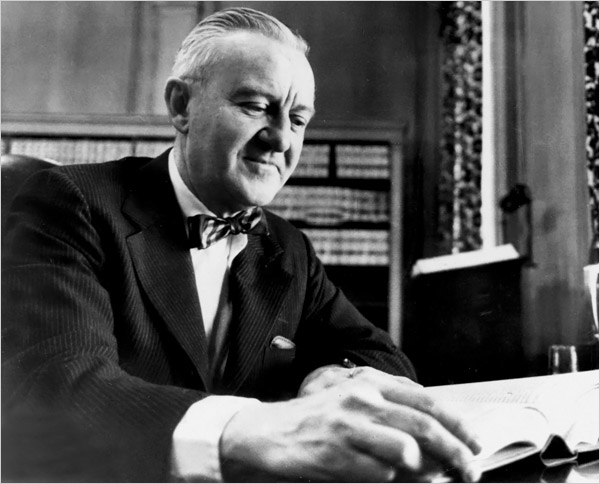
I’m late on this post on account of vacationing, but nonetheless: As the world knows (and long suspected after he only hired one clerk last year), Justice John Paul Stevens has announced his retirement after 34 years on the Court. (See also Dahlia Lithwick’s commemoration of Stevens’ empathy, as well as the Tao of Stevens here and here.)

Expected it may be, but this is not good news. The President is saying all the right things about picking a Justice who will uphold campaign finance laws in the wake of the Citizens United disaster. But, as the pathetic recent capitulation on Dawn Johnsen showed once more, this White House too often shrinks from a necessary fight in the name of an elusive “bipartisanship” that, quite frankly, does not exist.

With Stevens gone and the fearsome foursome of Roberts, Alito, Thomas, and Scalia still roaming the chambers, the Court needs a strong and unabashed liberal conscience right now. What it emphatically does not need is another centrist technocrat that will help push the Court ever further to the right. The ball’s in your court, Mr. President — It’s time to show more of the progressive gumption we voted you in office to provide.

Hudson Hawks (Lehman’s Garbage).

“‘How can anyone — regulators, investors or anyone — understand what’s in these financial statements if they have to dig 15 layers deep to find these kinds of interlocking relationships and these kinds of transactions?’ said Francine McKenna, an accounting consultant who has examined the financial crisis on her blog, re: The Auditors. “‘Everybody’s talking about preventing the next crisis, but they can’t prevent the next crisis if they don’t understand all these incestuous relationships.’

The NYT delves into the sordid story of Hudson Castle, a.k.a. Lehman Brothers’ alter-ego, which they used to squirrel away shady investments. (This shell game didn’t even make the recent Lehman report, which apparently found enough “materially misleading” behavior to warrant criminal charges against Lehman’s leadership.)

Blunt Rebuke.

‘Access for kids who have pre-existing conditions, who would be against that?’ Blunt asked a group of health care professionals in Springfield, MO. ‘But access for adults who’ve done nothing to take care of themselves, who actually will have as I just described every incentive not to get insurance until the day that you know that you’re going to have medical expenses–that’s a very different kind of story.‘”

Thanks, Roy! Republican congressman and ostensible chair of the “GOP Health Care Task Force” Roy Blunt actually comes out in favor of repealing the ban on denying coverage for pre-existing conditions, one of the few provisions in the recent health care law that usually garnered bipartisan support. For its part, leukemia declined to comment.

The Nuclear Option: Ignorance.

If there were any doubts that Sarah Palin is a total idiot, she settled them with that single statement….Tip to Sarah Palin: Obama may have some vulnerabilities, and you may have some strengths, but command of the issues doesn’t fall in either category.” As the up traffic here in DC, Slate‘s Fred Kaplan beats back some of the dumber GOP attacks on Obama’s nuclear policy, while Joe Conason tries to explain what Ronald Reagan really thought about nukes.

Sigh…Pick any issue these days, and for far too many of the GOP opposition, the question seems to come down to whether they’re out-and-out venal or just incompetent. Sadly, the answer seems to be yes.

Yelchin, You’re So Cool!

Breaking while in the BVI: Anton Yelchin of Star Trek and the McG Terminator is cast in the William Ragsdale role for a reboot of Fright Night. “The updated version, written by Marti Noxon (‘Mad Men‘), is expected to keep the comedy-horror tone while modernizing the effects.

True, there are a lot of unnecessary remakes being made right now, but this is pretty great casting, and Fright Night was one of my Halloween staples growing up. Now, as an AICN’er pointed out, how ’bout Mark Strong as Jerry Dandridge (the Chris Sarandon role)?

Made of Stone.

After about a half hour or so of stilted, mind-numbing, make-you-want-to-claw-your-eyes-out exposition, Louis Leterrier’s interminable remake of Clash of the Titans, for some reason or another, takes a brief moment to badmouth Bubo, the metal owl from the 1981 version of the film. Well, say what you will about that goofy Harry Hamlin-Burgess Meredith-Lawrence Olivier flick and its Minervan comic-relief droid — At least it had heart.

This whiteboy-angsty retread of Titans, on the other hand, basically has no pulse whatsoever. It’s just a lumbering, CGI-ridden box office monstrosity not unlike its Cloverfield-ish Kraken, and one that could desperately use the same spark of life Zeus ostensibly once infused in mortal men. You remember that godawful tag line from the first trailer — “Titans will Clash“? Well, the FX processors notwithstanding, that’s about the level of effort put forth by this movie, as in none at all. Granted, Clash isn’t quite as awful as last month’s woeful Alice in Wonderland, but it’s definitely in the same lo-rent ballpark.

This iteration of Clash begins with a starfield and the demi-goddess Io (Gemma Arterton, late of Quantum of Solace, soon of Prince of Persia) in full expository mode, a la Virginia Madsen at the start of Dune. (Or, for that matter, Cate Blanchett in Fellowship — Leterrier explicitly bites from PJ’s Tolkien trilogy several times here — See also all the very LotR-like pans of Perseus & co. walking through Glorious Nature to wherever they’re going next.) So, anyways, this backstory is pretty standard — Zeus defeats the Titans, he, Poseidon and Hades divvy up the universe, etc. etc.

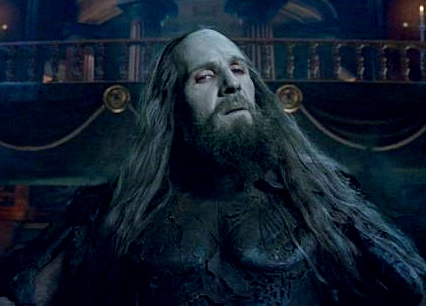
And eventually, along comes Perseus (Sam Worthington, more on him in a bit), a son of Zeus found lost at sea as a babe by a fisherman (Pete Postlethwaite, paying the mortgage). Unlike earlier iterations, this Perseus grows up a sullen, wrathful sort, and particularly after Hades (Ralph Fiennes, wasted) drowns his entire family as an afterthought to a fly-by shooting of sorts. Bent on revenge for these murders, Perseus soon enlists on a suicide mission to defeat Hade’s powerful pet, the fearsome Kraken — which, thanks to a bit of inopportune blasphemy by Cassiopeia, the queen of Argos (Polly Walker, wasted), will either be destroying the city or devouring its sensitive-soul, Peace Corps-ish princess, Andromeda (Alexa Davalos, unremarkable) in ten days time.

So this glum, grim, and altogether peeved demigod sets out with a team of soldiers — let’s just go ahead and call them the body count — to find a way to stop the Kraken, which may or may not include fending off giant scorpions, battling Calibos (Jason Flemyng), bartering with witches, and wrangling with Medusa (Natalia Vodianova). And, given the subject matter, it’s almost weird how boring all of this turns out to be. Partly because Perseus’ fighting style throughout is basically “run-in-the-other-direction-from-the-CGI-thingy.” Partly because the script…well, sucks. It’s just bad one-liners and lazy exposition all the live-long day. And partly because, aside from a pair of Asterix-and-Obelix-style hunters who tag along for the ride (Ashraf Barhom and Mouloud Achour), nobody’s having any fun whatsoever here. It’s all grimacing and cursing the Gods for this, that, or the other thing. Just deadly dull stuff.

Is this innate boringness Sam Worthington’s fault? Well…maybe. I said after the also-terrible Terminator: Salvation that Worthington “has presence, and I could see him being a A-lister if given the right material.” But after Avatar and this flick, I’m revising that statement. He’s had three bites at the apple now, and, while I suspect some female or gay readers may disagree — and making some allowances for the fact that, all three times, he probably spent a good bit of his days on set reacting to a green tennis ball — he’s really starting to come across as a charisma-free zone to me.

But, that being said, everybody here, with the possible exception of Casino Royale‘s Mads Mikkelsen, seems devoid of charisma here, even usual stalwarts like Liam Neeson and Fiennes (both phoning it in, as is brother Poseidon, Danny Huston — But, to be fair, Huston only has one line.) True, handsome/pretty stiffs like Worthington and Arterton so far seem to be shapely blanks no matter what film they’re in. But somehow or another, this movie has the power of Medusa over everyone involved: It just seems to suck the life right out of people. My advice, if it’s not too late: Don’t attempt to look this one in the eyes. By the Gods, save yourselves and turn away.