
Bound for Glory.


Nothing if not textbook and by-the-numbers (Coach Haskell would be proud), Disney’s Glory Road — the story of the 1966 NCAA Champion Texas Western Miners, the first basketball team in tournament history to feature five black starters — still makes for a decent genre matinee. It’s not a movie that’ll light the world on fire by any means, but it hits its beats decently, and benefits from amiable performances from Josh Lucas and Emily Deschanel right on down the bench. I wish the movie had stayed more with the historical game plan it marked out in the opening credits — and that the basketball scenes were more engrossing — but, all in all, Glory Road is a journeyman sports pic.

A synopsis here is probably overkill, suffice to say that a well-meaning disciplinarian coach (Josh Lucas) rides into El Paso, circa 1965, to try to mold a championship basketball team out of a triracial group of college athletes. Do these youngsters overcome their cultural differences, learn there’s a method to Coach’s madness, and become a Team? Do they play well enough to get to the Big Dance? Well, I’ll leave that for you to discover. The main — ok, the only — thing that differentiates Glory Road from its many predecessors is its period flavor. These players don’t just have to worry about the usual assortment of college problems: They’re also caught up in the middle of the civil rights revolution — and the white backlash — across the South, and have to contend with brutal acts of racism off the court as well as the usual opposing teams. George Will recently questioned whether this team was as history-making as it’s made out to be here. Well, ok, but, in a way, that’s beside the point. By bringing race and the civil rights struggle to the fore here, Glory Road acts as a corrective to the main flaw in what’s otherwise a better basketball film, Hoosiers. As Spike Lee points out in Best Seat in the House, it’s hard to watch that film, particularly its final game, and not feel at times that its an uncomfortably white basketball flick.

Speaking of Spike Lee’s book, it also kinda ruined some of Glory Road for me. Therein, Lee (pre-He Got Game) spends a chapter calling out ridiculous basketball scenes in movies — watching unathletic actors dunk on 6-foot rims, etc. And, while the rims look the right height in Glory Road, I have to admit, none of the basketball scenes are all that engaging. They’re cut too close, there’s barely a sense of plays developing, and very few shots seem to leave the actors’ hands to go into the basket. (For that matter, you don’t really get a sense of what various players’ strengths or weaknesses are here, other than that Bobby Joe Hill (Derek Luke) has a nice handle and Nevil Shed (Al Shearer) has a tendency to disappear in the paint. What’s more, Coach’s advice throughout basically can be summed up as “You can do it!” — Not a lot of play-calling going on.) Still, for what it is — an uplifting vignette of sports history — Glory Road is solid enough. Formulaic, sure, but no harm, no foul.
Nice Guys Finish Last.

“So, Mr. Orange, you’re tellin’ me this very good friend of mine, who did four years for my father, who in four years never made a deal, no matter what they dangled in front of him, you’re telling me that now, that now this man is free, and we’re making good on our commitment to him, he’s just gonna decide, out of the f**king blue, to rip us off? Why don’t you tell me what really happened?R.I.P. Chris Penn 1965-2006. (Salon reposted an appreciation of Penn by Cintra Wilson here.)

Another Green World.

For a transitory enchanted moment man must have held his breath in the presence of this continent, compelled into an aesthetic contemplation he neither understood nor desired, face to face for the last time in history with something commensurate to his capacity for wonder.” – F. Scott Fitzgerald, The Great Gatsby

Well, that’s that — the 2005 round-up is out-of-date. If you’ve ever seen a Terence Malick flick (Badlands, Days of Heaven, The Thin Red Line), you can guess the contours of The New World — a Fall of Eden motif, a languid, dreamlike pace, resonant images of natural splendor, conflicted characters wrapped up in voiceover self-reflection, all punctuated with the occasional underwater swimming cam and chaotic sortie of Man against Man. (At my sparsely attended afternoon show, the guy to my left fell asleep, and the woman to my right walked out.) That being said, I thought this movie was the perfect match of director and material, and one of the most transporting and beautiful films I’ve seen in years. Sure, it has some serious historical issues, and sometimes dabbles dangerously with the noble savage schtick, one of Malick’s favorite tropes. But as a work of cinema, I think it may just be a masterpiece.

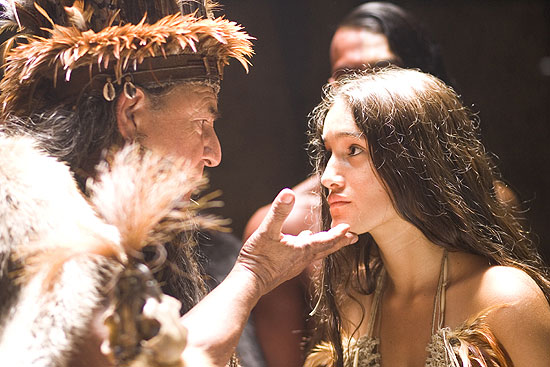
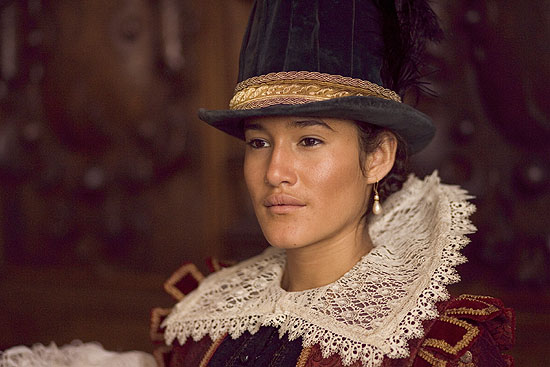
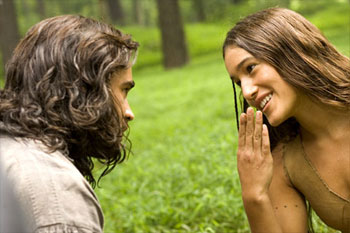
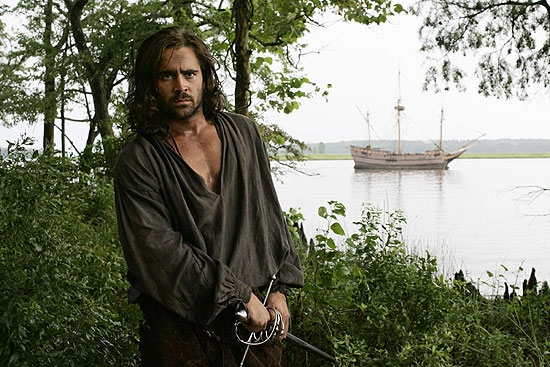
The year is 1607, and — with Capt. Christopher Newport (Christopher Plummer) at the helm and Capt. John Smith (Colin Farrell) in the brig — three English ships put to in a sun-dappled marshland, recently named after their late Virgin Queen. Short of food and enthusiasm after their exhausting Atlantic crossing, these new arrivals to the New World convey a tense hello to the “naturals,” construct a fort, plant a few token crops, and then begin frantically panning for gold and silver. When it soon becomes clear that the survival of the fledgling settlement will require both the forbearance and the trade of the nearby Powhatans, Smith is sent to visit the tribe in hopes of striking a deal. There, he is saved from a grisly death in the longhouse by the love, compassion, and curiosity of young Pocahontas (a radiant Q’Orianka Kilcher), daughter of the chief. (Lucky for Smith, and as the story goes, he gives her fever.)

Here is where some historical purists might start checking out (if they haven’t already), as the much-written-about romance between John Smith and Pocahontas, however enthroned in our overly happy tales of early Native American contact, probably didn’t happen. (The tale of his being saved may well be true, but it was probably an elaborate but traditional tribal ritual, one in which Chief Powhatan displayed his magnanimity to a potential rival by having a family member spare his life.) Similarly, the later relationship between Pocahontas and John Rolfe, America’s first (white) tobacco entrepreneur (Christian Bale, so that‘s how Batman made his money) had less to do with the chastened love story shown here than with an attempt to keep the peace — In Rolfe’s own words, he married “for the good of this plantation, for the honour of our countrie, for the glory of God, for my owne salvation, and for the converting to the true knowledge of God and Jesus Christ, an unbeleeving creature, namely Pokahuntas,” in that order.

Some other details rankle too. I’m not a colonial historian, but I highly doubt the brief reign of Capt. Wingfield (David Thewlis) ended exactly as it’s shown here. (Speaking of Thewlis and a la Thin Red Line, there are a number of recognizable actors skulking about Jamestown, including Ben Chaplin and Noah Taylor, and one film-fan cameo presiding over the Court of King James.)

But, really. To get too hung up on the history here is — quite literally — missing the forest for the trees. Like other Malick films, The New World is about impressions and evocations more than plot mechanics, and in that sense it’s a revelation. Through both natural sights and wondrous sound editing, the film does a stunning job of conveying the sublime strangeness of the other, and the magic and terror of an unfamiliar environment. In fact, the movie does it twice — Wes Studi has some powerfully haunting scenes in the third act, when, as an envoy of Powhatan, he is dumbfounded by the starkly manicured gardens of Europe. After the overgrown wilderness of Virginia, he — and we — might as well be on Mars. (Along those lines, I can’t remember the last time a film altered my perspective so much on the way out. After two and a half hours in this World, the Upper West Side seemed a bizarrely cluttered and unnatural realm for the rest of the evening.)

Terence Malick’s The New World is a masterfully crafted tale of discovery and transformation, passion and misunderstanding, intimacy and heartbreak, love and loss, and worlds Old and New. In short, it’s the best film of 2005 (and well-worth seeing on a big screen.)

Princes kept the view.

With The Lion, the Witch, and the Wardrobe still raking it in, the next Narnia movie, Prince Caspian, moves forward. Apparently, all four Pevensies are on board and shooting will begin this autumn. “If we don’t make it now we’ll never be able to, because [the kids]’ll be too old.” (Via WebGoddess.)

The Night Gwen Stacy…Returned?

Curiouser and curiouser…The Village‘s Bryce Dallas Howard joins Spiderman 3 as none other than Gwen Stacy, Peter Parker’s doomed childhood sweetheart. I find this somewhat strange, since they’d basically turned Kirsten Dunst’s Mary Jane Watson into Gwen Stacy in the first film (#6). (Plus, they’ve switched hair-colors, but ah well.)

Dead Man Writing.

“When we think about the authoritarian world that Orwell painted, the catchphrases are one thing, but when you read the book again, the specifics and relevance for now are stunning.” Apparently, Tim Robbins is thinking of bringing 1984 to the screen (again). Hmmm…I dunno. I enjoy Bob Roberts and Dead Man Walking, but thought Embedded was way over the top. And it’d be really hard to make a better or more faithful adaptation than the Michael Radford version with John Hurt and Richard Burton.