
Six new one-sheets from X3: The Last Stand make the rounds (as do a few new stills) and, hoo boy — Let’s just say that they’re not going to thwart the negative energy surrounding the project ever since Ratner came on board. Will this be the X-Men’s Batman and Robin?
Tag: Cinema
Cards and Guards.
In the movie bin, Ali G goes up against NASCAR racer Will Ferrell (and sidekick John C. Reilly) in the Anchorman-ish new trailer for Talladega Nights: The Ballad of Ricky Bobby, and In the Line of Fire meets The Fugitive in this preview of The Sentinel, with Michael Douglas, Kiefer Sutherland, and Eva Longoria. I might catch the first one, if the summer is sweltering enough.
Ah just caint knit yew!
 Back for the ’06: The Webgoddess Oscar Contest. Get yer entries in while you can: these two gay sock cowmonkeys desperately need a home off the range.
Welcome to Coen Country.
Javier Bardem and Tommy Lee Jones look set to enter No Country for Old Men for the Coen Brothers, from a book by Cormac McCarthy. “Set in West Texas in 1980, the story is about a young Vietnam vet who stumbles over the remnants of a drug deal gone bad. He’s hunted by two extremely vicious assassins who want the money back.” My, that’s a Coenesque plot line. (Hail Caesar!, their other current project, is apparently expected to start shooting soon.)
Phoenix Force Five.
The cast for Order of the Phoenix is announced, with Helen McCrory as Bellatrix Lestrange, Natalia Tena as Nymphadora Tonks, Kathryn Hunter as Mrs. Figg, and newcomer Evanna Lynch as Luna Lovegood. (Previously announced were George Harris and Imelda Staunton.) I have no sense of any of these actors, but they all seem to look the part.

Go Tell It on the Mountain.
The 2006 Oscar nominations are announced, with, to noone’s surprise, Brokeback Mountain leading the pack. Most of the major categories seem to be already locked up — Picture (Brokeback), Director (Ang Lee), Actor (Hoffman for Capote), Actress (Witherspoon for Walk the Line, barring a Huffman upsurge), Supporting Actress (Weisz, The Constant Gardener.) Of the Best Picture candidates (Brokeback, Capote, Munich, Good Night, and Good Luck), the only one I haven’t seen is Crash, but given its very mixed reviews, I’d be extremely surprised if it’s a better movie than Syriana or The New World.
Biggest snub? Jeff Daniels should be in Best Supporting Actor for The Squid and the Whale (William Hurt took his slot for A History of Violence.) Speaking of Supporting Actor, that category’s a two-man race between Clooney for Syriana and Paul Giamatti for Sideways. Giamatti’s been nominated for Cinderella Man, but many of his votes will be for the prior, passed-over film, just as Jim Broadbent won for Iris (over Ian McKellen as Gandalf) because of his performance in Moulin Rouge. Also, say what you will about Episode III, but it should be nominated in the visual effects category, even if Kong should win.
The most competitive of the major awards looks to be in the original screenplay division (Adapted will go to Team Brokeback, McMurtry & Ossana). If Clooney doesn’t win director or supporting actor, he could very well win here for GN & GL. Or, the academy might decide to reward a movie they otherwise overlooked: Syriana, Squid & the Whale, or Match Point. Hard to say — I guess I’ll go with GN & GL for now.
Being Kingsley.
Joining Imelda Staunton for Year 5 at Hogwarts, veteran actor George Harris will play Kingsley Shacklebolt in the forthcoming Harry Potter and the Order of the Phoenix (set to begin filming next month.) You may recognize him as Capt. Katanga in Raiders of the Lost Ark, or, more recently, as Morty in Layer Cake.
Coogan’s Bluff.
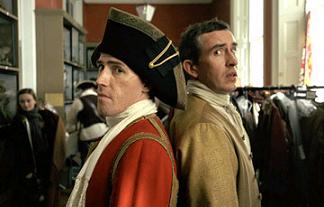 I’ve never read Laurence Sterne’s The Life and Opinions of Tristram Shandy, Gentleman (and was surprised to discover that this pre-mo fellow Sterne apparently beat out overhyped authors like David Foster Wallace and Dave Eggers to the sprawling po-mo novel by, oh, two hundred years.) So, to be honest, I’ve no clue as to whether Michael Winterbottom’s Tristram Shandy: A Cock and Bull Story succeeds as an adaptation (or Adaptation) of Sterne’s tome or not. I do know that this Shandy, while not as engaging as Winterbottom and Coogan’s 24 Hour Party People, is a breezy, detour-ridden romp through the life (well, birth) of Tristram Shandy, the business of filmmaking, and the public persona of the inimitable Steve Coogan.
After some discussion of the evocative shade of actor Rob Brydon (Rob Brydon)’s teeth, Tristam Shandy (Steve Coogan), a la 24HPP, emerges from his manor to introduce himself to us, the audience. He then proceeds to tell his life story — but wait, first we need to talk about his father, Walter Shandy (Steve Coogan), and the strange circumstances attending Tristram’s conception and birth. But, before we finish that digression, we meet Steve Coogan (Steve Coogan), who, while playing both Walter and Tristram Shandy in a film version of Tristram Shandy, must navigate among his visiting girlfriend Jenny (Kelly MacDonald), his possible new girlfriend Jenny (Naomie Harris), his long-suffering director (Jeremy Northam) and screenwriter (Ian Hart), and his co-star and erstwhile rival, Rob Brydon…who, as it turns out, can do a mean Steve Coogan impression.
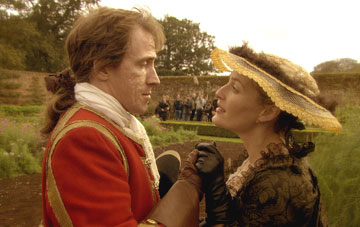 Meta enough for ya? (If not, you can throw in Gillian Anderson, Shirley Henderson, and Stephen Fry as Gillian Anderson, Shirley Henderson, and Stephen Fry respectively. And also skulking about the set are Shaun of the Dead‘s Dylan Moran, Extras‘ Ashley Jensen, Dirty Pretty Things‘ Benedict Wong, and even Mr. Weasley (Mark Williams), as the resident historical consultant/martinet.) Well, if it all sounds like two hours of breaking-the-fourth-wall head games and inside baseball, it sorta is. Still, this cock and bull story is also consistently funny, particularly if you find Steve Coogan’s dry not-so-self-effacing wit amusing. And, when you get right down to it, there just aren’t that many eighteenth-century literary adaptations out there that offer up chance circumcisions, Al Pacino jokes, and the sight of a grown man being lowered upside-down into a styrofoam womb.
Notorious.
In the trailer bin, you can see the seed of Satan swinging in the new teaser for Omen 666 (Yes, another needless remake. But I like the cast: Liev Schreiber, Julia Stiles, Mia Farrow, David Thewlis, Michael Gambon, and Pete Postlethwaite.) Or, take a visit with another original temptress in the trailer for Mary Harron’s The Notorious Bettie Page, with Gretchen Mol (That’s Gretchen Mol?), Lili Taylor, and David Strathairn (as Estes Kefauver.)
Fight Club.
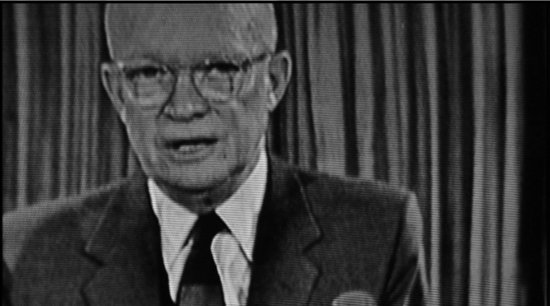
“In the councils of government, we must guard against the acquisition of unwarranted influence, whether sought or unsought, by the military-industrial complex. The potential for the disastrous rise of misplaced power exists and will persist. We must never let the weight of this combination endanger our liberties or democratic processes.” That flaming liberal Dwight Eisenhower’s somber farewell address to the nation is the historical and thematic anchor for Eugene Jarecki’s documentary Why We Fight, a sobering disquisition on American militarism and foreign policy since 9/11. In essence, Why We Fight is the movie Fahrenheit 9/11 should have been. Like F911, this film preaches to the choir, but it also makes a more substantive critique of Dubya diplomacy and the 9/11-Iraq switcheroo, with much less of the grandstanding that marred Moore’s earlier documentary (and drove right-wing audiences berzerk.)
Sadly, the basic tale here is all-too-familiar by now. Ensconced in Dubya’s administration from the word go, the right-wing think-tank crowd (Wolfowitz, Perle, Kristol, etc.) used the tragedy of 9/11 as a pretext to enact all their neocon fantasies (spelled out in this 2000 Project for a New American Century report), beginning in Iraq. Taken into consideration with Cheney the Military-Contractor-in-Chief doling out fat deals to his Halliburton-KBR cronies from the Vice-President’s office, and members of Congress meekly signing off on every military funding bill that comes down the pike (partly because, as the film points out, weapons systems such as the B-1 or F-22 have a part built in every state), it seems uncomfortably clear that President Eisenhower’s grim vision has come to pass.

To help him rake this muck, Jarecki shrewdly gives face-time not only to learned critics of recent foreign-policy — CIA vet Chalmers Johnson, Gore Vidal (looking unwell) — but also to the neocons themselves. Richard Perle is here, saying (as always) insufferably self-serving things, and Bill Kristol glows like a kid in a candy store when he gets to talk up his role in fostering Dubya diplomacy. (Karen Kwiatkowski, a career military woman who watched the neocon coup unfold within the corridors of the Pentagon, also delivers some keen insights.) And, when discussing the corruption that festers in the heart of our Capitol, Jarecki brings out not only Charles Lewis of the Center for Public Integrity but that flickering mirage of independent-minded Republicanism, John McCain. (In fact, Jarecki encapsulates the frustrating problem with McCain in one small moment: Right after admitting to the camera that Cheney’s no-bid KBR deals “look bad”, the Senator happens to get a call from the Vice-President. In his speak-of-the-devil grimace of bemused worry, you can see him mentally falling into line behind the administration, as always.)
To be sure, Why We Fight has some problems. There’s a central tension in the film between the argument that Team Dubya is a corrupt administration of historical proportions and the notion that every president since Kennedy has been party to an increasingly corrupt system, and it’s never really resolved satisfactorily here. Jarecki wants you to think that this documentary is about the rise of the Imperial Presidency across five decades, but, some lip service to Tonkin notwithstanding, the argument here is grounded almost totally in the Age of Dubya. (I don’t think it’s a bad thing, necessarily, but it is the case.) And, sometimes the critique seems a little scattershot — Jarecki seems to fault the Pentagon both for KBR’s no-bid contracts and, when we see Lockheed and McDonnell-Douglas salesmen going head-to-head, for bidding on contracts. (Still, his larger point is valid — As Chalmers Johnson puts it, “When war becomes that profitable, you’re going to see more of it.“)
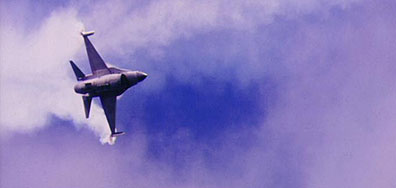
Also, the film loses focus at times and meanders along tangents — such as the remembrances of two Stealth Fighter pilots on the First Shot Fired in the Iraq war, or the glum story of an army recruit in Manhattan looking to turn his life around. This latter tale, along with the story of Wilton Sekzer, a retired Vietnam Vet and NYPD sergeant who lost his son on 9/11 and wants somebody to pay, are handled with more grace and less showmanship than similar vignettes in Michael Moore’s film, but they’re in the same ballpark. (As an aside, I was also somewhat irked by shots of NASA thrown in with the many images of missile tests and ordnance factories. Ok, both involve rockets, research, and billions of dollars, but space exploration and war are different enough goals that such a comparison merits more unpacking.)
Nevertheless, Why We Fight is well worth-seeing, and hopefully, this film will make it out to the multiplexes. If nothing else, it’ll do this country good to ponder anew both a president’s warning about the “disastrous rise of misplaced power,” and a vice-president’s assurance that we’ll be “greeted as liberators.”