The Ghosts of Ford and Bourne.

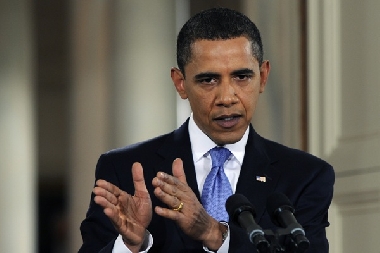
As most everyone keeping up on current events these days knows, the people around the president, as well as the president himself, spend a good bit of time emphasizing the pragmatic nature of this administration. One senior administration official recently deemed the president a “devout nonideologue”, and Obama himself has argued several times that he aims to tackle the myriad problems before us with a “ruthless pragmatism.” Now, we’ve seen nothing to indicate that Obama’s pragmatic nature is an act. If anything, from installing Sen. Clinton as his Secretary of State to keeping Sec. Gates at Defense, it’s clear that pragmatism, accommodation, and inclusiveness are his temperamental instincts as a politician. Nevertheless, it’s also clear that comparisons to Franklin Roosevelt, and the “bold, persistent experimentation” Roosevelt promised in 1932 — and subsequently followed through on over the course of the decade — aren’t entirely undesired by the White House.

Well, I’ve been traveling over the past few days, and thus haven’t been following the news as closely as usual. Still, even given President Obama’s health care announcement on Monday (highly reminiscent of the NRA in that it purports to let the big players in the health care industry help write the codes, so to speak) and the welcome declaration on Wednesday that the administration would soon seek a new regulatory apparatus for derivatives markets, Franklin Roosevelt was not the first president that came to mind as a point of reference for Obama this week.
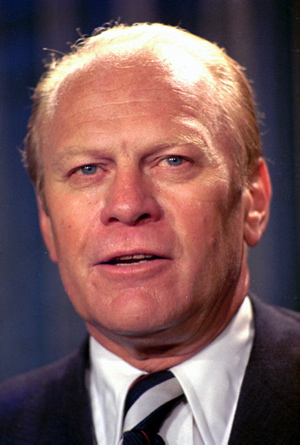
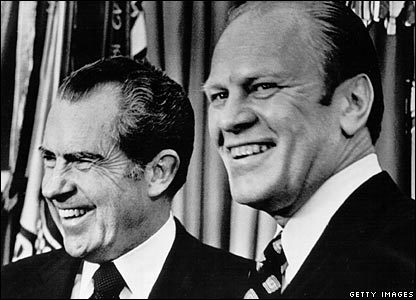
No, that would be Gerald Ford, who, most historians agree, was an honorable man thrust into a thorny dilemma by the crimes of his predecessor, and who grievously hamstrung his own brief administration by deciding to pardon Richard Nixon. And now, it seems, history gets dangerously close to repeating itself. For, it’s moved beyond obvious that the Dubya administration not only willfully engaged in torture — clearly, bad enough — but did so to compel false confessions of an Iraq-9/11 connection that they knew never existed. And yet, we’ve already witnessed the ungainly sight of President Obama equivocating on the question of prosecutions in the name of some dubious “time for reflection, not retribution.” (Never mind that, as President Obama reminds us on other matters, wounds, like corruption, fester in the dark.)

This week, President Obama has compounded his recent error — twice. In the first of two eleventh-hour reversals, Obama — who has promised us “an unprecedented level of openness in government” many times over — instead chose to side with the publicists of the Pentagon and block the court-ordered release of new photographs detailing detainee abuse: “‘The publication of these photos would not add any additional benefit to our understanding of what was carried out in the past by a small number of individuals,’ Obama said yesterday. ‘In fact, the most direct consequence of releasing them, I believe, would be to further inflame anti-American opinion and to put our troops in danger.‘” (How bad are they? If Sy Hersh is correct, and there’s no reason to think he isn’t, they could be very, very bad.)

Then, today, the Obama administration announced they will continue using extra-legal military tribunals, not federal courts or military courts martial, for Gitmo suspects. “‘Military commissions have a long tradition in the United States,’ said Obama in a statement. ‘They are appropriate for trying enemies who violate the laws of war, provided that they are properly structured and administered.’” (The key line of the WP story: “In recent weeks, however, the administration appears to have bowed to fears articulated by the Pentagon that bringing some detainees before regular courts presented enormous legal hurdles and could risk acquittals.)”

Obama’s statements aside, the arguments — re: excuses — in favor of blocking the release of these no-doubt-horrifying photos and maintaining extralegal tribunals — now with 33% less illegality! — are the thin gruel you might expect. The WP’s Dan Froomkin already eviscerated the former quite devastatingly, while Salon‘s Glenn Greenwald, laudable as usual, has taken point on the idiocy of the latter: “[W]e’ll give due process as long as we’re sure we can win, and if we can’t, we’ll give you something less.” In both cases, the principle animating the advice given to President Obama seems mainly to be the usual self-serving, CYA behavior of Dubya holdovers at the Pentagon.

But that doesn’t absolve President Obama of his failures here. For whatever reason — perhaps he’s trying to smooth things over in these areas so he can focus on the considerable domestic problems on his plate — Obama is increasingly making the exact same mistake as Gerald Ford. As other commentators have pointed out, by shoving the rampant illegalities of the GWoT under the rug — or worse, perpetuating them — Obama is dangerously close to making his administration retroactively complicit in the crimes of the previous administration.

Now, I’d like to move on to fixing the economy and universal health care — not to mention voting, lobbying, and campaign finance reform — as much as the next guy., But sidestepping the tough choices on torture and the imperial presidency, as Paul Krugman (whom I’ve had issues with but am in complete lockstep with here) noted a few weeks ago, is simply not an option, if we are to maintain anything resembling our national soul after this egregious wallowing in torture and illegality.

Speaking of which, a quick comment on the emerging question of what and when Speaker Pelosi knew about torture (which the Republicans have shamelessly latched onto like a life raft — see in particular Karl Rove frantically pointing at her to save his own skin the other day. You can almost smell the desperate flop sweat exuding from his every pore.) Well, let’s look into it. Commissions, investigations, prosecutions — let’s quit screwing around and start getting to the bottom of this fiasco. I can’t believe I have to keep writing this like it’s even a bone of contention, but look: If we can’t get it together enough to collectively agree that torture is both immoral and illegal, and that those who designed and orchestrated these war crimes during the Dubya administration be subject to investigation, prosecution, and punishment, then we might as well call this whole “rule of law” thing off. As ethicist David Luban noted yesterday in congressional testimony, the relevant case law here is not oblique. Either the laws apply to those at the very top, or they don’t — in which case, it’s hard to see why anyone else should feel bound to respect them either.

Which brings me back to pragmatism. Hey, in general, I’m all for it, particularly when you consider all the many imbecilities thrust upon the world by the blind ideological purity of the neocons of late. But, let’s remember, the limits of pragmatism as a guiding national philosophy were exposed before all the world before Obama, or even FDR, ever took office. When, after several years of trying to stay well out of the whole mess, Woodrow Wilson entered America into World War I in 1917, the very fathers of Pragmatism, most notably philosopher of education John Dewey, convinced themselves war was now the correct call and exhorted their fellow progressives, usually in the pages of The New Republic, to get behind it. (Many did, but others — such as Jane Addams and Nation editor Oswald Villard — did not.) War went from being a moral abomination to a great and necessary opportunity for national renewal. Given it was a done deal, the pragmatic thing to do now was to go with the flow.
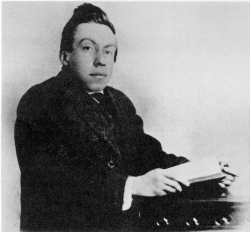
Aghast at this 180-degree shift in the thinking of people he greatly admired, a young writer named Randolph Bourne called shenanigans on this “pragmatic” turnaround, and excoriated his former mentors for their lapse into war fervor. “It must never be forgotten that in every community it was the least liberal and least democratic elements among whom the preparedness and later the war sentiment was found,” Bourne wrote. “The intellectuals, in other words, have identified themselves with the least democratic forces in American life. They have assumed the leadership for war of those very classes whom the American democracy had been immemorially fighting. Only in a world where irony was dead could an intellectual class enter war at the head of such illiberal cohorts in the avowed cause of world-liberalism and world-democracy.

Now, you’d be hard-pressed to find a bigger cheerleader for the progressives than I. But the fact remains that Bourne, who perished soon thereafter in the 1918 influenza epidemic, was prescient in a way that many of the leading progressive thinkers were not. The emotions unleashed by the Great War and its aftermath (as well as the sight of the accompanying Russian Revolution) soon fractured completely the progressive movement in America, and proved exceedingly fertile soil for the reascendancy of the most reactionary elements around. (Back then “Bolshevik” and “anarchist” were preferred as the favorite epithets of the “One Hundred Percent American” right-wing, although “socialist,” then as now, was also in vogue. At least then they had real socialists around, tho’.) And the pragmatic writers and thinkers of TNR, who thought they could ride the mad tiger through a “war to end all wars,” instead found their hopes and dreams chewed up and mangled beyond recognition. They wanted a “world made safe for democracy” and they ended up with the Red Scare, Warren Harding, and an interstitial peace at Versailles that lasted less than a generation.

The point being: however laudable a virtue in most circumstances, pragmatism for pragmatism’s sake can lead one into serious trouble. And, as a guiding light of national moral principle, it occasionally reeks. As Dewey and his TNR compatriots discovered to their everlasting chagrin, you can talk yourself into pretty much anything and deem it “pragmatic,” when it’s in fact just the path of least resistance. And, when your guiding philosophy of leadership is to always view intense opposing sides as Scylla and Charybdis, and then to steer through them by finding the calm, healthy middle, you can bet dollars-to-donuts that the conservative freaks of the industry will always be pushing that “center” as far right as possible, regardless of the issues involved. And, eventually, without a guiding moral imperative at work — like, I dunno, torture is illegal, immoral, and criminal, or the rule of law applies to everyone — you may discover that that middle channel is no longer in the middle at all, but has diverted strongly to the right. In which case, welcome to Gerald Ford territory.

Nobody wants that, of course. We — on the left, at least — all want to remember the Obama administration not as a well-meaning dupe notable mainly for its unfortunate rubberstamping of Dubya-era atrocities, but as a transformational presidency akin to those of Lincoln and the two Roosevelts. To accomplish this goal, it would behoove the White House to remember that Lincoln, pragmatic that he was, came to abolition gradually, but come to abolition he did. Or consider that Franklin Roosevelt, pragmatic that he was, eventually chose his side as well. “I should like to have it said of my first Administration that in it the forces of selfishness and of lust for power met their match,” FDR said in his renomination speech of 1936. “I should like to have it said of my second Administration that in it these forces met their master.

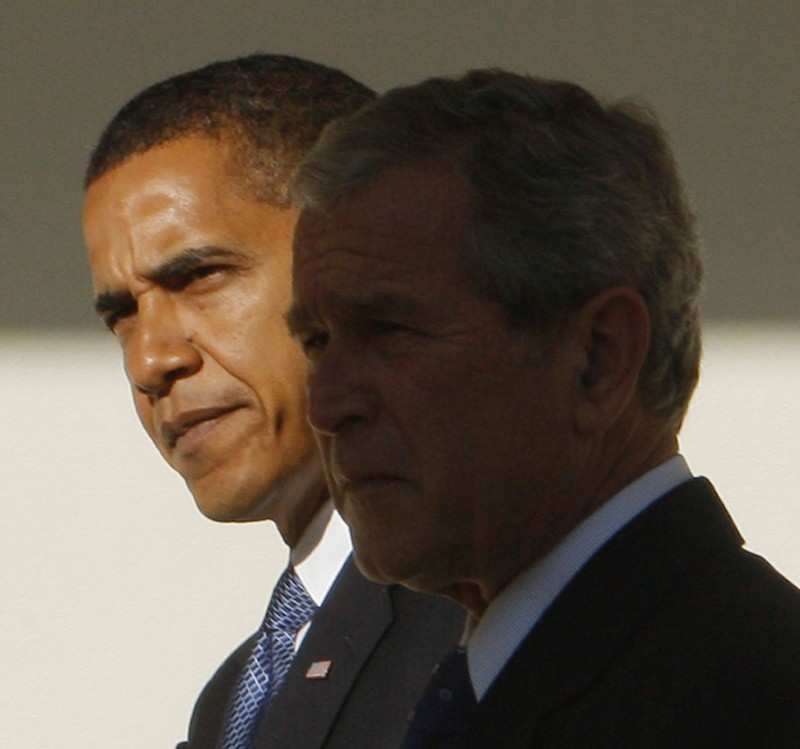
I should like to have it said of President Obama’s administration as well. The alternative — Obama’s sad, “pragmatic” capitulation to Dubya-era criminals — is too depressing to contemplate. But the picture below (found here) gives you a pretty good sense of what it’ll mean for America if we don’t get to the bottom of this, and soon.

Hedge of No Return.

But while many stakeholders made sacrifices, some did not. In particular, a group of investment firms and hedge funds that hoped to hold out for a taxpayer-funded bailout. I don’t stand with them. I stand with Chrysler’s employees, management and suppliers. I don’t with stand with those who held out when everybody else made sacrifices.” President Obama announces that Chrysler will file for bankruptcy, and lays the blame squarely at the feet of hedge funds who rejected an 11th-hour deal to save the company, apparently in the hopes of garnering more bailout cash.

The hedge funds in question have fired back, of course. Apparently, they’re all for the “rule of law” and upholding our “world-leading bankruptcy code.” I’d probably be more inclined to take them seriously on these matters if they weren’t also trying to spike regulation of their industry that is long overdue. At it is, i’m thinking profit is more of a motivator here than principled civil disobedience.

At any rate, I think Salon‘s Andrew Leonard is exactly right about where public opinion will come down on this one. Says one observer (cited by Leonard) of what happened today: “The banksters are eagerly, shamelessly, and openly harvesting their pound of flesh from financially stressed average taxpayers, and setting off a chain reaction in the auto industry which has the very real risk of creating even larger scale unemployment than the economy already faces. It’s reckless, utterly irresponsible, over-the-top greed.” From my admittedly limited vantage, that sounds like a plausible reading.

I don’t agree with that…do I?

“I actually think that the state secret doctrine should be modified. I think right how it’s over-broad. But keep in mind what happens is, we come into office, we’re in for a week — and suddenly we’ve got a court filing that’s coming up. And so we don’t have the time to effectively think through what, exactly, should a overarching reform of that doctrine take. We’ve got to respond to the immediate case in front of us.”

In case you missed it last night — I’ll concede, I’d forgotten about the presser and was watching the NBA playoffs — President Obama was finally asked about his troubling continuation of Dubya’s state secrets policy during his “100 Days” press conference last night. [Full transcript.] And his answer — basically, the justice department turns like a battleship, but we’re on the case — is somewhat heartening, I guess, in that the president seems to concede anew that the privilege has been abused of late, even under his own administration. But, as Salon‘s Glenn Greenwald reminds us today, the Obama/Holder JD has done a good bit more than just “stay the course” on states’ secrets since coming into office, and last night’s excuse — well, despite our actions over 100 days, this isn’t *really* our policy — isn’t going to hold water for much longer.

Also last night, while sort of pressed into it by ABC News’ Jake Tapper, President Obama said in no uncertain terms both that waterboarding is torture (correct) and that, as we all know, his predecessor’s administration sanctioned it: “I believe that waterboarding was torture. And I think that the — whatever legal rationales were used, it was a mistake.” Now, it isn’t the president’s call to move forward on an investigation and possible prosecutions at this point — that task falls to Attorney General Holder. Still, if what the president said last night is true, and it obviously is, then AG Holder has only one choice moving forward. It’s time to get to the bottom of this.

A Republic of Knowledge.

“I believe it is not in our character, American character, to follow — but to lead. And it is time for us to lead once again. I am here today to set this goal: we will devote more than 3 percent of our gross domestic product to research and development. We will not just meet, but we will exceed the level achieved at the height of the space race, through policies that invest in basic and applied research, create new incentives for private innovation, promote breakthroughs in energy and medicine, and improve education in math and science.

It’s poetry in motion: In a clear break with his predecessor, President Obama pledges $420 billion for basic science and applied research. “And he set forth a wish list including solar cells as cheap as paint; green buildings that produce all the energy they consume; learning software as effective as a personal tutor; prosthetics so advanced that you could play the piano again and ‘an expansion of the frontiers of human knowledge about ourselves and world the around us.’” Huzzah! (And fwiw, I would also like more manned spaced exploration…and a jetpack.)

U.S. History for Dummies.

As many readers here well know, I’ve spent a good bit of time over the past decade studying US history. (In fact, over the past few years, I’ve occasionally helped my advisor keep a textbook up to date that recently drew the ire of right-wing blowhard Bill O’Reilly. Apparently, those damn pesky facts were somehow mitigating O’Reilly’s ability to spew forth the usual idiotic blather.)

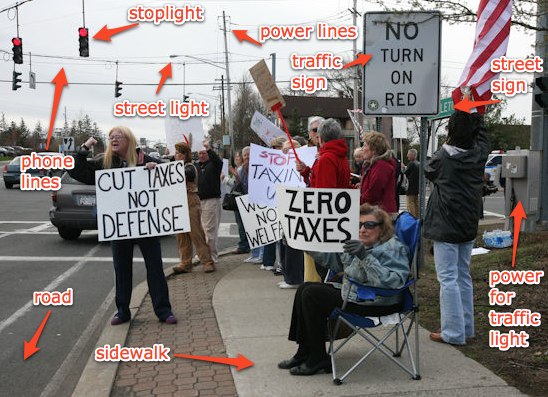
Anyway, over that period of time, I believe I have in fact learned me a few things. So, as a public service of sorts, and because, after this morning’s revelations, I’ve reached the limit of craven and/or patently stupid falsehoods that I can feasibly ingest over so short a time, some “U.S. History for Dummies.” I expect most everyone who comes by this site with any frequency knows all this, but ya never know. Apologies for the didacticism in advance — if this were this a Coors Light commercial, this would be where i vent. (And thanks to Lia for the timely visual tax lesson, above.)

  • The Tea Party: As you no doubt know, the Boston Tea Party of 1773 was recently appropriated by FOX News and the conservative group Freedomworks to simulate a widespread popular uprising against high taxes. (In other words, it was an “astroturf,” rather than a grass-roots, movement.) And, yes, the inconvenient fact that President Obama and the Democratic Congress actually lowered income taxes for 95% of Americans earlier this year didn’t seem to dissuade them from trying to jury-rig some rather dubious anti-tax ramparts and gin up enough disgruntled FOX-watchers to man them.

    At any rate, as most people remember from high school, the original 1773 Tea Party was not a protest against high taxes or high prices at all. (In fact, legally imported tea — i.e. that of the East India Company, which was both suffering serious setbacks over in India and losing market share to smuggled Dutch tea at the time — was actually cheaper in the colonies after the Tea Act, since it was now exempt from the usual obligations.)

    In small part a reaction of the East India’s commercial rivals to this sweetheart deal, the Boston Tea Party was mainly held to uphold the principle of No taxation without representation. Which I don’t think I need to explain. So, with the minor exception of DC-area conservatives who attended the tea gathering in Washington (without crossing over from Virginia or Maryland), the, uh, “teabaggers” don’t really have a leg to stand on here. This is particularly true after you consider that both ruthless gerrymandering and the vagaries of the Electoral College (I’m looking at you, Wyoming) actually tend to lead to over-representation of conservative Republicans in our halls of governance, even despite heavy losses for the “Grand Old Party” in 2006 and 2008.

  • The “Right” of Secession: Apparently, Rick Perry, the right-wing governor of Texas, really wants to keep his job. As such, he’s scared stiff of the forthcoming primary challenge by Sen. Kay Bailey Hutchison, who happens to be much more popular than he is among Texas Republicans. So, to sow up his “activist” (re: freak show) bona fides, this desperate fellow has been doing anything and everything he possibly can to prostrate himself before the paranoid ultra-right, including appearing before the current poobahs of the GOP’s lunatic fringe, Glenn Beck and Michael Savage. As you no doubt know, this recently culminated in Gov. Perry’s upholding Texas’ right to secede before a crowd of rabid teabaggers. Said the Governor: ““We’ve got a great union. There’s absolutely no reason to dissolve it. But if Washington continues to thumb their nose at the American people, you know, who knows what might come out of that…

    Well, in fact, no state in the Union has any legal right to secede. (Not even Texas.) The existence of such a right was posited and debated quite often in the early years of the republic: by Jefferson and Madison in the Virginia and Kentucky resolutions, by the members of the Hartford Convention, by South Carolina’s philosopher-politician John C. Calhoun, and countless others.

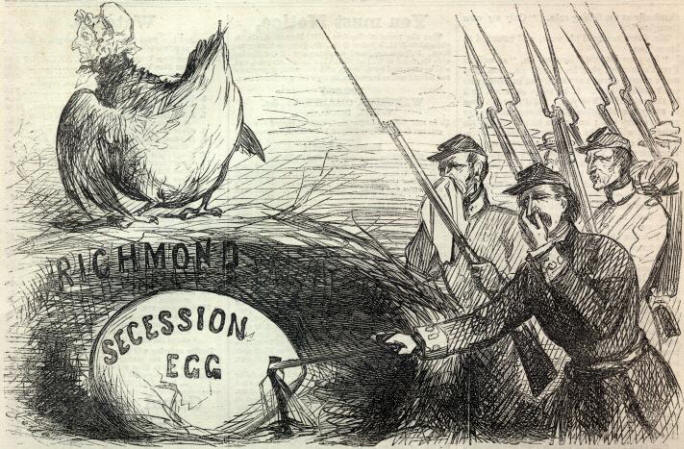
    But the illegality of secession was eventually confirmed — in blood — when eleven states attempted to pull out of the Union in 1861, due mainly to differing opinions on the institution of slavery and its expansion into the western territories. As a result of this insurrection by the southern states, a violent conflict broke out, which we call the Civil War. It lasted four years, and it was kind of a big deal.

    Prior to the war, the states of the Confederacy believed secession to be their natural right, while those remaining in the Union believed it to be tantamount to an act of treason. With the Union victory in that conflict, and the subsequent readmittance of southern states in such a manner that reaffirmed that no right of secession exists, the question was settled. So it remains to this day.

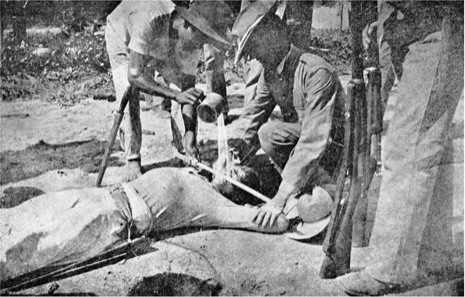
  • Waterboarding, Torture, and “Just Following Orders”: In the wake of recent revelations, there’s been a renewed push among certain conservatives to laugh off waterboarding as not being constitutive of torture. (See also Rush Limbaugh’s fratboy defense of Abu Ghraib a few years ago.) But (as even John McCain concedes), in the years after World War II, there was no question among Americans that waterboarding is torture. In fact, Japanese soldiers were tried and convicted of war crimes for waterboarding American GIs and Filipino prisoners. When you think about it, it’s not really a tough call.

    Another argument we’ve heard lately — today Sen. McCain made it with his usual comrades-in-arms, Sens. Lieberman and Graham, while trying to protect Dubya’s lawyers — is that the CIA officials who actually conducted these recent acts of torture should be exempt from prosecution, because they were following the legal dictates of those higher-up in the administration. (To follow the reasoning around the circle, the torturers should be exempt because they were listening to the lawyers, and the lawyers should be exempt because they didn’t do the actual torturing. Cute.)

    Anyway, whatever you think of the merits of this argument, this is usually referred to as the Nuremberg defense, and it is in fact no defense at all. Argues Principle IV of the Nuremberg Principles, devised by the Allies after WWII to determine what constituted a war crime: “The fact that a person acted pursuant to order of his Government or of a superior does not relieve him from responsibility under international law, provided a moral choice was in fact possible to him.” Insert “CIA interrogator” for person in that last sentence and you can pretty much see the problem.

  • Is America a Christian Nation?: At the end of his recent European tour, President Obama told an audience in Turkey the following: “We do not consider ourselves a Christian nation or a Jewish nation or a Muslim nation. We consider ourselves a nation of citizens who are bound by ideals and a set of values.” This statement — well the “not a Christian nation” part of it, at least — prompted no small amount of consternation from the porcine-moralist wing of the GOP — James Dobson, Karl Rove, Newt Gingrich, and sundry other freaks of the industry — all of whom fell over themselves to proclaim to the Heavens and preach to the FOX News choir that, yes, Virginia, America is a glorious Christian nation.

    America is not a Christian nation. This will be patently obvious to anyone who’s ever heard the phrase “separation of church and state.” Unlike, say, England, America does not have and has never had an official, established church. This is very much by design. For proof of this not-very-radical claim, see the very first clause of the very first amendment to the Constitution: “Congress shall make no law respecting an establishment of religion, or prohibiting the free exercise thereof.”

    If that doesn’t do it for you, see George Washington’s famous 1790 letter to the Jewish residents of Newport, Rhode Island. “May the Children of the Stock of Abraham, who dwell in this land, continue to merit and enjoy the good will of the other Inhabitants; while every one shall sit under his own vine and fig tree, and there shall be none to make him afraid.

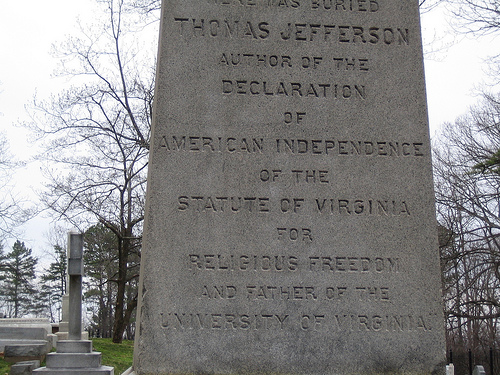
    Or consider that Thomas Jefferson skipped his presidency on his tombstone to make room for his authorship of the Virginia Statute for Religious Freedom: “Be it enacted by the General Assembly, That no man shall be compelled to frequent or support any religious worship, place, or ministry whatsoever, nor shall be enforced, restrained, molested, or burdened in his body or goods, nor shall otherwise suffer on account of his religious opinions or belief; but that all men shall be free to profess, and by argument to maintain, their opinion in matters of religion, and that the same shall in no wise diminish enlarge, or affect their civil capacities.” (We could also make mention of the Jefferson Bible, but let’s start slow.)

    Is the reasoning here too circuitous for Rove, Gingrich, et al to follow? Ok, then, here’s the cheat sheet: the 1797 Treaty of Tripoli, passed by a Congress of our Founders without declaim and signed into law by President John Adams. It begins: “As the Government of the United States of America is not, in any sense, founded on the Christian religion…” Did y’all catch it this time? Good, let’s move on.

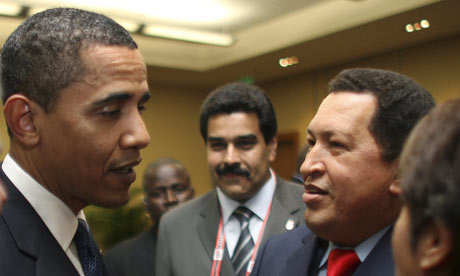
  • A Smile for Chavez: Our new president also attended the Summit of the Americas recently, at which he was photographed smiling and shaking hands with Venezuelan autocrat Hugo Chavez, a particular bete noire of the right who has said all manner of unpleasant things about America over the past few years.

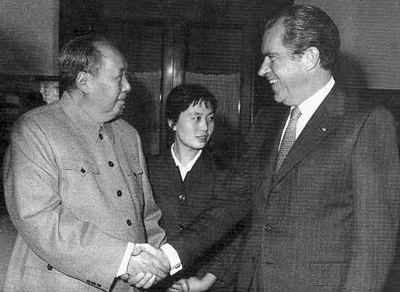
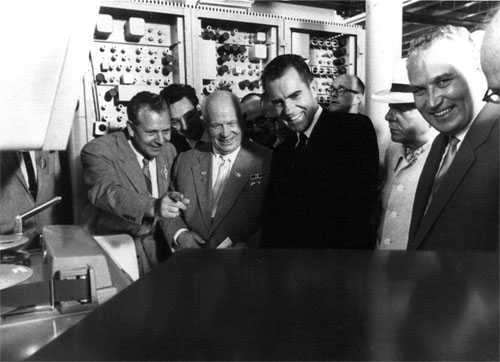
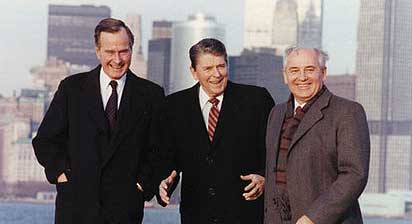
    After the picture was taken, conservatives went predictably livid, with Matt Drudge headlining the offending photograph with the usual red text, Dick Cheney deeming Obama “a weak president” on FOX News, and Gingrich arguing that it made Obama look “weak like Carter.” “We didn’t rush over, smile and greet Russian dictators,” said Newt, and he wasn’t the only potential 2012’er aghast at Obama’s behavior. Sen. John Ensign of Nevada called the president “irresponsible” and the consistently shameless Mitt Romney painted Obama a “timid advocate for freedom”.

    Um, ok. Well, let’s see here…


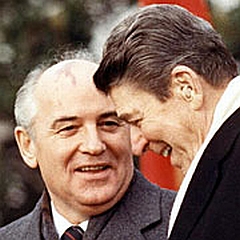
    I could go on. With regards to that last one — Reagan yukking it up with Mikhail Gorbachev, then of “the evil Empire” — it didn’t take long before (surprise) Newt was caught in a contradiction. Apparently, Gingrich had previously argued on his website that Ronald Reagan’s good humor with Gorby was a sign of strength, not weakness.

    Speaking of which, as Lawrence O’Donnell noted on MSNBC the other day, saintly old Ronald Reagan didn’t just smile and shake hands with America’s enemies. His administration sold them weapons under the table. So, please, assorted puddin’-heads of the GOP talkocracy, spare me your warmed-over tripe about poor diplomacy and weak leadership. As with everything else above, I’ve swallowed enough of your swill over the past few weeks to last me a lifetime.

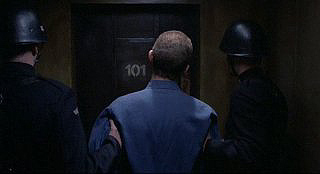
  • Inside our Room 101.

    “You asked me once,” said O’Brien, “what was in Room 101. I told you that you knew the answer already. Everyone knows it. The thing that is in Room 101 is the worst thing in the world.”

    The door opened again. A guard came in, carrying something made of wire, a box or basket of some kind. He set it down on the further table. Because of the position in which O’Brien was standing, Winston could not see what the thing was.

    “The worst thing in the world,” said O’Brien, “varies from individual to individual. It may be burial alive, or death by fire, or by drowning, or by implement, or fifty other deaths. There are cases where it is some quite trivial thing, not even fatal…In your case,” said O’Brien, “the worst thing in the world happens to be rats.”

    And, sometimes, here in our own Room 101, it’s insects. As breaking everywhere this afternoon, the President authorizes the release of four long-awaited CIA memos that detail the rationalizing and application of Bush-era torture policies. [No. 1 | No. 2, No. 3a/3b | 4a/4b.] And, as Salon‘s Glenn Greenwald notes, they seem to suggest that even the parties-that-be knew what they were doing constituted torture. (“Each year, in the State Department’s Country Reports on Human Rights Practices, the United States condemns coercive interrogation techniques and other practices employed by other countries. Certain of the techniques the United States has condemned appear to bear resemblance to some of the CIA interrogation techniques…The State Department’s inclusion of nudity, water dousing, sleep deprivation, and food deprivation among the conduct it condemns is significant and provides some indication of an executive foreign relations tradition condemning the use of these techniques.“) But, they approved these already-condemned practices as legal anyway, with the caveat that they “cannot predict with confidence whether a court would agree with this conclusion.” Yeah, you think?

    Well, let’s hope the courts get a chance to decide either way. While releasing these documents today, Pres. Obama and Attorney General Holder also made clear that the CIA interrogators involved will not be prosecuted for these acts. “‘It would be unfair to prosecute dedicated men and women working to protect America for conduct that was sanctioned in advance by the Justice Department,’ he said in a statement.” Um, I’m of the opinion that it would be unfair to get strung up in a, cough, “stress position” by a bunch of Cheney-authorized CIA yahoos and then see no legal recourse for it. (And, hey, “just following orders” — what a novel legal defense. Who were the ad wizards that came up with that one?)

    On the other hand, as the WP points out: “Today’s carefully worded statement left open the possibility, however, that agents and higher-level officials who may have ventured beyond the strategies approved by Bush lawyers could face legal jeopardy for their actions.” That still closes too many legal doors, imho. The strategies approved by Bush lawyers are horrible — and illegal — enough. But, at least we can still hold out the minute possibility that the real, top-level architects of Dubya-era torture policy will face some sort of prosecution for their crimes, above and beyond their inevitable condemnation in the history books. (President Obama may argue that “[t]his is a time for reflection, not retribution,” but, the law is the law. And, as he should know, pardoning Nixon didn’t do Gerald Ford any favors.)

    Either way, let’s be clear: These memos prove beyond a shadow of a doubt — as if there were any doubt left — that it was the stated and directed policy of the Dubya-era CIA to engage in acts they knew to be torture. That is unacceptable, completely antithetical to our ideals, and exceedingly worthy of a criminal investigation. If, in the name of national unity or CIA morale or whatever, the president wants to give a pass to the flunkies who actually held the victims down as they flailed, choked, or writhed in agony…well, that just means somebody else higher-up has to pay. Fine. But, if the rule of law means anything anymore, and I believe it does, the people responsible must be held to account.

    Fighting “Fighting the Last War.”

    After Gates was confirmed as George W. Bush’s defense secretary in December 2006, he gave several speeches outlining major reforms that his successor should undertake–in weapons procurement, promotion policy, and the whole careerist culture inside the Pentagon. (With only two years in office, combined with a plateful of crises in Iraq and elsewhere, he knew he wouldn’t have time to take those steps himself.) When he stayed on at Barack Obama’s request, and thus became his own successor, many wondered whether he would turn his words into action. With this budget, he has begun to do just that.

    A holdover from the bookmarks of last week: Slate‘s Fred Kaplan offers a concise overview of the proposed Obama-Gates military spending reforms. (These are not spending cuts, by the way, despite what you may have heard — just some much-needed and long-overdue reprioritizing over at the Pentagon. I also like the idea of phasing out defense contractors in favor of presumably much more cost-conscious civil servants.) “This budget will not go down easily in the Pentagon or in Congress. The F-22, the DDG-1000, and the Future Combat Systems are the favored systems by much of the Air Force, Navy, and Army brass, respectively…The F-22 in particular is also a favorite of many legislators — the result of politically shrewd subcontracting that spread out production of the plane to key districts in 46 states.

    We are the World.

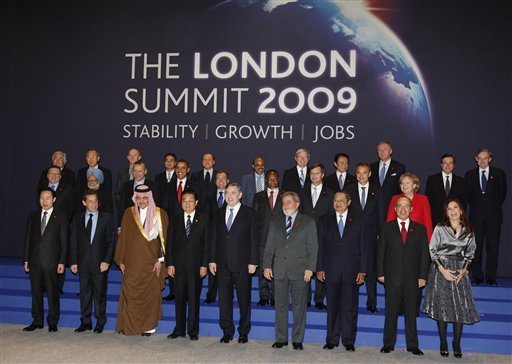
    We are its leaders. We are the ones who make a brighter day, so let’s give a trillion. “Mr. Brown, who organized the meeting in a hangarlike conference center in London, said: ‘This is the day the world came together to fight against the global recession. Our message today is clear and certain: we believe that global problems require global solutions.’

    In the meantime, Slate‘s Fred Kaplan applauds the return of real, honest-to-goodness American statecraft in London. “Vast multinational conferences, like the G20 summit…are useful mainly for the ‘bilaterals’ — the one-on-one side-room conversations — and, in these forums, President Barack Obama is living up to high expectations. Which is to say, the United States seems to be returning to diplomatic basics — a development that in the wake of the last eight years is practically revolutionary.

    At the very least, the president’s diplomatic mojo seemed to work on Russian president Dmitry Medvedev. “‘Yesterday I spoke about this with my new comrade President Barack Obama,’ Medvedev told reporters travelling with him to the London summit…’I liked the talks. It is easy to talk to him. He can listen. The start of this relationship is good,’ he said, adding: ‘Today it’s a totally different situation (compared to Bush).'”

    Hulk Free to Smash Again.

    Mr. Holder said in a statement that ‘I have concluded that certain information should have been provided to the defense for use at trial.'” Hmmm. Why does Clay Davis come to mind? After discovering that agents at Justice and the FBI tried to frame a guilty man, as it were, Attorney General Eric Holder drops the prosecution of 85-year-old former Senator Ted Stevens. “The collapse of the Stevens case was a profound embarrassment for the Justice Department, and it raised troubling issues about the integrity of the actions of prosecutors who wield enormous power over people they investigate.” Uh, ok…but why aren’t we seeing this judicious, otherwise laudable commitment to fair play when it comes to state secrets and victims of extraordinary rendition?

    At any rate, as official Washington rushes to embrace Stevens once more, let’s keep the big picture in mind: “[E]ven leaving criminal wrongdoing aside, no one disputes that Stevens accepted hundreds of thousands of dollars worth of home renovations and gifts (remember that massage chair?) from a supporter who had a slew of business interests that Stevens was in a position to affect as a powerful federal lawmaker and appropriator. That’s what we call ‘corrupt’. As Melanie Sloan of Citizens for Responsibility and Ethics in Washington put it, according to The Hill’s paraphrase: ‘Holder’s decision in no way should be viewed as a vindication of Stevens but rather as an indictment of the Justice Department’s inability to do one of its most important jobs.‘” True, that.

    He can’t get no relief.

    “‘Our nation finds itself in uncharted territory in the deep emptiness of space,’ Obama announced. ‘The Old Girl has limited supplies, no allies, and now, no hope. I never said this would be an easy journey. Yet I promise you this: There is a place where there is no war and no economic turmoil. It is where, according to the Sacred Scrolls handed down to us by the Lords of Kobol, the thirteenth tribe traveled over three thousand years ago. That place is called Earth. Not the other Earth. This Earth. It’s complicated. Anyway, I plan to take us there.’

    Businessmen, they drink his wine: By way of my sis, word from The Onion is that President Obama has been depressed and distant ever since the BSG finale. “‘I’m a little concerned,’ first lady Michelle Obama was overheard saying at a fundraising event Tuesday. ‘When Firefly was canceled, he walked around like a zombie for a week, and Serenity was the only thing that snapped him out of it.’