The New “Black Hole”: Bagram.

The bottom line is this: Current procedures under the CSRT are such that a perfectly innocent individual could be held and could not rebut the Government’s case and has no way of proving his innocence. I would like somebody in this Chamber, somebody in this Government, to tell me why this is necessary.Me too, Senator Obama, me too.

In a decisive break with his campaign stances and the best indicator yet that this administration is now happily perpetuating deeply troubling Bush-era policies, the President wins the right to hold detainees indefinitely in Bagram — the difference from the Boumediene decision on Gitmo being that Bagram is a “war zone.” (And Ben Franklin’s admonition aside, that’s an excuse you hear quite a bit these days.)

FWIW, Politico’s Josh Gerstein — while bending over backwards, as per the Village norm, not to call torture “torture” — suggests civil liberties concerns are overblown here, but check out his reasoning: “The Obama administration…has, so far, resisted seeking a full-scale preventive detention law that would apply to future captives. Instead, it has pleaded with civil liberties and human rights groups not to oppose some legal mechanism to allow the continued detention of Al Qaeda captives, at least some of whom may be untriable because of aggressive interrogations many view as torture.

Oh, please. We have to hold them forever because we tortured them? How utterly and completely effed up is that? As Stephen Colbert well put it: “It’s essentially the same stance taken by George Bush. With one important difference: Obama makes the kids like it.

Spitting on a Gift Horse.

They’re not accustomed to being engaged in politics this way,” says a private-equity investor. ‘Their skin isn’t toughened. They actually take [the attacks by Obama] personally. This is a profession with a lot of smart people, but who aren’t necessarily terribly introspective. They think they actually deserve to make all this money. So any attack on their livelihood is, ahem, unpleasant.’

In the wake of the Senate’s 59-39 passage of financial reform last week (not to mention increasing evidence of rampant and pervasive fraud at Goldman, Morgan, and elsewhere), New York‘s John Heilemann surveys the bruised egos of Wall Street’s would-be robber barons. (In very related news, Paul Krugman and the WP note that Wall Street is now betting heavily on the GOP again.)

Keep in mind: Wall Street is angry with the administration despite the fact that “Geithner’s team spent much of its time during the debate over the Senate bill helping…kill off or modify amendments being offered by more-progressive Democrats.” [Change we can believe in!] Heilemann writes: “Whatever the effects of the bill, among them will be neither an end to the too-big-too-fail doctrine nor any curb on what the sharpest Wall Streeters see as the central threat to the system’s stability: excessive financial leverage. Geithner, Summers, and Obama had little interest in tackling those matters, not because they are indentured servants to Wall Street but because at heart they are all technocrats who believe the system doesn’t need to be rebooted or downsized, merely better supervised.

Still, on the bright side and despite the ambivalence (or open opposition) from folks in high places, this bill did get significantly stronger on the Senate floor, and in some ways is now stronger than the House version passed last year. Let’s hope this welcome progressive trend continues in conference.

No Joy in Kabul.

Things in that unhappy country are going badly — much worse, of course, than Team Obama had to pretend this week but quite a bit worse than even a sensible skeptic might think. And unless Karzai takes to heart the lectures he heard (someone must have given him a stern talking-to amid all the bonhomie), things are only going to get worse still.

After perusing an unclassified DoD report released last month, Slate‘s Fred Kaplan sees ominous trends unfolding in Afghanistan. “[T]he full report is a hair-raiser. The news is almost all bad; and the few bits of good news turn out, on close inspection, to be extremely misleading…[T]he report states, ‘The insurgents perceive 2009 as their most successful year.’

Cut Corners Kill Coasts.


We had this gradual discovery during Hurricane Katrina, where a natural disaster eventually became seen as what it was, a man-made failure. And now, what was called an ‘act of God’ and a freak accident by the defenders of the pollution industry is now being labeled, proof positive, as the consequence of design failure. Not only did the blowout preventer under the Deepwater Horizon well have a leak in it, not only did it include a dead battery, not only were the tests on it falsified for years, but when engineers actually needed to use it and tried to activate it, they didn’t have the right schematics.

As the Gulf runs black, it’s the same old story: FDL’s David Dayen brings us up-to-date on the idiotic and/or corrupt shenanigans coming to light in the wake of the (still-gushing) Deepwater Horizon gusher. “This is all a consequence of aggressive deregulation by industry, the maneuvers whereby powerful interests save billions in safety costs. They follow the rules at their discretion, they practically own the regulatory agency. It’s amazing how much this mirrors the problems on Wall Street. And just like with Goldman Sachs, the criminal justice system may get involved.” (Pic via TBP.)

Update: “‘We don’t have any idea how to stop this,’ Simmons said of the Gulf leak. Some of the proposed strategies — such as temporarily plugging the leaking pipe with a jet of golf balls and other material — are a ‘joke,’ he added. ‘We really are in unprecedented waters.’

The Witchhunt is On.

Is our huge deficit a problem today? Not if you think people should have jobs. Private sector demand has plunged because of the collapse of the bubble. If the public sector does not fill the demand gap with deficit spending, then we have less demand and fewer jobs. That’s worth saying a few hundred thousand times since the deficit hawks have filled the airwaves and cyberspace with so much nonsense.

The CEPR’s invaluable Dean Baker rails anew at the deficit hysteria currently in Beltway vogue. I’ve said this several times already now, but I just cannot take anyone seriously who froths and frets about looming deficits, but then says nary a word about out-of-control defense spending. And right now, when it comes to such deficit peacocks, DC is a full-fledged menagerie.

Update: “The danger posed by the deficit ‘is zero. It’s not overstated. It’s completely misstated.’Ezra Klein talks with James Galbraith, son of the venerable J.K. Galbraith and originator of the great witchcraft metaphor, about the deficit hysteria seizing Washington:

[W]e should be focusing on real problems and not fake ones. We have serious problems. Unemployment is at 10 percent. if we got busy and worked out things for the unemployed to do, we’d be much better off. And we can certainly afford it. We have an impending energy crisis and a climate crisis. We could spend a generation fixing those problems in a way that would rebuild our country, too. On the tax side, what you want to do is reverse the burden on working people. Since the beginning of the crisis, I’ve supported a payroll tax holiday so everyone gets an increase in their after-tax earnings so they can pay down their mortgages, which would be a good thing.

Kagan’s Time to Shine.

“‘I am confident that she’s a solid, reliable modern Democrat…She’s not George McGovern or whoever the liberal left of the Democratic party would want, but the left of the Democratic party isn’t where the party is any more. She’s a good, solid Clinton-Obama Democrat.‘”

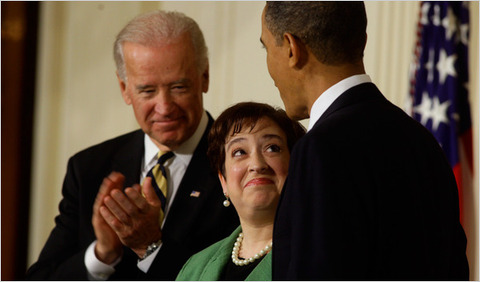
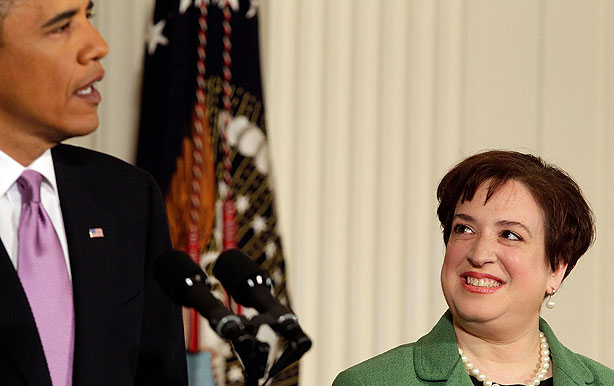
Well, that’s the trick, isn’t it? Particularly that she’ll be replacing the irreplaceable John Paul Stevens. In any case, President Obama has made his second pick for the Supreme Court, and it is his Solicitor General and former Harvard Law Dean Elena Kagan. “As solicitor general, Ms. Kagan has represented the government before the Supreme Court for the past year, but her own views are to a large extent a matter of supposition.

Making the progressive case for Kagan: Larry Lessig, an old friend of hers: “The Kagan I know is a progressive…[T]he core of Kagan’s experience over the past two decades has been all about moving people of different beliefs to the position she believes is correct. Not by compromise, or caving, but by insight and strength. I’ve seen her flip the other side.” Lessig expounds on this coalition-builder argument here: “To hear the liberals talk about it, it sounds like they think we need a Thomas or Scalia of the Left…But nobody who understands the actual dynamics of the Supreme Court could actually believe that such a strategy would produce 5 votes.” (To which one must ask, really? Who’s gonna flip?)

Making the progressive case against Kagan: Salon‘s Glenn Greenwald: “[G]iven that there are so many excellent candidates who have a long, clear commitment to a progressive judicial philosophy, why would Obama possibly select someone who — at best — is a huge question mark?…I believe Kagan’s absolute silence over the past decade on the most intense Constitutional controversies speaks very poorly of her.” This was a follow-up from another piece, where he argued: “Kagan, from her time at Harvard, is renowned for accommodating and incorporating conservative views, the kind of ‘post-ideological’ attribute Obama finds so attractive.” Interestingly, this last part seems much the same argument Lessig’s making in her favor, with the valence changed.

(As an aside, this feud got a bit heated, with Greenwald deeming Lessig a liar and stooge. Having been on the wrong end of Greenwald’s wrath myself on the Citizens United case, Lessig’s rebuttal to this charge sounded all-too familiar: “Chill, Glenn. Dial down the outrage. Dial back the hyperbole. And stop calling those who applaud you liars…[Y]ou can make your point well enough without painting everyone else as liars or constitutional crazies.” True story.)

Anyway, speaking of Citizens United, since the President has explicitly said that decision is lousy law several times over, I presume he’s made sure Kagan is in agreement on that front. (He has, right?) And, as I said back during John Roberts’ nomination, my feeling is generally the president’s prerogative in choosing Supreme Court justices should be respected. (Can’t countenance Roberts’ lying, tho’.) So, if Kagan’s the president’s choice, I’m prepared to give her the benefit of the doubt and support the nomination.

But, quite frankly, I shouldn’t have to doubt (and here, the next two links are via Greenwald.) As the NYT editorial page well put it: “President Obama may know that his new nominee to the Supreme Court, Elena Kagan, shares his thinking on the multitude of issues that face the court and the nation, but the public knows nothing of the kind. Whether by ambitious design or by habit of mind, Ms. Kagan has spent decades carefully husbanding her thoughts and shielding her philosophy from view.

So, sure, I guess it’s entirely possible Kagan is a secret superprogressive of the Leonard Cohen type. (“They sentenced me to 20 years of boredom, for trying to change the system from within.“) But there’s another explanation that’s more likely. And, loath as I am to agree with David Brooks, his column today echoes almost exactly what I was thinking:

Kagan has apparently wanted to be a judge or justice since adolescence (she posed in judicial robes for her high school yearbook.) There was a brief period, in her early 20s, when she expressed opinions on legal and political matters. But that seems to have ended pretty quickly. She has become a legal scholar without the interest scholars normally have in the contest of ideas. She’s shown relatively little interest in coming up with new theories or influencing public debate. Her publication record is scant and carefully nonideological…What we have is a person whose career has dovetailed with the incentives presented by the confirmation system, a system that punishes creativity and rewards caginess.

That’s my rub too, and it dovetails with larger problems I have with DC political culture. More often than not, the people who tend to succeed here are the ones who keep their head down, play the DC game, stay resolutely non-ideological and unobtrusive in their opinions. never go out on a limb, never say or do anything that could hurt their bid to be a Big (or Bigger) Shot down the road. (Hence, the whole phenomenon of The Village.)The problem is, these plodding, risk-averse careerist types are exactly the type of people you don’t want making decisions in the end, because they will invariably lead to the plodding, risk-averse and too-often rudderless politics of the lowest common denominator.

I’m really hoping the future Justice Kagan isn’t another example of this troubling trend, because as I said when Stevens retired: “The Court needs a strong and unabashed liberal conscience right now. What it emphatically does not need is another centrist technocrat that will help push the Court ever further to the right” But, as Kurt Vonnegut put it in Mother Night, “We are what we pretend to be, so we must be careful about what we pretend to be.” And when someone spends decades being so careful and circumspect in the face of so many obvious injustices, both by recent administrations and in the world at large…well, I really have to wonder about their judgment.

Update: Having said all that, this recently unearthed 1996 internal campaign finance reform memo to Chief of Staff Leon Panetta, on which Kagan is one of six signers, suggests she is in fact on the right side of the campaign finance reform issue: “It is unfortunately true that almost any meaningful campaign finance reform proposal raises unconstitutional issues and will provoke legal challenge. This is inevitable in light of the Supreme Court’s view — which we believe to be mistaken in many cases — that money is speech and attempts to limit the influence of money on our political system therefore raises First Amendment problems. We think…the Court should reexamine its premise that the freedom of speech guaranteed by the First Amendment always entails a right to throw money at the political system.” So that’s a big check-mark in my book — Unfortunately, other Clinton-era memos are less promising.

You down on OPM? (Yeah, you know them.)

‘You want to pull your hair out, you want to scream, you want to shout,’ said Stephanie Jones, 32, of Hyattsville, who lamented that she is only ‘killing trees’ with her 75 federal job applications over the past three years. David T. Ellwood, dean of Harvard University’s Kennedy School of Government, describes it as a ’19th-century hiring system’ in which applications disappear into a ‘black hole.’ The process, ‘even at the best of times,” he added, “can take nine months or a year.’

In a much-needed and long overdue move for anyone who’s ever used USAJobs.gov, the Obama administration moves to revamp and streamline the federal hiring process. “Although some government managers may like the current process because it weeds out certain applicants, calls for a hiring overhaul have come from across the spectrum, including unions, good-government groups, Democrats and Republicans.

FinReg: Where Things Stand.

Last week, Congress decided it would not confront Too Big To Fail, the single gravest threat to our collective financial security. But there are still several key Wall Street reforms worth fighting for–reforms that must be enacted before the next crisis hits, with or without a big bank break-up. And fortunately, key Senators have authored amendments dealing with each one.” In HuffPo, Zach Carter delineates the most worthwhile progressive amendments to financial reform still up for debate in the Senate. A good encapsulation of the state of play.

Change You Can Be Afraid Of.


“‘You’re coming of age in a 24/7 media environment that bombards us with all kinds of content and exposes us to all kinds of arguments, some of which don’t always rank all that high on the truth meter,’ Obama said at Hampton University, Virginia. ‘With iPods and iPads and Xboxes and PlayStations, — none of which I know how to work — information becomes a distraction, a diversion, a form of entertainment, rather than a tool of empowerment, rather than the means of emancipation.

Sigh. We’ve come a long way from “Dirt Off Your Shoulder.” In a commencement speech at Hampton University over the weekend, President Obama channels his inner grumpy-old-man (Roger Ebert?) to warn new grads about the perils of gaming and gadgetry. First off, it’s a ludicrous statement on its face: iPods are not particularly hard to work — and, if they’re really insidious Weapons of Mental Distraction, why give one to the Queen (who, by the way and to her credit, has fully embraced the Wii?)

Speaking more broadly, misinformation has been around as long as the republic — go read up on the Jefferson v. Adams race of 1800. If anything, today’s information society allows people to more easily hear the news from multiple sources, which is a very good thing. In fact, the reason our political culture these days is constantly bombarded with irrelevant, distracting, and inane mistruths has nothing — none, zip, zero — to do with iPods, iPads, Xboxes, or Playstations. It has to do with ABC, CBS, WaPo, Politico, and the rest of the Village, i.e. the very same people the President was noshing with a few weeks ago at the ne plus ultra of “information becoming distracting entertainment“, the White House Correspondents’ DInner.

Finally, while the “multi-tasking is distracting” proposition does seem to hold water, scientifically speaking, the jury’s still out on the pernicious effects of Xbox’s and the like. In fact, there are plenty of studies suggesting that video games improve vision, improve reflexes, improve attention, improve cognition, improve memory, and improve “fluid intelligence,” a.k.a. problem-solving. So, let’s not get out the torches and pitchforks just yet. It could just be that the 21st-century interactive culture is making better, smarter, more informed citizens. (And, hey, let’s not forget Admongo.)

To get to the point, while it’s not as irritating as the concerned-centrist pearl-clutching over GTA in past years, it’s just a troubling dynamic to see not only a young, ostensibly Kennedyesque president but the most powerful man in the world tsk-tsking about all this new-fangled technology ruining the lives of the young people. Let’s try to stay ahead of the curve, please. And let’s keep focus on the many problems — lack of jobs, crushing student loan and/or credit card debts, etc. — that might be distracting new graduates right now more than their iPods and PS3s. (Also, try to pick up a copy of Stephen Duncombe’s Dream — Video game-style interactivity isn’t the enemy. It’s the future.)

Madam Speaker.


Late one night in January, as congressional leaders and White House officials tried to narrow their differences on the cost of the health-care bill, Rep. Henry A. Waxman (D-Calif.) gave Obama credit. ‘I don’t speak for the House, but this is a good offer,’…’Henry, I agree with you about two things,’ Pelosi interjected. ‘The president put out some numbers, and, number two, you don’t speak for the House.’

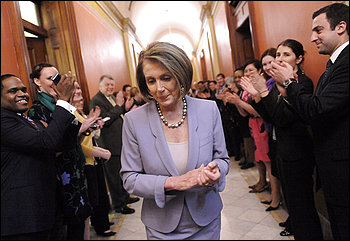
The WP‘s Paul Kane profiles the inimitable Speaker of the House, Nancy Pelosi. “Some historians list her alongside Rayburn and his successor, John W. McCormack, as among the most influential speakers in the annals of Congress.” (What, no love for Joe Cannon? C’mon now, American history doesn’t start in 1945.)

In any case, from my ringside seat here in the belly of the beast, it’s pretty clear: Speaker Pelosi gets things done. “After Scott Brown’s special-election victory…some pushed for a scaled-down version of health-care legislation to draw Republican support. Pelosi balked. In a moment that has come to define her speakership, Pelosi mocked a scaled-down bill as ‘Eensy Weensy Spider’ health care.