After Sunrise?

“‘I don’t know what we’re going to do but I know the three of us have been talking a lot in the last six months,’ Hawke said. ‘All three of us have been having similar feelings that we’re ready to revisit those characters. There’s nine years between the first two movies and, if we made the film next summer, it would be nine years again so we’ve really started thinking that would be a good thing to do. We’re going to try write it this year.‘”

Also occurring a near-decade later: In an interview with AlloCine, Ethan Hawke suggests a third installment of Before Sunrise may be on the way. Hrm. I loved Before Sunset (It was #8 on my best of the Oughts list.) But Linklater et al are messing with a delicate thing, and adding a third act makes me nervous. They met. They re-met…where would the story go from here?

Devil in a Blue Dress.


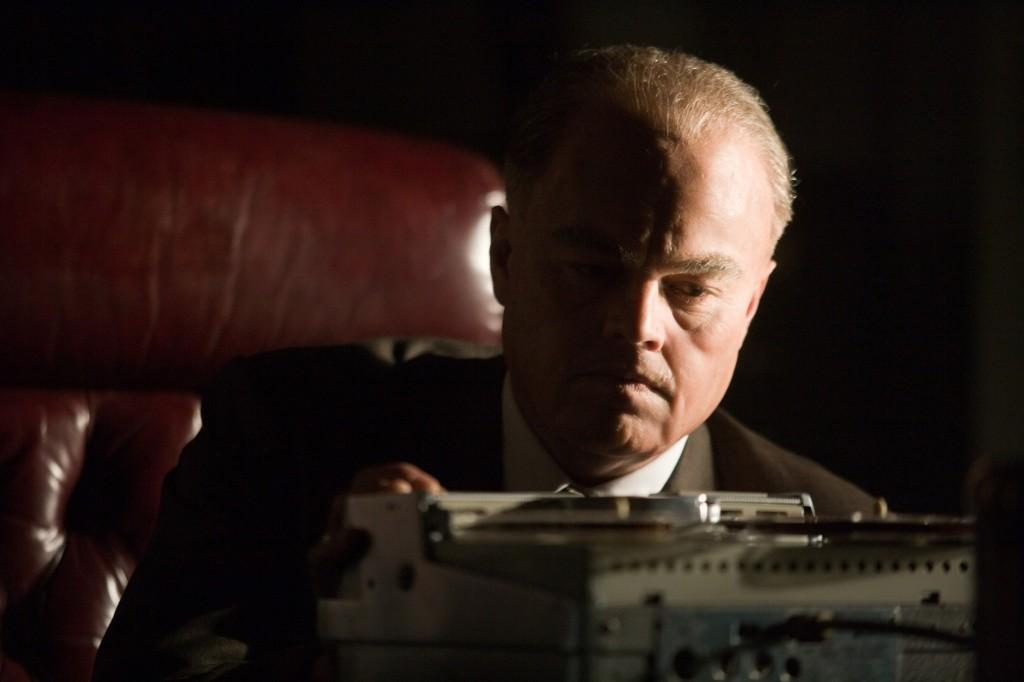
(Ok, admittedly, that’s still unsubstantiated. Sorry, couldn’t resist.) In any event, a sturdy and plodding workhorse of a biopic, Clint Eastwood’s J. Edgar attempts to humanize the man who fanned forty years of fears about Communism to become architect of the F.B.I. and one of the most powerful figures in Washington. It’s…not bad, and I would say I was engaged for most of the movie’s run. But, even despite all the Brokeback Mountain-style kabuki restraint that Eastwood must’ve felt he had to employ to do justice to the are-they-or-aren’t-they relationship of Hoover and longtime partner Clyde Tolson, a film about a figure as polarizing as J. Edgar Hoover should take stronger stands about its subject. Despite some very good (and, in di Caprio’s case, very bizarre) performances, this is mostly biopic mush.

It doesn’t help that Eastwood has yet again opted for the tinkly piano and gray palette that seems to characterize all of his historical pictures. This worked wonders for Letters of Iwo Jima, not so much for Flags of our Fathers and this film. Here, Eastwood has set a story beginning in 1919 — perhaps the most lurid and tumultuous single year for America in the 20th century (I’m only ever-so-slightly biased on this) — and made it look like a drab, washed-out daguerrotype. In that fateful summer, after an anarchist’s bomb blows up the front porch of Attorney General A. Mitchell Palmer’s house in the ritzy West End of Washington (his neighbors, Franklin and Eleanor Roosevelt, had just parked down the street), Hoover is hand-picked to run the new “General Intelligence Division” of the Justice Department that will bring the perpetrators to justice.

With previous experience at the Library of Congress in organizing information, Hoover soon takes on two key assistants in Tolson (Armie Hammer, once again exuding Ivy League entitlement) and personal secretary Helen Gandy (Naomi Watts, who gets the best of the age make-up), and quickly attempts to make a CSI of the GID. Cut to forty years later, and Hoover — now balding, paunchy, and covered in latex — is obsessively snooping on Martin Luther King and making veiled threats to Attorney General Bobby Kennedy about his brother’s sleeping habits. With our two historical poles established, the rest of J. Edgar flits back and forth in time, telling the story of its protagonist as both a young and old man – Other than these two moments, the film spends most of its time, strangely enough, dealing with the kidnapping of the Lindbergh baby. (In 2004, when discussing The Alamo, I noted how fun it is to cast the story of American history with actors. Let me say that Josh Lucas totally works as Charles Lindbergh.)

For the most part, J. Edgar is an innocuous edutainment. But it also has some serious problems, and not just the standard-issue groanworthy biopic tropes like Freudian parent issues overdetermining the subject’s entire life story. (Here, Mom (Judi Dench) is a stern and overbearing sort who forces Hoover to bury his secrets within, even as he’s trying to pry up everyone else’s.) Y’see, it comes out rather late in the third act that Eastwood and screenwriter Dustin Lance Black have attempted to add a Fight Club-ish “unreliable narrator” schtick to the film: The whole time, we’ve been watching Hoover’s sanitized retelling of his own history. But this should-be-huge reveal is underplayed, and thus becomes somewhat buried. And, as a result, people who don’t know anything about the times are going to leave a theater with a very wrongheaded sense of the story.

For example, it’s never mentioned or adequately explained that the 1919 anarchist bombings which open the film only killed two people — one of them the bomber on Palmer’s porch, who either tripped or mis-timed the blast — and that, not unlike recent times, pretty much everything Palmer and Hoover did subsequently in 1919 was a massive overreaction. (Hence, the “Red Scare.”) They show Hoover and a team of G-men knocking down an anarchist printing press in Paterson, New Jersey linked to the bombs, but, with the arguable exception of Emma Goldman’s deportation proceedings at Ellis Island, they don’t show any of the many, many raids that were just glorified fishing expeditions and/or excuses to remove foreign-born potential Communists from American shores.

Similarly, when the film briefly depicts the Centralia Massacre that same year, it shows events in a way that Hoover, and many other Americans, probably saw them — I.W.W. radicals killing patriotic veterans in a turkey shoot. But that depiction does violence to the much more complicated truth of the event, which involved American Legion members deciding first to go march on some radical Wobblies. And you’d never know that the culmination of that day was an I.W.W. member and veteran grabbed from jail by soldiers, beaten, castrated, hung, hung, hung, shot, and shot. Again, Eastwood and Black have written themselves a pass for this, because they hint Hoover is an unreliable narrator at the end of the film. But that lede is buried.

So the history has definite issues, and this same tendency towards whitewashing detracts from the whole film. Granted, given how little we know, the Tolson-Hoover relationship should perhaps be treated with this discretion — although my understanding is they were more conceived of as a couple than this film lets on. (FWIW, Hammer is quite good here despite some unfortunate age-makeup, and a Supporting Actor nod is likely.) But, that aside, and to be blunt about it, sometimes an asshole is just an asshole. One can argue that Hoover had all the reasons in the world to be the way he was — an overbearing mom, a traumatic secret, whathaveyou. But this film spends more time trying to make us feel charitable towards its protagonist than it does putting his behavior in any kind of appropriate context. (For example, why is Hoover obsessed with MLK? Should he be wiretapping him? It’s never really addressed.) Should we feel for J. Edgar, after hearing his story? Perhaps, yes. But we should also leave the theater with a clearer sense of how illegal and often reprehensible his rise to power really was.

That Sinking Feeling.


I’m just a symptom of the moral decay that’s gnawing at the heart of the country…George Clooney’s The Ides of March (which I finally caught several weeks after Drive — hopefully I’m a little faster with the back-half of this year’s Clooney double feature) is easier to admire than it is to recommend. Attempting to dramatize the dark corners of American politics where careerism strangles idealism, it’s a film with a serious purpose and admirable ambitions. It’s well-made, and definitely well suited to the deflated, cynical “change we no longer believe in” zeitgeist of this political moment. And it’s generous to its bevy of talented actors, even if they don’t interact as much on-screen as I might have liked.

At the same time, I found Ides‘ depiction of contemporary politics to be totally theatrical and unrealistic, and its messaging rather muddled. (For a Phillip Seymour Hoffman movie that does get politics right, despite its occasional Sorkinisms, check out Charlie Wilson’s War.) The basic conceit here is All the King’s Men, basically (or, if you’re new-school, Primary Colors) — No man is a hero to his valet and all that, especially in politics. But by having the feet of clay of Clooney’s Obama-esque candidate, Governor Mike Morris of Pennsylvania, here be (yawn…oh, and major spoiler, I guess), in the parlance of politics, a “bimbo eruption,” Ides not only makes itself seem relentlessly dated. It seems to flinch from the problems in contemporary politics that people are actually and justifiably cynical about.

So, now that I’ve spoiled one of the major “twists,” let me roll it back for a moment. It’s the final days of the Ohio Democratic primary, and Governor Morris is in a neck-and-neck race with Senator Ted Pullman of Arkansas (Michael Mantell, not a factor here.) Running the respective campaigns are Hoffman and Paul Giamatti — although, don’t get your hopes up, they have maybe 30 seconds of time together.The kingmaker of the entire race could well be Senator Thompson of North Carolina (Jeffrey Wright), who has recently dropped out and has delegates to spare — although, again, don’t get your hopes up, Wright is here for maybe five minutes tops. And the ace in the hole is Morris’ wunderkind campaign aide, Stephen Meyers (Ryan Gosling). He does…messaging? Voter outreach? It’s totally unclear, and we never see him do anything important. But the film depends on him being considered an amazing and indispensable political genius, so let’s presume he is. (Yes, yes, more Gosling haterade. He’s actually fine here, FWIW.)

In any case, Meyers is apparently such an earth-shattering asset that, one day, the opposition (Giamatti) asks to do lunch in a possible bid to get him to switch sides. But when word of this (totally innocuous) barroom meet leaks to an enterprising NYT reporter (Marisa Tomei), the story threatens to tank Meyers’ relationship with his boss (ok, maybe) and develop into a full-blown, campaign-sinking media sensation (Really? Why? They’re both Dems. And are all Ohio voters meant to be such political junkies that they would devote extreme import to an aide on one campaign having lunch with another? This is an inside-the-Beltway, Lloyd Grove tidbit at best.) And then there’s the complicating matter of Meyers’ new fling, a young and exceedingly friendly campaign intern (Evan Rachel Wood). What was it Chekhov said about comely interns in the first act of a political play…?

So you can basically tell where The Ides of March is going from relatively early on. (If not, every Obama-esque utterance by Morris, who’s a pro-gay-marriage, secular humanist liberal dream candidate, also gives the game away. There’s gotta be something up the man’s sleeve or there’s no movie.) Still, I admired some of Ides‘ visual conceits — for example, having the climactic, idealism-deflating tete-a-tete occur in a hotel kitchen. (In US politics, really horrible idealism-deflating things have happened in hotel kitchens.) And, thanks to its actors and crisp direction, the film mostly sustains an impressive dramatic heft even when the story seems more than a little implausible.

But here’s the trick [back to the big spoiler, if you want out]: So Governor Mike Morris, as its happens, has a failing for the interns. To which I say…Honestly, who cares? This is the sort of thing that destroys your political idealism? We had an impeachment crisis over exactly this issue, and 60% of America shrugged and backed the president at the time. And, ten years after the Bill Clinton era, the sin of his administration that rankles isn’t his dalliances with Monica Lewinsky — It was the final removal of Glass-Steagal, which helped pave the way for the (unpunished) economy-imploding blowout of our times. Similarly,the thousands hitting the bricks for #OWS in various cities right now don’t particularly care who Obama, or anyone else in Washington, is screwing at any given time. They care who they’re screwing over.

And, in the end, the intern problem here is only the icing on the cake. The Ides of March is a film that’s almost entirely about the process of politics — scoops and polls and leaks, campaign managers and endorsements. It has almost nothing to say about the actual content of politics — jobs and schools and taxes. I don’t even remember, other than the aforementioned litany of hot-button cultural issues, any actual, honest-to-goodness questions of political import coming up. One of the main reasons, I’d argue, why the American people are sick-to-death of politics and politicians today, is all the useless, inside-baseball, endless-horse-race media coverage, when all folks really want is a good, well-paying job and a decent school in the neighborhood. In this respect and despite its good intentions, Ides is less a diagnosis of the disease afflicting the body politic and more just another manifestation of the symptoms.


Secrets of the Five Toes.


We were once the greatest endurance runners on earth. We didn’t have fangs, claws, strength or speed, but the springiness of our legs and our unrivaled ability to cool our bodies by sweating rather than panting enabled humans to chase prey until it dropped from heat exhaustion. Some speculate that collaboration on such hunts led to language, then shared technology. Running arguably made us the masters of the world. So how did one of our greatest strengths become such a liability?

From recently in the NYT, Christopher McDougall makes the case for barefoot and minimalist running. YMMV of course, but at least for me, I’ve felt less injury prone since making the switch a few months ago. “‘Barefoot-style’ shoes are now a $1.7 billion industry. But simply putting something different on your feet doesn’t make you a gliding Tarahumara. The ‘one best way’ isn’t about footwear. It’s about form. Learn to run gently, and you can wear anything. Fail to do so, and no shoe — or lack of shoe — will make a difference.

International Ballet Machines.


Ballet pointe shoes are not typically thought of as technological artifacts, but they certainly are…Dancers on this pointe regimen developed characteristically long, lean leg muscles. Balanchine also encouraged dancers to let the shoes remake their bodies, including developing bunions that gave the foot just the right line.Speaking of shoes and from the Atlantic, a new paper examines pointe shoes within the history of technology. “[I]n 1980 dancers threatened to strike — not over hours or pay, but for better pointe shoes, and better management of them.

Change We Can Expect.

Since these petitions are ignored apart from an occasional patronizing and inane political statement amounting to nothing more than a condescending pat on the head, we the signers would enjoy having the illusion of success.” Democracy in action! A petition on We the People demands a vapid, condescending, meaningless, politically safe response. “Since no other outcome to this process seems possible, we demand that the White House immediately assign a junior staffer to compose a tame and vapid response to this petition, and never attempt to take any meaningful action on this or any other issue. We would also like a cookie.

Dozing at the Dozen.

As of today, Ghost in the Machine is 12 years old. [0, 1, 2, 3, 4, 5, 6, 7, 8, 9, 10. 11] Like its venerable ombudsdog, this site is mostly characterized these days by short bursts of frenetic activity followed by long periods of slumber. But, in its own way, the ghost is still keep-on-keepin’-on. If you’ve been here for awhile or just got lost on Google today, thanks, as always, for stopping by.

Keeping an Eye on the Ball.


It sure sounds like a fair place for two hostile opponents to meet. Half the basketball-related income goes to the owners, half the basketball-related income goes to the players and millions of pro basketball fans celebrate their first victory of the season in the form of, you know, a season. But in the end, there’s nothing fair about awarding 50 percent of BRI to the people who amount to 100 percent of the reason there’s any BRI in the first place.

This, this, a thousand times this. As talks continue and games disappear, Ian O’Connor summarizes the central issue of the NBA lockout: the owners bring no value to the table — they’re basically leeches on the system. “LeBron James, Kobe Bryant, Dirk Nowitzki, Dwyane Wade, Kevin Durant, Derrick Rose — they don’t play in the NBA. They are the NBA. The entire league. The workforce and the product. The owners? They’re just along for the ride.

Now, the better owners, I think — Mark Cuban, say — understand this. They get that an NBA team is a luxury asset that makes most of its money when it it sold, not as a day-to-day enterprise. And they have a good time playing the owner game and getting to hang around with basketball players.

As an aggregate, however, the NBA owners here are the problem. They’ve been lying about their financial straits, and then trying to pin the “downturn” on their employees. Just because the employees are reasonably well-compensated in this instance doesn’t change the fact that this is classic bait-and-switch behavior by management.

If there’s a reason the NBA is doing poorly at the moment — which, again, is an open question due to all the accounting shenanigans — it’s because unemployment is at 9% and poverty is at 15%. We did not get here because Eddy Curry ate his way to the bottom of a ridiculous contract. Besides, it is not Curry’s fault that somebody wants to pay him $100 million a year for riding the bench anyway. It is the fault of whoever paid him – cough, James Dolan — that exorbitant price. So now, owners want to be bailed out by the powers-that-be for their own terrible business decisions? We’ve seen this movie before. Classic corporate-socialism at work.

I expect the players will probably fold in the end, since, like labor in most situations these days, they don’t have much leverage. But, however it all pans out, let’s remember: The players have the skill set. They create the product. There is no product without the players. In an perect world, the owners should give players a generous share of the revenues (since they’re 100% of the value of the operation), and then be happy they get to own a basketball team. Now, let’s play ball.

Update: “One is, historically, you’ve seen franchises appreciate in value and that appreciation has more than outstripped any cash-flow losses that you’ve had…Secondly, it’s a lot of fun to own an NBA franchise…[B]y and large, NBA franchise ownership has been a good investment. You can’t base long-run projections on how you did in the biggest financial downturn of the last 50 years. On that basis, there are no good investments out there.

Karl Malone’s gonna play the way Karl Malone can. And Kevin Murphy’s gonna sort out this lockout like Kevin Murphy do.

Lithwick: It’s Not Us. It’s You.


For the past several years, while the mainstream media was dutifully reporting on all things Kardashian or (more recently) a wholly manufactured debt-ceiling crisis, ordinary people were losing their health care, their homes, their jobs, and their savings.

For the benefit of the willfully dense — i.e. all the telegenic denizens of the Village — Slate‘s Dahlia Lithwick explains the basic meaning behind Occupy Wall Street: “They are holding up signs that are perfectly and intrinsically clear: They want accountability for the banks that took their money, they want to end corporate control of government. They want their jobs back. They would like to feed their children. They want–wait, no, we want– to be heard by a media that has devoted four mind-numbing years to channeling and interpreting every word uttered by a member of the Palin family while ignoring the voices of everyone else.

Prognosis Fair.


I promised myself I would stop writing six-to-eight-paragraph movie reviews here if one-to-four paragraphs sufficed. Jonathan Levine’s 50-50 is an excellent film to launch the new occasional brevity.

In short, this is a solidly successful attempt at infusing a cancer dramedy with Knocked Up-style Apatowishness — the lowbrow humor, the wry observations, the bromance — and it’s totally fine for what it is. Joseph Gordon-Levitt’s character here is mostly indistinguishable from his turn in (500) Days of Summer — he’s the good guy bad things happen to — and Seth Rogen’s character here is mostly indistinguishable from, well, Seth Rogen. Given this, your mileage may vary.

My main problem with 50/50 is that it telegraphs its characters’ arcs from the beginning. Gordon-Levitt’s original girlfriend, here played by Bryce Dallas Howard, is just a little too unsympathetic from Jump Street — you know she’ll be out the door by Act 2 — while Anna Kendrick’s helpful therapist is so gosh-darned winsome that it’s no surprise she eventually ends up taking her work home with her. 50/50 would’ve been more interesting, I think, if Howard’s character was a reasonably sweet individual who was just overwhelmed by the burdens of the situation. But that’s now how we’re playing it here.

Otherwise, 50/50 has its moments — I particularly liked JGL’s two stoner/chemo buddies, Phillip Baker-Hall and Matt Frewer (getting typecast as a cancer patient?) And, when the film grows darker in its third reel, it feels reasonably well-earned. All in all, 50/50 is a perfectly benign fall date movie.