
The trailer for Richard Kelly’s much-anticipated Southland Tales, starring Dwayne “The Rock” Johnson, Seann William Scott, Sarah Michelle Gellar, Mandy Moore, Justin Timberlake, Miranda Richardson, Cheri Oteri, Janeane Garofolo, Nora Dunn, Jon Lovitz, Kevin Smith, Amy Poehler, John Larroquette, Bai Ling, Wallace Shawn, Christopher Lambert, and Wood “Avon Barksdale” Harris — Yeah, I know, weird, right? — is now online. I just hope it’s more like the theatrical Donnie Darko than it is the director’s cut.
Category: Cinema
No Country for Young Men.
 [Review, take 2.] Every day I think I’m going to wake up back in the desert… I must say, I went in expecting not much more than an over-the-top “message movie” schmaltzfest, or at best a harmless helping of mediocre, inert Oscar Bait like Cinderella Man or A Beautiful Mind. But Paul Haggis’ In the Valley of Elah, the first of four(!) movies I caught last Saturday, turned out to be quite a bit better than I expected. Rather, Elah is a melancholy rumination on the hidden casualties of (any) war and a somber inquiry into the heavy toll exacted on the wives, parents, and children of military men. (The families of military women will likely get their due in John Cusack’s forthcoming Grace is Gone.) The David and Goliath nonsequitur of its title notwithstanding, Elah more often brings to mind the questionable sacrifice for an unknown higher purpose in Abraham and Isaac, or the bloody fate of erstwhile brothers Cain and Abel. And, biblical parallels aside, the film showcases the best work Tommy Lee Jones has done in years. (Well, I didn’t see The Three Burials of Melquiades Estrada, and have high hopes for No Country for Old Men.) And it’s probably the most engaging police procedural of the year this side of Zodiac.
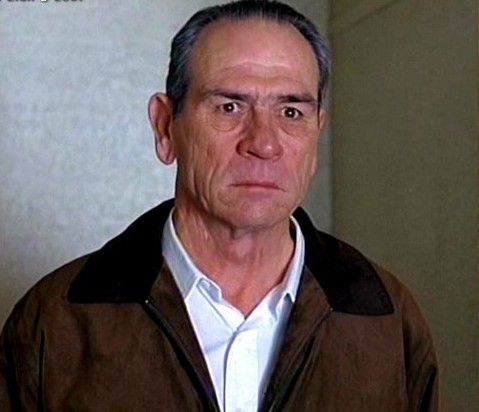 “Dad?” Roused from a dream he can barely grasp the edges of, grizzled Vietnam Vet turned mechanic Hank Greenfield (Jones) is awoken one Tennessee morning by a call from faraway Fort Rudd, informing him not only that his son Mike is back from Iraq but has gone AWOL since getting back stateside. This doesn’t gibe with Hank, who’s been receiving image-laden e-mails from his second son during his tour (his first son already perished in his nation’s service), and so he packs his bags, kisses his wife (Susan Sarandon) goodbye, and drives straight through to New Mexico, looking to ascertain the score.
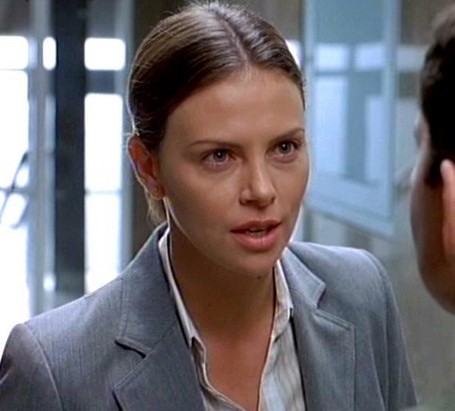
The sergeant on duty at Ft. Rudd (James Franco) and Mike’s returning platoon members all think he’s just shacked up with a good time woman somewhere…but Hank’s not so certain. And, just as he’s beginning to tease clues off Mike’s damaged cameraphone, a charred, mutilated, and dismembered body is discovered on the outskirts of town. Sure enough, it’s Mike, and as the ensuing homicide investigation slips into the jursidictional crack between local law enforcement (most notably represented by Charlize Theron) and the Military Police (headed by bureaucrat Jason Patric), Hank takes it on himself to bring his son’s murderer to justice. But, as Hank well knows, the dogs of war impart a moon-touched madness on those they’ve mauled, and Hank will be forced to confront some ugly truths about his son, and the man he became in Iraq, in order to get to the bottom of things.
 Admittedly, the movie starts out kinda rocky (or perhaps I was just gunning for Haggis in the first reel.) Events occur early on that scream symbolic significance (you’ll know what I mean), people speak in characterization shorthand — “Someday, you’ll just have to trust somebody, Hank” — and some plot points just don’t hang together. How did Hank ever find that (symbolically-named) computer guru operating out of a van, and why does it take him so ever-loving long just to do a defrag? But, for whatever reason — my money’s mostly on Jones — Elah is a significantly subtler and more resonant film than I ever expected from the writer-director of the lamentable Crash. (Then again, a ball-peen hammer to the skull is subtler than Crash, a film which, as I noted in my review of Inside Man last year, feels like it was made by and for people who don’t get out very much.)
In any case, Tommy Lee Jones is really excellent here: Check out the scene where he has to ID his son’s body in the morgue, or note how his early military rectitude seeps away as he sinks into the slough of despond. And Jones isn’t alone. Sarandon is memorable in every short scene she’s in, Theron is surprisingly believable as an ordinary (albeit beautiful) cop, and Patric — a dependable actor who never quite made it as a lead — seems to relish the freedom of his oncoming, paunchy Val Kilmer/Alec Baldwin phase. His “on a need to know basis” character in particular could’ve been way over the top, but Patric underplays him as a guy who really just doesn’t want to do the paperwork. (There’s also a brief but solid turn by Josh Brolin, Jones’ Coen compadre, as the local sheriff.)
Elah isn’t the best movie of the year or anything. But it is most of everything you’d want out of a fall film — It’s timely, sober-minded, well-acted and well-made. And, if nothing else, it shows Haggis has the ability to reboot after Crash.
Wife of Abraham.
Liam Neeson has his Mary Todd: Sally Field joins Spielberg’s forthcoming Lincoln biopic as Abe’s First Lady.
Clooney Hurt, Coens Serious.
A belated get well soon to George Clooney, who broke a rib in a motorcyle accident nearby last Friday, while in town to film the Coens’ Burn after Reading. And speaking of the Coens, details emerge about their next project, A Serious Man, which begins shooting next April. “According to FilmJerk, the story will focus on Larry Gopnik, a Jewish college professor in the Midwest during the 1960s…Larry seeks to solve his existential issues from men of God whom he hopes will help him to become an austere and devoted man.”
Indiana Jones and the Secret of the Loose-Lipped Edmontonian.
In a move sure to enrage the Lucas/Spielberg empire, a chatty extra spills the goods on Indiana Jones and the Kingdom of the Crystal Skull, including who the Big Bads are and how Marian Ravenwood (Karen Allen) will fit into the story. Oops.
Broadbent to Hogwarts.
Speaking of Indy IV, Dr. Jones’ new colleague, Jim Broadbent, is cast as professor and celeb hound Horace Slughorn for Harry Potter and the Half-Blood Prince. That works.
Slow Train Coming | How the West was Won (and where it got us).
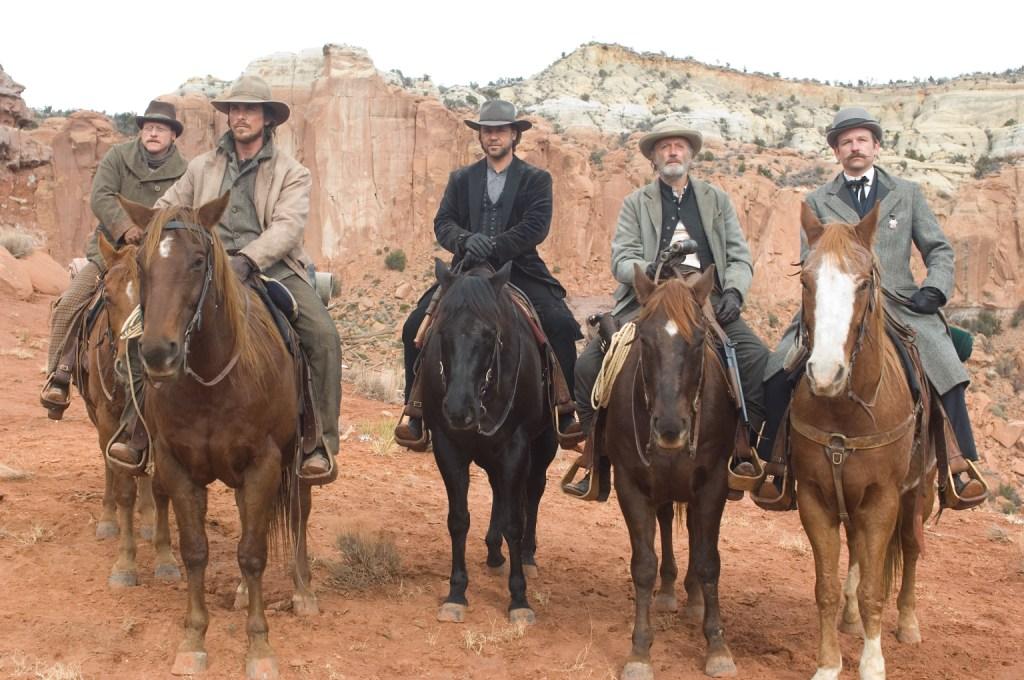
Although the last act strains credulity quite a bit, James Mangold’s moody, memorable 3:10 to Yuma is nonetheless a worthy foray into the unforgiving territory of the Old West. I’ve never been much for oaters, to be honest, but if they keep making ’em like David Milch’s Deadwood and 3:10 (and, hopefully, The Assassination of Jesse James by the Coward Robert Ford in two weeks), I’m all for a full-fledged return of the cowboy pic. Then again, I guess it’d probably have been hard for 3:10 to falter in any event, with talented actors like Christian Bale, Russell Crowe, and others in the respective saddles. Mangold (showing more skill here than he did in Walk the Line) displays an authoritative sense of the genre here, and he doesn’t stint on the fireworks. But, for all the breathtaking “Big Sky Country” vistas and well-executed gunplay on display, the most exciting parts of 3:10 occur in the quiet moments between its two stars, as we watch Crowe (the Black Hat) attempt to wend and worm his way into what remains of (White Hat) Bale’s haunted psyche. With their dark interplay driving 3:10, not even the high suspension of disbelief required by the end, nor an overwrought father-son subplot, manage to derail this train. Come on aboard.
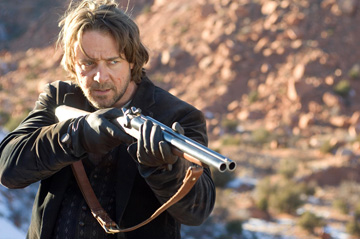
On the outskirts of Bisbee, in the years after the Civil War, an honest life is hard, as attested by the sad fate of one Dan Evans (Bale). Having lost his leg in the service of Abe Lincoln, Evans transplanted his wife (Gretchen Mol, dusty yet luminous) and two sons to the Arizona plains in search of renewal, only to find himself deeply in debt and on the verge of starvation. Dan’s boys, particularly his older son William (Logan Lerman), are humiliated by his failure and seeming weakness…and the rains just ain’t comin’. Meanwhile, the regal, courtly Ben Wade (Crowe), a part-time illustrator and full-time desperado, is living high on the hog, along with his gang of thieves, murderers, and bad, bad men — most notably his adoring #2 Charlie Prince (a.k.a. Ben Foster of Six Feet Under and Freaks & Geeks, strangely eerie and excellent here.) But, after a stagecoach job near Evans’ land, this Jack of Hearts lingers too long back in Bisbee, and is summarily captured by a mishmash of local law enforcement, bounty hunters on the Pinkerton payroll (i.e. a solid Peter Fonda, looking haggard and reminiscent of his dad), and Evans himself, in town to settle a debt one way or another. And, when the local railroad suit (Dallas Roberts) offers a $200 fee that might turn around his struggling fortunes, Evans enlists in the company assembled to take Ben Wade to Yuma Prison, by way of the 3:10 train in Contention. But — and it’s a big but — Wade’s gang is still at large, the forces of Law & Order are amateurish at best (note Firefly‘s Alan Tudyk as a well-meaning veterinarian conscripted into the group) and easily corruptible at worst, and Wade himself is no slouch in the survivability department. By means fair or foul, whether by quoting Scripture with a serpent’s tongue, bashing in a sleeping man’s head with a rock, or tempting Evans (and his son) with all the lucre and pleasurable squalor the ignoble life affords. Ben Wade will do what he must to restore his freedom…
…Or will he? My biggest problem with 3:10 to Yuma, and perhaps it’s also an issue in the Glenn Ford version of 1957 (I haven’t seen it), is that Ben Wade’s motivations grow increasingly confused as the film progresses. Given how easily he subdues certain people at certain times, one begins to wonder what’s keeping Crowe along for this ride, other than a general sense of bemusement about the whole proceedings. By the third act, which devolves into a town-wide shootout at the railroad crossing of Contention, it’s hard to figure exactly why Wade is behaving as he does (or, for that matter, why Evans’ missing leg isn’t a problem as he engages in the cowtown equivalent of Ninja Warrior.) Crowe is given a few lines at various points, and the final shot in the movie, to help explain his reasoning…and I guess it makes a certain amount of sense, from a dramatic perspective. But I’m not sure if I bought it, given all that’s come before.
Still, 3:10 to Yuma is another solid and welcome entrant in the burgeoning ranks of the revisionist western. (Indeed, the film reflects more of the New Western History than it does John Wayne country — For example, there’s a sequence involving evil Luke Wilson overseeing a Chinese railroad camp which is really kinda unnecessary, but I for one just liked seeing a Chinese railroad camp included in the proceedings.) And, as with The Wild Bunch, Unforgiven, and several other superlative entries in the genre, 3:10 frontlines the question of what code should — and actually does — govern a man’s actions when he is unconstrained by larger society.
Indeed, if you’ll permit me a digression, that was the beauty of Deadwood, a classic show still unsullied by Milch’s later, more confused attempt to fashion a Gospel of Surfing: Watching the varied, colorful residents of the town attempt to create a tentative order out of anarchic disorder: What rules must we live by if we are to live together? What should we do when the plague breaks out? How and when should the municipal government gather, who should attend, and what roles should it take on (and, for that matter, should there be canned peaches or cinnamon served at the meetings?) And, for the coup de grace, Milch offered a wry commentary on the iron fist within the velvet glove of the existing Gilded Age social order (and the ugly commercial realities that drove much of westward expansion.) When the fledgling entity of Deadwood finally ran up against the established authorities, it was not the government of these United States it faced, but rather the ruthless and mighty arm of unchecked Capital. By the end of Season 3, everyone — even the wily, formidable, and take-no-prisoners saloon proprietor Al Swearingen — was eventually forced to bow and succumb before the whims of the Great (and Monied) Man, George Hearst. (As Al put it, “Leviathan f**king smiles.”)
3:10 to Yuma doesn’t cover exactly the same ground as Deadwood, of course (and it has much less time to ruminate in any case.) But, at its heart, in the churning psychological tension between Crowe’s Wade and Bale’s Evans — as well as the omnipresent lure and power afforded by the almighty dollar therein — 3:10 ponders similar western verities. In the absence of external fetters, what drives a man to do the right thing, even to the point of ignoring his own self-preservation? In a world of complicated loyalties and compromising shades of grey, where the law is irrevocably bound up with the interests of the railroads and a struggling farmer and a smirking murderer can draw disparate conclusions from the same Bible, what, even, is the “right” thing in the first place? As today, different men come to different answers amid the open country of the Wild West. What probably matters most, 3:10 seems to suggest by the end, is that a man has some answer he’s ready to live — and die — by. As the cowboy troubador Alias once put it, “to live outside the law, you must be honest.” So you’d better do or find something to make your short time in Contention count…’cause no matter how you live your life, that slow train is coming up around the bend, and it ultimately waits for no one.
But in time you see things clear and stark.
In Marvel news, the the teaser for Jon Favreau’s take on Iron Man, with Robert Downey, Jr., Gwyneth Paltrow, Terrence Howard, and Jeff Bridges, is now officially online. (Basically, it’s a shortened version of the Comicon clip.) And has Matthew Vaughn found his Thor in Kevin McKidd of HBO’s Rome and Trainspotting? Possibly maybe…if so, that’s not half-bad.
The power of their source? The crystal.
Indy IV gets a title: If adventure has a name, it must be Indiana Jones and the Kingdom of the Crystal Skull? Well, better than Attack of the Clones, I suppose.
It Happened One Night.
What do stars do? Well, apparently, they mince around in petticoats. Although, like Knocked Up, Matthew Vaughn’s well-meaning but uneven Stardust is probably best enjoyed as a date movie, preferably with a large crowd of similar Princess Bride-leaning folk, I went ahead and caught an empty matinee of said fantasy yesterday afternoon, as it’s the last mainstream summer outing (with the possible exception of Ratatouille) I had any interest in seeing before the fall film deluge.
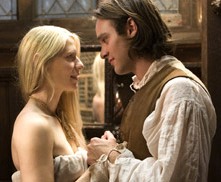 And, well, I wanted to like it, being a fan of both the genre and of Vaughn’s first feature, the sharp Brit gangster flick Layer Cake, and Stardust has its moments, scattered here and there — In fact, I think it eventually even comes off better than the sum of its parts. But, for most of its run, I thought the film overshot its intended target of whimsy and landed on the far side of twee. The movie’s two leads — Charlie Cox and Claire Danes — are affectionately engaging, and Michelle Pfeiffer chews up the scenery with aplomb as this fairy tale’s most wicked witch. But, to be honest, there’re just too many notes, and the film barely hangs together as a whole. If anything, Stardust reminded me of Terry Gilliam’s (superior) The Adventures of Baron Munchausen, an ambitious and episodic attempt at high fantasy that doesn’t quite work. But, then again…as the Dylan song goes, true love tends to forget.
Much of the action of Stardust takes place, Ian McKellen’s authoritative voiceover informs us early on, in the enchanted realm of Stormhold, which happens to be connected to our mundane world via a hole in the wall near the sleepy English village of…uh, Wall. In said village, eighteen years after his father indulged in a happy dalliance over on the Other Side, a shopboy named Tristan (Cox) decides he will woo the town beauty (Sienna Miller) by tracking down a fallen star for her in what he first presumes is a nearby field. (Would he feel the same if he knew about her Steve Buscemi daddy issues?)
The problem is, this star isn’t the hunk of smoldering space rock one might expect, but a delicately shimmering and seriously annoyed girl named Yvanne (Danes), who’s just been randomly pelted out of the sky by a large, translucent ruby. This magical gemstone, recently sent aloft by the spirit of King Peter O’Toole (still looking like Berkeley), holds the key to the kingdom, so to speak, and thus all of the monarch’s living (and dead) heirs are mercilessly tracking it down. But Stardust is much too complicated for only one MacGuffin — Three wicked witches (most notably Pfeiffer) also seek out this fallen star, in order to cut out her glowing heart and restore their vanished youth. So, by the time our hero arrives on the scene via a teleporting “Babylon Candle” (as with a lot of fantasy, there’s a lot of setting up of the ground rules here), he discovers he’s now in a much bigger pickle than he bargained for…and, eventually, that love has a funny way of sneaking up on you when you least expect it.
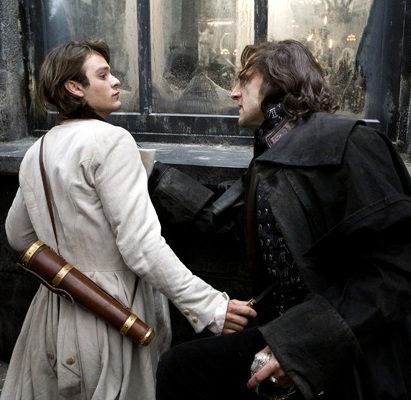 As I said, Stardust‘s problems are myriad. For one, a lot of what should come across as sly, understated British humour a la Douglas Adams, Terry Pratchett, or (naturally) the author here, Neil Gaiman, is instead telegraphed and overdirected to feel like a poke in the eye. (See, for example, the poisoning of the archbishop scene.) For another, the film aims to be wryly dark at times — there’s quite a bit of fun with reading entrails — but we’re still in Belle & Sebastian, Lisa Frank lunchbox territory a lot of the time. (I’m looking at you, unicorn.) For yet another, Stardust is burdened with one of the most bombastic and intrusive scores in recent memory. (Ilan Eshkeri did great work with Layer Cake, but this is just bad.)
And then there’s De Niro, preening in a supporting role as the cross-dressing buccaneer Capt. Shakespeare. I know De Niro is lauded as one of the greatest actors of his generation, and I’ve got Raging Bull sitting on my coffee table at the moment to prove it. But, lordy, is he terrible here. Making Elton John seem as in the closet as Larry Craig, De Niro’s wildly over-the-top performance is a flat-out cringeworthy embarrassment. It plays like he’s never met a gay person in his life, or as if some abrasive guy at a party was doing an impression of De Niro doing an impression of Liberace. (Along those lines, The Office‘s Ricky Gervais, in an extended cameo, seems like he’s playing his character in Extras here — he even gets in Andy’s unfortunate catchphrase. Waking Ned‘s David Kelly and the Lock Stock boys are hanging around too, but the funniest cameo is probably Mark Williams, a.k.a. Arthur Weasley, as an ornery old goat of an innkeeper.)
All that being said, I thought the movie did manage, somehow and despite itself, to stick the landing: However caustic and subversive Stardust pretends to be at first, it’s ultimately turns out a rather staid and traditional fairy tale about the enchantment of true love. And, with that in mind, I found myself willing to forgive the film most of its substantive flaws — and there are many — by the time the inevitable coronation coda rolled. However cynical I get as the years go by, it seems, like Fox Mulder, I want to believe.