Call it, Friendo.

[Update 3/26/08: Welcome. My review of No Country for Old Men is here, and the film review archive is here.]

The Coen Brothers’ No Country For Old Men, my most anticipated movie of the fall season, has a new trailer out. The film stars Josh Brolin, Javier Bardem, Tommy Lee Jones, Kelley MacDonald, Woody Harrelson, Stephen Root, and Garret Dillahunt, and it looks frickin’ fantastic. (And, also up this evening, a new trailer for Aliens v. Predator: Requiem. It looks…less fantastic.)

The Queen II: The Joint Inheritance.

Speaking of US-international relations, with Frost/Nixon, The Queen, The Last King of Scotland and rewrites of State of Play and Tinker, Tailor, Soldier, Spy under his belt, British writer Peter Morgan now plans a sequel to The Queenwhich will examine former UK Prime Minister Tony Blair’s relationships with U.S. presidents Bill Clinton and George W. Bush.” Michael Sheen is set to reprise his role as the PM, although director Stephen Frears is not returning.

From Who to Haddock | The Doctor is In | Creel to Reel | Heroes Fall.

Steven Spielberg and Peter Jackson’s previously-announced Tintin trilogy finds a writer in Doctor Who scribe Steven Moffat, of the Season 3 episode “Blink.” Speaking of which, I’ve run hot and cold on BBC’s Doctor Who update thus far, and have found showrunner Russell Davies’ campy contributions to be mixed at best. But the second half of Season 3 has been exceptionally good Who. From “Blink” to the “Doctor goes Human” two-parter in pre-WWI England (“Human Nature/”The Family of Blood“) to Derek Jacobi’s turn as a lonely, befuddled scientist at the end of time in “Utopia” to the Master taking Tony Blair’s job in “The Sound of Drums,” I’d say this most-recent run can hold its own with the best of the Pertwee-Baker years. (I haven’t seen “Last of the Time Lords,” the Season 3 finale, yet, but I dig John Simm as the Master, and his evil companion is a real kick.)

Off-topic, but also on the television front, I’ve recently boarded the 5:23 Mad Men commuter train. It’s a show I’ve been shying away from despite the good reviews, mainly because I feared it’d be 85% Rat Pack kitsch, i.e. its raison d’etre would be primarily to wallow in the unregenerate un-PCness of the early Sixties. But, while I’m still living a few episodes behind present-time, Mad Men makes for pretty solid television, even if, as with Miller’s Crossing, it can be hard to watch without a glass of Jamesons and clinking ice in hand. Jon Hamm’s Don Draper and John Slattery’s Roger Sterling are particularly good, and, as someone noted on The House Next Door, Michael Gladis’ Paul Kinsey is an eerie facsimile of the young Orson Welles. Plus, with all due respect to Officers Bunk and McNulty, it’s a nice change of pace to watch smart, well-written characters in a TV drama that aren’t cops, doctors, or mobsters.

Finally, I never much cottoned to it anyway, but after the Season 2 premiere, NBC’s Heroes is getting kicked off the DVR. As I said last Spring, the blatant, unattributed ripping off of Watchmen and the X-Men’s “Days of Future Past” in Season 1 was already hard to swallow. And, judging from the first week’s installment, Kring & co. have decided to go back to the well, and have stolen the Comedian storyline straight out of Watchmen too. Given that their poorly-written, overstuffed show is usually as artless as their theft here, count me out.

Medellin.

Looks like Batman’s taking the fight to clean up Gotham City to its source: Javier Bardem and Christian Bale enlist for Joe Carnahan’s version of Mark Bowden’s Killing Pablo, about the Delta Force hunt for Colombian druglord Pablo Escobar (and one has to believe Bardem will be better in the title role than Adrian Grenier.)

Where do you go to (my lovely)?

Apparently Natalie Portman loves her some prequels. In case you’re desiring to see Wes Anderson’s The Darjeeling Limited, or at the very least more of Ms. Portman than was disclosed in Closer, Anderson’s 13-minute short film, Hotel Chevalier, starring Jason Schwartzman and the former Queen Amidala, is now available free on iTunes. Cute…dare I say precious?

Beatles for Sale.


Woke up, got out of bed. Dragged a comb across my head. Found my way downstairs and drank a cup,
and looking at the blog I noticed I was late (heah, heah, heah, heah) in posting a review of Julie Taymor’s sadly insipid karaoke-musical Across the Universe. Ever since Ms. Quarles’ fourth-grade class in Florence, SC spent a full week on the Beatles — discussing lyrics, watching A Hard Day’s Night, etc. — they’ve been a part of my mental landscape. (We also did a week on Edgar Allan Poe — that had more morbid ramifications on my young brain.) In fact, the Beatles were the first musical group I remember being cognizant of. (Hmm, upon further reflection, that’s not entirely true: It seems like ABBA got some run in the house when I was a pre-schooler — I remember my brother getting this record for Christmas one year…You’ll have to ask him if that had anything to do wih him marrying a Swedish gal.) At any rate, from that fateful week of musical schooling to about eighth grade, when I discovered Pink Floyd’s “The Wall” and Depeche Mode’s “Black Celebration” and anguished adolescence began in earnest, the Beatles were far and away my favorite musical act, (In fact, I was justifiably eviscerated by friends and foes alike for crooning “Yesterday” in the seventh grade talent show — before my voice had broke — later prompting the waggish schoolyard riposte: “Suddenly, I’m not half the man I used to be…ever since that vasectomy…”)

But, really, there’s no point in going on trying to prove my Beatles bona fides. The fact of the matter is, everyone loves the Fab Four in their own way (and those few who don’t are either too cool for school or just certifiable Blue Meanies.) It’s hard to think of any band that’s as universally beloved as the boys from Liverpool…which is one reason why Across the Universe seems like such a misfire. Given Julie Taymor’s considerable talent, on display in Frida and elsewhere, and the ubiquitous fondness for the music she gets to play with, how did the final product end up as tepid and uninspired as what we’ve got here? Perhaps it’s a fault of the karaoke-musical genre — I didn’t much care for Twyla Tharp’s riff on Bob Dylan either. But really. Surely a band as influential and inspired as the Beatles deserve something better than a remake of Rent with better music. Unless you’re really a completist on matters Liverpudlian, or your iPod’s broken or something, I wouldn’t recommend crossing the street to see this, much less venturing across the universe.

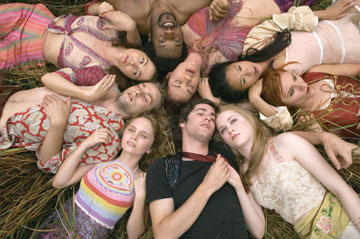
Is there anybody going to listen to my story, all about the girl who came to stay?” So pleads Jude (Jim Sturgess, looking like Paul with a hint of George) from the bleak gray oceanfront of what could only be North England. You see, before he started quoting Rubber Soul for effect, Jude was a working-class stiff in Liverpool who, on a youthful journey of self-discovery, set out for the green fields of Princeton University to find and confront his absent WWII GI father. Once arriving at the Ivory Tower, he reunites with dear old Dad, and, more importantly, meets up with the fun-loving, dissolute Max (Joe Anderson), who — in the natural manner of all Ivy League undergrads — spends his nights playing drunken golf with his father’s borrowed set of “silver hammers.” But here’s the important point: Max happens to have a little sister with kaleidoscope eyes, the lovely Lucy (Evan Rachel Wood), and — as you can probably guess — as soon as Jude sees her standing there, he’s got to get her into his life. In any case, Max drops out of college, and he and Jude — and ultimately, Lucy — procure tickets to ride to the bohemian paradise of New York City, whereupon they fall in with sultry singer Sadie (Dana Fuchs, a.k.a. Janis Joplin), guitar hero JoJo (Martin Luther, a.k.a. Jimi Hendrix), and crush-heavy misfit Prudence (T.V. Carpio, who, in one of many Beatles puns throughout, first comes in through the bathroom window.) All is groovy in East Village Bohemia, for awhile…but, there’s a war going on, man, and all things must pass. Soon enough the Magical Mystery Tour has come to an abrupt halt: Max is drafted, Prudence tunes out, Sadie and Jojo break up the band (with nary a Yoko in sight), and Lucy discovers SDS…leaving Jude once again a loser in Liverpool. But, hey Jude, don’t let us down. You have found her, now go and get her…

So, as you can see, the movie is basically just a bunch of Beatles songs assembled in a sort of narrative order. That’s fine — that’s what we were all expecting, and the Beatles obviously have a lot of great tunes to work with. But, while there are a few nice visual flourishes at times, more often than not, Across the Universe turns gold into lead: It tries to be transporting, but ends up feeling forced. Part of the problem — for me at least — is the rather pedestrian choices made, of which the Lower East Side Rent angle is only one. Obviously, I enjoy American history, or I wouldn’t do what it is I do. But, frankly, the Forrest Gumpian, TV miniseriesish “Summer of Love derailed in the jungles of Vietnam” trope has gotten really, really old over the past few years. Can we please find some other period in American history to fetishize, or find some way to tell this story differently? In all honesty, the hackneyed “Paradise Lost” version of the Sixties presented here has become as wheezy a historical contrivance as “The Greatest Generation.” (And is there a lazier way to string together a bunch of Beatles songs than “the Sixties experience”? Are they that bound up with their time? Even Tharp’s botched Dylanpalooza had its own traveling circus conceit.)

And, speaking of wheezy contrivances, I know I’m probably going to be an army of one on this, but oh well, go ahead and crucify me: I’m so deadly sick of the tired rom-com subgenre whereby our hero/ine does or says something irredeemably stupid in the second act of a movie and loses the object of his/her affection, but then goes all out in the third act with some zany, fearless, and/or bravura romantic display and all is forgiven. You see it all the time, and does life ever really work out like this? Um, no. Yes, I know it’s a trope that’s as old as the hills, but it is totally and utterly played out. (Offhand, I can think of only Annie Hall and maybe The Science of Sleep as movies that show this type of third-act Hail Mary blowing up in the protagonist’s face.) I fully realize that a happy-go-lucky musical based on Beatles tunes may not be the appropriate film to make this stand, but screw it — I’ve reached my tipping point. This bird has flown, Jude, so next time hide your love away and cry instead. (And, Ms. Taymor, what with all the Beatles characters here, where’s Eleanor?)

Even notwithstanding my more curmudgeonly issues, though, Across the Universe takes some missteps along the way. “Let it Be” makes for a lovely gospel rendition, but it’s just about the worst advice you can imagine as a civil rights anthem. And perhaps I’m living easy with eyes closed, misunderstanding all I see, but the “bleeding fruit” presentation of “Strawberry Fields Forever” here seemed almost completely wrong to me. But, hey, at least those two songs made an impression. Most of the tunes here never even get that far: Usually played deadly earnest and mostly stripped of any subversiveness therein, the songs as sung by the lead actors here tend to be flat, uninspired, and virtually interchangeable. The only way to tell them apart is in the very occasionally striking visual flourishes, from the myriad of Salma Hayek-y nurses present for “Happiness is a Warm Gun” to the teen-dream Bowlmor lanes conceit of I’ve Just Seen a Face” (which isn’t even the best musical number ever set in a bowling alley — that still goes to Kenny Rogers’ “I Just Dropped In (To See What Condition My Condition Was In” from The Big Lebowski.) Indeed, the trippy visuals often overshadow the bland versions of the songs. The eeriest image in Universe may have been Taymor’s weird Jungian bent on the famous Kim Phuc photo, but I’ll be damned if I know what it was in there for or remember what song it was in reference to.)

As for the musical guests, Eddie Izzard all but sleepwalks his way through a pained version of “Being for the Benefit of Mr. Kite,” and U2’s Bono shows up midway to embarrass himself as a Ken Kesey-type character. This AICN comment nailed it: Bono sings “I am the Walrus” as if it’s “MLK” or “Sunday Bloody Sunday,” like it’s the most important thing ever written. He’s meant to be ironic, I guess, but he can’t seem to get past his own vanity. But, to be fair, one musician here does ring true: In fact, almost everything that’s wrong with Across the Universe is made manifest by his fifteen-second cameo. Joe Cocker is partially famous for his blistering rendition of “With a Little Help From of My Friends” at Woodstock,” and, as a homeless guy here, he imbues his one verse of “Come Together” with all the heartfelt passion and hard-fought wisdom he brought to that earlier performance. (After it happened, the audience at my showing spontaneously applauded.) Don’t let him be misunderstood: Cocker makes clear these songs mean as much to him as they do to us. He’s the only one here able to strip away the saccharine, shrink-wrapped Rent-lite blandness of this whole enterprise and, at least for a moment, do the Beatles proud.

The Unbearable Whiteness of Being (Wes).

“Like his peers Zach Braff, Noah Baumbach (who directed the excellent Squid and the Whale and co-wrote Life Aquatic), and Sofia Coppola (whose brother Roman helped write Darjeeling Limited), Wes Anderson situates his art squarely in a world of whiteness: privileged, bookish, prudish, woebegone, tennis-playing, Kinks-scored, fusty. He’s wise enough to make fun of it here and there, but in the end, there’s something enamored and uncritical about his attitude toward the gaffes, crises, prejudices, and insularities of those he portrays.

Also in Slate Jonah Weiner takes issue with the racial politics of Wes Anderson’s oeuvre. Food for thought — I thought Weiner scored some of his best points early on: “In every film he’s made, even the best ones, there’s been something kind of obnoxious about Wes Anderson. By now, critics [Note: and The Onion] have enumerated several of his more irritating traits and shticks: There’s his pervasive preciousness, exemplified by the way he pins actors into the centers of fastidiously composed tableaux like so many dead butterflies. There’s his slump-shouldered parade of heroes who seem capable of just two emotions: dolorous and more dolorous (not that there haven’t been vibrant exceptions to this). And there’s the way he frequently couples songs — particularly rock songs recorded by shaggy Europeans between 1964 and 1972 — with slow-motion effects, as though he’s sweeping a giant highlighter across the emotional content of a scene. In The Royal Tenenbaums, Richie can’t watch Margot get off a bus without Nico popping up to poke us in the ribs: ‘He loves her! And it’s killing him! See?’” Ouch.

Oil and Lies.

“I look at people and I see nothing worth liking. I see the worst in people. I have a competition in me. I want no one else to succeed.” One thing about catching four movies in a row: you get used to the same trailers. And, along with the preview for Wes Anderson’s The Darjeeling Limited, two I hadn’t yet seen kept popping up. First, the full trailer for There Will Be Blood, Paul Thomas Anderson’s upcoming adaptation of Upton Sinclair’s Oil!, starring Daniel Day Lewis and Little Miss Sunshine‘s Paul Dano. (I’ve had adverse reaction to P.T.A. films in the past, most notably Magnolia and Punch-Drunk Love, but Day-Lewis is always a draw.) And James McAvoy and Keira Knightley live out the consequences of a child’s lapse in judgment in the trailer for the film version of Ian McEwan’s Atonement, also starring Romola Garai. It looks like my impressions of the book, I’ll give it that.

Ford’s Theatre.


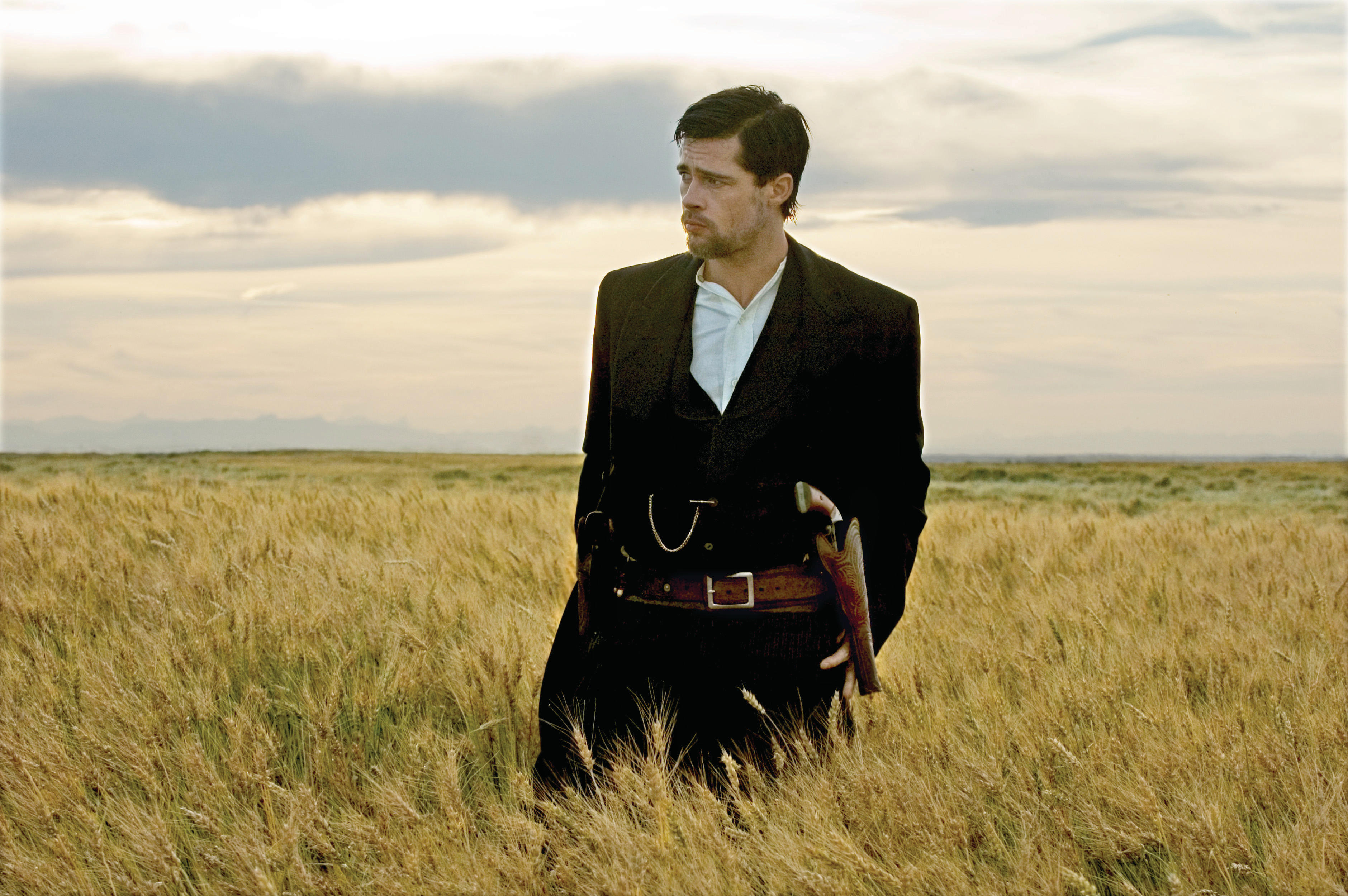
On a Saturday in late September, the gray hours were marked by occasional rains, and Kevin, having completed his affairs of commerce the evening prior and having no social prospects on the calendar, traveled to the theater on 68th St. to bask for a day in the fulgor of the cinematograph. And so it was that, three films into his personal odyssey, he came upon Andrew Dominik’s The Assassination of Jesse James By the Coward Robert Ford, a recount of the last days of one of the Old West’s most famous killers, and an analysis of the man who laid him low. Kevin found it to be an overly protracted and ultimately uneven work, to be sure. But he also found the movie often striking and occasionally beautiful, and — even if its reach exceeded its grasp — he admired the film for its ambition, and its confidence in taking extended, leisurely digressions. Kevin applauded Dominik’s attempt to pay homage to the films of Terrence Malick and to the sprawling psychological westerns of the 1970s. That being said, he found the interminable voiceover by Basil Exposition — which often needlessly described the action Kevin could witness for himself on the screen — more than a little irritating…

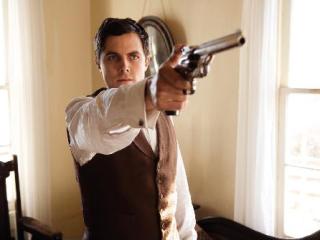
Thanks, Basil, I’ll take it from here. As Assassination begins, the James gang — or, more to the point, the gaggle of local toughs Frank (Sam Shepard) and Jesse (Brad Pitt) James have assembled for one last train heist in Blue Cut, Missouri — are waiting out the day in the woods. During this stopover, the weaselly wannabe Robert Ford (Casey Affleck), nursing a lean and hungry look, tries desperately to ingratiate himself with the celebrity brothers in turn. (If we couldn’t figure out from the title what part Ford will play in all this, he seems like trouble right from the get-go: one part Mark David Chapman (“I can’t shoot him like this. I wanted to get the autograph.“), one part Sirhan Sirhan (“I have achieved in one day what it took Robert Kennedy all his life to do.”)) And yet, through sheer dogged obsequiousness, Ford eventually manages to fall in with younger brother Jesse, who seems both amused by his blatant hero-worship and nonchalant about the quality of his riding partners. So, for the next two hours plus, we follow the twists and turns of Jesse and Robert’s doomed relationship, particularly as it becomes strained by James’ increasing (and justifiable) paranoia and Ford’s own delusions of easy immortality. And, as we eventually get to that fateful day when the shot is fired (and the years beyond), Ford slowly comes to discover that it’s one thing to kill a man. It’s another to live with yourself afterward.

Assassination definitely isn’t going to be everyone’s cup of tea, and, to be honest, it’s really not at the level that its pretensions seem to warrant: The film never achieves the psychological depths it purports to plumb — Ford in particular seems a pretty straightforward nutjob — and it runs for several beats too long. (The movie should already have ended two or three times over by the time Zooey Deschanel shows up.) And, then, of course, there’s that awful narration, which comes across as screenwriting on autopilot and nine times out of ten feels jarring and unnecessary. (I assume the passages come from the book by Ron Hansen, but they don’t work here at all. They either repeat — or worse, contradict — what we’re seeing. For example, the voiceover tells us in the first ten minutes that Jesse James was a constant blinker, after which Brad Pitt stares at things with an unfaltering, steely blue gaze for three hours.)

That being said, with some wonderful cinematography by Roger Deakins (who also shot In the Valley of Elah) and a solid, colorful cast, Assassination does have its moments. It’s always grand to see Sam Rockwell, and he’s quite commendable here as Bob’s older brother Charlie. (And, while he at first appears to be a mere buffoon, there’s more to him as the movie goes along.) Deadwood‘s Garret Dillahunt also adds another finely-honed cowboy to his western repertory here: His Ed Miller, an outlaw sadly operating a few cards short of a full deck, is a far cry from both Jack McCall and Frances Wolcott, but memorable nonetheless. And there’s plenty of other good work here, including outlaw turns by Jeremy Renner (of 28 Weeks Later), Paul Schneider (looking like the lost Fiennes brother), and, of course, Affleck and Pitt, both of whom bring their A-games to the table (even if Pitt’s motivations in his final moments escaped me.) Also, I’m forced to admit, I was rather tickled by the mean old cuss they acquired to play the Governor of Missouri

The Illustrated Man.


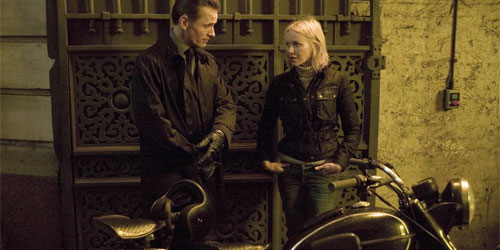
The King of the West may be a man of the East in David Cronenberg’s London gangster flick Eastern Promises, but — Anduril or no — he’s no less handy in a tight spot. As with Mortensen and Cronenberg’s last collaboration, A History of Violence, I found Promises to be a sleek and rousing genre exercise that’s being more than a little overpraised. I enjoyed the film, it’s worth catching if you have the stomach for it, and its steam bath centerpiece will be talked about for a good long while. But, to be honest, there’s really not much there there. Remove that fight from the equation and you’re basically left with sizable helpings of immigrant and gangster cliche. (Cronenberg seems to know as much — he tips his hand in the campy accordionist scene.) Naomi Watts is a fine actress, but she’s not given anything to do here besides tote around the film’s two Maguffins. Armin Mueller-Stahl, the Russian godfather of the tale, plays the same avuncular-going-on-sinister note throughout. And, while exemplifying the adage “still waters run deep” once again, Viggo’s character is almost too much of an archetypal badass — You can see the twists and turns in his story coming a mile away.

After a grisly assassination in a barber shop that’d do Sweeney Todd proud (just to let you know we’re in Cronenberg territory), Eastern Promises opens with the death of a young, drugged-out, and pretty clearly abused Russian teenager in a London hospital…and the subsequent birth of her child. (Speaking of Cronenberg territory, he films the newborn baby like it’s something out of Existenz.) Having lost her own pre-born of late, Anna Khitrova (Watts), the midwife in attendance, takes a shine to this orphaned child, and thus sets out with the dead girl’s diary to locate the foundling’s proper home. Anna’s (sort of) ex-KGB uncle takes one look at this untranslated journal and warns of a dangerous road ahead. Nonetheless, Watts’ investigation quickly takes her to a Russian restaurant run by Mueller-Stahl, an Old World type of fellow who’s clearly something of a n’er-do-well despite his fantabulous borscht. Soon enough, Anna also stumbles upon Mueller-Stahl’s flamboyant, hard-drinking Dauphin of a son (Vincent Cassel) and his assigned playmate Nikolai, a stoic, tough-as-nails chauffeur (Mortensen). And when it inevitably turns out that Mueller-Stahl et al are actually part of the feared vory v zakone (a.k.a. the Russian cosa nostra), the fates of Anna, the baby, the diary, and all involved come to rest in the hands of one enigmatic, very tattooed, and possibly conflicted driver…but what’s his angle? Let’s just hope the Russians love their children too.

I’m not going to spill Viggo’s secrets here, tovarisches, although you can probably guess he’s not one to just up and off a baby when called upon to do so. (Also, if this sounds a bit like Dirty Pretty Things, it may be because the films share a screenwriter.) Nonetheless, most of the buzz surrounding Eastern Promises justifiably centers on a fight scene in the middle going, when Viggo, naked as the day he was born, is confronted by two mobsters who don’t have his best interests at heart. It’s hard to say whether this gory steam room fracas is better than the splendid hand-to-hand duel in The Bourne Ultimatum, but it’s up there. If that deft, practiced, lightning-quick Bourne melee was a stiletto, this brutal scene packs the visceral, bone-crushing crunch of a mace. It’s also extremely hard to watch, and not because of Mortensen’s dangly bits — let’s just say David Cronenberg and sharp objects are involved. (Call me a lover, not a fighter, but when it comes to this director pushing the envelope of the R-rating, I prefer History‘s sex scenes with Maria Bello to nude, bloody Viggo plunging knives into people’s soft parts. But, to each his own.)