
Another preview I haven’t seen: This time, it’s the new trailer for Steven Soderbergh’s Ocean’s Thirteen, starring Clooney, Roberts, Pitt, Damon, and the usual assortment of Hollywood cads and roustabouts. I quite liked Twelve (and thought Eleven was so-so), so I’m up for another go.
Category: Cinema
Globes of Gold for Moviefilms.
This year’s Golden Globes nominees are announced, and it’s a particularly strange bunch, with The Departed, Bobby, Little Children, The Queen, and Babel vying for best picture and Kazakhstan’s finest up against Little Miss Sunshine, Thank You for Smoking, The Devil Wears Prada, and Dreamgirls on the comedy/musical side. (Also, lots of doubles, with Leonardo di Caprio (actor), Helen Mirren (actress, TV), and Clint Eastwood (director) all nominated twice in the same category.) Well, I haven’t seen all of these, but suffice to say, these aren’t the picks I would’ve made — even if you discount The Prestige, Children of Men, and The Fountain as genre choices, United 93 is very conspicuously absent. At any rate, it should be an interesting awards season regardless — the only real signed-and-sealed lock so far is Helen Mirren for The Queen.
Die Hard with an Ogre.
In the preview bin, the brand new teaser for Live Free or Die Hard (a.k.a. Die Hard 4) and the full trailer for Shrek the Third. I can’t see either on my current connection, so sorry if they’re terrible.
Guillermo does Greystoke.
Guillermo Del Toro — director of Blade 2, Hellboy, Devil’s Backbone, and Pan’s Labyrinth — announces he’s working on a remake of Tarzan with Master and Commander scribe John Collee. “‘I’d love to create a new version that is still a family movie, but as edgy as I can make it,’ Del Toro said. ‘There are strong themes of survival of a defenseless child left behind in the most hostile environment.’”
Born out of your Frustration.
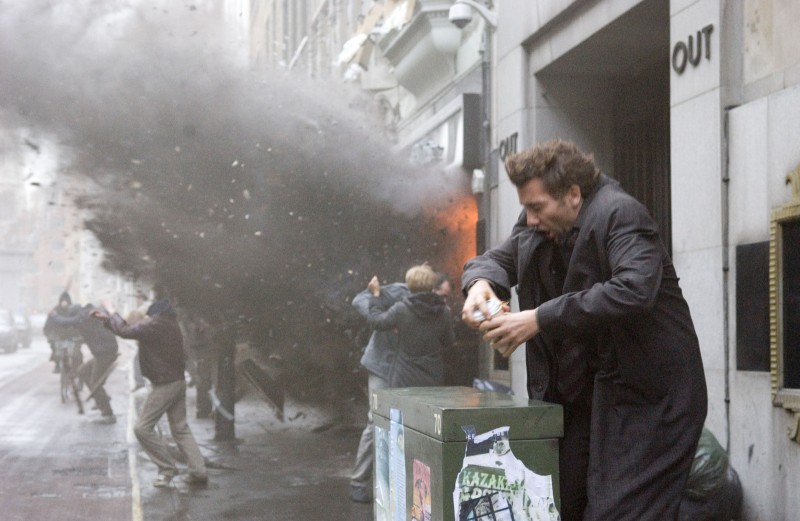
Children of Men, Alfonso Cuaron’s gritty dystopian parable of the near-future (which I saw in Nelson, NZ several days ago), is very, very close to being a great film. Boasting a standout performance by Clive Owen (other than Inside Man he hasn’t been in much lately, so I’d forgotten how good he can be), great character work by Michael Caine, Chiwetel Ejiofor, and others; timely ruminations on issues ranging from the War on Terror to immigration reform; a wicked streak of black humor (note, for example, the bus and pharmaceutical ads, as well as the “Baby Diego” stuff and the casual nod to the similarly sardonic Pink Floyd); cinematography by Emmanuel Lubezki (late of last year’s best film, The New World) that’s both striking and muted; and some of the most visceral urban-warfare scenes this side of Saving Private Ryan, the film has a lot in its corner, and is definitely worth checking out this holiday season. (Between this, The Fountain, and hopefully Pan’s Labyrinth, it’s been a banner time for heady, intelligent sci-fi/fantasy.) Alas, the film takes a few egregious missteps in the last act — the last fifteen minutes, even — which marred the experience for me. As a result, instead of leaving the theater stunned or moved by the otherwise impressive Children of Men, I left irritated with it. It’s a very good, even a remarkable, movie, to be sure, but when it comes to the last few leaps of logic (and sentiment), Cuaron’s film can’t quite stick the landing.
Children of Men takes place in the London of the not-too-distant future, where, as part of a string of world calamities and catastrophes (including some that possibly, Cuaron coyly suggests, have their roots in the Iraq war), humankind has become infertile, western civilization is in the throes of decay, and England, true to stiff-upper-lip form, remains the one teetering bastion of order against the forces of anarchy and global chaos. In this childless city under siege, where immigrants (or “Fugi’s”) are rounded up in cages and coffee shops are bombed for no reason in particular, we meet a troubled Everyman named Theo (Owen — we know he’s troubled because he downs lugs of scotch from a hip-flask whenever possible, but don’t worry — this sort of clumsy screenwriting shorthand is generally the exception here rather than the rule.) At any rate, on his way to work one day, Theo is apprehended by several masked goons in a van, among them his activist ex-girlfriend Julian (Julianne Moore) and her #2 (Ejiofor), who, as it turns out, have a very important task for him — one that only he can fulfill, and one that might just change the shape of this post-apocalyptic world…
If you’ve seen the trailer, then you know what Theo’s charge is for the remainder of the movie. (But if you haven’t, I won’t spoil it here.) Suffice to say, his travels take him to various dilapidated locales in this babyless Purgatory (including, memorably, the hideaway of Theo’s aging drug buddy Jasper (Michael Caine)), and we get a full sense of how the demise of the future, in the form of the next generation, has caused the world to wither and rot. This culminates in some of the most powerful and immersive urban war footage to come down the pike in a good while (note the long, uninterrupted shots in the final act, which are particularly impressive.) But, as you’ll come to find, one of the escape scenarios near the end — you’ll know which one I mean — is completely and utterly implausible, to the detriment of everything that’s come before. And, coupled with the ridiculously over-the-top symbolism in the final moments, Cuaron’s film unfortunately ends on a sour note. Still, if you can forgive the movie its wince of an ending, it’s well worth it to suffer the Children. It may step away from greatness in the last act, but it’s still very easily in the top echelon of movies I’ve seen this year.
Me and My Shadow.
Who knows what evil lurks in the hearts of men? Sam Raimi, apparently. The Evil Dead/Spidey director looks to be moving forward on another version of The Shadow (which should in all likelihood be better than the 1994 Alec Baldwin version.)
Spartans via Kiwi.
Two more minutes before my Internet time runs out and I disappear back into the ether…so, before I go, here’s the full trailer for Zack Snyder’s 300. Not as effective as — and somewhat derivative of — the grand teaser (and still no sign of McNulty or Faramir), but I’ll probably still catch it, if nothing else than to see what’s in store for The Watchmen.
Strange what Love Does.
By way of Ed Rants and Youtube, the trailer to David Lynch’s forthcoming three-hour Inland Empire, with Laura Dern, Jeremy Irons, Justin Theroux, Grace Zabriskie, Harry Dean Stanton, and Diane Ladd (as well a gaggle of cameos, from Naomi Watts to William H. Macy and Laura Harring to Mary Steenburgen.) Strange also to see Lynch shooting on DV, but I’ll definitely give it a look-see.
Smokin’ | Hot.
In the trailer bin, a second look at Joe Carnahan’s Smokin’ Aces (or as one AICN wag dubbed it, It’s a Mad, Mad, Mad, Mad Underworld) — I actually had a pass to a screening for this last week, but ended up skipping it…Oh well. And the Shaun of the Dead team of Simon Pegg and Nick Frost get backup from Bill Nighy, Jim Broadbent, and Timothy Dalton in the full trailer for Hot Fuzz.
The Ballad of Bobby.
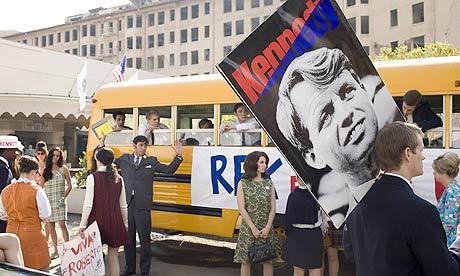
“Now that Dr. King is gone, there’s no one left but Bobby.” And, tragically, America would only have him for two more months. It’s hard to fault the sentiment behind Emilio Estevez’s Bobby, a humane, warm-hearted paean to the slain Senator, whose untimely end marked the final death rattle of hope for countless American liberals and progressives in the sixties. But, frankly, the film — while easy to sit through, to be sure — is also confused and overstuffed. It attempts to be Grand Hotel by way of RFK: Dozens of disconnected lives that intertwine one fateful night and that are ultimately bonded by their common humanity, as so eloquently articulated by Kennedy. But, however ambitious and meritorious its message and its patron saint, Bobby is a well-meaning muddle. The powerful stock footage and a few brief moments aside, a lot of the film just falls flat.
Due to its huge cast and multiplicity of stories, Bobby defies a full summation. Nevertheless, the film follows countless recognizable actors as they go about their lives at the Ambassador Hotel on June 4, 1968, the day before RFK was shot by disgruntled Palestinian Sirhan Sirhan. Among them are elder statesmen (Anthony Hopkins, Harry Belafonte), former A-listers turned B-listers (Emilio Estevez, Christian Slater), aging starlets (Sharon Stone, Demi Moore), TV standbys (Helen Hunt, David Krumholtz), likable character actors (William H. Macy, Freddy Rodriguez), strikingly attractive newcomers (Mary Elizabeth Winstead, Svetlana Metkina), and Frodo (playing, for all intent and purposes, Frodo.) Almost all of the performances are solid and likable (with the notable exception of Ashton Kutcher as a drug dealer — it’s unbelievable how a guy who’s made his living playing a stoner for years is so thoroughly implausible at it — he’s like a kid in a school play.) But there’s a lot of unnecessary overlap or what comes across as extraneous filler in these tales. Two separate stories (Wood and Lindsay Lohan’s quickie marriage, Shia La Boeuf and Brian Geraghty’s day off) cover basically the same ground about Vietnam. Hopkins, Belafonte, Moore, and Stone all talk about the indignities of growing old, while Stone, Macy, Moore, Estevez, Hunt, and Martin Sheen all lament failing marriages…but to what purpose? What, really, does all this have to do with RFK? I get it — it’s about shared humanity. But Bobby tries to do too much in the time given, and would’ve been more effective, I think, if it’d had been pared down some.
The most resonant parts of Bobby are the storylines involving Kennedy campaign workers (Joshua Jackson, Nick Cannon) and, most notably, the simmering racial tension among the kitchen staff (Freddy Rodriguez, Jacob Vargas, Lawrence Fishburne). The latter tale is particularly interesting — despite Slater being stuck as a cartoon “racist but a real person too” barely this side of Matt Dillon in Crash — since it highlights the concerns and aspirations of Latino immigrants, who are often completely neglected in movies dwelling on race in America (even in otherwise sterling shows like The Wire.) But, even here, it’s ultimately played too broadly: What we’re left with are “life is a blueberry cobbler” metaphors and monologues about King Arthur that’ll just make you wince. The problems with the movie can be summed up by the footage used of Bobby at the Ambassador Hotel — obviously powerful stuff. Unfortunately, it’s overlaid with Simon & Garfunkel’s “The Sound of Silence,” which even without the obvious Graduate overtones is entirely too broad a pick — It detracts from rather than enhances the already potent archival footage.
 Still, I don’t want to suggest that I’m completely hating on Bobby. For all its ham-handedness, I enjoyed the experience, and I sat there with a smile on my face through most of the film. And I do applaud Estevez’s obviously strong admiration for Senator Kennedy. I was recently on a date where discussion arose as to whether things would’ve been different if Bobby had lived. She thought not, or rather that it’d be impossible to tell. I’m more inclined to agree with Michael Sandel, who wrote that: “Had he lived, he might have set progressive politics on a new, more successful course. In the decades since his death, the Democratic Party has failed to recover the moral energy and bold public purpose to which RFK gave voice.” Regardless, as with Dr. King, we shouldn’t even have to ask this question. Both men who were continuing to grow and develop, Dr. King and Bobby were tragically ripped from us before their time, a back-to-back blow in an already miserable year that felled progressive ambition in America for decades. I have to think that our nation would be a brighter, happier, and more compassionate place in the years since if we could have continued to benefit from their leadership and counsel.
Since we cannot, we can only honor their examples and remember their words. In the end, Bobby could’ve been a much worse movie than it in fact is, and I still would give it credit for reminding us of Senator Kennedy’s essential creed: “But we can perhaps remember — even if only for a time –that those who live with us are our brothers; that they share with us the same short moment of life; that they seek — as we do — nothing but the chance to live out their lives in purpose and happiness, winning what satisfaction and fulfillment they can.”