In the trailer bin, Samuel Jackson takes drastic measures to save Christina Ricci from herself in the bizarre new trailer for Craig Brewer’s exploitation homage Black Snake Moan, also with Justin Timberlake and S. Epatha Merkerson. And the Shaun of the Dead team of Simon Pegg, Nick Frost, and Edgar Wright unfurl another trailer for their cop comedy Hot Fuzz, now with a brand-new moustache joke exclusively for American audiences.
Category: Cinema
Excessive Fauning.
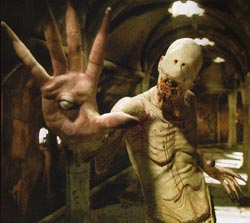 Well, I’m not very happy about being on the other end of the review spectrum for this film, which was one I’d been really looking forward to. But, I must confess, I’m somewhat mystified by the almost-universally stellar reviews that have accompanied Guillermo del Toro’s Pan’s Labyrinth. It’s not a bad movie by any means, but I found it the least accomplished of this year’s crop of A-list genre films (The Prestige, Children of Men, The Fountain — the latter in particular seems to have been unfairly maligned in comparison to this one.) Billed as a “fairy tale for grown-ups,” Pan’s Labyrinth is a diverting but disconnected hodgepodge of fantasy, horror, and historical fiction, held together, if at all, only by occasional reference to Del Toro’s usual visual affinities, such as creepy insects, yonic symbols, punctured/torn flesh, and Doug Jones in funny suits. And as far as fantastical tales of children during the Spanish Civil War go, Del Toro has tread this ground before with the haunting Devil’s Backbone, and, to be honest, I preferred that film in almost every regard.
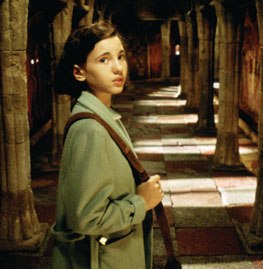 So, here’s the setup: Once upon a time — 1944, to be exact — there was a young girl on the verge of adolescence named Ofelia (Ivana Baquero) who was forced to accompany her sickly, pregnant mother (Ariadna Gil) into the Spanish countryside, and to live with her wicked (Fascist) stepfather (Sergi Lopez of Dirty Pretty Things, and I do mean wicked — he beats an old man’s face into bloody fragments within the first twenty minutes.) Although befriended by a kindly maid (Y Tu Mama Tambien‘s Maribel Verdu) — one who may have ties to Republican remnants in the nearby mountains — Ofelia is deeply disconsolate in her new home. That is, until a congenial fairy-mantis she encountered on her way in takes her deep into the nearby garden labyrinth, where an unnerving faun (Doug Jones) discloses that she may in fact be a long-lost princess of an underground world. To claim her birthright, Ofelia must first accomplish three fairy-tale-type tasks, all the while evading her wicked stepfather and doing what she can to protect her ailing mother. But, much to her dismay, Ofelia soon finds that her fantasy world can be just as dangerous and even deadly as her stepfather’s company, particularly once the two worlds begin to collide.
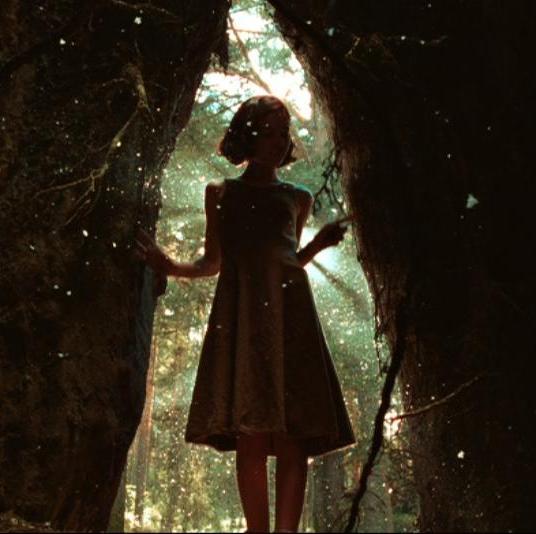 But do they collide? Perhaps I missed some vital subtext, but I found Ofelia’s dreamworld adventures — other than the “Girl, you’ll be a Woman soon” flourishes, like the bloody book — to be generally remote both from her problems at home and from the Republican-Fascist feud, other than that all three narrative strands grow increasingly grisly and grotesque. And, while certain scenes definitely linger in the senses like eerie reminiscences of a fever dream, most notably the Wraith’s Table, they don’t really serve the larger story in any way I could fathom. (Also, why does Ofelia suddenly decide to go all Augustus Gloop in that scene anyway? Dream logic, I guess, but it seemed out of character.) Throw in a few second-act torture scenes that are more off-putting than they are resonant or even necessary, and Labyrinth starts to wear thin well before the end. In sum, Pan‘s a decent film that’s worth seeing if you’re in the mood for it, but it’s by no means the genre classic it’s being made out to be. Perhaps the subtitles gave it gravitas in some corners, but, to my mind, Pan’s Labyrinth gets a little lost in its own maze.
Double Dip Disc Detente.
Hopefully (and cleverly) taking the sting out of the looming format wars, Warner Brothers announces the Total High Def disc at the Consumer Electronics Show in Las Vegas. “If broadly adopted by the industry, the Total Hi Def disc would eliminate consumer confusion by including both formats [HD-DVD and Blu-Ray] on a single disc. Tested with leading manufacturers and replicators, the Total Hi Def disc would also simplify point of sale issues for retailers by reducing the shelf space required to carry two versions of the same content.”
Much Support for the Monarchy.
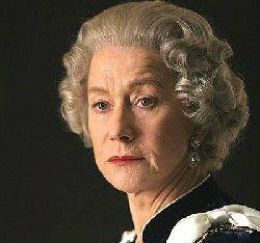 Just as I didn’t have much hankering to see a film about United 93 at first, I’ve been presuming that not much would interest me less than a movie about the aftermath of Princess Diana’s death in 1997. (Obviously, the loss of any relatively young person in a car crash, particularly one as committed to international concerns as Diana was, is tragic. But in all honesty, when I think of the hubbub and hysterics surrounding her untimely death, it reminds me of the “Baby Diego” sequence in Children of Men.) That being said, I’m happy to say that Stephen Frears’ The Queen is, like United 93, a surprisingly good depiction of recent history. Less a paean to “the people’s princess” than a sharp-witted rumination on changing social values and the effect of global “Oprahization” on contemporary politics, The Queen is an intelligent, discerning and enjoyable slice-of-life that’s well worth catching.
As the film begins — after a wink similar to the one opening Marie Antoinette — the young, charming, and recently-elected face of New Britain, Tony Blair (Michael Sheen), ventures to Buckingham Palace with resolutely anti-monarchist wife Cherie (Helen McCrory), in order to request of his sovereign Queen Elizabeth II (Helen Mirren) that he be allowed to form a government. A study in contrasts, the emotive, familiar prime minister and the punctilious, reticent Queen get on less well as exemplars of New and Old England than, say, Peel and Steed. Reared and residing in a bastion of venerable tradition, where faxes are still delivered in a wicker basket and feelings are not discussed, Queen Elizabeth has little patience for Blair’s studied informality and populist bonhomie. But, when tragedy strikes several months later, in the form of Princess Diana’s death at the hands of the loathsome paparazzi, the Crown finds itself soon embroiled in a downward spiral of their own making, as — the Prince of Wales (Alex Jennings) notwithstanding — the royal family shows little inclination to convert their grief into a public display (or to honor someone they’ve come to perceive as an impulsive and manipulative interloper.) And, when England’s people begin to surround Buckingham Palace with wreaths and bouquets that come to seem as menacing as torches and pitchforks, it falls on the prime minister to attempt to instruct the Queen on the vagaries of politics in the Tabloid era, before permanent damage is wrought upon the monarchy.
More than United 93, the film that actually comes to mind when watching The Queen is Nixon. Like Oliver Stone’s film, The Queen attempts to humanize a oft-maligned world figure for whom much of the audience may have little sympathy. Like Nixon, it portrays a government increasingly besieged by its own people, and a bewildered political leader who finds they’ve lost touch with their electorate or subjects (Consider the scene of Nixon at the Lincoln Memorial, or all the perhaps over-the-top talk of “the beast” therein.) And, of course, the Queen’s relationship to the fallen Diana is depicted here much like Nixon’s (and LBJ’s) to John — and later Bobby — Kennedy. This holds true particularly in the later scenes of the film, as Elizabeth is forced to confront the fact that, for all her sacrifices, she’ll never compete with the fallen princess in the public’s esteem.
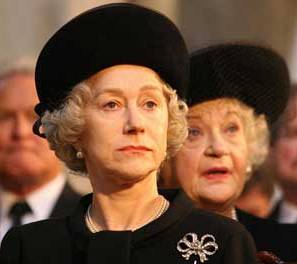 The emotions this sad realization elicits, along with many others in the film, are visible only in the margins of Helen Mirren’s mask of public composure, bringing home the conflict between restraint and immodesty (or, if you’d prefer, suppression and sensitivity) at the center of the film. Mirren, as always, is excellent here, and I’d guess her Oscar is already in the bag: She invests her monarch with grace and dignity even while frumpily walking her dogs down the lane, and rises above the very occasional clunks in the script (The buck stops here, indeed.) And Michael Sheen’s Tony Blair grows on you. At first, he seems off, but eventually you get the sense that he conveys Blair’s more notable qualities rather well: intelligence, boyishness, a way with people, and a potentially problematic penchant for deference. (Indeed, just when it seems the movie’s portrayal of Blair has grown cloying beyond words, Mirren’s Queen puts him in his place, and ties 1997’s hero of Labor to the more troubling Blair of today, one who could and should have more aggressively instructed his American counterpart on the vagaries of leadership in the reality-based world.)
Philly Soul.
 “The world ain’t all sunshine and rainbows. It is a very mean and nasty place and it will beat you to your knees and keep you there permanently if you let it. You, me, or nobody is gonna hit as hard as life. But it ain’t how hard you hit; it’s about how hard you can get hit, and keep moving forward.” Perhaps it was the beneficiary of low expectations…Still, Sylvester Stallone’s Rocky Balboa, however fundamentally formulaic at its core, proved a much more satisfying moviegoing experience than the first half of Monday’s double-feature, The Good Shepherd. I’ve never been much more than a casual Rocky fan: I was way too young to appreciate the first two, more nuanced movies when they came out, and have clearer childhood memories of Balboa trouncing cartoon boxing villains Clubber Lang (III) and Ivan Drago (IV) than I do of him going the distance against Apollo Creed. (Still, even when I was eleven, the Italian Stallion singlehandedly winning the Cold War in Rocky IV seemed cheesy, and Rocky V is, of course, best forgotten.)
Nevertheless, more a character study than an 80’s-style action flick, Rocky Balboa is — thankfully — a throwback to the early days of Philly’s finest, when the big lug spent more time just wooing the nerdy-cute gal at the pet store than he did wrestling Hulk Hogan and sorting out geopolitical wrongs. Here, we’re more often than not simply following a lion in — if not winter, than in really late fall — going about his day in the city he loves and searching for one more shining, meaningful moment before twilight beckons. And, I’m forced to admit: By the time Rocky gets his one last shot — the big bout that takes up the final third of the film — it would take a harder heart than mine not to be swept up somewhat by the ride.
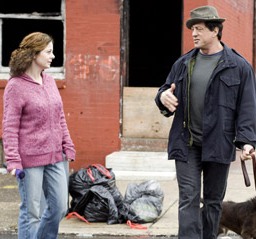 As Rocky Balboa begins, we discover that the Italian Stallion has not only lost most of his money from previous films (Sorry, sports fans, Paulie’s ridiculous robot is seemingly no more) but also his heart and soul, Adrian, who has succumbed to cancer. Clearly still very aggrieved, Rocky spends his days wandering around he and Adrian’s old haunts with the still-vexatious Paulie (Burt Young), trying to establish a connection with his mildly prodigal son (Milo Ventimiglia, a.k.a. Heroes‘ Peter Petrelli), and recounting old war stories to bored patrons at his restaurant. Then, one day after reconnecting with Little Marie (Geraldine Hughes) from the first film (Spider Rico is kicking around too), Rocky gets a hankering to deal with his ghosts by fighting again. “Sometimes I feel like there’s this beast inside me,” he tells Paulie in one of the film’s more affecting monologues. “I’ve got stuff in the basement.” And, as it turns out, the money-hungry managers of the current champ — Mason “The Line” Dixon (Antonio Tarver) — are looking to improve their client’s public profile by setting up a friendly “sparring” exhibition with a still-popular has-been…
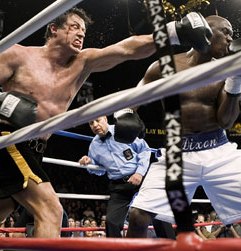 You can guess the rest (except perhaps the ending, which I won’t give away here.) So, yes, the film is both predictable and wildly improbable, but somehow, it kinda works. Perhaps it’s because Stallone here seems to emphasize Rocky, aged and bloody but still unbowed, as an exemplar of the Philadelphia spirit, an historic American city that’s taken its share of knocks in recent decades — from deindustrialization to those woeful sports teams — but still keeps on keepin’ on. Or perhaps it’s because Sly, looking more beaten-up, bloated, and wounded than we’re ever accustomed to seeing him, brings a measure of pathos to his tale of one last hurrah just by showing up. Rocky Balboa isn’t one for the ages or anything, but it is very good for what it is — a schmaltzy but well-written and enjoyable piece of uplift and a worthy last outing for one of cinema’s most popular and enduring pugilists. In a surprise upset, the sixth and final round goes to Stallone.
Compass Heading.
More images from The Golden Compass emerge online, including new looks at Lyra (Dakota Blue Richards), Lee Scoresby (Sam Elliot), Mrs. Coulter (Nicole Kidman), and Lord Asriel (Craig. Daniel Craig.) Also in the mix, Eva Green (as Serafina Pekkala) and Ian McShane (as the voice of Ragnar Sturlusson). [They’re also posted here.]


Secrets of the Hive.
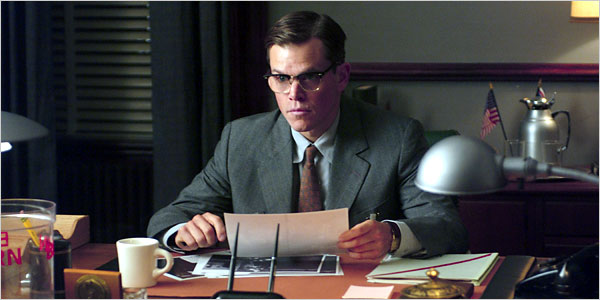
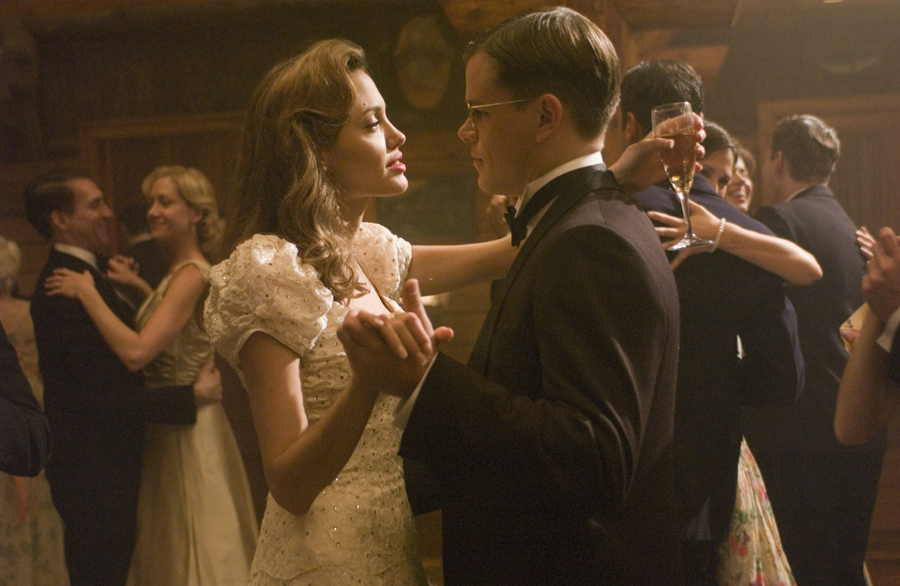
Robert De Niro’s The Good Shepherd, the first entrant in my ongoing end-of-2006 movie marathon this week, makes no secret of its Oscar-bait aspirations. Basically the WASP version of The Godfather, as told against the creation and Cold War consolidation of the CIA, Shepherd boasts a crisp look, a grand historical sweep, high-quality production values, and a stellar cast (including Best Supporting Actor-type turns strewn all over the place, like the wreckage from a better, more interesting movie.) But it’s also a film that never lets you forget how serious and sober-minded it aims to be. As such — however well-meaning and nice to look at, with all its chiaroscuro fedoras on hand — it’s also sadly a bit of a bore. Throw in an occasionally clunky script (note the particularly egregious God/CIA line near the end, for example) and some considerable miscasting issues (Matt Damon is a good actor, but is thoroughly implausible as a middle-aged man, and Angelina Jolie is too much of a star presence to be wholly believable as the ignored wife) and you have a respectable but ultimately somewhat pedestrian night at the movies. Shepherd gets the job done, I suppose, but it takes no pleasure in it.
When we first meet intelligence analyst Edward Wilson (Matt Damon), the bespectacled Everyman and titular shepherd of the film, it’s the spring of 1961, the Bay of Pigs invasion has just gone FUBAR, and America’s new president is looking for a few heads to roll over at Langley. In this middle of this spate of job anxiety, Wilson is mysteriously sent a photo and audioreel of a couple in the throes of passion, seemingly somewhere in the Third World. As he sets to work on deciphering this arcane message, Wilson’s thoughts wander all the way back to 1939, when he — a young, idealistic student of poetry at Yale — was recruited first by the infamous Order of Skull and Bones (a.k.a. preppy fratboys gone wild) and then, after war breaks out in Europe, by the OSS. Along the way, he takes on a number of varied mentors, ranging from a Nazi-sympathizing poetry professor with then-shocking proclivities (Michael Gambon) to a congenial if hobbled general and spymaster (De Niro, playing a variation on Wild Bill Donovan) to a gaggle of fellow scions of the WASP Old Boy Network (representing the Eli’s, William Hurt and Lee Pace; representing the Oxford-Cambridge crowd, Billy Crudup with a slipping accent.) He also falls in love, with a (note the symbolism!) kindly, open-hearted deaf co-ed (Tammy Blanchard), and falls, in lust, with a needy, easy, and borderline-psycho socialite (Angelina Jolie, verging on typecasting in a terribly written role, but still quite good.) As the years drag on and the world freezes into Cold War, Wilson finds himself not only engaged in high-stakes cloak-and-dagger gamesmanship against his Soviet counterpart, codenamed Ulysses (Oleg Stefan), but inexorably ceding more of his dreams, his morality, his family, and his very soul to that hungering bastion of the Eastern Establishment mafia, the Central Intelligence Agency. And every time he tries to get out, they keep pulling him back in…
Comparisons to The Godfather are probably as unfair as they are inescapable. Still, for all the striving and sweating on display here, Edward Wilson is ultimately no Michael Corleone. In fact, Damon, while trying admirably, can’t plausibly sustain the second “middle-aged” half of the film, and portrays Wilson as too much of a blank (clearly De Niro’s decision) to garner much in the way of sympathy or empathy. More resonant in The Good Shepherd are many of the supporting turns, particularly Gambon, John Turturro as Wilson’s tough-talking (non-WASP) #2, and Alec Baldwin in a minor role as a hard-living G-man. But they’re not enough to put Shepherd over the top, and for every vignette in the film that contains real emotional power — most notably the interrogation of defector “Valentin Mironov” (Mark Ivanir) — there are two that, through a combination of directorial straining and an overly intrusive score, spill over into overcooked blandness. (See for example, the plane and letter-burning sequences at the end of the film, both of which are carried for several beats too long and which suffer from paint-by-numbers swelling strings on the soundtrack.) The Good Shepherd is by no means a bad film, but, alas, it’s not particularly a good one either. Like a veteran CIA hand, it fades effortlessly into the background, and offers little that might be considered truly memorable.
Keeping Up with the Joneses.
We’ve heard it a few times before, but apparently this time it’s for real: A Steven Spielberg-directed Indy 4 is a go, with a David Koepp script and a planned May 2008 release.
Portrait of the Cannibal as a Young Man.
Premiering today on Amazon, the new trailer for Peter Webber’s Hannibal Rising, with Gaspard Ulliel, Gong Li, Rhys Ifans, and Dominic West. Hmm….even with the Jimmy McNulty voiceover, I’m not enthused. What’s next, Hannibal meets the Wolfman?
Grind, Kingdom, Prime, FF.
Another wave of holiday trailers comes down the pike: Quentin Tarantino and Robert Rodriguez let their B-film freak flags fly (again) in the full trailer for Grindhouse, with Kurt Russell, Rose McGowan, and Freddy Rodriguez, among others; Jamie Foxx, Jennifer Garner, Jason Bateman, Chris Cooper, Jeremy Piven, and Richard Jenkins fight the war on terror in Saudi Arabia in this first look at Peter Berg’s The Kingdom; and Shia la Boeuf and the US military run from metal toy-like things in the new preview for Michael Bay’s Transformers (If you’re interested, see also the pic of Optimus Prime here.) Word is the trailer for Fantastic Four 2 is also showing in theaters at the moment, although the only thing online right now is this rather meh image of the Silver Surfer…hopefully, they do a better job with Galactus. Update: The FF teaser is now up.