Twilight of the Drug War?

“Change is ‘snowballing in the right direction,’ said Tom Angell, chairman of Marijuana Majority. ‘I think you’re going to see a lot of action on the state level in the next several years and action will trickle up to the federal level…For a long time people would agree with us behind closed doors, but they would be afraid to say that in public,’ he said. Now, even in Washington, things are changing. ‘There was just a lot of cynicism and pessimism … I think that attitude is really going away.’

More fruits from Californication: With public support for legalizing marijuana over 50% for the first time, and a new documentary, The House I Live In, once again calling attention to the many cruel absurdities of the Drug War$1 trillion spent, 2.2 million in prison — signs suggest the ill-advised War on Drugs may finally be receding as a sacrosanct institution in Washington.

“For decades, the politics of the drug war were straightforward: Being tough could help at the polls and came with no political downside; being open to reform had few advantages, but would be used against a candidate on the campaign trail. That calculation is no longer so simple.”

PhDon’t. | JD’s a Bust too.

“[W]hat if I told you that by ‘five hours’ I mean ’80 hours,’ and by ‘summers off’ I mean ‘two months of unpaid research sequestration and curriculum planning’? What if you’ll never have time to read books, and when you talk about them, you’ll mostly be using made-up words like ‘deterritorialization’ and ‘Othering’…I can’t even tell you what kind of ass you have to kiss these days to get tenure — largely because, like most professors, I’m not on the tenure track, so I don’t know.”

Another one for my burgeoning PhDont tag: Literature professor and Kafka scholar Rebecca Schuman explains once again why getting a humanities PhD is a terrible life decision these days. “No, you will not get a job – In the place of actual jobs are adjunct positions: benefit-free, office-free academic servitude in which you will earn $18,000 a year for the rest of your life.”

What she said: The jobs are not out there, the wheels have come off the tenure-track cart, and many people are in a bad way. I count my lucky stars every day that I had a prior career to fall back on.

Update: “More attorneys are finding themselves in plights similar to that of the thirty-four-year-old lawyer with more than $200,000 in school loans and a job that would never pay enough to retire them: ‘It’s a noose around my neck that I see no way out of.'” As Stephen Harper points out in Salon, law school isn’t the best answer either. “The promise of a secure future at a well-paying job is often illusory. The persistent problem of lawyer oversupply rose to crisis level, and the market for new talent has remained weak…For most of the nation’s forty-four thousand annual graduates today…positions were never there at all.”

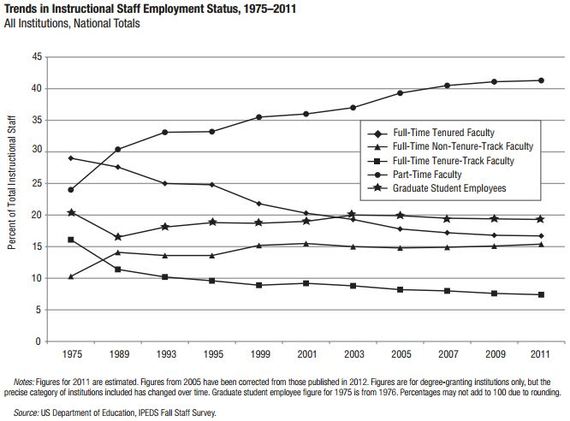
Update 2: “Once, being a college professor was a career. Today, it’s a gig…Since 1975, tenure and tenure-track professors have gone from roughly 45 percent of all teaching staff to less than a quarter.” More fuel for the pyre: The Atlantic‘s Jordan Weissmann offers a graph depicting the demise of tenure. “[T]he big story across academia is broadly the same: if it were a movie, it’d be called ‘Rise of the Adjuncts.’…The AAUP reports that the median pay for teaching a single course was $3,200 at a public research university, and just $2,250 at a community college.

The Balcony is Closed.

“I know it is coming, and I do not fear it, because I believe there is nothing on the other side of death to fear…I was perfectly content before I was born, and I think of death as the same state. I am grateful for the gifts of intelligence, love, wonder and laughter. You can’t say it wasn’t interesting. My lifetime’s memories are what I have brought home from the trip. I will require them for eternity no more than that little souvenir of the Eiffel Tower I brought home from Paris.”

Roger Ebert, the reigning Dean of film critics, 1942-2013. As a movie reviewer, I often didn’t agree with him – I found his sensibilities a bit too saccharine for my taste. But as a writer and convivial voice, he was always inviting, and and always worth reading, and few established columnists have embraced the democratic give-and-take of writing on the web as much as he did. R.I.P.

That’s Exactly What They Want You to Think.

“9% of voters think the government adds fluoride to our water supply for sinister reasons (not just dental health). 4% of voters say they believe ‘lizard people’ control our societies by gaining political power…14% of voters believe in Bigfoot. 15% of voters say the government or the media adds mind-controlling technology to TV broadcast signals (the so-called Tinfoil Hat crowd.)”

PPP polls America’s taste for various conspiracy theories. “37% of voters believe global warming is a hoax, 51% do not. Republicans say global warming is a hoax by a 58-25 margin, Democrats disagree 11-77, and Independents are more split at 41-51. 61% of Romney voters believe global warming is a hoax…20% of voters believe there is a link between childhood vaccines and autism, 51% do not.” Sigh. Don’t blame me, I voted for Lizard People.

Titan’s Brew.

“‘Scientists previously thought that as we got closer to the surface of Titan, the moon’s atmospheric chemistry was basically inert and dull,’ said Murthy Gudipati, the paper’s lead author at JPL. ‘Our experiment shows that’s not true. The same kind of light that drives biological chemistry on Earth’s surface could also drive chemistry on Titan, even though Titan receives far less light from the sun and is much colder.'”

A NASA/JPL simulation of Titan’s atmosphere suggests a chaotic chemical brew conducive to life on Saturn’s most interesting moon. “Now we know that sunlight in the Titan lower atmosphere can kick-start more complex organic chemistry in liquids and solids rather than just in gases.” (Titan image via this 2011 post.)

Plancking the Universe | AMS Activate.

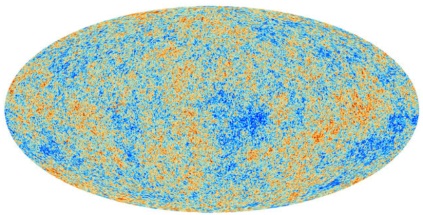
“In a statement issued by the European Space Agency, Jean-Jacques Dordain, its director general, said, ‘The extraordinary quality of Planck’s portrait of the infant universe allows us to peel back its layers to the very foundations, revealing that our blueprint of the cosmos is far from complete.'”

This came out while I was in Seattle and I’ve been meaning to catch up: By measuring the cosmic background radiation still extant from the Big Bang, the ESA’s Planck satellite gives us our most detailed map of the universe yet.

“[T]he new satellite data underscored the existence of puzzling anomalies that may yet lead theorists back to the drawing board. The universe appears to be slightly lumpier, with bigger and more hot and cold spots in the northern half of the sky as seen from Earth than toward the south, for example. And there is a large, unexplained cool spot in the northern hemisphere.”

I find these maps particularly fascinating because, as I said when NASA’s WMAP returned its data in 2003 (and here in 2002), I spent the summer of 1992 poring over the original COBE DMR version of this map for my high school senior thesis, in order to determine whether the radiation exhibited a fractal distribution. (And, honestly, how early 90’s is that?)

“‘A.M.S. has confirmed with exquisite precision and to high energy one of the most exciting mysteries in astrophysics and particle physics,’ said Justin Vandenbroucke, of the University of Wisconsin and Stanford’s SLAC National Accelerator Laboratory.” In related news, NASA’s recently-installed Alpha Magnetic Spectrometer on the ISS is helping physicists and cosmologists get to the bottom of the dark matter mystery.

The A.M.S. has “confirmed previous reports that local interstellar space is crackling with an unexplained abundance of high energy particles, especially positrons, the antimatter version of the familiar electrons that constitute electricity and chemistry…’Over the coming months, A.M.S. will be able to tell us conclusively whether these positrons are a signal for dark matter, or whether they have some other origin.’

Dad to Daleks, Mom to Muppets, Uncle to Many.

R.I.P. Dalek inventor Ray Cusick 1928-2013, Muppets co-creator Jane Henson 1934-2013, and actor Richard Griffiths 1947-2013, best known as Uncle Dursley of Harry Potter, Professor Hector of The History Boys, and Uncle Monty of Withnail and I.

The Dismal, Ignoble Science.

“The obvious medicine for a slump due to inadequate private-sector demand is to run government deficits large enough to restore the economy back to its potential. The private sector isn’t going to increase demand on its own, no matter how much we profess our love for job creators. That is the simple reality. But instead of preaching what the textbooks prescribe, much of the economics profession has become enamored of numerology, telling us that all hell will break loose if the debt-to-GDP ratio crosses some magical number.”

CEPR’s Dean Baker, one of the only economists to anticipate the collapse of the housing bubble, calls out his many colleagues currently collaborating in the deficit witchhunt. [Y]oung people today can expect many more years of dire labor market conditions, because the remedies that could turn around their job situations have been blocked by nonsense spewing from economists. Incidentally, this situation works out very nicely for those on top, who are enjoying the benefits of record-high profit shares, which have also helped to fuel a soaring stock market.”

Along very similar lines, here’s James K. Galbraith on the state of economics in 2002:

“Leading active members of today’s economics profession, the generation presently in their 40s and 50s, have joined together into a kind of politburo for correct economic thinking. As a general rule — as one might expect from a gentleman’s club — this has placed them on the wrong side of every important policy issue, and not just recently but for decades. They predict disaster where none occurs. They deny the possibility of events that then happen. They offer a “rape is like the weather” fatalism about an “inevitable” problem (pay inequality) that then starts to recede. They oppose the most basic, decent, and sensible reforms, while offering placebos instead. They are always surprised when something untoward (like a recession) actually occurs.

And when finally they sense that some position cannot be sustained, they do not re-examine their ideas. Instead, they simply change the subject. No one loses face, in this club, for having been wrong. No one is disinvited from presenting papers at later annual meetings. And still less is anyone from the outside invited in. Only the occasional top-insider-turned-dissident — this year the admirable Stiglitz — can reliably count on getting a hearing.

Discontinuity and Rupture.

‘Many music critics still believe in magical black people: “Oh, they’re making crazy, avant-garde music in Chicago, and it’s called juke”,’ he says. ‘But at the same time, the privilege of being a black man with a middle-class background at the start of the 21st century is that I can do whatever I want: it doesn’t have to feel representative. I was nerdier than people wanted DJ /rupture to be.'”

On the eve of his new reinterpretation of works by Julius Eastman, The Guardian profiles musician and recombinator Jace Clayton, a.k.a. DJ Rupture, a friend of mine from college and, along with Parks and Recreation creator Mike Schur, author Nell Freudenberger, and star Rashida Jones, one of the more accomplished members of Harvard’s class of ’97. “Boston’s extremely segregated…And musical segregation was indistinguishable from actual segregation.”