Reagan gets Racial.

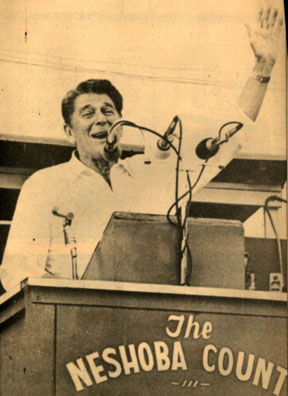
“The upshot was that by 1980, race and ideology had become so commingled that one’s stand on racial issues served as a proxy for one’s partisan preference. Previously, economic issues had been the chief dividing line between the parties. By 1980, though, according to the Edsalls, the changes that followed the civil rights movement had crystallized, and racial politics figured just as strongly.Slate‘s resident historian David Greenberg weighs in on the recent furor at the NYT (and elsewhere) over Ronald Reagan’s 1980 campaign kickoff speech in Philadelphia, Mississippi, site of the 1964 Schwerner-Chaney-Goodman murders. (Coincidence? Sheah.) Therein, Greenberg correctly and succinctly argues that Reagan’s “I believe in states’ rights” was, in an apt turn of phrase, “a dog whistle to segregationists.

Honestly, I’m not really sure how you could dispute this, unless you want to argue that Reagan and his political handlers were completely ignorant about the civil rights struggle, massive resistance, and the significance of Philadelphia, Miss. in those struggles. (Of course, then you’d have to explain how Reagan remained blissfully unaware of the fact his 1966 gubernatorial bid often relied on similar loaded language.) Was Reagan a racist? I dunno, that’s not the issue. Did Reagan rely on coded racial messages to appeal to white conservatives, akin to what Dubya does these days with pro-lifers and Dred Scott? Obviously.

Say what you will about the tenets of National Socialism…

I’m talkin’ about friendship. I’m talkin’ about character. I’m talkin’ about – hell, Leo, I ain’t embarrassed to use the word – I’m talkin’ about ethics.” If you’re a cinephile of any sort, The House Next Door is probably already (or should be) on your reading list. Still in case it isn’t, Matt Zoller Seitz wrote a particularly intriguing essay on the Coens’ view of morality last week (which you absolutely should NOT read until after seeing No Country for Old Men — it gives away the whole game.) “Though they are habitually described as snotty formalists with nothing on their minds but cinematic gamesmanship, the Coens’ body of work is one of the most sneakily moralistic in recent American cinema. To some extent, all of their movies poses questions that supposedly deeper filmmakers have broached time and time again: if we cannot be certain of God’s existence; if there is a possibility that no one’s watching what we do; if, to reference Johnny Caspar in Miller’s Crossing, ‘morality and ethics’ are agreed-upon lies…then what’s the point of being good? Just because.Update: Also via THND, the Chicago Sun-Times‘s Jim Emerson offers up another quality dissection of No Country.

Drawn into Grendel’s Den.


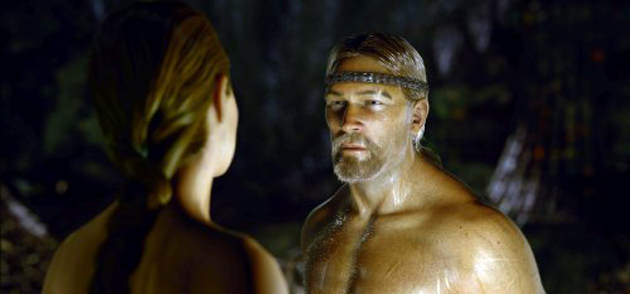
I am the ripper, the terror, the slasher. I am the teeth in the darkness! The talons in the night! My name is strength! And lust! And power! I AM BEOWULF!” Well, ok then. If Zack Snyder’s 300 last spring only whetted your appetite for cartoonish sword-and-sandal epics featuring hyperstylized gore and naked men bellowing, you’re in luck. For now arises Robert Zemeckis’ Beowulf, a rousing 3-D mo-capped glimpse into the future of filmmaking and the ancient past of storytelling. To be honest, it’s harder than usual for me to judge Beowulf on its own terms, since this was my first feature-length IMAX-3D experience (notwithstanding documentaries like Aliens of the Deep), so I can’t say if it’d have the same effect at your regular 2D cineplex. But, in three dimensions, Beowulf is pretty darned impressive, what with arrows, swords, and viking viscera flying in all directions…We’ve come a long way from Captain Eo. And, while the film is basically a pretty standard three-act summer action movie, I’ll give it points for daring to be both more bloody and more downbeat than your average animated fare. If you see one movie this Thanksgiving holiday, see No Country for Old Men…but, if you’re in the mood for it, Beowulf is well worth a look-see as well.

In late 5th century Scandinavia, as rumors of a new god, Christ Jesus, leak out of lands to the South, the Danes under the dissolute King Hrothgar (Anthony Hopkins) and his lovely Queen Wealthow (Robin Wright Penn) are just looking to have a good time. This they proceed to do in the manner of ancient peoples and Ren Faires immemorial, with ribald songs and lusty wenches, meat straight off the bone, and more mead than you can shake a spear at. But interrupting these hearty proceedings is an uninvited guest, an oozing, decaying nearby troll known as Grendel (Crispin Glover), who proceeds to wreck the mead hall, tear Danes limb from limb, and otherwise bring the party down. Seeking respite from Grendel’s gory visitations, King Hrothgar and his people need a Hero. They find one in the traveling Geat warrior Beowulf (Ray Winstone), who arrives via ship with his loyal lieutenant Wiglaf (Brendan Gleeson) and a band of battle-tested scoundrels, all seeking honor and glory. Beowulf is tough, Beowulf is fearless, Beowulf is…a bit of a braggart, as deduced by one of the local noblemen (John Malkovich). But that’s beside the point, as, having enlisted under Hrothgar’s standard, mighty Beowulf must now confront the demon Grendel whether he likes it or not…as well as his more powerful, more alluring mother (Angelina Jolie), who has certain feminine wiles in her arsenal that our Hero may find harder to resist.

If you read, or were forced to read, Beowulf back in school days, you’ll quickly find that screenwriters Neil Gaiman and Roger Avary have changed the story considerably — They’ve made it bawdier, they’ve completely rewritten the second and third acts, and they’ve emphasized the human fallibility of the characters rather than their epic heroism. (While I’m sure this is anathema to many, none of this bothered me very much, as I’ve actually never read Beowulf before…sad, I know.) Still, for what’s here, Beowulf works decently well, although a Faustian bargain is made at one point that doesn’t seem nearly as tragic and horrible as it’s made out to be. (Sure, regrets he’s had a few, but Beowulf seems to do pretty well by the deal, and you could argue he’s only undone once it is inadvertently broken, rather than as a consequence of consummating it in the first place.)

All that being said, in most eyes Beowulf is less likely to be judged for its capturing the nuances of the ancient poem than it is for its motion-capture, and here’s it’s going to be up to one’s personal aesthetics. Some reviewers are completely creeped out by the effect, but it didn’t bother me much at all. (The 3-D assuredly helped.) Sure, there were a few establishing shots — the viking ship, horses crossing a bridge — that screamed World of Warcraft cutscene, and the men, with their chiseled features and facial hair, still look more realistic than the women, whose faces often lack as much definition. But, all in all, I was rather impressed by the quality of the animation. And, besides, it’s animation — it was more important to me that Beowulf and Grendel seem part of the same world than that Beowulf looked exactly like someone I’d see at the deli. (And if this is what it takes to see Ray Winstone and Brendan Gleeson as the two leads in a buddy picture, so be it, although it still might be more fun to see them face off in a Sexy Beast II.)

So, yes, Beowulf is more a cartoonish action flick (see below) than a somber and faithful retelling of the epic poem. But, as far as cartoonish action flicks go, I thought it was pretty entertaining. (And if you have an IMAX 3-D theater near you, it’s pretty much a must-see.) And, while admittedly it may achieve nothing close to the heights of the original poem, I still admired the general sense of dread and melancholy at work through much of Beowulf. Even the greatest heroes in our canon, it seems, often have a failing for beauty and proud words.

Update: If you’re a first-time visitor arriving via The House Next Door today, welcome! (And, happy thanksgiving.) This way to the site’s front page, and down the hall on your left is the movie review archive. And, sorry, the turkey isn’t ready yet (unless you mean Southland Tales.)


The Monster and its Critic.

“Zemeckis took the oldest and most important text of our ur-language, and turned it into a 3-D Disneyland ride so cheesy he should have called it ‘Anglo-Saxons of the Caribbean.’…But the ‘Beowulf’ travesty is especially glaring, because of the obvious contrast with another work that mined the same ancient field: J.R.R. Tolkien’s ‘The Lord of the Rings.’” Taking issue with the “plastic entertainment‘ that is Zemeckis’ Beowulf much more than I did, Salon‘s Gary Kamiya movingly explains what Tolkien understood about the poem, and how it informed his own work. “Tolkien’s brilliant essay can be seen as a ringing defense not just of ‘Beowulf,’ but of the work he was soon to embark on, another great tower composed of ancient stones. And the themes of lateness, of heroic loss, being caught between one age and another (his world is not called ‘Middle-earth’ for nothing), are the deepest and most sublime parts of his own epic.

Ready for his Close-Up.

“But political success on television is not, unfortunately, limited only to those who deserve it. It is a medium which lends itself to manipulation, exploitation and gimmicks. It can be abused by demagogs, by appeals to emotion and prejudice and ignorance. Political campaigns can be actually taken over by the ‘public relations’ experts, who tell the candidate not only how to use TV but what to say, what to stand for and what ‘kind of person’ to be. Political shows, like quiz shows, can be fixed-and sometimes are.”

By way of Ted at The Late Adopter, Senator John F. Kennedy ruminates on how television has changed politics in 1959, and much of it reads as presciently as Eisenhower’s farewell address fourteen months later. “The other great problem TV presents for politics is the item of financial cost. It is no small item…If all candidates and parties are to have equal access to this essential and decisive campaign medium, without becoming deeply obligated to the big financial contributors from the worlds of business, labor or other major lobbies, then the time has come when a solution must be found to this problem of TV costs.” Yeah, I’d like to say we were working on that.

Choose Your Own Scandal | Iowa Update.

The Dem race took another ugly turn over the weekend as a column by conservative DoL Bob Novak dropped that the Clinton campaign is harboring “scandalous information” about Obama but has chosen not to use it, thus making “Obama look vulnerable and Clinton look prudent.” Obama then dared the Clinton camp to release whatever info they were insinuating about on deep background, at which point Team Clinton disavowed all knowledge of the leak, choosing instead to go snide about the matter. Said Clinton spokesman Howard Wolfson: “A Republican-leaning journalist runs a blind item designed to set Democrats against one another. Experienced Democrats see this for what it is. Others get distracted and thrown off their games.” I must say, the politics of personal destruction have gotten pretty bad when you can just let the suggestion of a scandal do the dirty work for you. Who needs a Swift Boat when you can just let people’s imaginations run wild? Well, speaking as an “experienced Democrat” — i.e. several years spent in the Beltway trenches — I seriously doubt Novak just made this all up. I wouldn’t trust Novak as far as I could throw him, but somebody out there, either by mistake or by design, planted this seed in his head. Update 12/13/07: Novak reveals more.

Update: Along with the phantom scandal comes a new poll showing progress for Obama in Iowa: Obama 30%, Clinton 26%, Edwards 22%. Strangely enough, unlike last week’s tied poll, the usual gender and generational groupings didn’t show up here. “Obama is running even with Clinton among women in Iowa, drawing 32 percent to her 31 percent…And despite widespread impressions that Obama is banking on unreliable first-time voters, Clinton depends on them heavily as well: About half of her supporters say they have never attended a caucus before, compared with 43 percent of first-timers for Obama and 24 percent for Edwards.

Townsend Acts.

The ranks of Team Dubya dwindle further as chief terrorism adviser Frances Fragos Townsend announces her resignation. “Townsend has been a key player in Bush’s circle, earning the president’s trust despite initial suspicion among Republicans because of her background in the Clinton Justice Department…As gatekeeper for intelligence wiretap requests [in the Clinton era], her office fought efforts to invoke the Foreign Intelligence Surveillance Act in matters that could result in criminal cases, fearing that prosecutors would use warrants under that law instead of amassing the evidence needed to cross the more difficult threshold for obtaining a criminal wiretap…Townsend later said she fought ‘tooth and nail’ against information-sharing restrictions.”

Me Read Pretty One Day.

America. Land of the free, home of the obese illiterates? “We are doing a better job of teaching kids to read in elementary school. But once they enter adolescence, they fall victim to a general culture which does not encourage or reinforce reading. Because these people then read less, they read less well. Because they read less well, they do more poorly in school, in the job market and in civic life.” An extremely frightening new study by the National Endowment for the Arts finds that, despite the best efforts of the First Lady (which I applaud) over the past seven years, Americans increasingly can’t read so good. “The NEA reports that in 2006, 15-to-24-year-olds spent just 7 to 10 minutes a day voluntarily reading anything at all. It also notes that between 1992 and 2003, the percentage of college graduates who tested as ‘proficient in reading prose’ declined from 40 percent to 31 percent.

Uh, what?! How can over two-thirds of college graduates not be able to read “proficiently”? This is the type of dire news that demands a Sputnik-level response from our political leaders. “A popular Government, without popular information, or the means of acquiring it, is but a Prologue to a Farce or a Tragedy; or, perhaps both, as James Madison put it in 1822. “[A] people who mean to be their own Governors, must arm themselves with the power which knowledge gives” Or, see Thomas Paine: “[I]t is monarchical and aristocratical government only that requires ignorance for its support,” and that’s what we’ll be getting (more of) if this troubling trend continues. Not to get all progressive up in here, but education and citizenship are the lifeblood of the republic. Without them, the whole experiment falls apart.

Not with a Bang but a Whimper.

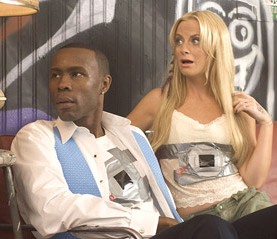
Well, I guess nobody can doubt its commitment to Sparkle Motion. But, sadly, the sprawling, incoherent Southland Tales, the second film by Donnie Darko creator Richard Kelly, is a ghastly trainwreck, and easily the worst film I’ve seen in a theater since 2003’s Gods and Generals. As I said to my brother on the way out (and as David Edelstein also noted), it makes the excellent Donnie Darko look worse in retrospect (and goes a long way toward explaining why the needlessly expository Darko Director’s Cut is so much less satisfying than the original version.) A hackneyed, overwrought stoner mishmash of leaden political satire and borrowed apocalyptic sci-fi influences, Southland Tales is so terrible I left the theater irritated that it even got made. It’s not so-bad-its-good…it’s just bad. Really, how does a movie this lousy get filmed? How do the actors and everyone else involved not see they’re in the midst of a disaster? And why didn’t marginally more talented folks like Kevin Smith or Eli Roth take a break from their oh-so-cutesy cameos and give their boy a heads-up? As it is, Southland Tales basically feels like something composed in the back of a high school notebook, amid album cover doodles and lyrics about being misunderstood, after a long night at the bong.

As Southland Tales begins in the near-future of 2005 (which should give you a sense of how long this film was stuck in development hell), a family barbeque in Abilene, Texas is disrupted by nuclear devastation, and WW3 begins in earnest. As then explained in voiceover by a disfigured Iraq vet (Justin Timberlake) over an impressive infotainment presentation (probably the best thing about the film), the US is now at war with Dubya’s entire Axis of Evil (and Syria to boot); the world is facing a global oil shortage which may be alleviated by a newly-created hydrothermal energy source known as Fluid Karma; the Department of Homeland Security has taken NSA wiretaps to the next level and fashioned an Orwellian nightmare known as USIdent; “Neo-Marxist” (really?) cells have sprung up around Venice Beach, CA to fight Big Brother; and the crucially important election of 2008 pits the staid Democratic ticket of Clinton/Lieberman against the sinister Republican team of Eliot/Frost (both poets which Kelly quotes throughout like they’re going out of style –They’re not.)

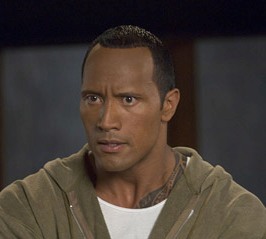
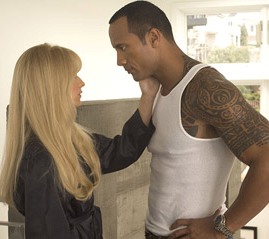
Finally, to kick off our story (which is apparently Part IV of a larger, presumably even more boring saga), we learn that an impressively-tattooed, Schwarzeneggerian movie star with top GOP connections (The Rock) has shown up in the middle of the desert suffering from amnesia, and has been taken under the wing of talk show hostess/porn star Krysta Now (Sarah Michelle Gellar) and her drug dealer roommate (Will Sasso). Got all that? We also discover along the way that the GOP and the Fluid Karma gurus (more on them in a second) might be in cahoots, that the NeoMarxist underground is basically run by former SNL alums (and poor, poor Avon Barksdale (Wood Harris) — guess he won’t be making fun of McNulty anymore for 300), that — paging Mr. Darko — there may be a time travel aspect to all of this, and that the secret to everything may rest on a pair of twin brothers (Seann William Scott), who find themselves getting drugged and/or knocked out a lot. Oh, and since JT keeps quoting Revelations over various scenes, its a solid presumption that the End of the World is more than likely on hand too…Bummer.

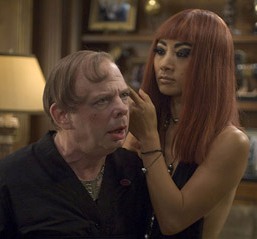
If this all sounds splendidly bizarre, well, it’s not. Southland Tales‘ strained attempts to come off as surreal might have worked if they had seemed effortless, but sadly they always feel here as if they required Herculean labor. Too much of the dialogue is drowning in exposition or weighed down by ponderous nods to Eliot, Frost, Revelations, etc. (I fear Kelly defenders will cite these to argue the film has hidden depths, when really they just expose how often Tales languishes in the shallows. But, admittedly, they might seem profound if you were completely baked out of your gourd.) Kelly has also clearly tried to give this project some weirdness cachet by dint of offbeat casting — the film is overloaded with C-grade celebrities and former ’80s icons. Case in point: Early in the film, we meet the team behind Fluid Karma, and they’re — I kid you not — composed of Wallace Shawn (best known for his “inconceivable” rants in The Princess Bride), Bai Ling, Zelda “Poltergeist” Rubenstein, Beth “Sparkle Motion” Grant, and Curtis “Booger” Armstrong. This sort of thing is good for a chuckle every so often, but after awhile — John Larroquette plays Karl Rove, Christopher Lambert drives an ice cream truck — it all just seems glommed on and irritating, particularly since Kelly seemingly expects the sheer presence of these people to do all the heavy lifting.

So what’s good about Southland Tales? Lordy, not much. As I said earlier, the satirical CNN of the near-future is well-constructed. The cast do what they can with what they’ve got, and most of ’em rise above the material: The Rock is charismatic enough to jet by, Seann William Scott at least seems like he’s trying, and Justin Timberlake redeems himself with one of the better scenes in the film, a lip-synched video to The Killers’ “All These Things That I’ve Done” (which nonetheless comes off as a Big Lebowski ripoff set to ski-ball, and mirrors quite closely the “Happiness is a Warm Gun” routine from Across the Universe earlier this year.) But these brief moments are by no means enough to recommend this dismal misfire of a film. Let me put it this way: I really liked the original version of Donnie Darko (note the rotating header), I really like cutting political satire and big-think sci-fi (for a classic example of how to do it right, see Brazil), I really like seeing semi-forgotten actors find work (see my post on Matt Frewer and Watchmen earlier this week) and I hated — hated — this film. You’d be hard pressed to find someone more likely to give Richard Kelly and Southland Tales a larger benefit of the doubt than I did going in, but this movie is rambling, incoherent, puerile, and, worst of all, tedious. Revelation 3:16: So then because thou art lukewarm, and neither cold nor hot, I will spue thee out of my mouth.