
Dressed in Black Again.

Today is Dylan Day, but before Together Through Life moves to first spot in the iPod rotation, some thoughts on Depeche Mode’s latest, Sounds of the Universe, released last Tuesday. (I know it’s always been fashionable to bag on DM here in the States, Southern California excepted, but I’m an old-school Mode guy from way back…as people who knew me in my youth — and the many black ensembles in my high-school wardrobe — will attest.)

To get the bad news out of the way first, the obscenely catchy first single, “Wrong,” is far and away the high point of the album. I warmed slow to this ditty at first, but, even tho’ it unfolds at a more relaxed tempo than I might prefer, it’s undeniably infectious. With Dave Gahan in full street-preacher mode and Marty Gore carrying the song home in the final stanzas, “Wrong,” like “Precious” on Playing the Angel and “It’s No Good” on Ultra, can stand proudly with the best singles of the halcyon days, and that’s no small thing.

That being said, there are a lot of filler tracks on Sounds of the Universe, and it’s a hard album to recommend to anyone but tried-and-true DM fans (who don’t need the recommendation anyway — they all bought multiple versions of it, likely along with tour tix and a DM t-shirt, last Tuesday.) Along with producer Ben Hillier, who’s good with the bells and whistles, I guess, but never really manages to make the DM sound “fill the room” as it did in the Daniel Miller/Flood days — SotU is often far too tinny), the band seem to be exploring ways to resurrect and update their old synth-sound without over-forcing the issue. The results are mixed.

(Digression: For a good example of “over-forcing the issue,” imho, listen to U2’s recent No Line on the Horizon, which to me sounds like a bunch of quintessential-to-the-point-of-feeling-contrived U2 hooks interpersed amid long sessions of random studio noodling. No songs really coalesce therein — it sounds like someone fiddling with the dial on a radio that only plays U2. And No Line is all glommed together with that uber-Lanois production sound. I like Daniel Lanois, he’s done some landmark albums — Achtung Baby, Us, Time Out of Mind — and I’ve even bought some of his solo stuff over the years. (“Sleeping in the Devil’s Bed” is a mixtape standby.) But it all does kinda sound the same after awhile.)

The question arises on SotU: What is DM’s old sound? “Fragile Tension,” like “Lillian” on the previous album, goes whole-hog with the early-synth pulse, recalling the very early days of the band — Speak & Spell, A Broken Frame, etc. Alas, it doesn’t really work. (As a vocalist, Gahan does some things really well — melisma isn’t one of them.) “Spacewalker” is another atmospheric instrumental a la “The Great Outdoors!”, “St. Jarna,” or “Agent Orange,” the type of moody keyboard piece that conjures up visions of Eurothrillers like George Sluizer’s The Vanishing (or, more on topic, Anton Corbijn’s Strange.) “In Chains,” on the other hand, is more in the later-period gospel-grunge mode of “Clean,” “Higher Love,” or “Condemnation” (with a touch of the bang-the-metal interlude of “Stripped”) — it’s perfectly acceptable, I guess, but it doesn’t really bring much new to the table.

Those tracks aside, main songwriter Martin Gore spends too many songs in the treacly New Age, post-rehab platitude rut that characterizes at least a few tracks on every album since 1993’s Songs of Faith and Devotion. (See “Freestate” or “I am You,” for example.) The middle of SotU in particular — “Fragile Tension,” “Little Soul,” “In Sympathy,” the Beatlesque by way of Tears for Fears second singlePeace” — all run together in this fashion.

Speaking of sounding-like-TfF, my second favorite song on the album is probably “Perfect,” which argues amusingly that even when you consider the Anathem-like philosophical ramifications of string theory, the DM multiverse is still on the bleak side. (“In a parallel universe that’s happening right now, things between us must be worse, but it’s hard to see just how.“) That being said, with its mid-80’s key changes and all, “Perfect” sounds eerily like a long-lost Howard Jones number.

In its favor, SotU is the first DM album where the Gahan-penned contributions intermix with the Gore fare enough to be virtually indistinguishable. Indeed, while two of the Gahan songs — “Come Back” and “Miles Away/The Truth Is” — are a little over-produced (The stripped down version of “Come Back” which leaked a few months ago attests to this), it’s the lead singer, rather than Gore, who seems to have a better handle on “that classic DM sound.” In effect, while Gore sometimes seems a bit lost in his gospel influences lately, Gahan — as one review I read somewhere well put it — has improved to the point of becoming a pretty good Depeche Mode tribute band.

Now even I, a DM fan of long standing, am prone to bag on how much of the classic Mode oeuvre revolves around sex, sin, obsession, religion, and redemption. (My love is a black car, and you crucify me on the steering wheel because I asked you to, etc. etc.) Still, the best moments on Sounds of the Universe are when they stop reaching for some new synthetic harmony and, as with “Wrong”, just let that old freak flag fly. Put another way, it’s when DM stops trying to fuse their early synth and later gospel periods into a new, cohesive sound and goes right for the crunchy, tongue-in-cheek “Master and Servant”-to-“Personal Jesus”-style crowd-stompers that the album really works best.

Gahan’s “Hole to Feed,” for example, is a jaunty ditty about what one might call the Benjamin Braddock problem — once you’ve finally managed to land the one true love you’ve been writhing and pining for…well, then what? (“We are here, we can love, we share something. I’m sure that you mean the world to me. When you get what you need, there’s no way of knowing what you have is another hole to feed.“) As for “hole to feed,” I’ll let you figure that one out. But, like any number of vaguely raunchy DM songs (or like Gary Oldman endlessly stuffing the hole in his backyard with cash in Romeo is Bleeding), the metaphor here isn’t very oblique.

Similarly, with its creepy-filthy blips and trademark Gahan croon, “Corrupt,” the album closer, is another electroblues number that’s right in DM’s usual wheelhouse (“I could corrupt you, it would be easy. Watching you suffer, Girl, it would please me.“) And it suggests the sexy, mordant fun the band could be having if they stop trying to grope toward some new respectable Zen plateau and just unabashedly do what they do best.

Along those lines, I’d argue that some of the best songs of the SotU sessions were inexplicably left off the album (but are included in the deluxe version, which also offers 14 very worthwhile demos of earlier songs such as “Walking in My Shoes” and “Little 15”. Think DM standards done with Magnetic Fields simplicity.) That may be because they just feel looser and less forced than many of the album cuts. A sinister electronic sibling to Kristin Hersh’s indie rock standard “Your Ghost,” DM’s “Ghost” is driven by the most infectious and mesmerizing synth backbeat of the new tracks. (“I’m the ghost in your house, calling your name. My memory lingers, you’ll never be the same. I’m the hole in your heart, I’m the stain in your bed, the phantom in your fingers, the voices in your head.“)

The Sun and the Moon and the Star” is the type of throwback torch song that Martin Gore probably writes over breakfast every morning, but it’s still more resonant than “Jezebel,” the one that’s officially on the album. (And, tbh, neither will replace classics like “Somebody” or “The Things You Said” in the hearts of Gore aficionados.) And “Oh Well,” the first song co-written by Gore and Gahan, succeeds because it’s nothing more or less than what it aspires to be — a propulsive club cut designed just to get ’em dancing. I’ll let that song sum up my general impression of SotU, which is a mostly harmless outing, and works best when it doesn’t try so hard: “It’s nothing to feel ashamed about, nothing I can complain about. Oh well.

A Republic of Knowledge.

“I believe it is not in our character, American character, to follow — but to lead. And it is time for us to lead once again. I am here today to set this goal: we will devote more than 3 percent of our gross domestic product to research and development. We will not just meet, but we will exceed the level achieved at the height of the space race, through policies that invest in basic and applied research, create new incentives for private innovation, promote breakthroughs in energy and medicine, and improve education in math and science.

It’s poetry in motion: In a clear break with his predecessor, President Obama pledges $420 billion for basic science and applied research. “And he set forth a wish list including solar cells as cheap as paint; green buildings that produce all the energy they consume; learning software as effective as a personal tutor; prosthetics so advanced that you could play the piano again and ‘an expansion of the frontiers of human knowledge about ourselves and world the around us.’” Huzzah! (And fwiw, I would also like more manned spaced exploration…and a jetpack.)

100 DVDs, 1 Disc(overy).

“‘If this can really be done, then G.E.’s work promises to be a huge advantage in commercializing holographic storage technology,’ said Bert Hesselink, a professor at Stanford and an expert in the field.” Scientists at GE develop a way to compress 500 gigs of information onto a standard disc, equivalent to 100 DVDs or 20 Blu-Rays. That should free up some shelf space. “The recent breakthrough by the team, working at the G.E. lab in Niskayuna, N.Y., north of Albany, was a 200-fold increase in the reflective power of their holograms, putting them at the bottom range of light reflections readable by current Blu-ray machines.

Academe: Fun While It Lasted.

“Each academic becomes the trustee not of a branch of the sciences, but of limited knowledge that all too often is irrelevant for genuinely important problems. A colleague recently boasted to me that his best student was doing his dissertation on how the medieval theologian Duns Scotus used citations.” In the NYT, Mark Taylor, the chair of Columbia’s religion department, reads the writing on the wall and calls for a complete overhaul of graduate school education in America. “Graduate education is the Detroit of higher learning. Most graduate programs in American universities produce a product for which there is no market (candidates for teaching positions that do not exist) and develop skills for which there is diminishing demand (research in subfields within subfields and publication in journals read by no one other than a few like-minded colleagues), all at a rapidly rising cost (sometimes well over $100,000 in student loans).” Ya, sounds about right.

Girl, You’ll Be a Woman Soon.

A belated happy birthday to my sister Tessa, who turned 22 a few days ago, and who will be graduating from Dartmouth in a few short weeks. Hope it went splendiferously, and here’s to having a grand ole time before the Real World comes a-callin’. (Also, sorry but, per the link above, Big Bro calls dibs on the first J-O-B to come down the pike.)

Songs of Love and Hate.

“Cohen has explored the theme of love as an all-consuming flame, both destructive and creative, from the outset of his career — a painting of St. Bernadette in flames appears on the back cover of his first album — and that tortured ambiguity flickered throughout the evening. ‘If he was fire, then she must be wood,’ Cohen sang in ‘Joan of Arc,’ but the old ladies’ man himself has always been dry wood, burning up, consumed by the same flame, dying endlessly. Cohen is a battered philosopher of eros, and the beauty and horror of much of his poetry derives from his alternately exhausted and triumphant response to the demigod of sex.

Rumors of the Death of a Ladies’ Man have been greatly exaggerated: From the bookmarks, and based on the current tour that’s recently been immortalized on the very listenable Live in London, Salon‘s Gary Kamiya sings the praises of one of his idols, Leonard Cohen. “‘Looks like freedom but it feels like death/ It’s something in between, I guess,’ Cohen sings in ‘Closing Time.’ That knife edge, that balancing act between the intolerable and the redemptive, is where Cohen lives, both in his work and in his performances. He is a fearless explorer of darknesses of all kinds, mostly erotic and romantic, but also, and increasingly, political and spiritual. For Cohen, without darkness there is no light — a credo summed up in his song ‘Anthem,’ with its exquisite chorus ‘Ring the bells that still can ring/ Forget your perfect offering/ There is a crack in everything/ That’s how the light gets in.’

U.S. History for Dummies.

As many readers here well know, I’ve spent a good bit of time over the past decade studying US history. (In fact, over the past few years, I’ve occasionally helped my advisor keep a textbook up to date that recently drew the ire of right-wing blowhard Bill O’Reilly. Apparently, those damn pesky facts were somehow mitigating O’Reilly’s ability to spew forth the usual idiotic blather.)

Anyway, over that period of time, I believe I have in fact learned me a few things. So, as a public service of sorts, and because, after this morning’s revelations, I’ve reached the limit of craven and/or patently stupid falsehoods that I can feasibly ingest over so short a time, some “U.S. History for Dummies.” I expect most everyone who comes by this site with any frequency knows all this, but ya never know. Apologies for the didacticism in advance — if this were this a Coors Light commercial, this would be where i vent. (And thanks to Lia for the timely visual tax lesson, above.)

  • The Tea Party: As you no doubt know, the Boston Tea Party of 1773 was recently appropriated by FOX News and the conservative group Freedomworks to simulate a widespread popular uprising against high taxes. (In other words, it was an “astroturf,” rather than a grass-roots, movement.) And, yes, the inconvenient fact that President Obama and the Democratic Congress actually lowered income taxes for 95% of Americans earlier this year didn’t seem to dissuade them from trying to jury-rig some rather dubious anti-tax ramparts and gin up enough disgruntled FOX-watchers to man them.

    At any rate, as most people remember from high school, the original 1773 Tea Party was not a protest against high taxes or high prices at all. (In fact, legally imported tea — i.e. that of the East India Company, which was both suffering serious setbacks over in India and losing market share to smuggled Dutch tea at the time — was actually cheaper in the colonies after the Tea Act, since it was now exempt from the usual obligations.)

    In small part a reaction of the East India’s commercial rivals to this sweetheart deal, the Boston Tea Party was mainly held to uphold the principle of No taxation without representation. Which I don’t think I need to explain. So, with the minor exception of DC-area conservatives who attended the tea gathering in Washington (without crossing over from Virginia or Maryland), the, uh, “teabaggers” don’t really have a leg to stand on here. This is particularly true after you consider that both ruthless gerrymandering and the vagaries of the Electoral College (I’m looking at you, Wyoming) actually tend to lead to over-representation of conservative Republicans in our halls of governance, even despite heavy losses for the “Grand Old Party” in 2006 and 2008.

  • The “Right” of Secession: Apparently, Rick Perry, the right-wing governor of Texas, really wants to keep his job. As such, he’s scared stiff of the forthcoming primary challenge by Sen. Kay Bailey Hutchison, who happens to be much more popular than he is among Texas Republicans. So, to sow up his “activist” (re: freak show) bona fides, this desperate fellow has been doing anything and everything he possibly can to prostrate himself before the paranoid ultra-right, including appearing before the current poobahs of the GOP’s lunatic fringe, Glenn Beck and Michael Savage. As you no doubt know, this recently culminated in Gov. Perry’s upholding Texas’ right to secede before a crowd of rabid teabaggers. Said the Governor: ““We’ve got a great union. There’s absolutely no reason to dissolve it. But if Washington continues to thumb their nose at the American people, you know, who knows what might come out of that…

    Well, in fact, no state in the Union has any legal right to secede. (Not even Texas.) The existence of such a right was posited and debated quite often in the early years of the republic: by Jefferson and Madison in the Virginia and Kentucky resolutions, by the members of the Hartford Convention, by South Carolina’s philosopher-politician John C. Calhoun, and countless others.

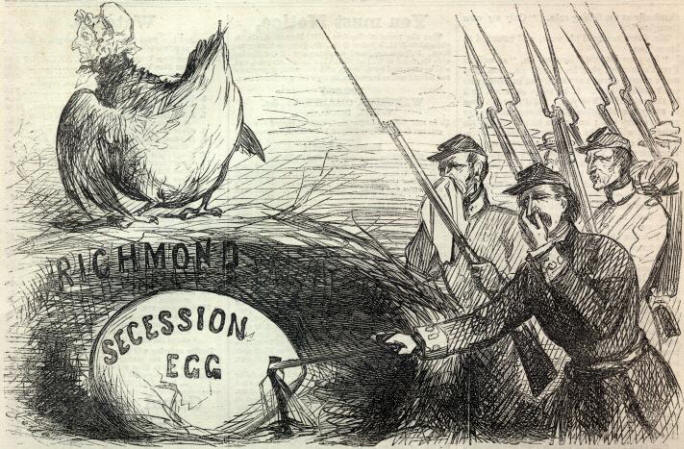
    But the illegality of secession was eventually confirmed — in blood — when eleven states attempted to pull out of the Union in 1861, due mainly to differing opinions on the institution of slavery and its expansion into the western territories. As a result of this insurrection by the southern states, a violent conflict broke out, which we call the Civil War. It lasted four years, and it was kind of a big deal.

    Prior to the war, the states of the Confederacy believed secession to be their natural right, while those remaining in the Union believed it to be tantamount to an act of treason. With the Union victory in that conflict, and the subsequent readmittance of southern states in such a manner that reaffirmed that no right of secession exists, the question was settled. So it remains to this day.

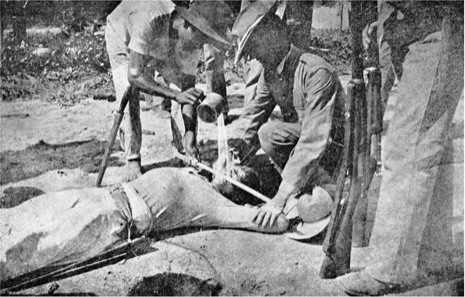
  • Waterboarding, Torture, and “Just Following Orders”: In the wake of recent revelations, there’s been a renewed push among certain conservatives to laugh off waterboarding as not being constitutive of torture. (See also Rush Limbaugh’s fratboy defense of Abu Ghraib a few years ago.) But (as even John McCain concedes), in the years after World War II, there was no question among Americans that waterboarding is torture. In fact, Japanese soldiers were tried and convicted of war crimes for waterboarding American GIs and Filipino prisoners. When you think about it, it’s not really a tough call.

    Another argument we’ve heard lately — today Sen. McCain made it with his usual comrades-in-arms, Sens. Lieberman and Graham, while trying to protect Dubya’s lawyers — is that the CIA officials who actually conducted these recent acts of torture should be exempt from prosecution, because they were following the legal dictates of those higher-up in the administration. (To follow the reasoning around the circle, the torturers should be exempt because they were listening to the lawyers, and the lawyers should be exempt because they didn’t do the actual torturing. Cute.)

    Anyway, whatever you think of the merits of this argument, this is usually referred to as the Nuremberg defense, and it is in fact no defense at all. Argues Principle IV of the Nuremberg Principles, devised by the Allies after WWII to determine what constituted a war crime: “The fact that a person acted pursuant to order of his Government or of a superior does not relieve him from responsibility under international law, provided a moral choice was in fact possible to him.” Insert “CIA interrogator” for person in that last sentence and you can pretty much see the problem.

  • Is America a Christian Nation?: At the end of his recent European tour, President Obama told an audience in Turkey the following: “We do not consider ourselves a Christian nation or a Jewish nation or a Muslim nation. We consider ourselves a nation of citizens who are bound by ideals and a set of values.” This statement — well the “not a Christian nation” part of it, at least — prompted no small amount of consternation from the porcine-moralist wing of the GOP — James Dobson, Karl Rove, Newt Gingrich, and sundry other freaks of the industry — all of whom fell over themselves to proclaim to the Heavens and preach to the FOX News choir that, yes, Virginia, America is a glorious Christian nation.

    America is not a Christian nation. This will be patently obvious to anyone who’s ever heard the phrase “separation of church and state.” Unlike, say, England, America does not have and has never had an official, established church. This is very much by design. For proof of this not-very-radical claim, see the very first clause of the very first amendment to the Constitution: “Congress shall make no law respecting an establishment of religion, or prohibiting the free exercise thereof.”

    If that doesn’t do it for you, see George Washington’s famous 1790 letter to the Jewish residents of Newport, Rhode Island. “May the Children of the Stock of Abraham, who dwell in this land, continue to merit and enjoy the good will of the other Inhabitants; while every one shall sit under his own vine and fig tree, and there shall be none to make him afraid.

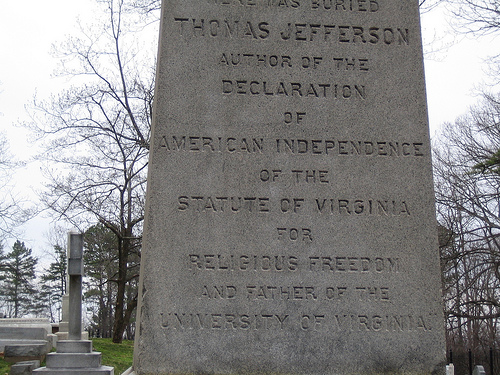
    Or consider that Thomas Jefferson skipped his presidency on his tombstone to make room for his authorship of the Virginia Statute for Religious Freedom: “Be it enacted by the General Assembly, That no man shall be compelled to frequent or support any religious worship, place, or ministry whatsoever, nor shall be enforced, restrained, molested, or burdened in his body or goods, nor shall otherwise suffer on account of his religious opinions or belief; but that all men shall be free to profess, and by argument to maintain, their opinion in matters of religion, and that the same shall in no wise diminish enlarge, or affect their civil capacities.” (We could also make mention of the Jefferson Bible, but let’s start slow.)

    Is the reasoning here too circuitous for Rove, Gingrich, et al to follow? Ok, then, here’s the cheat sheet: the 1797 Treaty of Tripoli, passed by a Congress of our Founders without declaim and signed into law by President John Adams. It begins: “As the Government of the United States of America is not, in any sense, founded on the Christian religion…” Did y’all catch it this time? Good, let’s move on.

  • A Smile for Chavez: Our new president also attended the Summit of the Americas recently, at which he was photographed smiling and shaking hands with Venezuelan autocrat Hugo Chavez, a particular bete noire of the right who has said all manner of unpleasant things about America over the past few years.

    After the picture was taken, conservatives went predictably livid, with Matt Drudge headlining the offending photograph with the usual red text, Dick Cheney deeming Obama “a weak president” on FOX News, and Gingrich arguing that it made Obama look “weak like Carter.” “We didn’t rush over, smile and greet Russian dictators,” said Newt, and he wasn’t the only potential 2012’er aghast at Obama’s behavior. Sen. John Ensign of Nevada called the president “irresponsible” and the consistently shameless Mitt Romney painted Obama a “timid advocate for freedom”.

    Um, ok. Well, let’s see here…


    I could go on. With regards to that last one — Reagan yukking it up with Mikhail Gorbachev, then of “the evil Empire” — it didn’t take long before (surprise) Newt was caught in a contradiction. Apparently, Gingrich had previously argued on his website that Ronald Reagan’s good humor with Gorby was a sign of strength, not weakness.

    Speaking of which, as Lawrence O’Donnell noted on MSNBC the other day, saintly old Ronald Reagan didn’t just smile and shake hands with America’s enemies. His administration sold them weapons under the table. So, please, assorted puddin’-heads of the GOP talkocracy, spare me your warmed-over tripe about poor diplomacy and weak leadership. As with everything else above, I’ve swallowed enough of your swill over the past few weeks to last me a lifetime.

  • But Wait, It Gets Worse.

    ‘How many fingers, Winston?’

    ‘Four. I suppose there are four. I would see five if I could. I am trying to see five.’

    ‘Which do you wish: to persuade me that you see five, or really to see them?’

    ‘Really to see them.’

    ‘Again,’ said O’Brien.

    Perhaps the needle was eighty — ninety. Winston could not intermittently remember why the pain was happening. Behind his screwed-up eyelids a forest of fingers seemed to be moving in a sort of dance, weaving in and out, disappearing behind one another and reappearing again. He was trying to count them, he could not remember why. He knew only that it was impossible to count them, and that this was somehow due to the mysterious identity between five and four. The pain died down again. When he opened his eyes it was to find that he was still seeing the same thing. Innumerable fingers, like moving trees, were still streaming past in either direction, crossing and recrossing. He shut his eyes again.

    ‘How many fingers am I holding up, Winston?’

    ‘I don’t know. I don’t know. You will kill me if you do that again. Four, five, six — in all honesty I don’t know.’

    ‘Better,’ said O’Brien.

    Hard to believe, but, this morning, the recent grisly revelations of Dubya-era torture practices became even more horrifying. As we’ve gleaned more info over the past few days, certain obvious and troubling questions kept popping up. Why, as indicated here, would higher-ups insist on additional waterboarding sessions for Zubadayah, even after the CIA agents at hand thought the suspect “had given up all the information he had“? Also: Mind you, even one session of torture is reprehensible — and illegal — enough. But what more did the powers-that-be think they were going to get out of these suspects after ten waterboardings? Twenty? One hundred?

    Well, now we know. Not only did Dubya apparachiks conceive a torture regime well before it was approved (and before they had any prisoners on hand — see also the new and unredacted Armed Services Committee report), but they tortured their suspects into the ground because they were trying to prove a false positive, i.e. that there was some serious operational link between Iraq and Al Qaeda that could be used to sell the second Gulf War. (See also the forged Habbush letter.)

    ‘There were two reasons why these interrogations were so persistent, and why extreme methods were used,’ the former senior intelligence official said on condition of anonymity because of the issue’s sensitivity. ‘The main one is that everyone was worried about some kind of follow-up attack (after 9/11). But for most of 2002 and into 2003, Cheney and Rumsfeld, especially, were also demanding proof of the links between al Qaida and Iraq that (former Iraqi exile leader Ahmed) Chalabi and others had told them were there.‘”

    So, in short, it would seem the suspects held by the CIA were tortured over and over again because they would not concede that two plus two equals five.

    Really, how much lower can these assholes sink? What could they possibly do that would cause more violence to our ideals, or that would make our cherished role as a beacon of freedom seem any more ridiculous in the eyes of the world, than what they’ve already done?

    Once again, I’m reminded of Lincoln’s famous remark to the Indiana 14th: “‘Whenever I hear anyone arguing for slavery, I feel a strong impulse to see it tried on him personally.‘” At the very least, somebody, or somebodies, better go to jail for a loooong time for this. Anything less is simply unacceptable.

    Help: Need Money for Cadre of Lobbyists.

    “‘Taxpayers are subsidizing a legislative agenda that is inimical to their interests and offensive to what the whole TARP program is about,; said William Patterson, executive director of CtW Investment Group, an activist group affiliated with a coalition of labor unions. ‘It’s business as usual with taxpayers picking up the bill.” Sigh. The WP’s Dan Eggen reports on GM and a host of financial firms using bailout money to lobby for the status quo. “Major recipients of federal bailout money spent more than $10 million to lobby lawmakers in the first three months of 2009, including arguing against pay limits for corporate executives, according to newly filed disclosure records.

    Adventures on the Holodeck.


    Let’s disconnect these cables, overturn these tables, this place don’t make sense to me no more… As you can see [or maybe you can’t — the “embed code” option doesn’t seem to work, so I switched it out with a jpg], I’ve been having a little fun with this pretty spiffy Star Trek advertising toy, which is definitely worth playing around with for a few minutes. I’ve seen a lot of upload-your-pic widgets in the past, but I’m pretty amazed at how fast and how well this maps a pic onto a 3-D avatar. Could this Dylan-spouting Vulcan be the future of MMORPG gaming?