Thud.

“‘Our health-care system is simply unsustainable,’ the Montana Democrat said during a news conference today at which he appeared without any other lawmaker. ‘It’s time to act.’” Well, at least we agree on that much. After frittering away a month trying to appease obvious GOP irreconcilables, Sen. Max Baucus finally releases the Senate Finance health reform bill. [Here it is.] Key components include co-ops, a tax on “cadillac” insurance plans (which still doesn’t make much sense to me), cheapo catastrophic insurance for people under 25, and, of course, no public option.

Suffice to say, it’s not up to snuff, and many important folks aren’t particularly happy. “On the House side, the Baucus proposal falls very, very short…Sen. Russ Feingold (D-Wisc.) was disappointed by the Baucus bill, calling it ‘health care reform in name only.’” Said Rep. Anthony Weiner of the failed attempts at bipartisanship: “The Senate and the president to some extent have been like a child looking for a unicorn. I don’t see it.Nor is HCAN amused.

Update: Whatever you think of the Baucus bill, one thing is clear: Despite what they’re saying now, the Republicans got what they wanted…just ask Kent Conrad.

Rock of Ages.

“‘We would have never dreamed you would find a rocky planet so close,’ he said. ‘Its year is less than one of our days.'” Astronomers discover the first rocky planet outside our solar system in CoRoT-7b.

But don’t prep the colony ship just yet: “It is so close to the star it orbits ‘that the place may well look like Dante’s Inferno, with a probable temperature on its ‘day face’ above 3,600 degrees Fahrenheit (2,000 degrees Celsius) and minus-328 degrees Fahrenheit (minus 200 degrees Celsius) on its night face,’ said Didier Queloz of Geneva Observatory in Switzerland, the project leader.” Eh, we’ll work with it.

Lest Ye Be Judged.

For completion’s sake, two comedies I caught over Labor Day weekend and have already almost forgotten about: Mike Judge’s Extract and Bobcat Goldthwait’s World’s Greatest Dad. One is generally optimistic and humane towards its fellow man, the other misanthropic and downright grim. Alas, neither, in the end, turned out to be particularly funny. If you’re looking for a good laugh at the theater right now, I still stand by In the Loop.

Of the two, it’s probably more surprising — and disappointing — that Mike Judge’s Extract turned out so pedestrian. As most everyone knows, Office Space is a certifiable classic, and however you feel about Beavis & Butthead, the basically straight-to-video Idiocracy was reasonably clever about bringing that duo’s schtick to its logical endpoint. (Idiocracy is also uneven, but its highs — the opening, the Wal-Mart greeter gag, etc. — are much higher than those to be had here.) At any rate, perhaps because of the Idiocracy snafu — there was really no good reason for Fox to bury it like they did — Judge seems to be playing it far too safe here. Extract mostly just feels like leftover vignettes from King of the Hill scripts, perhaps ones that were slightly too risque for television.

It’s hard to put a finger on exactly what’s wrong here (as it always is with funny), but perhaps it’s this: Office Space is much-beloved because it’s involves situations that anyone who’s spent any amount of time in cubicle life (or, per Jennifer Aniston’s “flair,” in food service) could identify with. Ok, most of us have never pulled the Superman III con, but who hasn’t been tsk-tsked for lack-of-TPS cover sheets, or wanted to go yard on a hiccuping fax machine? The humor of Office Space revolved around the penny-ante frustrations of work life, like getting stuck in traffic or losing your stapler, and in that sense it feels — almost — universal.

I had assumed going in that Extract would be the Office Space of the factory floor, but it isn’t. For one, it mainly revolves around the trials and tribulations of Jason Bateman’s factory owner — a small businessman, basically — and all the folks on the floor (including Judge himself) are mostly secondary characters, however sympathetically drawn. But, more to the point, Extract doesn’t really rely on workday nuisances for its humor like Office Space. Instead, it revolves around increasingly outlandish situations like, say, sorta accidentally buying your wife a sweet but lunk-headed gigolo (Dustin Milligan) while zonked out on ketamine. I can’t say I’ve ever worked in a factory, but I can’t imagine gigolos, femme fatale drifters (Mila Kunis), or even horrifying Rube Goldberg disasters resulting in testicular detachment play much of a day-to-day role in things.

And, divorced from that everyday humor that Judge does so well, Extract just feels episodic and throwaway. The funniest scene in the movie involves Bateman’s getting stoned out of his gourd with absolutely the wrong guy — let’s just say he’s slightly aggro — and even that goes on for too long. (Also, I missed Pineapple Express, but I get the sense that this very same joke was half the movie.) I didn’t mind throwing money at Extract in the end — after what happened to Idiocracy, Mike Judge probably deserves it. But I can’t really recommend the film either — there’s just not much there there.

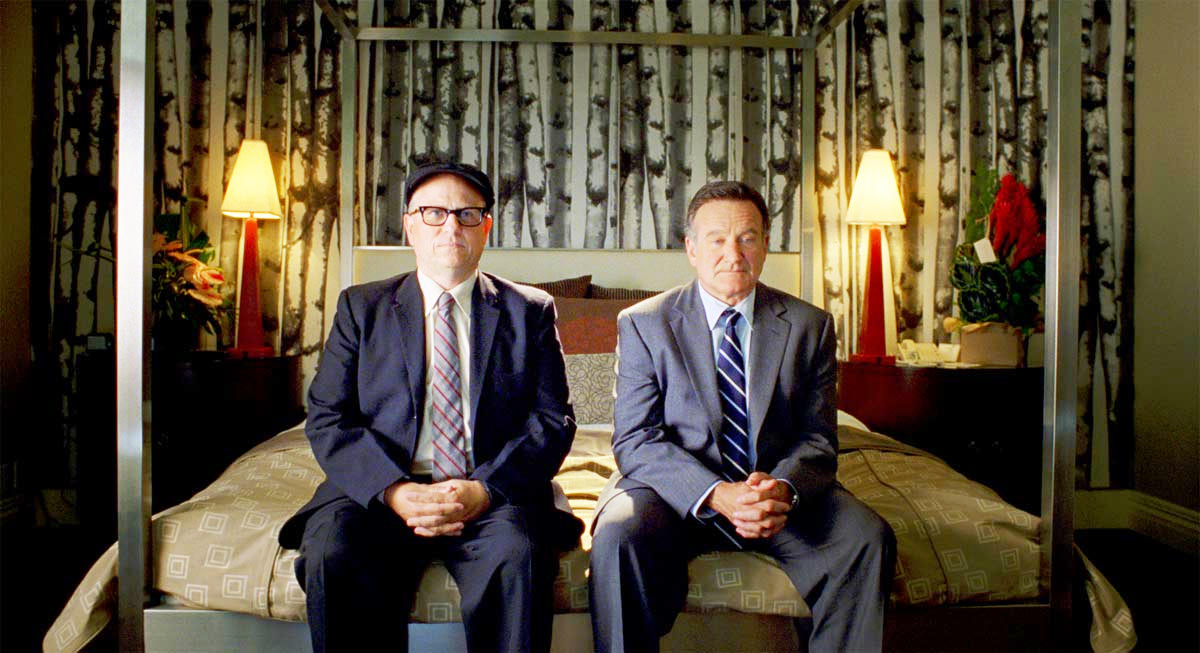
Speaking of one-joke movies, and this probably counts as very big spoiler, Bobcat Goldthwait’s mordant squirmathon World’s Greatest Dad — which I caught with my priest on Labor Day (think Orgrimmar, not the Vatican) — is basically an extended riff on the “Teen Suicide: Don’t Do It,” “I love my dead gay son!” antics of Heathers. I didn’t loathe World’s Greatest Dad like my friend — he walked out around the eighty minute mark — but, again, there’s just not enough here to sustain a full movie.

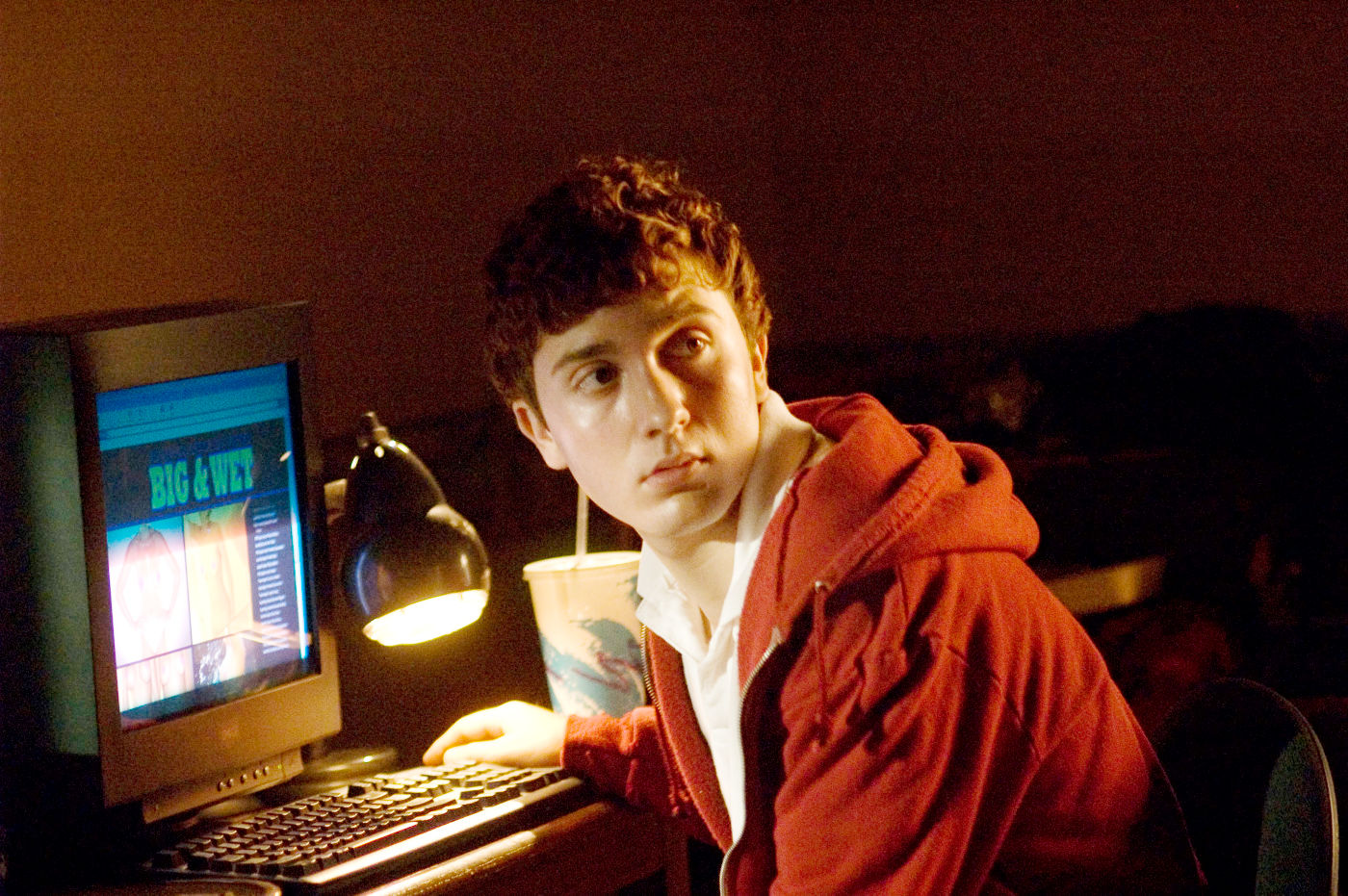
The single-parent dad in question is Lance Clayton (Robin Williams), a failed writer laboring in (and loathing) obscurity as a poetry teacher at a private high school. In danger of losing both his job — nobody much cares about poetry anymore — and his surreptitious girlfriend Claire, the school’s art teacher (an appealing, if chirpy, Alexie Gilmore), Lance’s biggest problem these days is just trying to raise his really wayward son, Kyle (Daryl Sabara). Kyle is…well, Kyle is a douchebag, pure and simple. The kid has no redeeming qualities whatsoever — He terrorizes his father into submission on all manner of issues, and nobody can stand him, except for one long-suffering friend (Evan Martin) with his own problems at home. And that just about sums up Lance Clayton’s life, until an deadly (and embarrassing) accident — think David Carradine or Michael Hutchence — presents some horrible new opportunities…

The film’s big credit here is Robin Williams, who gives one of his better performances in recent years. To my mind, Williams can be hit-or-miss. He’s often excellent when he finds a role that balances comedy and drama (The World According to Garp, Dead Poet’s Society, The Fisher King, Good Will Hunting), but deteriorates rapidly if the script pushes him too far in either direction. (On one hand, abominations like Patch Adams or Mrs. Doubtfire; on the other, one-note performances like Insomnia and One Hour Photo.) Here, Goldthwait serves Williams well, and vice versa — The only thing that makes WGD work at all is Williams’ often surprisingly nuanced performance. (His reaction to “Parenting is the toughest job you’ll ever love” still makes me laugh every time I see the trailer.)

That being said, World’s Greatest Dad ends up being mostly a one-note film. (Part of the problem is the set-up: The movie is driven by a Big Lie, and so, just as you always end up waiting for the couple to get (back) together in a standard-issue rom-com, a lot of the time here is spent just waiting for the other shoe to drop.) I admired WGD‘s intentions — Get past the kink and the misanthropy, and the movie is an pretty timely riff on the blatant white-washing that often attends our public mourning rituals. But, in the end, it’s not particularly funny, and it beats its one dead horse so thoroughly that WGD loses steam well before its final act. Next time, Dad, cut to the chase.

Shireland Security.

“A GCHQ historian, who would not give his name for security reasons, said: ‘JRR Tolkien is known the world over for his novels, but his involvement with the war effort may take a few people by surprise.’” By way of Ed Rants, it seems J.R.R. Tolkien was briefly trained in the art of code-breaking at the Government Codes and Cypher School (GCCS), and was even approached to partake in the Council of Turing in the fields of Bletchley, where presumably his linguistic skills would help in deciphering the Black Speech of the Enemy.

John, son of Arthur, however, took the hobbit’s route…this time. “While he didn’t sign up as was probably intended, he did complete three days’ training and was ‘keen’ to do more. Why he failed to join remains a mystery. There is no paperwork suggesting a motive, so we can only assume that he wanted to concentrate on his writing career.” Perhaps he feared the seductive power of the Palantir, or perhaps he simply had had enough of war.

Regulators, Mount Up.

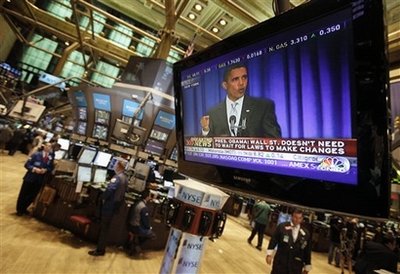
“Unfortunately, there are some in the financial industry who are misreading this moment. Instead of learning the lessons of Lehman and the crisis from which we are still recovering, they are choosing to ignore them. They do so not just at their own peril, but at our nation’s. So I want them to hear my words: We will not go back to the days of reckless behavior and unchecked excess at the heart of this crisis, where too many were motivated only by the appetite for quick kills and bloated bonuses. Those on Wall Street cannot resume taking risks without regard for consequences, and expect that next time, American taxpayers will be there to break their fall.

In the bowels of Wall Street and one year after the collapse of Lehman Brothers, President Obama outlines his vision for financial regulatory reform, including a new Consumer Financial Protection Agency and stronger accountability and oversight in the existing regulatory regime. [Transcript.]

But — see also health care — some wonder if the President is going far enough: “The problem with concentrating on the banking system is that it allows the administration to present an overly optimistic assessment of its actions…Taking credit for stabilizing the financial system after feeding it with massive amounts of federal money is like a teacher bragging about turning around the academic performance of a failing student after handing them all the answers to the big tests.

Continues economist Nomi Prins, in an analysis that dovetails quite tellingly with the health-care situation:”A strong CFPA is a sensible plan…This proposal has drawn the most ire from the banking community, so you know it’s good…But Obama’s reforms do not strike deeply enough. The banking crisis has been subdued, not fixed, because of enormous amounts of government assistance. Ignoring that fact, and failing to overhaul the sector, leaves us open to another crisis. And the next round will be worse, because there is now so much more federal money invested in the banks.

Mr. Wendell.

“With this history, you can rest assured that the insurance industry is up to the same dirty tricks, using the same devious PR practices it has used for many years, to kill reform this year, or even better, to shape it so that it benefits insurance companies and their Wall Street investors far more than average Americans.” Former head of corporate communications at CIGNA, Wendell Potter, the health insurance industry equivalent of Russell Crowe in The Insider, explains in Salon what his former employers are up to, and why our republic appears to be in a spot of trouble:

“During my 20 years in corporate communications and public affairs, I participated in the steady growth and influence of largely invisible persuasion — and at a time when newsrooms are shrinking and investigative journalism seems to be vanishing. The number of PR people long ago surpassed the number of working journalists in this country…The clear winners as this shift occurs are big, rich corporations and other special interests. The losers are average Americans, most of whom are completely unaware how their thoughts and actions are being manipulated to achieve corporate goals on Capitol Hill.

Cogburn’s Crossing.

I missed this when it first broke back in March, but it seems the Coens have caught the remake bug, and are re-making True Grit, with Jeff Bridges in the John Wayne role. (No word on who’s playing Kim Darby.)

“Not a traditional remake, the Paramount film will be more faithful to the Charles Portis book than the 1969 pic…while the original film was a showcase for Wayne, the Coens’ version will tell the tale from the girl’s p.o.v.” Interesting…and it pretty much has to pan out better than the Coens’ last remake.

Stuck in the Middle with You.

“That large-heartedness – that concern and regard for the plight of others – is not a partisan feeling. It is not a Republican or a Democratic feeling. It, too, is part of the American character. Our ability to stand in other people’s shoes. A recognition that we are all in this together; that when fortune turns against one of us, others are there to lend a helping hand. A belief that in this country, hard work and responsibility should be rewarded by some measure of security and fair play; and an acknowledgment that sometimes government has to step in to help deliver on that promise.

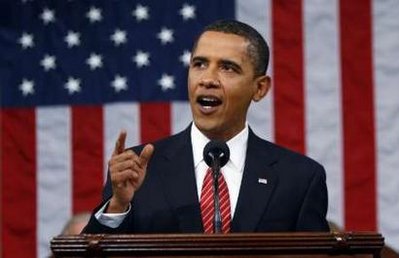
As I’m sure you know, President Obama delivered his health care reform address to Congress last night. [Transcript.] My thoughts on it are mixed.

On one hand, speaking in terms of rhetoric, style, and delivery, this was an amazing speech, his best since the campaign days. While it’s an open question how long its effects will linger, the address clearly and decisively helped move the reform ball forward. And the emotional closer, featuring Ted Kennedy’s heartfelt final words to the President, was incredibly moving. In sum, it’s the exemplary address we knew Obama had in him on this issue, and he brought it home perfectly.

But, all that being said, I can’t shake the nagging feeling that [a] the policy being outlined last night didn’t quite jibe with the wonderful speech, and, as all too common of late, [b] the president far too readily threw his left flank — the very people who sweat blood and tears to get him elected — under the bus.

To take the second part first, Obama early on indulged in an irritating and textbook case of Beltway false equivalence by setting himself up as the sensible middle between those cuh-rrrrazy single-payer types on the left and the free market fundies on the right. (“There are those on the left who believe that the only way to fix the system is through a single-payer system like Canada’s…“) Uh, yes, and not so long ago, Mr. President, you were among them. I feel like I’ve said this several times recently, but painting the left as dingbats to shore up one’s centrist bona fides is a pretty tired parlor trick at this point, and it never gets any less insulting.

As an aside, on the way into work yesterday, I — and everyone else around the Metro — was accosted by guys in Grim Reaper costumes and bullhorns, telling us all, basically, that violence will erupt and we will all die if this health care bill passes. Y’know, there’s a term for telling people they’ll be killed if a political event happens — We call it terrorism. (As it turns out, there’s a term for wearing a hood while telling people they’ll be killed too.) Well, imagine my surprise to hear — from the president I’ve vocally supported for two years now — that me and my fellow clowns on the left are just as part of the health care problem as these jokers are on the right. I have to admit, it kinda tempers the enthusiasm.

And then there was the discussion of the public option. Yes, the President did make a case for the public option in last night’s remarks: “[A]n additional step we can take to keep insurance companies honest is by making a not-for-profit public option available in the insurance exchange…It would also keep pressure on private insurers to keep their policies affordable and treat their customers better.” In addition, the President correctly pointed out, “It’s worth noting that a strong majority of Americans still favor a public insurance option of the sort I’ve proposed tonight.

But what the President giveth, the President also taketh away. The public option was clearly brought up in the speech after the non-negotiable section. (“While there remain some significant details to be ironed out, I believe a broad consensus exists for the aspects of the plan I just outlined.“)

Indeed, in case we missed the point, President Obama later made it clear: “To my progressive friends, I would remind you that…[t]he public option is only a means to [an] end – and we should remain open to other ideas that accomplish our ultimate goal.

He then went on to float two “compromise” ideas that, for all intent and purposes, are public option killers: (1) a trigger and (2) co-ops. (“For example, some have suggested that that the public option go into effect only in those markets where insurance companies are not providing affordable policies. Others propose a co-op or another non-profit entity to administer the plan.“)

The trigger notion — the idea that if the insurance companies don’t fix the problem themselves, a public option would then be “triggered” into existence — is in effect, as one progressive well put it, a threat made with an unloaded gun. It’s kabuki theater, pure and simple, because everyone knows that Congress never pulls the trigger in question. (See also the cost of prescription drugs in Medicare Part D.) As Slate‘s Tim Noah recently ably pointed out, triggers are used all the time as “compromise” fodder, and what they really mean is we’re going to pretend to have addressed the problem and let things go on as they have. And, really, how much worse would insurance companies have to fail before this trigger kicked in? We’re talking about health care reform right now because the system is already broken.

As for co-ops, there’s a good reason they are the compromise that the insurance industry tends to favor. Most likely, they’ll be too small, weak, and scattered to bring real competition to the market.

So, granted, we don’t have a final bill yet, and there are many strong advocates of a public option in the House who will continue to fight for it. But, if the public option is as expendable to the administration as it seemed last night, then we may have some problems.

To wit, if a health care reform bill passes that has an individual mandate (i.e. everyone has to buy insurance), limited subsidies (to keep costs down), and no public option, than what’s basically happening is this: People are being forced to buy insurance they likely still can’t afford from the very private companies that are making vast amounts of coin from the current, broken system. If this sounds like a huge boon for private insurance companies, it is. (One might even start to think they had a hand in writing the legislation.) Yes, a larger risk pool should make health insurance cheaper — but without a public option keeping rates honest, what guarantee do we have that these savings would be passed on to the consumer?

Along those lines, President Obama also made the case last night for a tax on premium plans to help pay for reform. (“This reform will charge insurance companies a fee for their most expensive policies, which will encourage them to provide greater value for the money – an idea which has the support of Democratic and Republican experts.“) But, again, without a robust public option holding the private industry’s feet to the fire, what will stop said insurance companies from just passing these costs down the line, in the form of higher premiums across the board?

(I’ll confess to being confused about this element of the plan anyway. The article I just linked on this premium plan tax says: “The hope is that employers would buy cheaper, less generous coverage for employees, thereby reducing the overuse of medical services.” Uh…cheaper, less generous coverage for employees? That’s a good thing? And I’m by no means an expert on these matters — far from it — but is “the overuse of medical services” really the main problem afflicting our health care system? It sounds a bit to me like “too many notes.”)

All of which is to say that I really hope the substance of the final plan matches the beauty of last night’s rhetoric. Now, I understand the counter-arguments: As Paul Begala recently reminded us, the Social Security Act of 1935 had serious problems too, and look how that turned out. The great is the enemy of the good. Politics is the art of the possible, etc. etc.

I don’t disagree with any of that. But I also believe that leadership is the art of expanding the horizons of the possible. (Cue RFK: “Some men see things as they are and say why. I dream things that never were and say why not.“) We always knew that the President is a master of oratory, and that he would move us all with his eloquence when the time came. But, in setting their sights so low on this bill, the administration, in my view, have come close to squandering both the historical moment and the president’s once-in-a-generation gift.

A historical puzzle lingers over the entire health care reform enterprise at the moment: How is it, with a Democratic House, a filibuster-proof Democratic Senate, and a Democratic president, that the proposal for health care reform on the table basically remains to the right of Richard Nixon? (See also: The Family Assistance Plan.)

Well, the short answer, imho, is lack of meaningful campaign finance and lobbying restrictions. (A key problem that’s about to get a whole lot worse.) But I would also argue in favor of another cause. For decades now, Democrats have tried to find that safe happy moderate middle, while Republicans — flaks, representatives and presidents alike — have willfully and consistently pushed that center to the right. The president’s address, however magnificent and even moving at times, felt like another step in the same old vicious cycle. And at this crucial historical moment, I strongly believe it would be a better demonstration of “our American character” if we Dems — and this administration — showed the courage of our convictions in words and deed.