
Speakin’ in tongues is worth a broken lip for Michael Cera, as is the love of Ramona Flowers (Mary Elizabeth Winstead, creepily dead-on), in the new trailer for Edgar Wright’s Scott Pilgrim vs. the World, with Chris “Captain America” Evans (I like that choice, btw), Jason Schwartzman, Kieran Culkin, Allison Pill, Brandon Routh, and Anna Kendrick. Between this and Kick-Ass, we’re getting pretty meta with our fanboy films now…but it looks like fun.
Author: KcM
The Failure at the Crack.
Here’s to our Health.
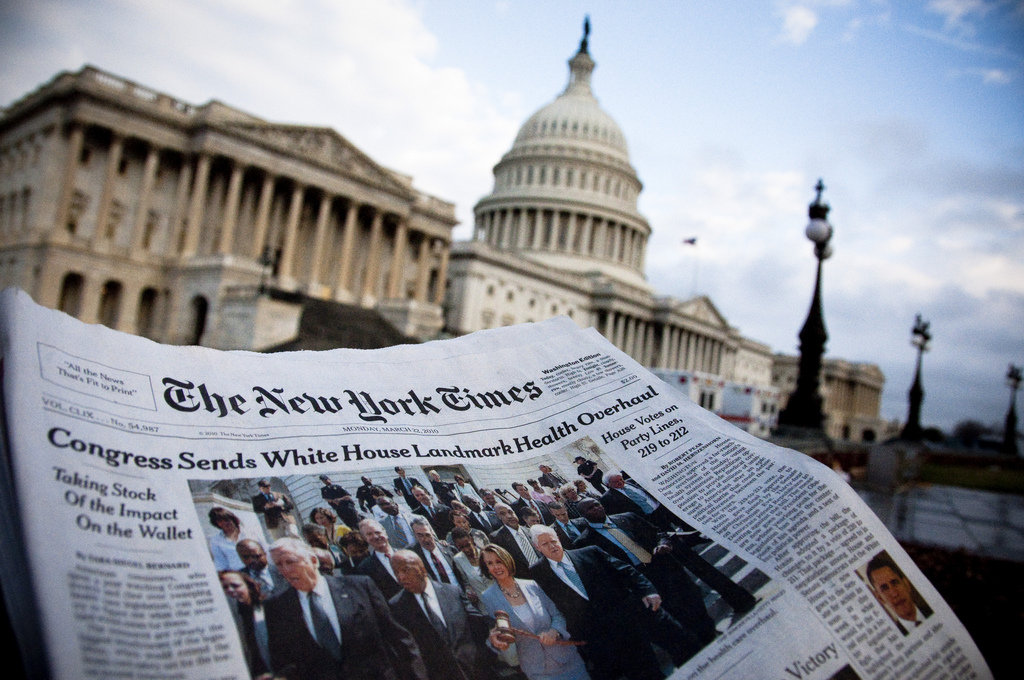
So, as you may have heard, the House passed the health care bill 219-212 late last night. It was a long and busy weekend, and a long and busy week is ahead, formulating the death panels and whatnot. Still, we’ve been talking about this bill since I got here last July, so it feels quite good to finally get this done. Now, let’s make it better. (Pic via here.)
Update: Here’s what goes into effect right away, and here’s what it means for you.
To Catch Some Predators.
Adrien Brody, Topher Grace, Lawrence Fishburne, Alice Braga, and Danny Trejo, among others, find themselves stuck in another world’s Most Dangerous Game in the new trailer for Robert Rodriguez’ Predators. Eh, maybe.
Le Prisonnier.
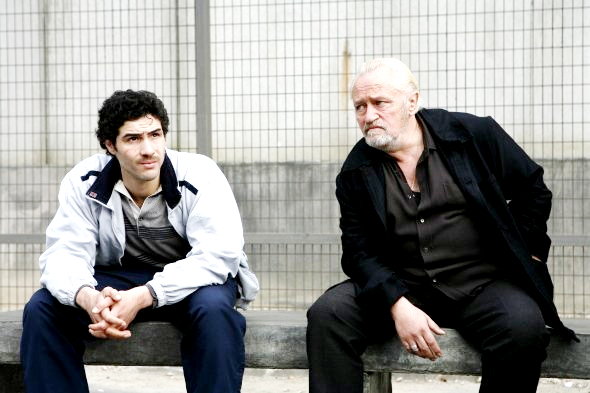
For even as our main character Malik (Tahar Rahim) wiles away years in “the corner of his room” in a French prison, he’s always watching, his mind’s always whirring. A Prophet is possessed of that same quiet, impressive, and inexorable intelligence. Audiard’s movie feels a bit on the long side, and, as you might expect from any movie about life in the Big House (even a French Maison Grande where everyone has separate cells and au bon pain is served on the regular) it can be hard to sit through at times. But it’s also a film that keeps making clever choices, lingering on a small detail or adding that little extra flourish that really makes various scenes resonate.
As A Prophet begins, our young prisoner is being processed for a six-year-stint in the joint for crimes unknown, although it sounds like roughing up a cop was involved. With no family or friends to speak of and a lousy public defender (Rabah Loucif) who just wants the paperwork cleared so he can get paid, Malik enters jail with nothing to his name except a desiccated cigarette and one 50-franc note. How could things get worse? Well, for starters, Cesar Luciani (Niels Arestrup) — the head of the Corsican gang who are the reigning ethnic power in Malik’s prison — may decide he wants an Arab prisoner (Hichem Yacoubi) murdered, and that Malik is just the fresh meat who can get into the Muslim block and get the job done. Hey, everybody’s got to start somewhere.
After wrestling with this dirty deed and its consequences, and picking up an unorthodox roommate, Malik goes from working in the prison’s blue jean factory to being the Corsicans’ new cook, maid, and whipping boy. He starts to make more friends, like Ryad (Adel Bencherif), the testicular cancer survivor who teaches him to read, and Jordi the Gypsy (Reda Kateb), the guy to go to for the quality hash. He starts to understand the prison’s racial fissures, like the great divide between the Corsicans (who treat like him an Arab, and who happen to have the guards in their pocket) and the Muslims (who treat him like a Corsican, and whose numbers are growing.) And, particularly after he establishes some friends on the outside, he starts seeing some angles to make some real money…if his Corsican masters will let him and live.
As critics go, I’m not usually a fan of the NYT’s Manohla Dargis, but her blurb in this trailer — “precisely observed” — is a very good way of putting this movie’s main strength. Time and again, A Prophet colors in its margins with small, wordless, and often devastating details. We watch Malik slice up his mouth over and over again as he tries to learn how to squirrel a razor blade in his cheek. After a day-long furlough that brings him to the beach, we see him slowly run the sand from his shoe through his fingers. When Malik one day gets on a flight, he initiates his full-cavity-search rigamarole in the security line, expecting no different from the French TSA than what he gets in prison every night.
Like I said, there are some scenes in A Prophet that can be hard to watch, and a few of the usual arthouse types at my Saturday afternoon viewing walked out. This is prison after all, and no Green Mile Oscar-bait prison either. Still, while I don’t think I’d want to see it again anytime soon, the movie definitely has moments of real grace, beauty, and haunting power. (Along with the aforementioned penchant for great novelistic details, I especially liked some of the deliriously creepy “dream” sequences in Malik’s prison cell, and particularly as they become normalized to him over the years.)
Did I like A Prophet better than Terribly Happy? Hmm, hard to say — they’re very different kinds of films, this one as sprawling and Scorsesean as Happy was lean and Coen-y. But, of the Best Foreign Film nominees in 2010, this was a much more worthwhile flick than The White Ribbon, and if The Secret in Their Eyes is better, it must be really something.

Madness — Our House.
(Sorry about the bad pun in the title, but I needed a new earworm in my head to help kill off the segwaying chimp ditty.) Anyway, so, yes, it’s that time of year: The madness is upon us once more. (FWIW, I picked Syracuse to win over Duke in the Final, but have zero confidence in my bracket this year.) Unfortunately — or fortunately, if you consider the past ten months — I’m missing my usual annual reunion of college friends, as it’s gonna be a work weekend…
It’s Not Easy Being Green.
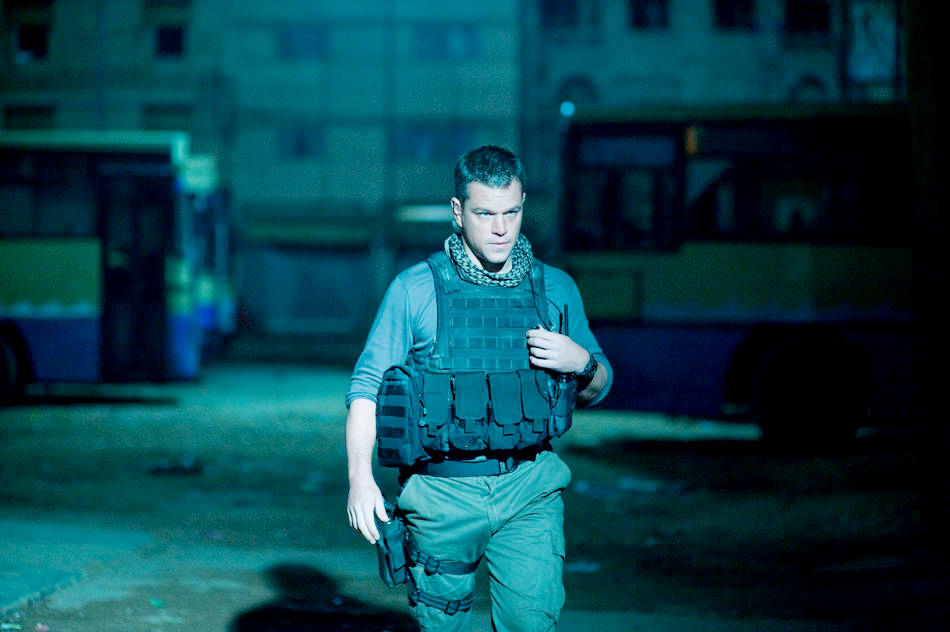
On this St. Patrick’s Day, what better recent release to discuss here at GitM than Paul Greengrass’ Green Zone? Not only do we have two shades of emerald in that last sentence, but we’re now on the cusp of the 7th anniversary of the beginning of the War in Iraq. (It broke out, I well remember, just as I was heading to a March Madness weekend in Vegas.) Alas, I just wish I had a better sitrep to report.
I don’t mean to be too harsh — There’s nothing terribly wrong with this edutainment-y attempt to explain de-Baathification, highly dubious detainee procedures, and most notably the faked WMD casus belli to disinterested laypersons by way of action-thriller. And, in a way, I sorta admire the gutsiness of the the attempt. But, if you were already well aware of these grim developments, and I assume most GitM readers are, then it’s hard to escape the sensation that one is mainly just being talked down to for two hours. Wait, there were no WMD in Iraq? You’re kidding me, right? And, while I’m a great fan of Greengrass’ previous output — I said over and over again in this space that I wish he had stuck with Watchmen, and on the Top 100 films of last decade list, Bloody Sunday was #84, his two Bournes were at #49, and the exemplary United 93 was at #6 — The Green Zone feels quite a bit more leaden than usual.
As with the political edutainment project Greengrass aspired to here, I like the idea of fusing his highly visceral action work (the Bournes) with his fly-on-the-wall discursions into recent history (Sunday, ’93)…on paper. But The Green Zone gets lost somewhere in the interstice, and lacks the gripping power of either of these previous Greengrass grooves. Instead, Zone ends up mostly being two grainy hours of watching Matt Damon run around at night, as he tries to uncover an insidious government plot that our nation has been fully aware of for years…and has chosen to greet with a yawn.
More on that depressing problem in a bit, but, first, to bring y’all up to speed: Loosely based on Rajiv Chandrasekaran’s Imperial Life in the Emerald City, a non-fiction examination of Dubyaite imbecility and excess in post-war Baghdad, Green Zone begins with a brief sequence set amid the original Shock-and-Awe period of the war, followed by, a few weeks later, a tense raid on a possible WMD storehouse by American soldiers. Led by Chief Warrant Officer Roy Miller (Damon), this crack MW2-ish assault ends up finding, well, bupkis, just like the time before and the time before that.
To Chief Miller, the problem here is obvious — the intel must be rotten. But, when he brings this up at the next briefing for high-level military muckety-mucks, he is basically told to shut up and do his job. Nonetheless, events soon conspire to introduce Miller to the “Jack of Clubs” in the Dubya deck, a Baathist general (Yigal Naor) with a still-clearly extant power base in Baghdad. And, when our hero digs deeper to figure out how this Jack might know “Magellan,” the top-secret source of all this lousy intel, he soon finds himself trapped — along with a very Judith Miller-y reporter (Amy Ryan) — in a power play between a slimy executive branch bureaucrat (Greg Kinnear, stuck no more) and a grizzled CIA hand (Brendan Gleeson), one that might just end up getting Miller fragged by the creepy Special Forces guy (Jason Isaacs, with great accent) who keeps popping up…
Along the way, there’s a digression into a detainee facility with all the makings of an Abu Ghraib waiting to happen, the tearful homecoming of the administration’s hand-picked Iraqi stooge (re: Ahmed Chalabi), some rather pained attempts to make the decision to de-Baathify an action beat…In other words, Green Zone is basically an attempt to dramatize the Iraq war for people who, for whatever reason, weren’t paying much attention the first time ’round. And, to be fair, it’s done with solid acting all around (including several folks recognizable from United 93), quality production values, and a reasonable degree of versimilitude throughout. (Note also the brief Paul Rieckhoff cameo, which should nip any IAVA whining about dramatic license right in the bud.)
But, for all its edutainmenty truths to tell, Green Zone still ends up feeling rather fake and film-ish to me, perhaps in part because — unlike Greengrass’ other recent histories — it seems to subscribe to a very movie-like All the President’s Men view of things, where, once word of misdeed gets out, justice will be done tho’ the heavens fall. Not to get all Debbie Downer up in here, but that’s not really the way the world works anymore, is it? One of the saddest and scariest moments in the recent and very worthwhile Daniel Ellsberg: The Most Dangerous Man in America is when Ellsberg explains how he thought everything would change once the Pentagon Papers got out…and then he finds that, in the face of clear and irrefutable evidence of government wrongdoing, most people just shrugged.
This is the uncomfortable horror that Green Zone almost seems willfully designed not to recognize. The whole premise of the movie seems to be that, if We the People knew what really went down in Iraq (or could just be taught via action-movie), we would be totally livid about the corruption involved. But, is the problem really that the American people don’t know what happened in the build-up to Iraq? Or is it that we know pretty well what happened and don’t much seem to care?
Just as with our indefensible dabbling in torture and indefinite detention in recent years, we have known about the lies and incompetence that fueled the Iraq fiasco for awhile now. And, alas, nothing ever happened. Dick Cheney, Karl Rove, and the whole awful, lying lot are still deemed Serious People with Serious Opinions by the nation’s domesticated media watchdogs, who, by the way, have also been studiously ignoring the Blair hearings overseas. Our current president, elected with the largest mandate for change in a generation, has deemed all of this just the sins of the past and refused to “look backward” (or worse, made himself complicit in these Dubya-era crimes.) And life continues, much as it has this past age, with no sense of reckoning whatsoever for the Big Lies that were told.
One of the main reasons Bloody Sunday and United 93 work so well is that they offer complex, nuanced portraits of complicated times. But, as Green Zone moves along, it just ended up feeling more and more like a cartoon to me, and one predicated mainly on wishful thinking. Like I said, I guess I admire what Paul Greengrass & co. were trying do here, but Green Zone as an action film feels flat and mostly uninvolving. And Green Zone as a political enterprise — Iraq War: The Movie!, basically — often seems at best condescending and at worst dangerously naive.
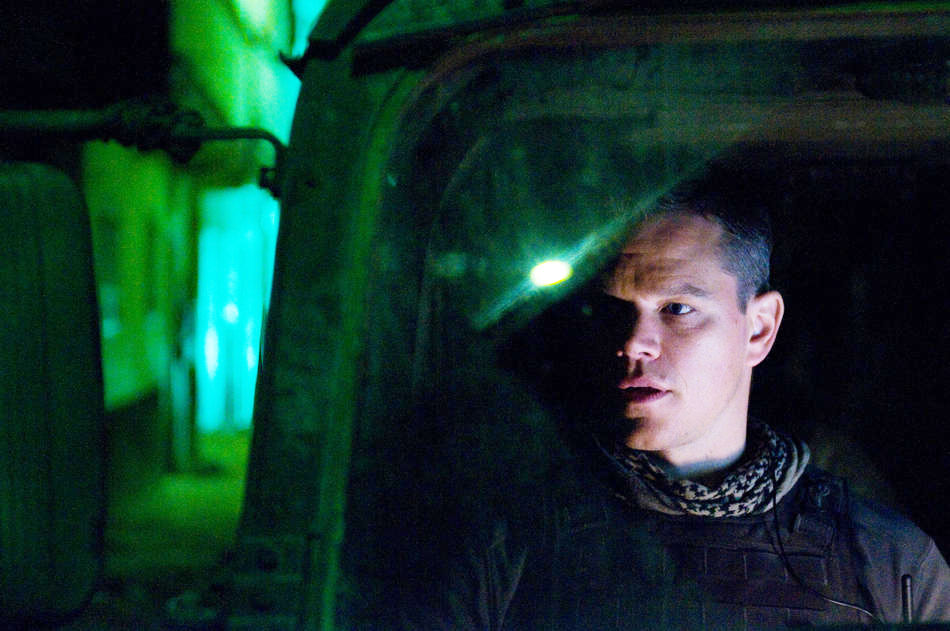
Slainte 2010.

A very happy St. Patrick’s Day to you and yours.
Life in a Northern Town.

This is the North, where we do what we want.” Welllll…unless you’re Brian Clough, of course. After a rough start of Alice and Brooklyn on Friday, movies #3, #4, and #5 of last weekend righted the ship considerably. Those would be the dark and very worthwhile Red Riding trilogy, based on the four-book crime series by David Peace (also the author of The Damned United.)
Consisting of Julian Jarrold’s Red Riding 1974, James Marsh’s Red Riding 1980, and Anand Tucker’s Red Riding 1983, these, unlike the various threads of Brooklyn’s Finest, are three interlocking crime stories than actually enhance and deepen one another, all the while telling one story. And, like The Wire and unlike Brooklyn again, nothing is spelled out for the audience, and all the pieces matter. Over six hours, it all adds up to a grim, complicated, and often harrowing portrait of the Evil that Men do in deepest, darkest Yorkshire.
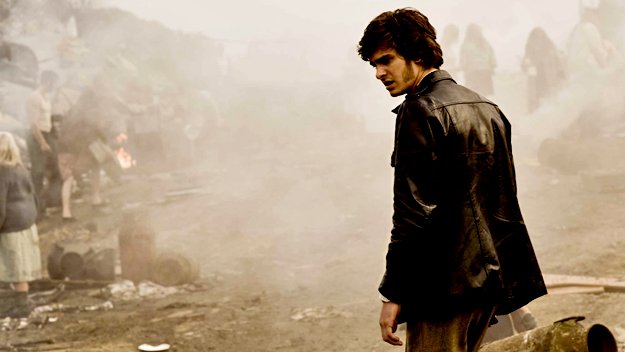
In the first and arguably best installment, it is the Year of our Lord 1974, and a young girl has gone missing. On the case right away is Eddie Dunford, an enterprising journalist just back from a long stint in London (Andrew Garfield, late of Gilliam’s Imaginarium), who very quickly — too quickly, for the cops on the case — ties the disappearance to two earlier murders. But when the child’s body is found, with swan wings stitched into her back, no less, the case officially passes into the hands of Jack Whitehead (Eddie Marsan, late of Sherlock Holmes), the paper’s lead reporter and something of a worthless drunk.
Regardless, Eddie’s interest is piqued, and he continues to follow the leads where they take him — from the arms of a beautiful-but-sad Girl of the North Country (Rebecca Hall) to the clutches of the local developing magnate (Sean Bean), who holds grand ambitions and no small amount of pull in the community. And, while Eddie first thought his drinking buddy Barry (Anthony Flanagan) was a wee bit paranoid for ranting on about disappearances and death squads in li’l old Yorkshire, he starts to wonder about it some when Barry becomes the victim of a horrible sheet glass accident. Was Barry in fact murdered? And if so, how deep does this rabbit hole go?
Deep enough that Detective Peter Hunter (Paddy Considine) is still trying to sort things out six years later, in the Year of our Lord 1980. A Manchester cop reassigned to this beat to help catch the Yorkshire Ripper, or at least to figure out why he hasn’t been caught after thirteen victims, Hunter and his team (Tony Pitts, Maxine Peake) uncover some…discrepancies in the case files of one of the victims. Either the police work is exceedingly shoddy, or the Yorkshire Ripper now has a copycat — or maybe it’s just convenient for some murders to look like Ripper victims.
This all brings to mind the last time Detective Hunter found himself in this godforsaken corner of the North. That would be six years earlier, when he was assigned to look into a bloody crime scene that left a few extra bullets and lots of unanswered questions. The problem is, some folks in town don’t seem to want either of these mysteries looked into anymore, and Hunter has left himself dangerously exposed by recently engaging in an illicit office romance. Something’s gotta give, and it doesn’t look like it’s going to be the wall of silence that surrounds so many of the sinister goings-on in this riding…
Cut to the Year of our Lord 1983, when, just as the Ripper’s bloody swath through this area is at last fading into grim memory, another local girl goes missing. This conjures dismal memories of the case nine years earlier for Detective Superintendent Maurice Jobson (David Morrissey, a.k.a. “The Next Doctor“), one of the higher-ups on the Yorkshire police force, who we’ve seen engaged in some dodgy behavior in the first two installments. (He’s known as the Owl, not to be confused with the Wolf, the Swan, or the Badger.)
Meanwhile, on a visit to his late mother’s home, a local solicitor (Mark Addy, soon of Robin Hood) is guilt-tripped by his old neighbors into revisiting the case of the developmentally disabled man (Daniel Mays) convicted of the 1974 child murders. Suffice to say, there are some troubling holes in the prosecution’s story, and they seem to point right back at “enhanced interrogation” practices in the Yorkshire PD. And when another local man (Gerard Kearns) is taken into custody for this new child disappearance, well, it starts to seem like this has all happened before — and the good lawyer’s father might have been deeply involved.
In all honesty, the story skips off the rails a bit in 1983 — A medium becomes involved in the previously played-straight story, and the original village conspiracies get to be a bit too baroque for plausibility. (Even notwithstanding the huge body count at this late date, there would now seem to be [spoilers-highlight to read]two different and almost-completely unrelated shady operations at work by now.) And, in any event, the overarching three-film plot becomes so byzantine at times that it does get quite hard to maintain the thread. (I’m still unclear as to why [same]the cops shot up the Kirachi Club after Eddie left in 1974. What were their intentions anyway?)
But taken as a whole, this glum trilogy has an admirably dark mojo to it. I mentioned The Wire early on, but perhaps the best analogue for these films is to think of them as sort of an extended British version of Zodiac. If you can handle the violence, the accents, and the unrelenting Yorkshire gloom, the Red Riding trilogy is worth the trip…just be careful who you talk to while you’re there.
Keep the Prius: I’m going Fett.
“The jetpack is made from carbon fiber, with a touch of kevlar in the rotors, and generates 600 pounds of thrust. Because the center of gravity is below the ‘center of thrust’ (a notional point between the engines), it is self-righting: If the pilot lets go of the controls, he hovers steadily in one spot.” Where is my jetpack? Ah, it’s right here, for the paltry sum of $75,000-$90,000. [You can see it in action here.]