The Ballad of Casino Jack.

The festival was over and the boys were all planning for a fall.
The cabaret was quiet except for the drilling in the wall.
The curfew had been lifted and the gambling wheel shut down.
Anyone with any sense had already left town.
He was standing in the doorway looking like the Jack of Hearts.


Thanks, Bob, I got it from here. As the links above attest, the sordid dealings of “Casino Jack” Abramoff and his GOP associates — most notably Tom DeLay and Bob Ney — made for solid blog fodder here at GitM for several years. So, between that and my current place of work, I probably had more interest than most in Alex Gibney’s Casino Jack and the United States of Money, a documentary recounting Abramoff’s rise-and-fall. And…well, it’s not bad. But, unfortunately, it’s not great either. And in terms of making the points he wants to make, I don’t get the sense Gibney really stuck the landing.

Part of the problem is Casino Jack is a maddeningly mercurial sort — and unlike the recently-released Ney, the soon to trial DeLay, chastened aide Neil Volz, and others, he and “Gimme Five” kickback co-conspirator Michael Scanlon choose not to go on the record here. So, right away, there is a cipher at the center of this ostensibly biographical story. And even more problematic for the film’s narrative and structure: Casino Jack had his fingers in a lot of pies, and if there was any way to game the political system somehow to make money, he was on the case. In short, this is one long, twisted, and convoluted story.

And thus, Gibney is left with the ungainly task of trying to explain how Abramoff turned Northern Marianas sweatshops into a bribe farm for GOP congressmen, and how his shady, playing-both-sides kickback operation gamed Native American casinos. Not to mention how his phantom think-tank on the Delaware coast was in fact a money-laundering outfit. Or how the seemingly Mob-connected takeover of a fleet of Suncruz casino ships — and the murder of its former owner — went down. And, amidst all this, how Abramoff managed to move up the GOP food chain by throwing his money around, and was depressingly successful at it. This is all not even withstanding weird tangents like Red Scorpion. So, while Gibney does an admirable job explaining the details of these various operations, he has to jump through so many hoops to get it all down that the Big Picture often gets lost.

I’m probably being a little too hard on this doc, if only because I went in with very high expectations. I was hoping Casino Jack would be more of a concise and devastating prosecutorial brief about the plague of unfettered money in politics, but it’s more broad and meandering than that. (And, to be fair, whenever you take a subject this broad, there will be some meandering — See also Why We Fight.) Still, as I said, even if the high-level connections aren’t quite nailed down, Gibney does a good job of nailing the specifics of each particular grift — the sweatshops and casinos and whatnot. And, coming across with the nerdy charm of a more buttoned-down, politically-minded version of R.E.M.’s Mike Mills, author and ex-Republican Thomas Frank (The Wrecking Crew, What’s the Matter with Kansas) is an appealing interviewee throughout, and he enlivens the discussion considerably.

Speaking of Frank’s ex-GOP years: If you already knew the contours of this Abramoff story (and I suspect most of the people who bother to see this film will), perhaps the most interesting part of Casino Jack is the first half-hour, which chronicles the old College Republican days of friends Abramoff, Grover Norquist, and Ralph Reed. And from Reed’s penchant for outlandish stunts at campus protests, to Norquist’s unabashed admiration for Leninist tactics, to Abramoff et al’s abortive attempt to engage the Third World in their free-market fundie ways, it’s seem as if the young Reagan Right of the ’80s were mainly just a cracked-funhouse-mirror version of the ’60’s New Left they so despise. (This is also in keeping with what you might expect from books like Rick Perlstein’s Before the Storm, about the ’64 Goldwater campaign.)

Still, as we move into the present day and these young conservatives fan out into the political system, Casino Jack and the United States of Money unfortunately gets its overarching message muddled. Is this movie about the former (Abramoff) or the latter (the U.S.M.)? Is Casino Jack a uniquely well-connected criminal mastermind, or, worse, the clearest expression of a political system overwhelmed by cold, hard cash? It’s true the answer to this question may just be “yes,” but the documentary can’t seem to decide at times if it wants to skewer Abramoff (and, by extension, his “unindicted co-conspirators”) or catch bigger game — the whole rotten system — and as a result, both sorta end up writhing off the hook.

At one point, Casino Jack gets caught up recounting the exceptionally douchey e-mail traffic between Abramoff and Scanlon, which is fun and all. (The best laugh in the movie is when the beach bum lifeguard running their Delaware front operation turns out to be savvier than these two would-be Masters of the Universe: “Uh, you’ve been putting this all in e-mails?”) But, even as we delve into these sordid details, the scarier implications of the Abramoff story feel shortchanged — that not only does this pay-to-play stuff seem business as usual for the Dubya White House and DeLay ring, but worse, that this monied corruption festering at the heart of our republic is both legal and even institutionalized.

And so, when the Citizens United fiasco comes up at the end, it unfortunately feels like a bit of a non-sequitur, rather than the sad culmination of the story we’ve been told for two hours. Casino Jack and the United States of Money is an able attempt at muckraking, but, to my mind, it fails to capture the true horror unfolding here: Jack Abramoff may be languishing in prison right now, and for many, many good reasons. But the mess of a system he thrived in is still right here with us — and if anything, after Citizens United, it might soon be getting worse.

Lowry? Has anybody seen Sam Lowry?

In the trailer bin, aspiring Senator Matt Damon thumbs his nose at Fate — as represented by Organization Men John Slattery and Terence Stamp — by wooing ballerina Emily Blunt in the new trailer for George Nolfi’s The Adjustment Bureau, based on a short-story by Phillip K. Dick and also starring Anthony Mackie, Shohreh Aghdashloo, and Michael Kelly. (This is not to be confused with Information Adjustments, although they do share the same sartorial sense.) Hmmm…maybe. I just hope it’s more A Scanner Darkly than The Time-Traveler’s Wife.

Tiger, Tiger, Burning Bright.

It’s December 1997, and a man-eating tiger is on the prowl outside a remote village in Russia’s Far East. The tiger isn’t just killing people, it’s annihilating them, and a team of men and their dogs must hunt it on foot through the forest in the brutal cold. As the trackers sift through the gruesome remains of the victims, they discover that these attacks aren’t random: the tiger is apparently engaged in a vendetta. Injured, starving, and extremely dangerous, the tiger must be found before it strikes again.

Risin’ up and back on the street, Brad Pitt will apparently delve into the tiger woods for Darren Aronofsky and writer Guillermo Arriaga (Babel) in a film adaptation of John Vaillant’s The Tiger: A True Story of Vengeance and Survival. Well, ok then…but Aronofsky is getting notorious for signing aboard more projects than actually happen. Along with the ballet-thriller Black Swan, which may be in the can by now, he’s also meant to be making a Robocop reboot, a Jackie Kennedy in November 1963 story with wife Rachel Weisz, and a movie about UFC fighter Lightning Lee Murray. Sounds like a full plate.

In a Flash, a Grim Recognition.

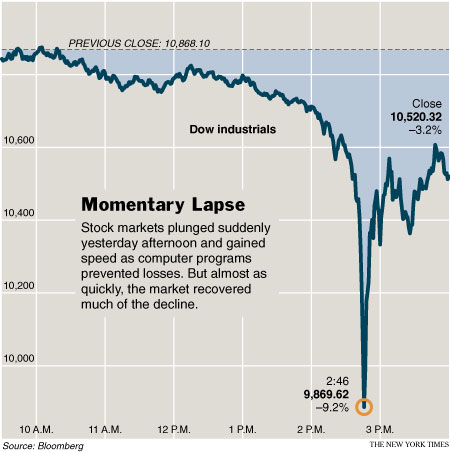
The initial reaction of traders to the Flash Crash was that some human must have made a mistake submitting a trade. But the SEC…hasn’t found evidence of a ‘Fat Fingered Louie’ punching a billion rather than a million on an order. In fact, the SEC still doesn’t know what caused this crash. Curiously, no one is focusing on what caused the crash to stop…JP Morgan and Merrill Lynch were big buyers precisely as the market hit minus one thousand points on the Dow. It seems rather odd that both these firms at the same time would see the same trading opportunity.

In fact, what they did was violate one of the prime rules of trading: never try to catch a falling knife. The market was falling fast and furious at the point they entered the pit to buy equity futures, so why did they take such an enormous risk? We learned yesterday that both of these firms, plus Goldman Sachs, were such superb traders in the market that none of them had a single losing trading day all last quarter. This type of risky trade is not how you get to be a superb trader.

Over at the Agonist, Numerian digs deep into last week’s “Flash Crash” — and comes to some very troubling conclusions. To wit, the big players know the thresholds where the trading algorithms kick in, and thus, basically, the fix is in. “The stock market seems to be nothing but a playground for the big banks and other connected firms who get a preview peek at everything that goes through the market, and who can program their computers to skim profits off daily with no risk whatever. The stock market is also, quite possibly, prone to more serious manipulation that resulted in last Thursday’s crash.

Oof. I’m out of my comfort zone when it comes to understanding market behavior, so I hope someone has a better explanation for the Flash Crash than the disconcertingly plausible one offered here. (Just saying Greece doesn’t quite cut it, I don’t think.)

The Witchhunt is On.

Is our huge deficit a problem today? Not if you think people should have jobs. Private sector demand has plunged because of the collapse of the bubble. If the public sector does not fill the demand gap with deficit spending, then we have less demand and fewer jobs. That’s worth saying a few hundred thousand times since the deficit hawks have filled the airwaves and cyberspace with so much nonsense.

The CEPR’s invaluable Dean Baker rails anew at the deficit hysteria currently in Beltway vogue. I’ve said this several times already now, but I just cannot take anyone seriously who froths and frets about looming deficits, but then says nary a word about out-of-control defense spending. And right now, when it comes to such deficit peacocks, DC is a full-fledged menagerie.

Update: “The danger posed by the deficit ‘is zero. It’s not overstated. It’s completely misstated.’Ezra Klein talks with James Galbraith, son of the venerable J.K. Galbraith and originator of the great witchcraft metaphor, about the deficit hysteria seizing Washington:

[W]e should be focusing on real problems and not fake ones. We have serious problems. Unemployment is at 10 percent. if we got busy and worked out things for the unemployed to do, we’d be much better off. And we can certainly afford it. We have an impending energy crisis and a climate crisis. We could spend a generation fixing those problems in a way that would rebuild our country, too. On the tax side, what you want to do is reverse the burden on working people. Since the beginning of the crisis, I’ve supported a payroll tax holiday so everyone gets an increase in their after-tax earnings so they can pay down their mortgages, which would be a good thing.

Concrete Jungle Where Rings are Made Of.

“Hey, Lebron, it’s us, New York. First of all, congratulations on winning your second straight MVP last week. Now, may it be the last one you ever win with the Cavaliers. You see, we heard somewhere that your contract with them ends at midnight on July 1 and that you’ll be free to play with any team. And you know what? We think you’d love it here in New York.”

Well, the King’s season isn’t over yet. (Although it may be soon, if there’s another game like tonight’s 120-88 Game 5 fiasco.) Nonetheless, New York Magazine offers LeBron James a multi-part hard sell of NYC on behalf of the Knickerbockers. To my mind, their logic is irrefutable.

So the Aliens Won’t Get Snagged.

Way to shield the hated heat, way to put myself to sleep: In the trailer bin of late, something out of Area 51 has a very bad train experience in the teaser for J.J. Abrams’ Super 8, produced by Steven Spielberg. I didn’t cotton much to MI:3 or Abrams’ last (produced) monster movie, Cloverfield. But fingers crossed this is closer to the summery fun of Star Trek.

Kagan’s Time to Shine.

“‘I am confident that she’s a solid, reliable modern Democrat…She’s not George McGovern or whoever the liberal left of the Democratic party would want, but the left of the Democratic party isn’t where the party is any more. She’s a good, solid Clinton-Obama Democrat.‘”

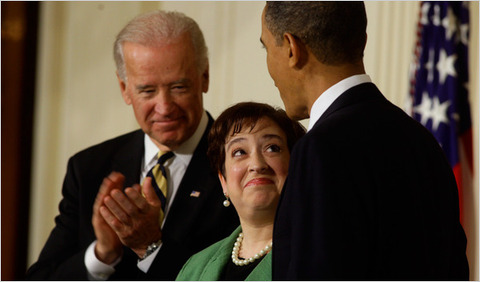
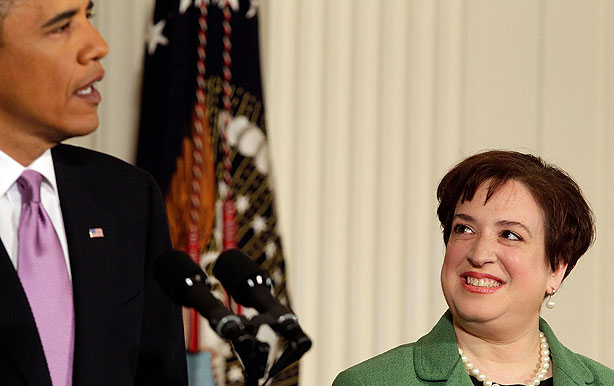
Well, that’s the trick, isn’t it? Particularly that she’ll be replacing the irreplaceable John Paul Stevens. In any case, President Obama has made his second pick for the Supreme Court, and it is his Solicitor General and former Harvard Law Dean Elena Kagan. “As solicitor general, Ms. Kagan has represented the government before the Supreme Court for the past year, but her own views are to a large extent a matter of supposition.

Making the progressive case for Kagan: Larry Lessig, an old friend of hers: “The Kagan I know is a progressive…[T]he core of Kagan’s experience over the past two decades has been all about moving people of different beliefs to the position she believes is correct. Not by compromise, or caving, but by insight and strength. I’ve seen her flip the other side.” Lessig expounds on this coalition-builder argument here: “To hear the liberals talk about it, it sounds like they think we need a Thomas or Scalia of the Left…But nobody who understands the actual dynamics of the Supreme Court could actually believe that such a strategy would produce 5 votes.” (To which one must ask, really? Who’s gonna flip?)

Making the progressive case against Kagan: Salon‘s Glenn Greenwald: “[G]iven that there are so many excellent candidates who have a long, clear commitment to a progressive judicial philosophy, why would Obama possibly select someone who — at best — is a huge question mark?…I believe Kagan’s absolute silence over the past decade on the most intense Constitutional controversies speaks very poorly of her.” This was a follow-up from another piece, where he argued: “Kagan, from her time at Harvard, is renowned for accommodating and incorporating conservative views, the kind of ‘post-ideological’ attribute Obama finds so attractive.” Interestingly, this last part seems much the same argument Lessig’s making in her favor, with the valence changed.

(As an aside, this feud got a bit heated, with Greenwald deeming Lessig a liar and stooge. Having been on the wrong end of Greenwald’s wrath myself on the Citizens United case, Lessig’s rebuttal to this charge sounded all-too familiar: “Chill, Glenn. Dial down the outrage. Dial back the hyperbole. And stop calling those who applaud you liars…[Y]ou can make your point well enough without painting everyone else as liars or constitutional crazies.” True story.)

Anyway, speaking of Citizens United, since the President has explicitly said that decision is lousy law several times over, I presume he’s made sure Kagan is in agreement on that front. (He has, right?) And, as I said back during John Roberts’ nomination, my feeling is generally the president’s prerogative in choosing Supreme Court justices should be respected. (Can’t countenance Roberts’ lying, tho’.) So, if Kagan’s the president’s choice, I’m prepared to give her the benefit of the doubt and support the nomination.

But, quite frankly, I shouldn’t have to doubt (and here, the next two links are via Greenwald.) As the NYT editorial page well put it: “President Obama may know that his new nominee to the Supreme Court, Elena Kagan, shares his thinking on the multitude of issues that face the court and the nation, but the public knows nothing of the kind. Whether by ambitious design or by habit of mind, Ms. Kagan has spent decades carefully husbanding her thoughts and shielding her philosophy from view.

So, sure, I guess it’s entirely possible Kagan is a secret superprogressive of the Leonard Cohen type. (“They sentenced me to 20 years of boredom, for trying to change the system from within.“) But there’s another explanation that’s more likely. And, loath as I am to agree with David Brooks, his column today echoes almost exactly what I was thinking:

Kagan has apparently wanted to be a judge or justice since adolescence (she posed in judicial robes for her high school yearbook.) There was a brief period, in her early 20s, when she expressed opinions on legal and political matters. But that seems to have ended pretty quickly. She has become a legal scholar without the interest scholars normally have in the contest of ideas. She’s shown relatively little interest in coming up with new theories or influencing public debate. Her publication record is scant and carefully nonideological…What we have is a person whose career has dovetailed with the incentives presented by the confirmation system, a system that punishes creativity and rewards caginess.

That’s my rub too, and it dovetails with larger problems I have with DC political culture. More often than not, the people who tend to succeed here are the ones who keep their head down, play the DC game, stay resolutely non-ideological and unobtrusive in their opinions. never go out on a limb, never say or do anything that could hurt their bid to be a Big (or Bigger) Shot down the road. (Hence, the whole phenomenon of The Village.)The problem is, these plodding, risk-averse careerist types are exactly the type of people you don’t want making decisions in the end, because they will invariably lead to the plodding, risk-averse and too-often rudderless politics of the lowest common denominator.

I’m really hoping the future Justice Kagan isn’t another example of this troubling trend, because as I said when Stevens retired: “The Court needs a strong and unabashed liberal conscience right now. What it emphatically does not need is another centrist technocrat that will help push the Court ever further to the right” But, as Kurt Vonnegut put it in Mother Night, “We are what we pretend to be, so we must be careful about what we pretend to be.” And when someone spends decades being so careful and circumspect in the face of so many obvious injustices, both by recent administrations and in the world at large…well, I really have to wonder about their judgment.


Update: Having said all that, this recently unearthed 1996 internal campaign finance reform memo to Chief of Staff Leon Panetta, on which Kagan is one of six signers, suggests she is in fact on the right side of the campaign finance reform issue: “It is unfortunately true that almost any meaningful campaign finance reform proposal raises unconstitutional issues and will provoke legal challenge. This is inevitable in light of the Supreme Court’s view — which we believe to be mistaken in many cases — that money is speech and attempts to limit the influence of money on our political system therefore raises First Amendment problems. We think…the Court should reexamine its premise that the freedom of speech guaranteed by the First Amendment always entails a right to throw money at the political system.” So that’s a big check-mark in my book — Unfortunately, other Clinton-era memos are less promising.

Green Noise.

In casting news, Colin Farrell (recently signed as Jerry Dandridge 2.0) and Marion Cotillard (currently looking stunning in the trailer for Inception) both sign aboard David Cronenberg’s version of Don DeLillo’s Cosmopolis. “The film, based on Don DeLillo’s novel, will follow a multimillionaire on a 24-hour odyssey across Manhattan. Farrell will play the asset manager who loses all his wealth over the course of one day. Cotillard will play his wife.” Oh, the exquisite, finely-manicured melancholy of the super-rich! Eh, I’ll probably see it anyway.

When the Dust Clears, Tories on Top.

“‘I have been privileged to learn much about the very best in human nature, and a fair amount, too, about its frailties, including my own,’ he said. Brown said he loved the job — ‘not for its prestige, its titles and its ceremony, which I do not love at all. No, I loved the job for its potential to make the country I love fairer, more tolerant, more green, more democratic, more prosperous and more just.’

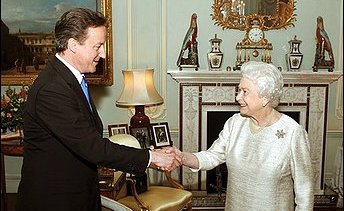
After a cantankerous election that got positively (In the) loopy at times (or, if you prefer, Coakley-esque), Prime Minister Gordon Brown has resigned, ending thirteen years of Labor rule, and Conservative David Cameron is the new PM of a coalition Tory-Liberal Democrat government. [Bio.]

According to E.J. Dionne, “Cameron’s decision to ally with the Lib Dems could have a far-reaching impact on his own party. Many on the right end of the Tory Party are wary of the alliance — a mirror of the reaction on the Labour left. Cameron’s eagerness for a deal suggests he really may want to remake the Conservative Party along more progressive lines. I guess we’ll soon find out.

Update: Speaking of In the Loop, the man himself, Armando Ianucci, weighs in: “Nnnyaaaaaghwooohaaooooororarararararghhhhhhh. That’s the message the electorate gave on Thursday. A long, angry, discordant noise that eventually became silly…[F]or a result that so perfectly expresses the public’s mounting mix of contempt, confusion, and sheer bloody-minded desire to see the political classes sit down to eat humble pie, stand up to get thwacked on the head with the remainder, and then shoved into a corner to be locked in a dark cupboard to sit in their own mess, Thursday’s result was sheer comic genius.