Death and Taxes.

‘Instead of having all of us pay our fair share, we’ve got over $1 trillion worth of loopholes in the corporate tax code,’ he said. ‘This isn’t the invisible hand of the market at work. It’s the successful work of special interests.” In a speech at Washington’s Tax Policy Center, Barack Obama unveils his tax plan. “The plan means billions in breaks by: nixing income taxes for the 7 million senior citizens making less than $50,000 a year, establishing a universal credit for the 10 million homeowners who make less than $50,000 annually and do not itemize their deductions, and providing 150 million Americans with tax cuts of up to $1,000…Obama proposes funding the tax cuts by closing corporate loopholes, cracking down on international tax havens and increasing the dividend-and-capital-gains tax for the wealthy, he said.

Meanwhile, not to be outdone, Hillary Clinton unveils her new health care plan. “A Clinton adviser compares the plan’s ‘individual mandate’ — which requires everyone to have health insurance — to current rules in most states that require all drivers to purchase auto insurance…Clinton is the third of the front-running Democratic White House hopefuls to formally unveil her plan, following Sen. Barack Obama, D-Illinois, and former Sen. John Edwards.” Said Edwards of the Clinton plan: “I’m glad that, today, the architect of the 1993 plan has another care proposal — and if imitation is the sincerest form of flattery, then I’m flattered…The lesson Senator Clinton seems to have learned from her experience with health care is, ‘If you can’t beat ’em, join ’em.’ I learned a very different lesson from decades of fighting powerful interests — you can never join ’em, you just have to beat ’em.

Crossfire, Hard-Wired?

Is political conflict bred in the bone (or, put less charitably, do some among us just have an easier time with higher-order thinking)? A new joint NYU-UCLA neurobiological study finds once again that left- and right-leaning brains function differently, with liberal minds more receptive to change than their conservative counterparts. “Dozens of previous studies have established a strong link between political persuasion and certain personality traits. Conservatives tend to crave order and structure in their lives, and are more consistent in the way they make decisions. Liberals, by contrast, show a higher tolerance for ambiguity and complexity, and adapt more easily to unexpected circumstances…[In this case] respondents who had described themselves as liberals showed ‘significantly greater conflict-related neural activity’ when the hypothetical situation called for an unscheduled break in routine. Conservatives, however, were less flexible, refusing to deviate from old habits ‘despite signals that this…should be changed.’

At what cost Clinton?

“‘Republicans are upset with their candidates,’ Arnold added, ‘but she will make up for that by essentially scaring folks to the polls.’” Although few Dems seem willing to go on the record publicly about their doubts, the AP’s Ron Fournier reports on widespread Democratic concern over Hillary’s reverse coattails in the general election. “The problem is her political baggage: A whopping 49 percent of the public says they have an unfavorable view of Clinton compared to 47 percent who say they hold her in high regard, according to a Gallup Poll survey Aug. 3-5. Her negative ratings are higher than those of her husband, former President Clinton, former President George H.W. Bush and 2004 Democratic nominee John Kerry at the end of their campaigns. A candidate’s unfavorability scores almost always climb during campaigns.

Sharpening the Knives | She Laughs Last?

“I find it amusing that those who helped to authorize and engineer the biggest foreign policy disaster in our generation are now criticizing me for making sure that we are on the right battlefield and not the wrong battlefield in the war against terrorism.” The attacks grow more pointed among the Dems at last night’s AFL-CIO debate (which I missed), and it sounds like both Obama and Edwards got in some good zingers. (Edwards: “The one thing you can count on is you will never see a picture of me on the front of Fortune magazine saying I am the candidate that big, corporate America is betting on.“) And yet, a new poll finds Senator Clinton widening her lead over Obama to 18 points and enjoying huge advantages in big states like Ohio, Florida, and Pennsylvania. Hmm. Is the race already over? The inveterate pessimist in me says definitely maybe, but let’s remember, Howard Dean was looking pretty solid in August of 2003. We have a ways to go yet. (I mean, the critical Jolie and di Caprio endorsements are still up for grabs, for example. And Obama does have Bourne and Clooney locked up.)

A New Day in Washington?

“‘We have kept our promise to drain the swamp that is Washington, D.C.,’ Speaker Nancy Pelosi (D-Calif.) said, adding that the legislation is ‘historic.’” “These are big-time fundamental reforms,’ said Fred Wertheimer, president of the open-government group Democracy 21.Noted Common Cause president Bob Edgar: ” If there is a positive side to Jack Abramoff and the wave of congressional scandal, this is it.

Yes, this could be big. In the wake of the broiling Stevens scandal, the House votes 411-8 to pass a comprehensive new ethics bill: “Secret ‘holds’ in the Senate, which allow a single senator to block action without disclosing his or her tactics, would end. Members of Congress would no longer be allowed to attend lavish convention parties thrown in their honor. Gifts, meals and travel funded by lobbyists would be banned, and travel on corporate jets would be restricted.” In addition, “bundles” — small campaign contributions packaged together — will now have to be disclosed, along with political contributions by lobbyists and the identities of the lobbyists themselves.

Of course, the bill still has to pass the Senate, where some conservatives are threatening to force a filibuster vote (in part due to the weakening of earmark rules, which is admittedly rather annoying.) But that was before Stevens’ unfortunate run-in with the FBI, so we’ll see. Right now, I’m cautiously optimistic that the right-wing will have to fall in line. As Meredith McGehee of the Campaign Legal Center put it: “It may not be a grand slam, but it’s a home run…There is no credible excuse to oppose this legislation.

We Ain’t Seen Nothing Yet?

“‘We’re sitting on the doorstep of a definitional moment,’ said Rep. Rahm Emanuel (Ill.), chairman of the House Democratic Caucus.” Faced with their own low poll numbers, the Democratic Congress readies a flurry of late-term legislation involving homeland security (implementing most of the 9/11 commission recommendations), ethics (gift bans and increased disclosure requirements), and child health care (expanding insurance coverage for children of the working poor.) “Republican leaders plan to stand in the way…But against such philosophical stands, there is a stark political problem: How many Republicans are really going to oppose legislation expanding insurance coverage for children, tightening ethics rules and bolstering homeland security?” More than one might think, I’d wager.

Debate and Digression.

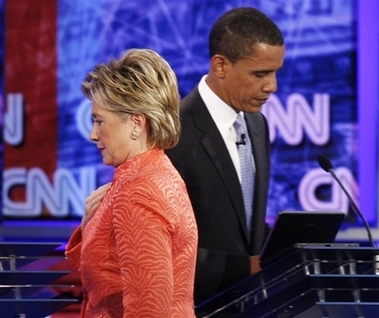
Well, it may seem like they’ve been going at it for awhile now…nevertheless, the first official Democratic primary debate was held last night, co-sponsored by the good folks at CNN and YouTube. [Transcript.] (As you likely heard, this gimmick this time was that the questions were submitted by Youtube users the nation over. All in all, they turned out to be a mixed bag, but no more or less cutting than the ones usually conjured up by George Stephanopoulos, Anderson Cooper, or some other venerable talking head of the moment. Still, not a single query on campaign finance reform managed to sneak through the vetters…so now, I kinda wish I had at least tried to submit one.)

And the verdict this time? Well, no one broke out of the pack as a result of their performance last night, which — the talking heads tell me (hey, David Gergen’s gotta eat) — means a win for Clinton. But, as with the past few debates, I still find my position further solidifying in favor of Obama and Edwards, and against the Senator from New York. (My reasons have been put forth previously here and here.) In fact, the most irritating moment of the debate for me, and I’ll admit that this’ll be considered well beyond stupid and pedantic to most people, was Senator Clinton’s butchering of the distinction between “liberal” and “progressive” to contort her way out of having to name herself the former. For what it’s worth, the key element of a turn-of-the-century progressive was never “someone who believes strongly in individual rights and freedoms” — that would be a liberal. Indeed, arguably the major flaw in the progressive movement — until after WWI — was its inattentiveness to individual rights and freedoms…hence, Prohibition, or, to take an even more sordid example, the proliferation of Jim Crow in the South.

But, more importantly, and this is what really irked me, Hillary Clinton has proven herself to be the least progressive of the Democratic candidates, in that she’s been the most willing to get into bed with corporate interests time and time again. (And, for you historians reading this, yes, I’m calling shenanigans on Kolko.)

Ok, I’ll concede, Clinton can’t honestly be expected to deliver a comprehensive historical disquisition about liberalism v. progressivism in a 45-second debate answer. But, please don’t chalk up my concern simply to being an aggrieved aspiring egghead just yet. (And, hey, speaking of parochial, Obama mentioned my hometown, Florence, SC, tonight, albeit not in a positive light. But I digress again.) The fact is, the differences between liberalism and progressivism do matter, particularly when you consider [a] how often politicians in our party seem confused, or even ignorant, about the Left’s guiding political philosophies these days, and [b] how different a truly progressive presidential candidate would seem from what Hillary Clinton has yet offered us.

Most importantly, a true “modern progressive” would push campaign finance reform, ethics in government, and voting reform though the heavens fall. These are hardly central tenets of the Clinton campaign, to say the least. And, along with the obvious necessities of a sane, competent, foreign policy, accessible, affordable health care, and comprehensively reworked environmental and energy plans, a real “modern progressive” would also extol education, civics reform, universal (if not mandatory) service, community-building, a vast increase in arts and science funding, an end to child poverty…all ways to help renew the bonds of citizenship, to help encourage an active, engaged, self-governing electorate, and to help foster a new generation of Americans more attuned and responsive to the concerns of their fellow men and women — here and around the globe — than they are to the self-absorbed and increasingly inescapable dictates of rapacious consumerism and the corporate bottom line.

It’s late, and I’ve clearly started soapboxing. Still, what I wrote back in 2000 here, before I came to Columbia, still holds: “I know it all sounds a bit academic and removed from reality, but, what can I say? This is where my idealism (or what vestiges of it that survive this election cycle) lies.” Well, it’s been a few election cycles since then, and in many other ways the years since have not been kind, in terms of progressivism or otherwise. I’d very much like to continue indulging in “the audacity of hope” when it comes to such matters — I know it’s way early in the game, and that we’re probably still at least a good 3 or 4 “Macaca moments” out before this all gets decided. But increasingly, and particularly after listening to these debates thus far and the virtual Clinton coronation by the talking heads thereafter, other quotes often come to mind as well. For example: “Look for your friends, but do not trust to hope. It has forsaken these lands.”

I’m not saying Clinton would make a terrible president — Obviously, she’d be much better than the current fiasco of an administration. (But, as always, who wouldn’t be?) But I do increasingly fear her tenure — if it’s marked by the same confused, wishy-washy and corporate-friendly Republican-lite “centrism” her campaign and the DLC have pushed in the past — will make for yet another missed opportunity in terms of fostering real progressive change in this country. (And Senator Clinton, to get to the point: I know progressives. I’ve spent the past six years and change studying progressives. And, you, Madam, have been no progressive.)

No Choice at All.

“‘Democrats are reasonably comfortable with the range of choices. The Democratic attitude is that three or four of these guys would be fine,’ David Redlawsk, a University of Iowa political scientist. ‘The Republicans don’t have that; particularly among the conservatives there’s a real split. They just don’t see candidates who reflect their interests and who they also view as viable.’” Currently leading the Republican race for President: “none of the above.” I wholeheartedly agree.

…or Echoes of Camelot?

On civil rights, the Cuban Missile Crisis, the race to the moon, and other issues, President Kennedy succeeded by demonstrating the same courage, imagination, compassion, judgment, and ability to lead and unite a troubled country that he had shown during his presidential campaign. I believe Obama will do the same.” Also concerning Sen. Obama and from the pages of this week’s New Republic, Kennedy speechwriter Ted Sorensen compares his old boss to Barack Obama. (If you’re not a TNR subscriber, Sorensen makes a similar case on Youtube here.)