
He’s seen a world that no man should see. Now he’s suiting up as the lead in the Coen brothers’ Burn after Reading, with George Clooney, Frances McDormand, and Brad Pitt. It’s good to be John Malkovich.
Tag: Cinema
Twenty-Five for Fanboys.
EW lists the top 25 sci-fi offerings (in tv and film) of the past twenty-five years. Pretty arbitrary, really, but it includes Brazil (at #6), BSG (at #2 — these two should have switched places), Children of Men (#14), Eternal Sunshine (#17 — same problem), Aliens (#9), The Thing (#10), The X-Files (#4), Galaxy Quest (#24), and Blade Runner (#3), so it’s by no means a bad list. (Both Lost and Heroes should be replaced, however.) Just from what’s missing above, you can probably guess #1…can’t you, Mr. Anderson?
Iron and Silver.
“‘This is a decidedly adult superhero story,’ says Favreau. (Fanboy FYI: Look for Stark’s legendary drinking problem to pop up in possible sequels.)” Entertainment Weekly gets an exclusive first look at Iron Man‘s armor (as, in the red-and-gold suit, not the early prototype.) And, also in Marvel-to-film news, the new trailer for Fantastic Four: Rise of the Silver Surfer premieres online. Nope, still not feeling it.
The Pope of Gotham City.
You know what the next Batman movie needs? That certain straight-to-video je-ne-sais-quoi…Eric Roberts joins the cast of Chris Nolan’s The Dark Knight, as “a Mafia kingpin.”
Matt Daemon?
No, Mayra Daemon, as in Mayra the Hare, because I’m apparently “modest, humble, spontaneous, inquisitive, and solitary.” (Well, they got the solitary part right.) Discover your daemon at the official Golden Compass movie site, which does a decent job of trying to explain the basics of Philip Pullman’s world to non-readers. (And, sorry, Mayra m’dear, but I’ve already got a power animal…no hard feelings.)
So Serious.
Word comes of yet another Coen brother project in the pipeline: A Serious Man, “a dark comedy in the vein of Fargo.” Well, ok then. In my view, that’s seriously good news — One can never have too much Coen.
Dumbledore’s Army.
Alert the Ministry: The new trailer for David Yates’ Harry Potter and the Order of the Phoenix is now online, albeit not in the best format. Looks…ok, although I’d be surprised if it lives up to Newell’s Goblet of Fire (or even Cuaron’s Prisoner, since Order may have been my least favorite book in the series thus far.) Update: It’s now available in Quicktime — go here instead.
In a World of Hurt.
“Writing is a way to have a dialogue with yourself. You can never compete with something in the past, in memory. Like some people said, we love what we can’t have. In this world, the end becomes the beginning. It’s very unfair for anyone around him [Tony] in the present, because they can never compete with his imagination or his memory. We love what we can’t have, and we can’t have what we love.”
Since I spent Friday evening watching In the Mood for Love — a tale of a romance-that-almost-was, told in furtive hallway glances — and 2046 — a broader and more diffuse disquisition on love and heartache — back-to-back, here’s an intriguing 2004 interview with director Wong Kar-Wai on how they fit together: “Mood is a chapter in 2046. It’s like 2046 is a big symphony, and Mood is one of its movements.” Maybe so, but I’m glad I saw them as I did. At first Tony Leung’s Chow in 2046, a dissolute, world-weary rake, seemed eons apart from the quiet, somewhat nervous journalist of ITMFL. But the films are clearly meant to be taken as a piece. From its first images (hole, train) to its last (taxi, hole), 2046 dwells on the corrosive consequences for Chow of ITMFL: The memory of Su (Maggie Cheung), bottled up in the tree, is eating Chow alive…hence, the whole otherwise-non sequitur sci-fi subplot (ITMFL told again, by Chow to himself) involving the indecisive android. (Um, the last few sentences make more sense if you’ve seen the films, but only slightly.)
Now I really kinda wished I’d watched Days of Being Wild, the first part of Wong’s trilogy, before these two. But then again, however sumptuously filmed (these movies are absolutely gorgeous to look at), and however tempered by the presence of several stunningly beautiful actresses (Cheung, Zhang Zi Yi, Gong Li, Faye Wong), there’s only so much exquisite melancholy I can take in a given evening. By the end of this extended tale of romance and loss, I had half a mind to just curl up in a ball and drift amid a sea of despond for the rest of the night, lost in the phantom reverie that was both the allure and prison of “2046” in 2046. Even stronger was the urge to light a cigarette and watch the tendrils of smoke slowly writhe and curl through a shaft of light, preferably to the strands of some vintage Nat King Cole. If nothing else, these very worthwhile films suggest, if you’re going to ruminate on old heartaches, you might as well look really good doing it.
The Village Green Preservation Society.

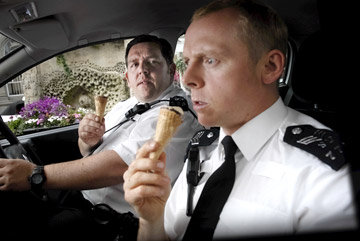
Move over, Grindhouse, ’cause, lo, here comes the fuzz! (We will say goodbye to flesh and blood.) When Hot Fuzz began by packing no less than five funny cameos of very likable people in its first five minutes, I figured I was in for another good time with the Shaun of the Dead crew. And happily, they didn’t disappoint — this action flick homage-parody by Edgar Wright, Simon Pegg, and Nick Frost is as smart, witty, rousing, and enjoyable as its zombie-laden predecessor. Moreover, unlike Tarantino and Rodriguez’s recent foray into film nostalgia (and, for that matter, Team America: World Police, also an action-parody), Hot Fuzz works at both levels — it’s both a clever send-up of action movie tropes and not a half-bad actioner itself (particularly in its last half-hour.) The proceedings here are all frightfully British, of course — in fact, that’s most of the joke. Hot Fuzz is Die Hard in a Wee Country Village, a bunch of quintessentially American Bruckheimerisms cross-bred with quintessentially droll English understatement. But if that wry sense of humor is your cup of tea (as it is mine), the result is probably the goofiest fun you’ll have had at a movie theater since Borat.
This time around, Simon Pegg is Sergeant Nicholas Angel, the most accomplished and dedicated peace officer on the London police force. (uh, police department, that is — the new protocols state you shouldn’t say force. Sorry about that.) He’s so accomplished, in fact, that he’s making everyone else look bad, and thus his superiors ship him off to the remote country idyll of Sandford, which proudly wears the title of the safest village in England. 9-1-1 is a joke in this town, and it soon seems Angel will spend the remainder of his days busting underage drinkers, chasing wayward swans, and fielding dumb questions from his new partner (Nick Frost), a second-generation lousy cop with an inordinate love for Point Break and Bad Boys II. Of course, if you’ve ever read an Agatha Christie novel, watched an episode of Doctor Who, rented The Prisoner or The Wicker Man, or basically taken in any contemporary tale ever set in a remote English village this side of All Creatures Great and Small, you can guess that things may not be all that they seem. And sure enough, it soon becomes clear that there’s a killer loose in this sleepy little haven, and that Sandford may need Angel’s finely honed police skills after all… (Particularly given that the town elders include Bond, Belloq, Boss Tweed, Jimmy Price, and the Equalizer, among others, so there are more than a few possible prime suspects to go around.)
A lot of the fun of Hot Fuzz comes not only from its smart writing and satiric edge (some of which I can’t discuss without giving away the game, sadly — but you’ll see what I mean) but also from its affectionate spoofing of American action tropes throughout. We have the two partnered cops, of course: the wide-eyed rookie learning the ropes and the grizzled veteran who can’t leave the job at home. But Hot Fuzz also features the ubiquitous Tony Scott quick-edits, the not-very-oblique homoerotic male-bonding subtext, the Michael Bay circular pans, the bad detective mustaches, and, of course, the big guns and bigger explosions. (I don’t remember a shot through the windshield of Pegg and Frost simultaneously screaming, as per the buddy-movie-standard, but I’m guessing it might have been in there too.) What separates Fuzz from the similarly knowing Planet Terror, a movie that was basically all inside-jokiness, is that this film never seems derisive toward its target, really. It lampoons the genre, sure, but it also delivers as a genre exercise. (As did Shaun, now that I think about it…hopefully Edgar Wright will bring a similar balance and panache to the superhero movie with his forthcoming take on Ant-Man.)
No Country for Tyler Durden.
It’s a good time to be a Coen fan (but isn’t it always?) Not only is their version of Cormac McCarthy’s No Country for Old Men in the can (and at Cannes), but casting is filling out for their next project, Burn after Reading. Joining George Clooney in this second flick, his Oceans A-List stablemate Brad Pitt (long attached to a failed Coen project, To the White Sea.)