
He’ll need more dilithium crystals, Captain…Following news that Chris Pine has been offered the role of James T. Kirk and that Eric Bana will play the villain (“Nero”) in J.J. Abrams’ Star Trek reboot, Simon Pegg joins the Enterprise crew as Montgomery Scott. Ooh, that’ll be fun. Perhaps we’ll get Nick Frost as a Redshirt? Update: And another. John Cho, best known as Harold of Harold & Kumar, will suit up as Sulu. Update 2: And now McCoy…Karl Urban.
Tag: Cinema
Teleport Authority.
By way of Freakgirl, the trailer for Doug Liman’s Jumper is now online, starring Hayden Christiansen, Samuel L. Jackson, Jamie Bell, Rachel Bilson, Diane Lane, Michael Rooker, and Tom Hulce. As I noted in this 2006 Comic-Con post, the book by Steven Gould is a concise, clever and well-thought-out take on teleportation…but I don’t remember a second jumper, or Jackson’s character being nearly as menacing. (Perhaps he’s still ticked about the whole Episode III thing.)
The Polar Express.
A brand new trailer for The Golden Compass materializes online, and apparently Christopher Lee (Magisterium Big Bad), Freddie Highmore (voice of Pantalamion), and Ian McKellen (voice of Iorek) have all signed up for duty in Chris Weitz’s film. They join Dakota Blue Richards, Daniel Craig, Nicole Kidman, Eva Green, and Sam Elliot (the latter as Lee Scoresby, but reeking of The Big Lebowski.)
Lust in Translation.
 Attempting to be Last Tango in Shanghai by way of Paul Verhoeven’s Black Book, or at the very least to cast straight sex in as taboo a light as the gay love of Brokeback Mountain, Ang Lee’s Lust, Caution is, the lurid promise of its NC-17 rating notwithstanding, sadly a bit dull. As with most of Lee’s oeuvre, the film is ravishingly beautiful throughout, and it recreates WWII Shanghai much more evocatively than, say, Soderbergh’s The Good German did Berlin. But, at two hours and forty minutes, the film also feels overlong, and its central conceit — female agent deep undercover, deep under the covers — is burdened with entirely too much in the way of backstory. Lust, Caution isn’t a bad film by any means, but, its occasional explicitness notwithstanding, it doesn’t make for a particularly memorable one either.
As Lust, Caution begins, it’s 1942 in Japanese-occupied Shanghai, and four wealthy women, seemingly above the harsh impositions of wartime, exchange gossip and veiled state intel over a friendly game of Mahjong. Among this quartet are Yee Tai Tai (Joan Chen), wife of the secret police chief (Tony Leung), and one Mak Tai Tai (Tang Wei), the young and beautiful spouse of a Hong Kong importer. But, as we soon discover (after she leaves the game and makes a suspicious phone call in an English cafe), Mak Tai Tai does not in fact exist. Rather, we are to learn in a very extended flashback (it’s Michael Clayton all over again), she is Wong Chia Chi, a resistance agent whose journey to that Mahjong table began four years earlier, as a displaced schoolgirl in Hong Kong. Falling under the spell of a handsome, earnest young patriot (Wang Lee Horn) then, Wong, a lover of movies, begins appearing in nationalistic plays to much acclaim. And, when it is decided by her schoolyard coterie of six that more drastic action should be taken to fight the Japanese invader, she takes on the role of an importer’s wife to lure a key collaborationist, the aforementioned Mr. Yee, to his demise.
 But trapping Mr. Yee poses several quandaries for these budding freedom fighters. For one, there is the rather delicate matter of how an inexperienced virgin could pass for a married woman. For another, this Yee is no provincial rube, but a man who’s at once deeply careful and extremely untrusting. Most problematic, Mr. Yee is no ugly, oafish lout, but the one-and-only Tony Leung, and hardly anybody in this world looks better smoking artfully in period suits than Tony Leung. Nevertheless, the kids go for it…with mixed results. And, when a spy is needed by the real Resistance to trap Mr. Yee a few years down the line, they find one ready-made in Wong, who takes on her role anew with even higher stakes. Only now, she discovers, Mr. Yee is more cruel than he first lets on, and very much into the rough stuff, sexually speaking. And, more to the point, once the Pandora’s Box of her own sexuality has been jarred open by Yee, Wong begins to lose herself in the part, to the detriment of all…
 WWII spies, steamy, illicit sex…this seems like it should be an enticing concoction, to be sure…obviously it was right up Verhoeven’s alley in Black Book. But, as several reviewers have put it, Lust, Caution turns out to be much more cautious than it is lustful. Even if you factor out the extra hour of padding here, that’s a problem. Ang Lee’s films, among them Crouching Tiger, The Ice Storm, and Brokeback, have always been noted for their delicacy and artful restraint, which is frankly why he may not have been the best choice for this material, about a couple who lose themselves in sexual passion. The much-discussed sex scenes aren’t as puritanically minded as the nightmare visions of Requiem for a Dream, but there’s a definite coldness and frigidity about them, as if neither participant is having very much fun. They’re not so much erotic as they are animalistic, all acrobatic contortions and grunted yelps. I guess you could argue that’s the point — the two are driven not by love at all but by an inexplicable earthy necessity, and Lee even cuts to a growling German shepherd to forward that idea along. But, if that’s the case, if it’s all just physical — then why — spoiler here — when a key slip-up is made by one of the lovers, doesn’t it happen while in the throes of passion, rather than when one is presented with the sight of a shiny (dare I say gaudy?) bauble?
The acting in Lust, Caution is universally good, with special plaudits going to Tang Wei and Tony Leung. And sex is usually handled so sophomorically in films that I feel bad for faulting Lee’s unabashed use of it to further the story along here. But take away those few explicit scenes, and you’re left with a rather conventional snooze of a cloak-and-dagger movie, however lusciously filmed. And even the sex here could’ve used some of the sensuous warmth of Shanghai-born Wong Kar-Wai’s work. Sadly, when it comes to lust and caution in this film, Lust, Caution pretty much foregoes the red-light, and ends up raising more red flags than a Mao rally.
Limited Appeal.
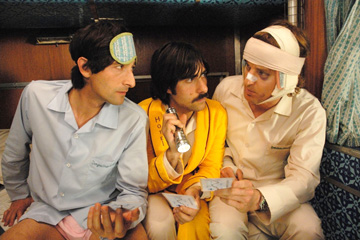
If you’ve ever seen a Wes Anderson movie, you probably already know if you’ll like The Darjeeling Limited or not. For better or worse, this one is right in his wheelhouse — It is to India and trains what The Life Aquatic with Steve Zissou was to Cousteau and boats. I felt pretty much the same about this film as I did about Aquatic — It’s vaguely engaging and mildly diverting at times, but it doesn’t really add up to much, and is basically an excuse for Anderson to parade his usual indulgences for ninety minutes. (Nor is Limited as fresh as Rushmore or as occasionally moving as his best film, The Royal Tenebaums.) I mean, if Wes is your quirky-precious Louis Vuitton bag, don’t let me ruin the fun. But if he isn’t, I suggest taking a plane instead.
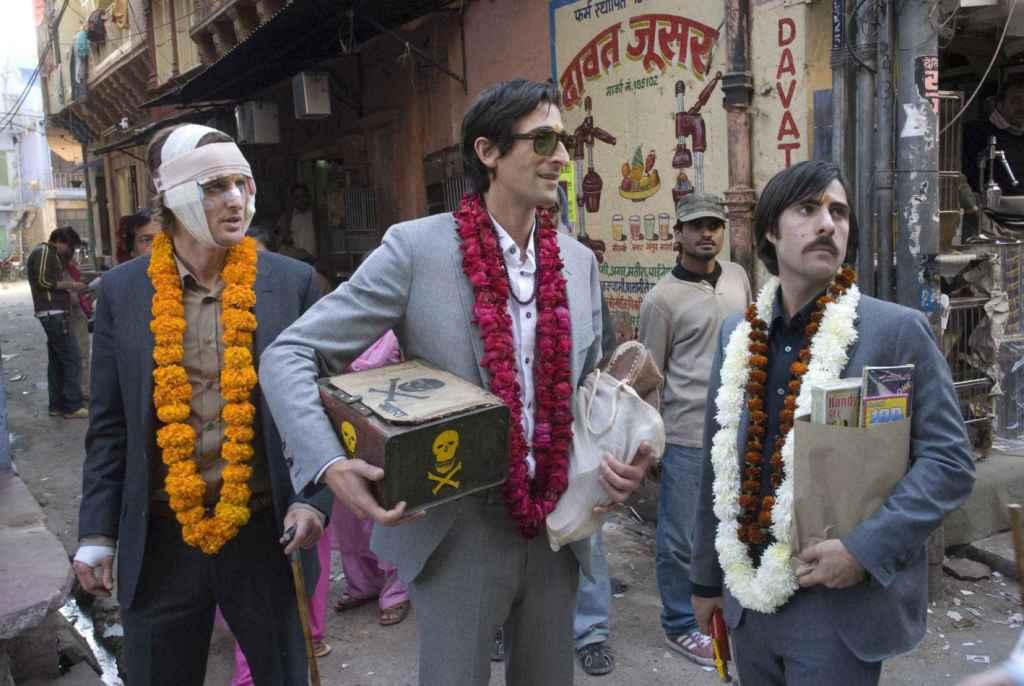
Somewhere on the Indian subcontinent, at what passes for rush hour, a flustered American in Organization Man garb (Bill Murray) tries to will his careening taxi through a typically chaotic Third World marketplace, in the vain hope that he can reach his train — the spiffy Darjeeling Limited — on time. Unfortunately for him, this is not his story. Rather, we follow the travails of the three Whitman brothers on this colorful locomotive, who’ve reunited one year after the untimely death of their father to partake in a journey of spiritual bonding. Jack (Jason Schwartzman), the youngest of the three, is currently writhing on the horns of a messy break-up (See The Hotel Chevalier.) Peter (Adrien Brody), the middle brother with a klepto streak, is wrestling with the dilemma of imminent (and seemingly unwanted) fatherhood. And Frances (Owen Wilson), the oldest brother and planner of the trip, is recovering from what looks to have been a self-induced motorcycle accident. (Plus, he’s a bit of a martinet.) These three reluctantly experience the scenic wonders of India at first, spending most of their time quibbling and bickering in fraternal fashion. But, eventually, a tragedy along their travels shakes the trio out of their touristy complacency. And, once they find (a la 3:10 to Yuma) that the train of life can come to an abrupt stop at any time, will the Whitmans then rise above their individual problems and learn the immortal spiritual truth that “brothers gotta hug?” Well, I’ll leave that for you to discover.
And that’s about it, folks…There’s not much else here to speak of. (In fact, the experience of The Darjeeling Limited was almost completely encapsulated by watching the trailer, from the basic outline of the plot to the general mood and rhythm of the film.) I will say that Adrien Brody, fun to watch on most occasions, comes across as right at home in the Andersonverse. And Owen Wilson, whose injuries can’t help but remind us of recent events in his real life, adds a haunted dimension to his character simply by his presence. Still, Darjeeling is a lark — Even with the funeral in the middle going (I’ll let others do the bashing about the dead-anonymous-native-kid-as-plot-point — I’ll confess it did seem a bit off), The Darjeeling Limited has no scene approaching the power of, say, the quietly devastating suicide attempt in Tenenbaums, and no turn as memorable as those of Bill Murray or Olivia Williams in Rushmore. Wes Anderson has shown in the past that he can tell a moving, dramatic story using his signature style. But, Darjeeling is just a rich kid playing with his train set.
Feet of Clay(ton).
 Move over, Erin Brockovich. The skimpy blouses and truth-to-power sass isn’t going to phase these corporate ne’er-do-wells in the slightest. An intelligent, well-made throwback to the conspiracy-minded thrillers of the 1970s (such as The Parallax View and Three Days of the Condor), first-time director Tony Gilroy’s Michael Clayton is a withering and mostly plausible excursion into the ethical dead zone that can emerge at the top levels of the money game. (Gilroy previously wrote the Bourne movies and that TNT new classic The Devil’s Advocate, with Keanu Reeves as a hotshot lawyer who ends up working for Satan (Al Pacino in full hoo-ah mode), and the influence of both can be seen here.) I didn’t really buy every element of the film, to be honest, but for the most part Michael Clayton works. It’s an adult, believable thriller that’s well worth checking out, and George Clooney, as per the norm, is excellent.
When we first meet Clooney’s Clayton, he’s in the middle of an illicit Chinatown poker game, wearily enduring the taunts of a toupeed yokel at the end of the table, when duty calls. A fixer for the legal firm of Kenner, Bach, & Ledeen, Clayton must venture out to Westchester in the middle of the night to reassure a high-end client (Denis O’Hare) who’s just committed a hit-and-run. (This being the real world, there’s not much he can do, Clooney or no.) On the way back, Clayton, in the grip of an ethical crisis that will later be explained, is briefly mesmerized by three horses standing in the early morning light. And, just as he reaches out to pet one of these chestnut mares, BAM! His car explodes. What turned Michael Clayton’s ride into an unlikely fireball? For that, we’ll have to venture four days into the past, when he was sent to Milwaukee to pick up Arthur Edens (Tom Wilkinson), a senior litigating partner who, a la Peter Finch in Network, has blown a fuse somewhere and can no longer handle his lifetime role as a corporate stooge. This poses a particular problem, as Edens was the architect of a $3 billion class-action defense for the agribusiness behemoth U/North, and his coming to Jesus, mid-deposition, couldn’t have happened at a worse time for the company. And, when Edens, in-between his flights of insanity, starts brandishing a smoking-gun memo and threatening to give it to the plaintiffs, elements at U/North decide they must take extra-legal action…and if Clayton gets in the way, well, he should know the score by now.
 Perhaps it’s a failure of imagination or just willful naivete, but, as with The Constant Gardener, I tend to have trouble believing corporations, however undeniably shady, have assassins on the payroll. (Blackwater notwithstanding, of course.) And, though it’s not entirely her fault, Tilda Swinton is wholly unbelievable as the fastidious, insecurity-wracked Karen Crowder, chief counsel for U/North (i.e. what passes for the Big Bad here.) From the moment her OCD character is introduced, practicing a television interview over and over again in the mirror, she feels more like a writerly construct than a person, and that feeling never goes away. (That being said, one of the funnier scenes in the movie involves Swinton and one of said assassins “taking a meeting” on a street corner, and trying to negotiate a kill-order in corporate legalese.)
Still, there are a number of noteworthy performances throughout Michael Clayton. Sydney Pollack is almost too convincing as Marty Bach, the firm’s take-no-guff man in charge. Thoroughly accustomed to the entitlements of power, Pollack’s Bach exudes a ruthlessly professional mien, and doesn’t suffer people who waste his time gladly. Equally scene-stealing is Caddyshack‘s Michael O’Keefe as Barry, Pollack’s #2. He doesn’t get a lot of run, but O’Keefe personifies the lifetime corporate comer who’s made it all the way up the ladder by dint of hard work and sheer weaselling, and will be damned if anyone’s going to screw it up for him now. And then there’s Clooney, who continues to surprise as an actor and shows us something different here. When we first hear Michael Clayton is $75,000 in the hole with some unsavory types who bankrolled his (and his alcoholic brother’s) failed restaurant — hence the card room — it’s hard not to think, “Oh, just get the gang together again and do another job.” But Clooney here — haggard, puffy, furtive — is no Danny Ocean. When he turns on the know-it-all charm here, it seems a suit of armor Clayton dons to do his job, so as to mask the stench of failure and compromise that threatens to leak out of every pore. If Michael Clayton turns out to be a rather conventional tale by the end, Clooney’s Michael Clayton still makes the trip worthwhile.
Grave and a Haircut, to go.
The trailer for Tim Burton’s Sweeney Todd: The Demon Barber of Fleet Street, starring Johnny Depp, Helena Bonham Carter, Sasha Baron Cohen, Alan Rickman, and Timothy Spall, is now online. Burton wants me to see a bloody musical? I dunno.
Call it, Friendo.
[Update 3/26/08: Welcome. My review of No Country for Old Men is here, and the film review archive is here.]
The Coen Brothers’ No Country For Old Men, my most anticipated movie of the fall season, has a new trailer out. The film stars Josh Brolin, Javier Bardem, Tommy Lee Jones, Kelley MacDonald, Woody Harrelson, Stephen Root, and Garret Dillahunt, and it looks frickin’ fantastic. (And, also up this evening, a new trailer for Aliens v. Predator: Requiem. It looks…less fantastic.)
Medellin.
Looks like Batman’s taking the fight to clean up Gotham City to its source: Javier Bardem and Christian Bale enlist for Joe Carnahan’s version of Mark Bowden’s Killing Pablo, about the Delta Force hunt for Colombian druglord Pablo Escobar (and one has to believe Bardem will be better in the title role than Adrian Grenier.)
Where do you go to (my lovely)?
Apparently Natalie Portman loves her some prequels. In case you’re desiring to see Wes Anderson’s The Darjeeling Limited, or at the very least more of Ms. Portman than was disclosed in Closer, Anderson’s 13-minute short film, Hotel Chevalier, starring Jason Schwartzman and the former Queen Amidala, is now available free on iTunes. Cute…dare I say precious?