
In the trailer bin, The Nightmare Before Christmas meets Grim Fandango in this new look at Tim Burton’s Corpse Bride. And, for non-stop-motion haunts, lawyer Laura Linney tries to ascertain priest Tom Wilkinson’s part in The Exorcism of Emily Rose, ostensibly based on a true story.
Tag: Cinema
Everybody Knows.
 So, in keeping with my usual Independence Day and unBirthday ritual of going to the movies (My b-day is December 29, my brother‘s is January 2 — as these dates fall uncomfortably close to Christmas, we received our birthday gifts on July 4th when I was a kid — whether or not this personal validation on America’s birthday every year played a part in my pursuing a career in US history is still an open question), I went to check out the exceedingly well-reviewed Me and You and Everyone We Know, written, directed, and starring performance artist Miranda July, at the new IFC Center (a.k.a. the old Waverly, where I lost my keys during Apollo 13 a decade ago.) And? Well, July definitely has an original and distinctive voice, and I can see why some critics loved this film. But, frankly, her voice is also one that didn’t speak to me very much. Me and You deserves credit for its sunny disposition and dogged faith in people, I suppose, but frankly, after ninety minutes I found the whole enterprise a bit stilted and twee.
So the upshot is this…Miranda July is a struggling video artist who one day decides she’ll be smitten with John Hawkes (Deadwood‘s Sol Starr), a soon-to-be-divorced shoe salesman who tries (and fails) to connect with his distant kids Peter and Robby (Miles Thompson and Brandon Ratcliff) through ill-thought-out stunts such as lighting his hand on fire. I came in figuring that this July-Hawkes romance was the centerpiece of the film, and I was basically in for a smart, indy-inclined romantic comedy. But, in fact, Me and You spends as much or more time with Everyone They Know, from Hawkes’ creepy, pedophile-in-training partner in the shoe department to two sexually adventurous teenage classmates of Peter’s to the little girl next door, who has developed a slightly disturbing penchant of collecting a “dowry” of home appliances in her hope chest.
If this is starting to sound like a Todd Solondz movie, well we’re in the same ballpark. But, unlike the relentlessly dark and downbeat Solondz, July’s universe is a much shinier, happier place, where (in one of the more affecting scenes in the film) even a lowly and abandoned goldfish is loved by many and doted on in its final moments. And, at times, July’s “bright-side-of-life” vision was truly transporting, as when Hawkes is distracted from the final collapse of his marriage by the sight of a bird alighting outside. (“Banish all dismay, extinguish every sorrow. If I’m lost or I’m forgiven, the birds will still be singing.“)
 Whatsmore, what seems to be July’s wider theme is an intriguing one — we live in a world where me, you, and everyone we know are likely more comfortable communicating by keyboards, cellphones, photographs, video, or other interpolating media than we are by simple voice or touch. After awhile, though, I confess I found myself pining for something more akin to Solondz’s trademark misanthropy. Despite nice moments scattered here and there, I found too much of this film precious and quirky for its own sake, and it began to feel less like a movie than a series of video art vignettes at the Whitney. Take it with a grain of salt — again, I could see this movie being more appealing to warmer, gentler, and less cynical souls…but, as for myself, I have to admit I had emotionally checked out by the last reel.
From Mars to Munich.
“‘Viewing Israel’s response to Munich through the eyes of the men who were sent to avenge that tragedy adds a human dimension to a horrific episode that we usually think about only in political or military terms,’ [Spielberg] said. ‘By experiencing how the implacable resolve of these men to succeed in their mission slowly gave way to troubling doubts about what they were doing, I think we can learn something important about the tragic standoff we find ourselves in today.'” War of the Worlds complete, Steven Spielberg moves on Vengeance.
Close Encounters of the Worst Kind.
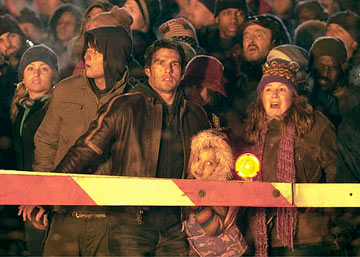 “Across the gulf of space…intellects vast and cool and unsympathetic, regarded this earth with envious eyes, and slowly and surely drew their plans against us.” Hey, don’t say L. Ron Hubbard didn’t try to warn us. At any rate, Spielberg’s take on War of the Worlds is a gritty, eye-popping ride at first, but ultimately ends up being a disappointing affair. In short, it too often abandons the eponymous conflict for pained bouts of family melodrama and lots of Signs-like crashing about in a basement.
I’m aggravated by this film more than most, because from the lightning storm in the first fifteen minutes to the incident at the Hudson River ferry about halfway in, War showed flashes of amazing promise at times. With their introduction from below and their commence-the-killing foghorns, the tripods were spindly alien nightmares, just as they should be. Some of the humanity adrift sequences didn’t make much sense (Why do the news crew cannibalizing the downed plane act starved 12 hours into Day 1 of the attack? How could everything else be picked over by then?), but I particularly liked the swarm of panic and rage surrounding the sight of the Cruise family’s working van. And, while using blatant and Dubyaesque terror, terror, terror, 9/11, 9/11, 9/11 imagery seems like something of an easy shortcut (and how was that “missing persons” board near the ferry created so quickly, in such a random place?), it still helped augment the apocalyptic gloom that an adapation of War of the Worlds needs front-and-center.
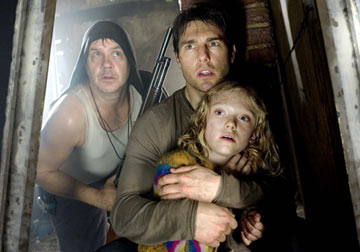 But, alas, amidst all this armageddon, we’re forced to take multiple timeouts so that Tom Cruise and his kids can work out their unresolved family issues. You have to expect some of this in a Spielberg movie, sure, but it still seems like filler, pretty much every time. And it seriously detracts from the terror War is trying to invoke when one starts counting the character beats until the unavoidable group hug. Moreover, when we get to the interminable basement of Crazy-Eyez Robbins, the film just stops dead. (I know there was a similar sequence in the 1953 George Pal film, but frankly I don’t remember enough to compare the two.) After all the rabid, contagious fear of teeming, ant-like humanity that permeates the first hour, why would we want to watch Cruise, Robbins, and Fanning play hide-and-seek for twenty minutes with that Abyss-like tentacle? (Particularly given that we saw Cruise already do this with the ID spiders in Minority Report.) As a result, by the time Team Cruise gets to (a surprisingly undamaged) Boston for the cathartic group hug, I’d pretty much checked out. Unfortunately, despite a captivating first hour, War of the Worlds eventually bogs down into quagmire.
Fawkes Force V.
 The new poster for V for Vendetta is up.
Eighth Wonder of the World.
The much-anticipated teaser for PJ’s King Kong is now online.
Method Clowning.
Sean Penn as The Joker? I’ve been hoping for Adrien Brody as the Clown Prince of Crime myself, but it’s definitely outside-the-box thinking.
Leggy Maguire.
Oops…this has been languishing in the bookmarks for a few days — our first look at Cameron Crowe’s Elizabethtown, with Orlando Bloom, Kirsten Dunst, Susan Sarandon, Jessica Biel, and Alec Baldwin. As several others have noted, it all looks a bit Garden State-ish, but I’ll probably still give it a spin.
Muppet Eberts.
As seen on CNN, Statler and Waldorf, the cantankerous and curmudgeonly duo in the upper balcony of The Muppet Show, now review movie trailers each week. While we’re at it, can we get political commentary by Sam the Eagle?
Short Reign.
It’s only a second or two long, and I expect it’ll get hard to access really soon, but MovieNewz has posted an NBC teaser for the King Kong teaser, with an all-too-brief glimpse of a T-Rex, Ann Darrow (Naomi Watts)…and the Ape in question.