While I prefer the teaser image below, the recently released international poster for PJ’s King Kong is definitely worth a look-see as well, if you’re in any way Kong-inclined.
Tag: Cinema
Oil & Smoke.
In the movie bin, Jake Gyllenhaal welcomes the suck in the full trailer for Sam Mendes’ Jarhead (teaser noted here) , and John Turturro directs an all-star cast to song and dance in this first clip from Romance & Cigarettes.
Craig. Daniel Craig.
Welcome to the Layer Cake, 007. The London Evening Standard is reporting that Daniel Craig has been cast as the new James Bond. His name’s been floating around for awhile now and, this side of Clive Owen, I think he’s probably the best fit for the assignment. Now, if only they’d forsake the exploding pens and laser-guided paper clips for some quality, no-frills cloak-and-daggering.
Exhuming McCarthy.
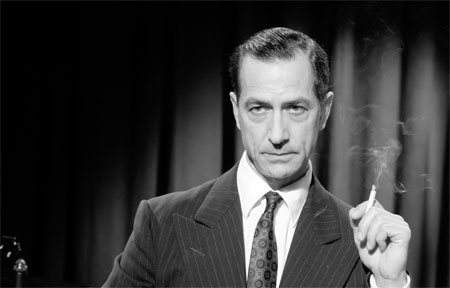
While perhaps a bit too black-and-white in terms of the history, George Clooney’s Good Night, and Good Luck is nevertheless a somber and captivating paean to Edward R. Murrow, his televised expose of Joe McCarthy, and, by extension, the Pioneer Days of Television Journalism. (In this last regard, it’s somewhat reminiscent of the excellent Clooney-produced live TV version of Fail Safe a few years ago.) It’s also assuredly a smoother, subtler, and more accomplished bit of muckraking than, say, Tim Robbins’ recent and lamentably over-the-top Embedded. Once again displaying the surprisingly strong directorial sense he exhibited in Confessions of a Dangerous Mind, Clooney also benefits here from a smartly written script which refuses to talk down to its audience, the crisp black-and-white cinematography, and quality performances across the board. As a result, what could have been an above-average History Channel documentary is instead a powerful and intelligent work of cinema that’s easily one of the better films out this year.
Admittedly, as Jack Shafer pointed out in Slate, Good Night, and Good Luck is rather narrowly focused, and works better as an impassioned and articulate morality play than it does as sound history. The Murrow of this film is saintly to a fault (although David Straitharn ameliorates this with a sardonic and multifaceted performance that may well get some nods come award time.) And there’s very little historical context offered herein, either for the origins of the McCarthy hysteria or for the Wisconsin Senator’s ultimate downfall, which had more to do with picking a fight with the army than with the Murrow broadcast.
That being said, I really like the way Clooney uses archival footage in this film. For one, Clooney was clever to follow Murrow’s example and let Joe McCarthy hoist himself on his own petard. Having the real McCarthy excoriate Murrow as the “leader of the jackal pack” gives the film a sense of history (and menace) that an actorly turn couldn’t have provided. For another, Clooney, who definitely appears to have done his homework, is unafraid to cut to real historical footage — the Annie Lee Moss hearings, for example — for extended periods, and just let the inherent drama of the real proceedings speak for itself. As a result, the history feels alive and contemporary, no mean feat when so many other historical films seem to use the past as merely exotic window dressing. Could the film have been more nuanced in its appraisal of both Murrow and McCarthyism? Undoubtedly. (Then again, nuanced appraisals weren’t exactly McCarthy’s strong point, either., nor is it a long suit of his current defenders.) But on the whole, Good Night, and Good Luck is, I think, a worthy exercise in historical filmmaking, and one with some obvious relevance in light of today’s entertainment-addled, sideshow-obsessed news media.
Movie-wise, there are a few small problems. I think the GN, & GL should have done either more or less with Robert Downey, Jr. and Patricia Clarkson as Wershbas Joe and Shirley — their particular plight doesn’t tie in to the rest of the story very well. And, while Ray Wise is good as the broadcaster-at-wits-end Don Hollenbeck, he’s also typecast in my mind — I kept expecting him to break into the Leland Palmer dance. All in all, though, Good Night, and Good Luck manages to enliven both the staid television studios of Fifties CBS and this historical moment with smoky jazz, languishing cigarettes, and ominous shadows. As the show says, see it now.
Men of Gondor (and Baltimore).
King Leonidas (Gerard Butler) enlists backup from Faramir and Jimmy McNulty as David Wenham and Dominic West join the cast of 300 — based on Frank Miller’s graphic novel retelling of the Battle of Thermopylae — along with Rodrigo Santoro of Love, Actually and Lena Headey of The Brothers Grimm. 300 Spartans against a million Persians? McNulty had best call up Omar for this one.
Black Gold, Black Ops.
“Corruption is our protection. Corruption keeps us safe and warm. Corruption is why we win.” Tim Blake Nelson channels Boss DeLay in the new trailer for Stephen Gaghan’s Syriana (a.k.a.Traffic meets Big Oil), starring George Clooney, Matt Damon, Jeffrey Wright, Chris Cooper, Amanda Peet, Alexander Siddig, and Christopher Plummer.
We’ll always have New York.
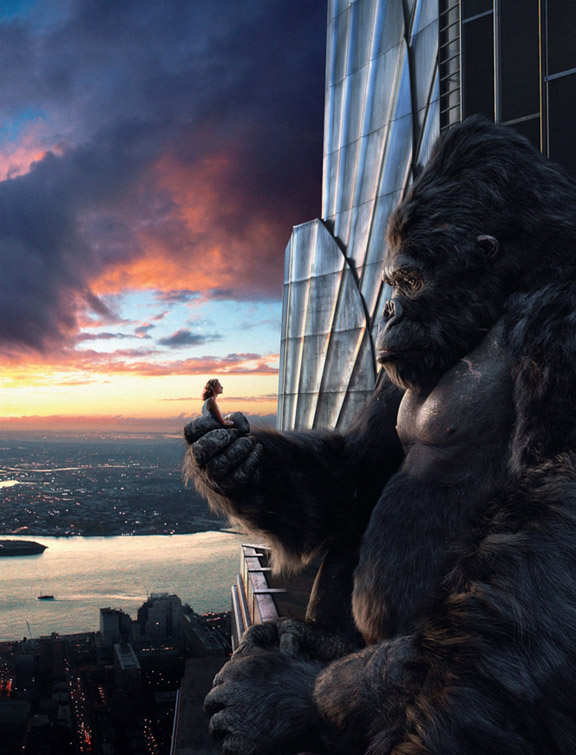 Beauty and the Beast share a private moment in this magnificent teaser image for PJ’s King Kong.
Covenant of the Ring.
LotR masterminds Peter Jackson and Fran Walsh announce they’ll be executive producing the film version of Halo, with WETA in charge of the FX. “‘As a gaming fan, I’m excited to bring Halo’s premise, action and settings to the screen with all the specificity and reality today’s technology can provide,’ said Jackson.” Halo? I dunno…even as just a production credit, I think it’s a bizarre choice for Wingnut Films, particularly as a follow-up to the Rings trilogy and Kong.
A Long-Expected Party.
“Have you ever been called home by the clear ringing of silver trumpets?” Alas, for the first time in three years, we don’t have a new extended LotR DVD in the works this Christmas. But to ease the pain of its passing, the full, three-disc, 180-minute Fellowship of the Ring score will be released November 22, which will include a DVD-version in 5.1 surround sound. Presumably, the other two films will follow in due course. In the meantime, this site has assembled mp3s of some of the missing musical moments from the trilogy. (Unfortunately, they haven’t yet included the culmination of the Rohan theme, as heard during the Ride of the Rohirrim.) I will go there, I will go there…and back again.
Unsound Methods.

Given the very favorable (and somewhat spoilerish) reviews that David Cronenberg’s A History of Violence has been getting, I went in expecting a great film from this auteur of the disturbing (albeit one without the throbbing, fleshy, pulsating chunks of gristle usually associated with Cronenberg’s oeuvre.) But, while Violence is a good film with some excellent performances — most notably by Viggo Mortensen and Maria Bello — it is not ultimately a great one. In fact, I found it something of a letdown after all the hype. [Be warned: I don’t want to give everything away, but it’s a hard movie to talk about without delving into some very heavy spoilers, including the film’s conclusion.]
I’ve never read the source graphic novel, so I can’t vouch for the deviations in the tale, but it basically goes as follows: Viggo Mortensen is Tom Stall, a hard-working, Midwestern fella who runs the local diner in Smalltown USA. He is loved by his adoring, alluring wife (Bello, exquisite as usual), admired by his two children, respected by the community, and generally living the American dream, as long exemplified in Norman Rockwell paintings and The Saturday Evening Post. (A lot of this corn-fed small-town-America set-up — a little girl’s nightmare, a run-in with a high-school bully — comes off as completely flat and stilted, but I think there’s method in Cronenberg’s madness. What he’s doing is akin to the Naomi Watts/Nancy Drew stuff in the first half of David Lynch’s Mulholland Drive — he’s lulling us in with mundanity to knock us off-kilter later on.)
Anyway, Tom’s picture-perfect life goes awry after he becomes an unwitting “American Hero” media sensation by killing two Bad Men in his diner one evening. (We know they’re Bad Men because one of them blows away a little girl in the first five minutes, which seems like exceedingly cheap and lazy character development.) Soon, scraggly-looking n’er-do-wells like Ed Harris come-a-knockin’, convinced that Tom Stall is not Tom Stall at all, but rather…Aragorn of the Dunedain, Isildur’s Heir and a trained, lethal adversary. Ok, not quite…nevertheless, this case of mistaken identity eventually forces Stall to forego being a man of peace and come to grips with his violent tendencies. And, in true Cronenberg fashion, this violence soon seems to infect Stall’s world like a particularly dangerous viral meme, and threatens to transform forever the lives of he and his family.
Along the way, A History of Violence comments on many significant tropes in the history of violence — “justified” violence, parental violence, marital and sexual violence — culminating in a replay of the original Biblical murder (one which loses much of its force due to William Hurt being an insufferable hambone — Perhaps he and Harris should’ve switched roles.) And, to its credit, it leaves many of these setpieces tantalizingly ambiguous. Was Viggo’s kid right to smash up the bully? How should we feel about the incident on the stairwell? But, for all that, I’m with Edelstein — The larger arc of the story seems cartoonishly black-and-white. Yes, the last scene of the film is an undeniably powerful one, but, really, the Stalls get off easy. If violence, once unleashed, spreads like a wildfire, then how come only Bad People (or at the vey least Deserving People, like the bully) end up on its brunt end? True, Cronenberg shows us the gory consequences of murder (Throbbing Gristle sighting!), but never upon any character that we happen to like.
I can see the argument that the story had to end the way it did — with the Stalls perhaps physically unharmed but in spiritual turmoil — as a commentary on either the standard narrative of the Western (covered similarly in Unforgiven) or on Dubya’s foreign policy, which Cronenberg says is an analogy he and Viggo had in mind. Still, as it is, I think the story’s conclusion subverts the movie’s message. By leaving the white hats shaken, not stirred and the black hats pushing up daisies, A History of Violence ends up suggesting that violence is actually a rather effective way of dealing with Bad People, although it may cost you (sniff) a few tears. All in all, A History of Violence is a much-better-than-average movie and it’s one well worth seeing, but, in the end, I don’t think it quite holds up.
