
Ground Control to Major Tom: So Michael Caine won’t be Nikola Tesla in Chris Nolan’s The Prestige (also with Christian Bale & Hugh Jackman)…That’s part’s gone to the inimitable David Bowie, who’s been basically out of the film scene since Basquiat in 1996. Now that’s fun casting.
Tag: Cinema
Understand Your Man.
 While there’s no one hard and fast rule to a good artist biopic (and, indeed, last week’s Capote belies to some extent what I’m about to say), it should capture what’s innovative and idiosyncratic about its subject, and help to explain why we should care about their artistry. And, while James Mangold’s reasonably entertaining Walk the Line has its moments, and Joaquin Phoenix and Reese Witherspoon are both excellent, I ultimately found this movie somewhat frustrating. For, except for occasional flashes, the movie, I think, misses the chance to do Johnny Cash justice — you never really get a sense of what was so unique and extraordinary about him. And, even considered solely as the romance of the Man in Black and his long-suffering muse, June Carter (of the fabled Carter Family,) Walk the Line stumbles ever so slightly. If you came into this film knowing nothing about Johnny Cash or June Carter Cash, I’m not sure this movie makes their case. Too often, it follows a standard Behind the Music “rise, drug-addled-fall, and rise again” structure, which makes it feel like it could be about, well, anybody.
To its credit, the film starts off well — We begin on a chilly day outside Folsom Prison in 1968, as a guard nervously listens to an ominous throb emanating from and through the high, grey walls. Slowly, it resolves into a readily identifiable Cash backbeat, and we go inside to find the Man in Black’s band waiting for him to take the jailhouse stage. But Cash is lost in reverie, struck by the sight of a buzzsaw blade in the prison shop room. For a soon-to-be-obvious reason, it takes him back to his boyhood days picking cotton in rural Arkansas, where the sounds of trains going someplace else are always in the distance, and the only respite from the sweltering heat is the voice of young June Carter on the radio. Ok, so far, so good…Mangold has shown that he’s not afraid to keep everything a little impressionistic, to color his palette with iconographic Cash-isms and help the man’s music breathe through the picture.
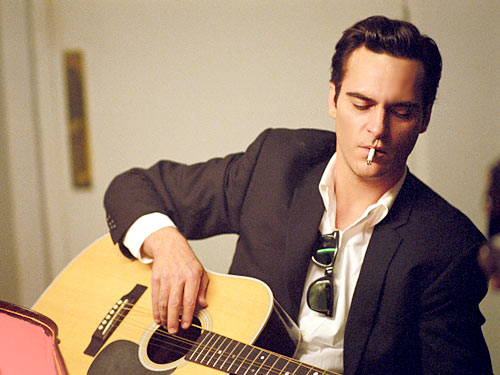 Unfortunately, though, most of the film thereafter feels depressingly literal. After apprising us of a childhood tragedy, the film takes us through Cash’s early days in the Air Force, his increasingly loveless first marriage to Vivian Liberto (Ginnifer Goodwin, looking like Audrey from Twin Peaks and feeling like a stock biopic trope), his rise to fame, his subsequent addiction to Go Pills, and his ultimate redemption thanks to a good-hearted woman, always there to help out a good-timin’ man in his hour(s) of need. This is all capably handled, I guess, but too often it feels rote, in an Insert-Rock-Star-Here kinda way. Worse, aside from one discerning monologue by rock-n-roll impresario Sam Phillips (Dallas Roberts) at Cash’s first audition, the film never really gets to the bottom of the singer’s appeal. We see Cash on his all-star Sun Records tours — and thus get impersonations of Elvis Presley, Jerry Lee Lewis, Roy Orbison, and Carl Phillips, among others — but the film never explains what was unique about Cash among Phillips’ impressive stable of talent. (No Dylan here later on, though…but Cash’s close friendship with Bob is explicitly referenced several times, including a timely cover of “It Ain’t Me, Babe” and a lively use of “Highway 61“‘s police whistle intro.)
 In fact, allow me to digress — one of the many fascinating aspects of the Dylan-Cash camaraderie (also briefly featured in one of the most memorable moments of the recent No Direction Home) is that, aside from a shared affinity for murder ballads and mind-altering substances, they were a study in contrasts, at least in the Sixties. Often, the young Dylan seems impetuous and invincible. Keenly aware of injustice, he nevertheless remains unfazed. He’s unrepentant in his anger — To paraphrase Herbert Croly‘s colorful description of Theodore Roosevelt, the early Dylan wields righteousness like a hammer, throwing the sins, taunts, and ridicule of this world right back from whence they came. Or, at many of his best moments, he turns his back on it all. Instead, he illuminates our experience by imagining the world anew, conjuring a landscape (what Greil Marcus has called the “invisible republic”) that renders both grievous sins and exalted sacraments to be often socially conditional, if not absurd and irrelevant.
 But Cash — Cash can’t escape his critics, because his worst critic is himself. Nor can he either simply condemn or intricately reimagine Evil, because he has been Evil’s instrument. He’s a man of our world — In fact, he’s the Last Man, the Fallen Man. (“But just so we’re reminded of the ones who are held back, Up front there ought ‘a be a Man In Black.”) Forget righteousness: Cash’s characters are just as cognizant of injustice as Dylan’s, but they also know they’ve done wrongs that can’t and never will be forgiven. They’ve been living desperate for so long they’ve become resigned to it. They walk the line, because they know what it’s like to stray far off the path, and they’ve paid the price in spades. And their adherence to their creed — be it a woman, the Savior, or something else, depending on the song — is all the more heartfelt and admirable because it has been tested, and even broken. In short, Cash has suffered grave consequences, and persevered in spite of them. He’s been through the Ring of Fire and out the other side, and his gravelly-delivered tales of guilt and penitence have set the stage for any number of later artists, including Tom Waits, Nick Cave, Leonard Cohen, and, by no coincidence at all, the older Bob Dylan.
 Well, that’s my take on Cash, and there are many others (For example, Ed Champion had a nice read on him last week contrasting Cash with Franz Ferdinand.) But, back to the movie — I barely got any sense of a Cash critique at all in Walk the Line. At best, it assumes you already have an opinion and appreciation of the man coming in, which may be true but still seems like lazy writing. (Or, alternatively, I guess you could say that it attempts to explode the Cash myth — “He wasn’t really a jailbird!” — but that gets us back into staid Behind the Music territory again.) That being said, the fault with the film is not Joaquin Phoenix’s by any means. Admittedly, his singing voice is off — although, whether it be to his getting better or my brain sorting out the cognitive dissonance — he improves as the film goes along. But, otherwise, Phoenix goes for it, and despite often seeming physically and vocally far afield from Cash, he delivers a powerful performance from the inside-out. As Dave Edelstein noted, it’s hard to watch him wrestle with drug abuse and the memory of his dead brother here and not think of River Phoenix. (If anything, I was reminded of Anthony Hopkins in Oliver Stone’s Nixon, which is another brilliant performance, although arguably one that doesn’t suggest Tricky Dick to anyone who remembers him.)
 Reese Witherspoon is also superb (indeed, award-worthy) as June Carter, who, as in life, I suppose, was both a vivacious stage presence and a model of forbearance. (It’s also great to hear a genuine, unaffected southern accent onscreen. Too often, they sound actorly and are off by hundreds of miles — I’m looking at you, Cold Mountain.) But, the romance at the heart of the film is missing that certain je-ne-sais-quoi. From what little I know about it, Johnny and June Carter Cash are one of those love stories for the ages. She was his angel, his ray of light in the dark (images which the film does try to bring to life.) But, here, and I’m not quite sure exactly who’s at fault, Johnny Cash just comes off as a disciple of the mega-creepy Anakin Skywalker school of courting — i.e., act like a stalker for long enough and eventually she’ll come ’round. Again, I don’t really blame the actors. They do what they can with what they’ve got (although perhaps memories of Phoenix’s turn as Gladiator‘s Commodus are partially at fault.) But, to my mind, if the movie tried harder to sell us on Cash’s unique artistry, perhaps we’d have a better sense of what June, daughter of an estimable clan of folkies, saw in him. As it is, he just seems like an extremely lucky, albeit talented, amphetamine junkie.
And, to close an overextended review, that’s the basic problem with Walk the Line. The parts are all here, but, aside from the occasional flicker of life, the soul of Cash is mostly absent. Perhaps it’d be impossible to do right by him, to capture all the mystique of his music and his persona on celluloid. But, that doesn’t make this film any less frustrating. Try as Walk the Line might, the elusive and unforgettable Johnny Cash remains a ghost rider in the sky.
Big Red.
Seen before Harry last night: the brand-new teaser for Superman Returns. I dunno…with Marlon Brando’s Jor-El voice-over and the John Williams music, this should really grab me. But everytime I see Supes, I still think Rushmore. (The trailer for M. Night Shyamalan’s Lady in the Water was also shown, but it doesn’t appear to be online yet. Well, if turns out to be as laughably bad as Signs and The Village, I may just have to see it.) Update: Here it is.
X, XY.
In other comic-film news, more X-Trouble on the horizon: In keeping with schlockmeister Brett Ratner’s earlier-professed desire to sex up the X-Men, X3 adds two come-hither mutants: Mercedes Scelba-Shorte of America’s Next Top Model as M/Monet St. Croix (from Generation X, which is after my time..they’re the new New Mutants, I guess) and Ashley Hartman of The OC as Emma Frost, the White Queen (formerly a villain, until reconceived during the Grant Morrison run.) I guess this means we’ll never get a full Hellfire Club X-film, which is particularly depressing after reading a fanboy dream-cast Deadwood‘s Ian McShane as Sebastian Shaw, the Black King, in the AICN talkback. That would’ve been ten kinds of perfect.
The Union of the Snake
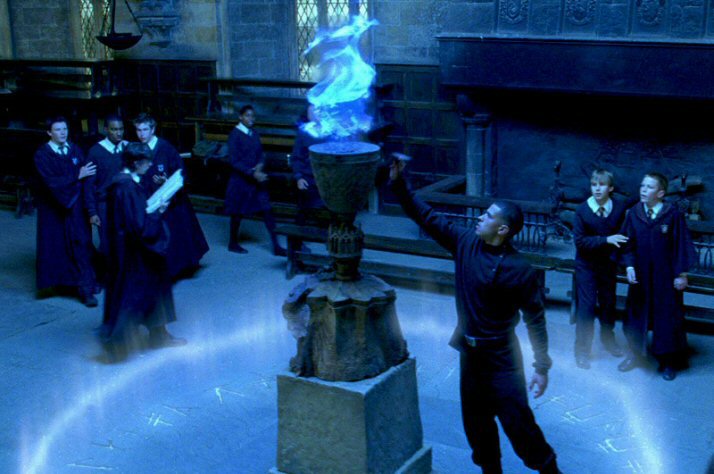
is on the climb…which means trouble ahead for Harry and Hogwarts in the surprisingly satisfying Harry Potter and the Goblet of Fire. I said of Alfonse Cuaron’s Azkaban that it was probably the ablest representation of the Rowling books we were going to get on film, but you know what? I was dead wrong. Mike Newell’s dark and delectable Goblet is brimming over with energy and suspense, and, to my surprise, it’s probably the best Potter film so far. (And this is coming from someone who actually preferred Book III to Book IV on paper.)
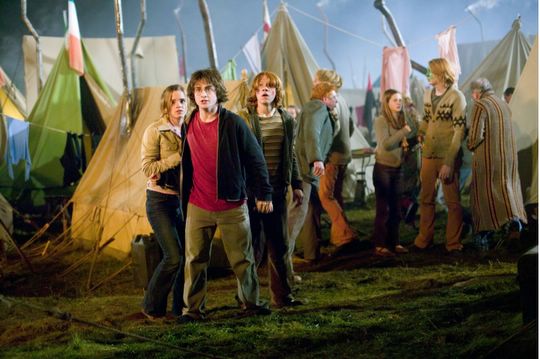
I assume most of y’all out there already know the story, but in a nutshell, Harry’s fourth year at England’s premiere Magickal Boarding School is one marked by three novel, terrifying, and wholly inscrutable challenges: (1) The Tri-Wizard Tournament (held every few years against rival academies Beauxbatons and Durmstrang); (2) the possible return of You-Know-Who (as announced by the sight of His Mark at the Quidditch World Cup); and (3) girls. Yes, on top of their usual troubles with magical enchantments and strange goings-on, Harry, Ron, and Hermione have hit those awkward middle school years, when a brief conversation with Cho Chang (Katie Leung), a waltz with Parvati Patel (Shefali Chowdhury), a bath with Moaning Myrtle (Shirley Henderson), or a date with Victor Krum (Stanislav Ianevski) becomes as nerve-rattling as facing down a wayward basilisk. Nevertheless, the Yule Ball is only the least of Harry’s worries, as — for some reason and in defiance of all the usual protocols — he’s been picked as a fourth entrant in the highly dangerous TriWizard Tournament…and, even with the aid of new Dark Arts teacher Mad-Eye Moody (a superb Brendan Gleeson), it’ll take all the wits and combined resources of our teenage trio (well, and Neville) for Harry to make it through intact.
To their credit, Newell and screenwriter Steve Kloves have done an excellent job scaling down the dense 700-page novel into a sleek two-and-a-half-hour film. Goblet moves at such a brisk clip that rarely did I find myself (as I did in Azkaban) enumerating the remaining plot points to be explained. [For what it’s worth, the House Elf subplot is gone, Rita Skeeter (Miranda Richardson, note-perfect) has basically one-and-a-half scenes, and the other TriWizard contestants — particularly poor Fleur Delacour (Clemence Poesy) — get somewhat short shrift.] In fact, even Harry’s usual nemeses — Severus Snape (Alan Rickman) and the scions of Slytherin — are for the most part pushed to the background here (although fans of those Schoolboys in Disgrace, the Weasley twins, will be happy to know that they get considerable screen time, and Ginny’s always lurking around too.)
Whatsmore, we’re definitely in PG-13 land this time. [Warning: Here there be spoilers, particularly for non-book-readers] Goblet is a film filled with unsettling images from its opening moments, from the floating Death Head above the World Cup to the highly creepy Pensieve flashback of Karkaroff’s plea hearing (Given recent events involving torture and secret prisons, I found this scene — and the contraption they were keeping Karkaroff in — particularly perturbing.) So it’s a testament to Newell’s vision that the scene everyone’s waiting for in Goblet of Fire, the big climax, is the creepiest one of all. The wretched, fetal You-Know-Who was disturbing enough, but once Voldemort emerges in all his twisted glory (looking a bit like the head vampire in Blade 2), Ralph Fiennes ratchets up the freak to eleven and almost runs away with the film. As I went to sleep last night after the midnight show, it was Fiennes’ crisp, lithe, and serpentine Voldemort (and his band of Klannish Death Eaters) that stuck in my head, exactly as it should be.
[As a tangent, and I’m probably thinking about this too much, but now I really like the shaggy haired dos of all our protagonists in context of the film — I don’t think it’s just a nod to Kinks/Pink Floyd-ish boarding house visions or a post-Anakin fad. There’s method to Newell’s madness…As Stephanie Zacharek also points out, he’s deliberately invoking the 70’s as the uncertain, transitional adolescence after the heyday of the Sixties, as well as the cultural moment just before Thatcherism and the Tory revival. Everything’s going to change, indeed.]
Finest Work-Kong.
 Dark Horizons procures a number of very fetching King Kong stills…some might be considered minor spoilers, if for some reason you don’t already know the basic outlines of the tale.
IV for V.
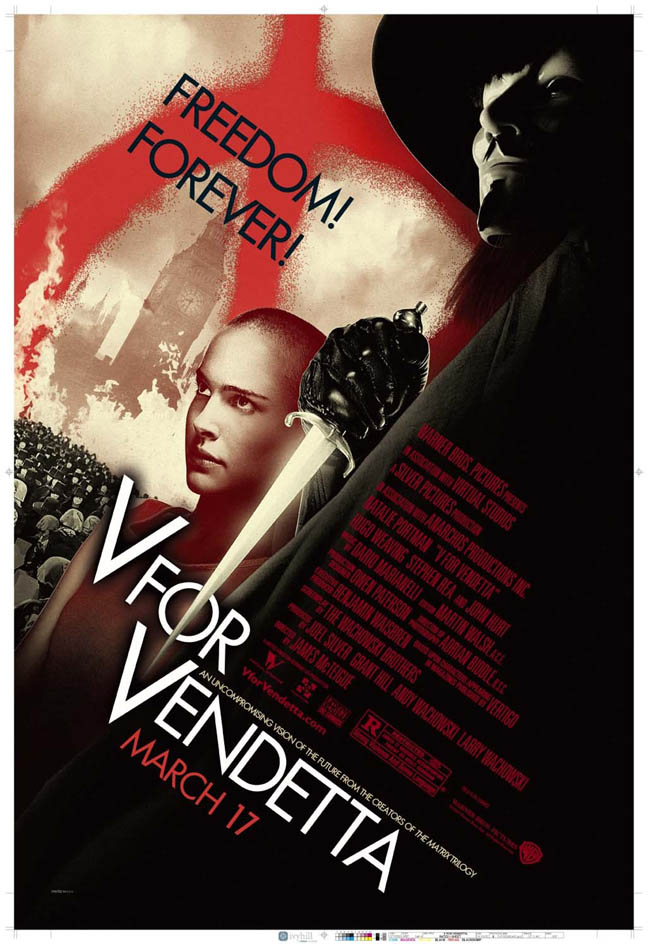 Remember, remember, the…17th of March? Guy Fawkes teams up with St. Patrick this year as the ad blitz begins for the rescheduled V for Vendetta. Here’s one of four new teaser posters, with the rest to be released sometime today. Update: The others are here, here and here.
Indiana vs. Identity Theft.
Armed only with his trusty Finger of Death and a deep, abiding love for his family, Security specialist Harrison Ford faces off against evil Paul Bettany in the highly spoileriffic trailer for Firewall, also starring Virginia Madsen, Robert Patrick, and Alan Arkin. I’m rooting for a Ford comeback one of these days, but this warmed-over retread of other Ford films doesn’t look to be the start of it.
The Truman Show.
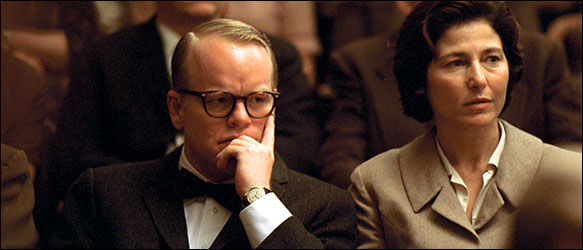
“Ever since I was a child, folks have thought they had me pegged, because of the way I am, the way I talk. And they’re always wrong.” Capote, starring Philip Seymour Hoffman, is a somber and compelling character study of the eponymous author, during the six years he spent in Kansas researching his renowned “non-fiction novel” of true crime, In Cold Blood. It’s a slow-moving film, but a memorable one. I don’t think I’d want to sit through it again anytime soon, but I do expect it’ll be on the short list for Best Actor nods come awards time.
To be honest, I have no memory or sense at all of Truman Capote, so I can only assume that Hoffman’s performance here, with his fey, lilting voice and precise, carefully-constructed mannerisms, is of a piece with the real author. Regardless, Hoffman’s Capote cuts a complex and striking figure that’s hard to take your eyes from — He’s at once vainglorious and needy, extroverted and remote, compassionate and manipulative, convivial and detestable. Intrigued by a newsclipping of four brutal 1959 murders, he and childhood friend Harper Lee (Catherine Keener) venture to the stark landscape of Holcolmb, Kansas, to investigate. Capote soon realizes that that story of the murders could make for a new kind of novel. But, as he comes to befriend the killers — most notably Perry Edward Smith (Clifton Collins, Jr.) — he also discovers that the problem with writing a non-fiction novel is that the characters have lives of their own, and events may not follow the path you necessarily intend.
This is Hoffman’s film through-and-through, and, like I said (sorry, David Strathairn), I expect that he’ll be a tough act to beat come awards season. Still, Capote is also anchored by a strong sense of place and by many fine supporting performances — most notably Collins and Keener — but also Chris Cooper, Bruce Greenwood, Bob Balaban, and The Wire‘s Amy Ryan. Strangely enough, Capote also bookends nicely with last week’s Jarhead, and crystallizes some of my problems with that film. While we were supposed to feel for Pvt. Swofford’s predicament that he’s gone to war and (sniff) can’t actually kill anybody, this film shows the devastating emotional consequences of a not-unrelated predicament — Capote can’t finish his work of genius until “the story ends,” so to speak. And, as Hoffman emphatically illustrates by the end of this powerful film, “More tears are shed over answered prayers than unanswered ones.”
I have forgiven Jesus.

I’ve fallen behind on the movie reviews — so this one might be brief. As a nightcap (and highbrow/lowbrow change-up) to Ballets Russes on Friday, I also partook of Jesus is Magic, comedienne Sarah Silverman’s new concert film. And, while it has some decently amusing moments amid the live footage, this doesn’t feel like a movie so much as a glorified HBO special, particularly once you factor in the egregiously unfunny songs and skits included to pad out the material. Silverman is an endearing presence (even given the 9/11, Holocaust, and ethnic jokes) with impeccable comic timing, but she eventually wears out her welcome here in Jesus is Magic.
So, in case you haven’t heard of her (or didn’t see her in The Aristocrats), Silverman’s schtick in a nutshell is “cute, well-mannered, narcissistic girl saying vile and horrifying things,” and most of the humor comes from either the shock of her words or the disconnect between her looks and her material. And Silverman does have some funny lines along the way, if you’re ok with her anything-goes style of humor: She remembers 9/11 as “devastating…especially for me, because it happened to be the exact same day I found out that a soy chai latte was, like, 900 calories.” To motivate her niece, she tells her ” that every time she loses at tag, an angel gets AIDS,” and that “when God gives you AIDS…make LemonAIDS.“
From vanity Holocaust tattoos (her aunt’s was “Bedazzled”) to racist jokes (“I don’t care if you think I’m racist, I just want you to think I’m thin.”), Silverman shows again and again that she’s more than willing to veer over into tastelessness and back again for the sake of a laugh. But, after awhile, one gets the sense that there’s little more to her persona than shock value. When other comics invoke racial stereotypes — Richard Pryor and Chris Rock come to mind — it’s often as much about social commentary as it is about the joke at hand. But Silverman just seems to let social taboos do all the work — her gags don’t go anywhere, and the only thing funny or resonant about them is the “Did she really just say that?” factor. Throw in the lame songs, most of which are even worse than an after-the-musical-guest SNL skit, and Jesus is Magic ends up being rather a unmagical theater experience. Like I said, this might’ve worked as a decent HBO comedy special, but it’s not a movie by any stretch of the imagination, filthy or not.