
Scots meet Aussies in the trailer for Geoffrey Wright’s gangsterland update of Macbeth, with Sam Worthington, Victoria Hill, and Lachy Hume.
Tag: Cinema
Sands of Iwo Jima.
A trailer for Clint Eastwood’s forthcoming Iwo Jima double-feature, Flags of our Fathers and Red Sun, Black Sand, is now online.
Murders Most Foul.
Some new trailers for films I likely won’t see: Orlando Bloom, Bill Paxton, and Bobby Cannavale face trouble in paradise in the new trailer for Haven, Brian De Palma and James Ellroy return to their respective wheelhouses with Josh Hartnett, Scarlett Johansson, Aaron Eckhart, and Hillary Swank in the true-crime thriller The Black Dahlia (not to be confused with Hollywoodland), Buffy faces the Case of the Haunted House in this look at The Return, and Napoleon Dynamite takes on Billy Bob Thornton (with Todd Louiso, Horatio Sanz, Michael Clarke Duncan, and Ben Stiller in tow) in the new frat pack venture, School for Scoundrels. Ok, I might catch Dahlia for the Ellroy/Eckhart factor, although I’ve been burned by too many bad De Palma flicks of late. Snake Eyes, Mission to Mars and Femme Fatale, anyone?
Towers of Stone.
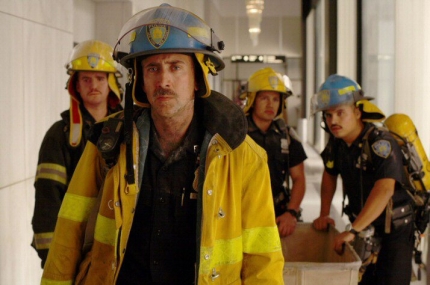 If you’re going to see only one movie about 9/11, see Paul Greengrass’ United 93, far and away the best movie of the year. If you’re going to see two movies about 9/11, see United 93 and Spike Lee’s The 25th Hour, still the best film I’ve seen about the day’s aftermath here in Gotham. And, if you’re going to see three movies about 9/11…hmm, now that’s a tough one. Maybe add the first hour of Steven Spielberg’s War of the Worlds and the first half-hour of Oliver Stone’s surprisingly rote World Trade Center? While much better than the godawful Alexander or the misfiring Any Given Sunday, World Trade Center nevertheless suggests that Stone is still somewhat off his game. The movie has some moments of genuine power, particularly in its first act (as it would have to given the potency of its source material), but it’s hard to believe the director of JFK, Platoon, Natural Born Killers, and Nixon would make such a staid and conventional Lifetime movie-of-the-week from the defining tragedy of our decade. (Even more unStonelike, aside from an indirect dig at the blathering television newsmedia, who continuously recycle the morning’s events well past everyone’s endurance, WTC is also resolutely apolitical and uncontroversial.) In sum, World Trade Center is crisply-made and at times affecting, but nowhere near as interesting or eventful a movie as you might expect. As EW’s Owen Gleiberman aptly summed it up, “World Trade Center isn’t a great Stone film; it’s more like a decent Ron Howard film.“
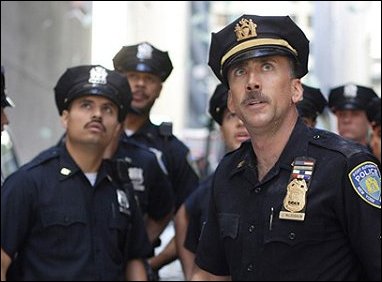 Much like United 93, World Trade Center begins in the wee morning hours of Tuesday, September 11, 2001 (3:29 am, to be exact), as some of New York City’s earliest risers — and, indeed, the City itself — wake up to face another day. Among the bleary-eyed morning commuters are two of the Port Authority’s finest, family men Sgt. John McLoughlin (Nicolas Cage) and rookie officer Will Jimeno (Michael Pena). We follow McLoughlin and Jimeno through the beginnings of their usual routine — walking the beat at the Port Authority bus terminal — until the shadow of a jet zooms overhead, and the horrors of the day start to unfold. An expert on the World Trade Center since before the 1993 bombing, McLoughlin quickly leads a busload of anxious Port Authority cops down to what will soon become known as Ground Zero, where he and a small team (including Jimeno), after choking back their awe and fear, enter the mall concourse between the towers. As metal coughs, creaks, and grinds onimously in the background, these first responders gather up their gear and prepare for their trek up Tower 1. But, just when McLoughlin gets wind that there may be something wrong in Tower 2 (news which Jimeno heard on the way down), a terrible Wrath-of-God rumbling begins, and the World caves in. Having barely made a desperate sprint to the elevator shaft, which McLoughlin — thankfully — had known was the strongest part of the building, the surviving members of his team find themselves entombed (and partially crushed) amid a hellish morass of concrete and twisted steel. Then — although they have no clue what’s going on — the other Tower falls, and McLoughlin and Jimeno are left alone in the dark, hopelessly pinned underneath the smoldering wreckage of the two towers.
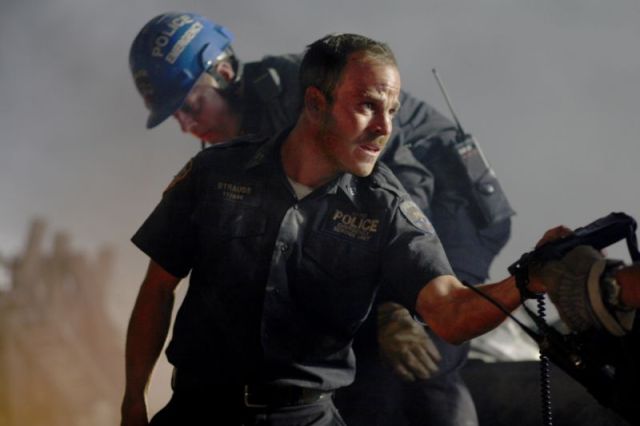 Up to this point, Stone’s movie is almost completely riveting, and the scenes in the doomed (and painstakingly recreated) WTC concourse in particular have a horrifying “I can’t believe I’m seeing this” feel to them…Unfortunately, we’re only about thirty minutes into the film. For the next ninety minutes, WTC switches back and forth between these two dying peace officers and the anxious pacing of their confused and griefsick wives, Donna McLoughlin (Maria Bello, wearing really distracting blue contacts that make her look Fremen) and a pregnant Allison Jimeno (Maggie Gyllenhaal). Alas, horror yields to hokum, and the film pretty much wallows in melodramatic platitudes for the remainder of its run. This is not to say that the rest of World Trade Center is terrible — It’s competently made and, given the human drama at stake here, even moving at times. But it’s also breathtakingly conventional, with Stone (and WTC‘s writer Andrea Berloff) pulling every single disaster-movie-tearjerker cliche out of the book by the end: flashbacks to happier times, ghostly visions of loved ones (as well as a faceless Jesus, which is the closest Stone gets to his usual obligatory shaman cameo), the kid who won’t accept the situation at face value, the musing over last words spoken, etc. (The bromides also extend to the brief and not very realistic characterizations of some of the post-collapse rescuers, which include Stephen Dorff, Frank Whaley, and Michael Shannon.)
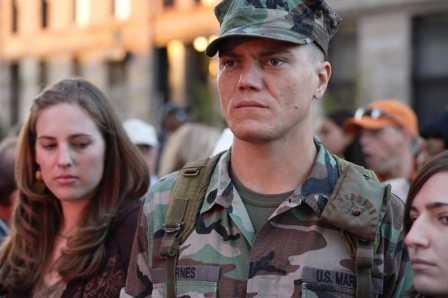 Along those lines, I don’t want to make it sound like I’m criticizing the true story of McLoughlin and Jimeno — their story is a miracle, and one of the few small beacons of cheer from that terrible morning. But, when a movie called World Trade Center ends up focusing so narrowly on these two survivors and — big spoiler, but it’s in the poster — ends with happy reunions and two families getting unexpectedly wonderful news, something seems off. Unlike United 93 which managed to recapture both the primal nightmare and unexpected heroism of that day and did so unblinkingly, without sugar-coating the fate of the fallen, WTC instead transmutes the stark emotions of 9/11 into saccharine, easy-to-swallow caplets of Hollywood sentiment. Some people may like this alchemy better, I suppose, but, in all honesty, to me it felt like an overly-sanitized cop-out (or two cops-out, in this case.) World Trade Center means well and is a decent film in every sense of the word. But the first half-hour notwithstanding, it also feels superfluous — which, given the confluence of director and material here, is somewhat surprising.
A Slacker Darkly.
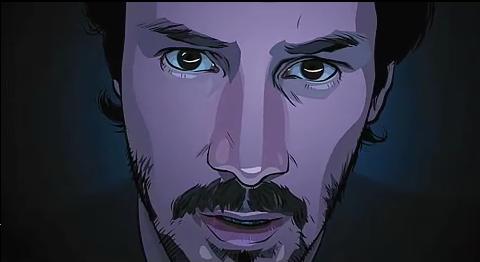
Set in the near future, Richard Linklater’s A Scanner Darkly is basically a po-mo meditation of sorts on how both technologies of surveillance and hallucinogenic drugs have warped our conception of reality, and can probably best be summed up as a meditation on the wisdom that “just because you’re paranoid doesn’t mean they’re not out to get you.” Unfortunately, while it’s both faithful to the paranoid-android feel of Philip K. Dick’s best work and undeniably unsettling for most of its run, Scanner — a movie I’ve been meaning to see for weeks — never really gets off the ground quite like it should. In short, the film lacks momentum — it feels episodic and choppy, and doesn’t manage to generate or sustain much in the way of narrative drive: Things happen, then more things happen, and then they don’t. (Since the movie is partially about a descent into schizophrenia, some may argue this was the point…but it still means the film stalls out all too often.) In short, I was entertained by Scanner for most of its run, but I also left feeling vaguely unsatisfied by it.
The film, as in the book, follows an undercover cop by the name of Fred (Keanu Reeves), whose true identity remains unknown to all of his colleagues thanks to his mercurial standard-issue “scramble suit.” Early in the film, Fred is assigned to spy on the life of one Bob Arctor, a suspected drug kingpin and trafficker of Substance D, which is a mind-bending and thoroughly addictive substance known to produce vivid hallucinations and, eventually, schizophrenia in its users. The trick is, Fred is not only a slightly-more-than-casual user of this tenacious D, he’s Bob Arctor, and has in effect been ordered to spy on himself…although the more D he takes the less aware he becomes of this ironic fact. (To quote Keanu in another film, “whoa.”)
Regardless, Fred/Arctor then spends much of the rest of the film popping D and hanging around with his girlfriend Donna (Winona Ryder) and his two bizarro roommates, amoral motormouth James Barris and hot-tempered hippie Ernie Luckman (Robert Downey Jr. and Woody Harrelson respectively, both expertly doing variations on drug-addled babble that seems, um, unrehearsed.) At first, this is rather fun, sorta like Dazed and Confused with the aggro ratched up to 11. But, ultimately, we’re left with a few too many intermittently amusing scenes of paranoid-stoner schtick, and they get to be repetitive after awhile (and are too laconic to achieve the madcap mayhem of Terry Gilliam’s more rousing and enjoyable Fear and Loathing in Las Vegas.) As a result, when the movie arrives at its big reveals near the end (which will remain scramble-suited here), I thought they seemed out of the blue and somewhat unearned. I didn’t dislike the film, and would even recommend it to a certain type of Dickian sci-fi fan. Still, I thought it was missing a certain something (what the French call I don’t know what) that would’ve made it a truly memorable experience.
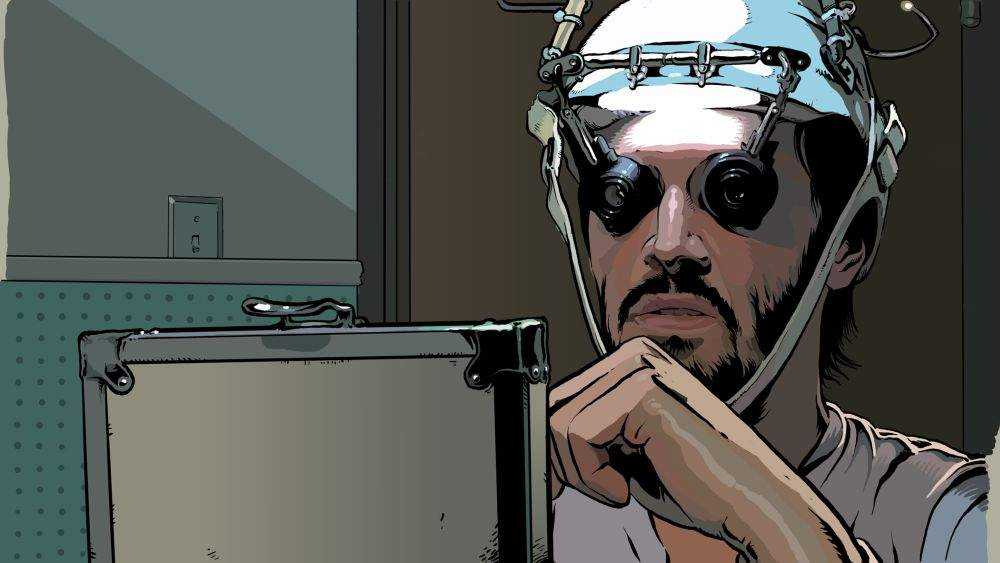
As most of y’all know (or can tell from the film stills here), one of A Scanner Darkly‘s main conceits is that it was filmed and then re-animated via interpolated rotoscoping a la Waking Life (or those “Talk to Chuck” Charles Schwab ads.) At times, the decision works wonders in giving Scanner the semblance of a fever dream, particularly whenever the creepy, hypnotic, and bizarrely off-putting scramble-suits are onscreen. Nevertheless, a few aphids and interdimensional visitors notwithstanding, the cartoon flights of fancy you might expect come less often than you’d think.
Miami Heat.
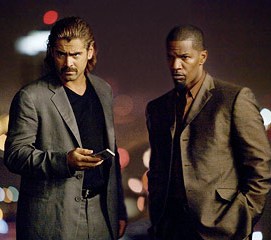 As an atmospheric and consistently engaging police procedural that’s well above the mean of this year’s tepid summer crop, Miami Vice — which I caught several days ago and haven’t had the time to write anything about — is definitely worth a look-see. The plot is wafer-thin — two tough cops go undercover with an impressive arsenal of sleek, speedy vehicles at their disposal — and at times well past implausible, but, much like the first half of Collateral, Michael Mann mostly makes up for it by layering on the captivating high-def ambience thick. If you’re a fan of Mann’s film work — Manhunter, Last of the Mohicans, The Insider, Heat, Ali, Collateral — and don’t go in expecting anything like his ’80s TV show (which I saw exactly never — when it started, I was living overseas, and I was probably too young for it anyway — in any case, this movie feels more like Mann’s short-lived Robbery Homicide Division), I think you’ll definitely find it rewarding. (Indeed, some Manniacs are raving about the film.)
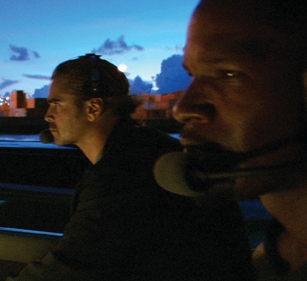 The film begins without credits and in media res, with vice detectives Sonny Crockett (Colin Farrell, rocking a grotesquely bad ‘do) and Ricardo Tubbs (Jamie Foxx) in da club, dressed to the nines, and apparently looking to break up a prostitution ring. As the scene progresses, we intuit that Messrs. Crockett & Tubbs are the no-nonsense heads of a crack Miami police unit made up of Naomie Harris (of 28 Days Later and POTC 2) and the HBO All-Stars: The Wire‘s Herc (Domenick Lombardozzi), Brenda’s boyfriend Joe on Six Feet Under (Justin Theroux), and — indirectly — Deadwood‘s Sol (John Hawkes) and Blazanov (Pasha Lynchnikoff) and Rome‘s Julius Caesar (Ciaran Hinds). But before this hardy team of television thespians can capture their quarry, a frantic call from one of Crockett & Tubbs’ regular CIs (Hawkes) eventually sets the squad on a new target: Latin American drug lord Jose Yero (John Ortiz), who appears to be using nasty Aryan Brotherhood types as muscle. Soon, Miami’s dynamic duo find themselves deep undercover without a net in Yero’s organization, only to discover that he may only be a stalking horse for even Bigger Bad Arcangel de Jesus Montoya (Luis Tosar), and his beautiful majordomo Isabella (Gong Li), whom Crockett has his eye on…
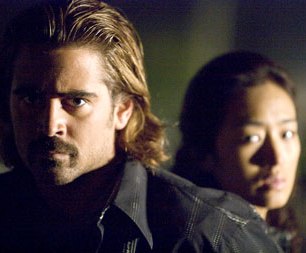 That’s the setup, but as I said, it’s basically all just an excuse for Farrell and Foxx to wear nice duds, get behind the wheels of some really fancy people-movers, and seethe, flex, canoodle, and ruminate like the typical bevy of manly Mann men. To be honest, I’m more fascinated by gritty, street-level Wire-like depictions of the drug trade than I am this sort of fast-cars-and-million-dollar-tech type stuff. But for the most part, all this ends up being more entertaining than it sounds on paper, drenched as it is in a moody atmosphere of perpetual dusk and lightning flashes on the horizon (and, as in Heat Mann can do quality shootouts like no other.) Only when Farrell and Li lose their heads and fall head over heels in love does the film really slip off the rails — Basically the movie stops cold a few times so Sonny and Isabella, the latter acting particularly out of character, can get mojitos in Havana or go salsa dancing in South Beach. (Foxx’s relationship with Naomie Harris is equally formulaic, but less time is spent on it, until a third-act rescue which feels more than a bit like well-made television.) In sum, Miami Vice isn’t the type of movie that’ll knock your socks off, but it is consistently diverting throughout. And, as a worthwhile reimagining of the TV show, it earns its place among the very few recent television-to-movie remakes worth checking out.
Moving right out of Babylon.
In a special Africa-themed edition of the movie bin, a young Scottish doctor (former faun James McAvoy) hangs with Ugandan dictator Idi Amin (Forrest Whitaker) and Gillian Anderson in the new trailer for The Last King of Scotland, potentially crooked cop Nic Vos (Tim Robbins) spurs Patrick Chamusso (Derek Luke) to rally against South African apartheid in the trailer for Phillip Noyce’s Catch a Fire (which continues the director’s move from Patriot Games-type thrillers to global-political fare such as Rabbit-Proof Fence and The Quiet American), and things go awry in Morocco for Brad Pitt and Cate Blanchett (and elsewhere for Gael Garcia Bernal and Clifton Collins Jr.) in this look at Alejandro Gonzalez Inarritu’s Babel. (Let’s hope it’s better than Inarritu’s woeful 21 Grams.)
Peevishness, Palpatine, and Parselmouth.
By way of other, more frequently updated blogs, some amusing links to wile away the hours: the Curb Your Enthusiasm soundboard [LMG], the Emperor takes an important call [DangerousMeta], and Your Own Personal Samuel [Webgoddess] Use ’em at your own risk.
Send in the Clowns.
In the movie bin, Jack Black and Kyle Gass venture to the crossroads in the new trailer for Tenacious D in The Pick of Destiny, while Sasha Baron Cohen is unleashed upon Red State America in this second look at Borat: Cultural Learnings of America for Make Benefit Glorious Nation of Kazakhstan.
The Joke’s on Heath.
It’s official (and Latino Review is 2-for-2): Heath Ledger will be suiting up as the Joker in Christopher Nolan’s sequel to Batman Begins, now called The Dark Knight. Ok, I can dig it…now, who’s Harvey Dent?