Two more minutes before my Internet time runs out and I disappear back into the ether…so, before I go, here’s the full trailer for Zack Snyder’s 300. Not as effective as — and somewhat derivative of — the grand teaser (and still no sign of McNulty or Faramir), but I’ll probably still catch it, if nothing else than to see what’s in store for The Watchmen.
Tag: Cinema
Strange what Love Does.
By way of Ed Rants and Youtube, the trailer to David Lynch’s forthcoming three-hour Inland Empire, with Laura Dern, Jeremy Irons, Justin Theroux, Grace Zabriskie, Harry Dean Stanton, and Diane Ladd (as well a gaggle of cameos, from Naomi Watts to William H. Macy and Laura Harring to Mary Steenburgen.) Strange also to see Lynch shooting on DV, but I’ll definitely give it a look-see.
Smokin’ | Hot.
In the trailer bin, a second look at Joe Carnahan’s Smokin’ Aces (or as one AICN wag dubbed it, It’s a Mad, Mad, Mad, Mad Underworld) — I actually had a pass to a screening for this last week, but ended up skipping it…Oh well. And the Shaun of the Dead team of Simon Pegg and Nick Frost get backup from Bill Nighy, Jim Broadbent, and Timothy Dalton in the full trailer for Hot Fuzz.
The Ballad of Bobby.
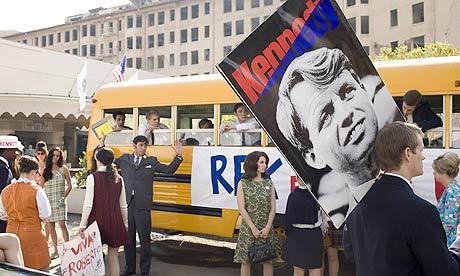
“Now that Dr. King is gone, there’s no one left but Bobby.” And, tragically, America would only have him for two more months. It’s hard to fault the sentiment behind Emilio Estevez’s Bobby, a humane, warm-hearted paean to the slain Senator, whose untimely end marked the final death rattle of hope for countless American liberals and progressives in the sixties. But, frankly, the film — while easy to sit through, to be sure — is also confused and overstuffed. It attempts to be Grand Hotel by way of RFK: Dozens of disconnected lives that intertwine one fateful night and that are ultimately bonded by their common humanity, as so eloquently articulated by Kennedy. But, however ambitious and meritorious its message and its patron saint, Bobby is a well-meaning muddle. The powerful stock footage and a few brief moments aside, a lot of the film just falls flat.
Due to its huge cast and multiplicity of stories, Bobby defies a full summation. Nevertheless, the film follows countless recognizable actors as they go about their lives at the Ambassador Hotel on June 4, 1968, the day before RFK was shot by disgruntled Palestinian Sirhan Sirhan. Among them are elder statesmen (Anthony Hopkins, Harry Belafonte), former A-listers turned B-listers (Emilio Estevez, Christian Slater), aging starlets (Sharon Stone, Demi Moore), TV standbys (Helen Hunt, David Krumholtz), likable character actors (William H. Macy, Freddy Rodriguez), strikingly attractive newcomers (Mary Elizabeth Winstead, Svetlana Metkina), and Frodo (playing, for all intent and purposes, Frodo.) Almost all of the performances are solid and likable (with the notable exception of Ashton Kutcher as a drug dealer — it’s unbelievable how a guy who’s made his living playing a stoner for years is so thoroughly implausible at it — he’s like a kid in a school play.) But there’s a lot of unnecessary overlap or what comes across as extraneous filler in these tales. Two separate stories (Wood and Lindsay Lohan’s quickie marriage, Shia La Boeuf and Brian Geraghty’s day off) cover basically the same ground about Vietnam. Hopkins, Belafonte, Moore, and Stone all talk about the indignities of growing old, while Stone, Macy, Moore, Estevez, Hunt, and Martin Sheen all lament failing marriages…but to what purpose? What, really, does all this have to do with RFK? I get it — it’s about shared humanity. But Bobby tries to do too much in the time given, and would’ve been more effective, I think, if it’d had been pared down some.
The most resonant parts of Bobby are the storylines involving Kennedy campaign workers (Joshua Jackson, Nick Cannon) and, most notably, the simmering racial tension among the kitchen staff (Freddy Rodriguez, Jacob Vargas, Lawrence Fishburne). The latter tale is particularly interesting — despite Slater being stuck as a cartoon “racist but a real person too” barely this side of Matt Dillon in Crash — since it highlights the concerns and aspirations of Latino immigrants, who are often completely neglected in movies dwelling on race in America (even in otherwise sterling shows like The Wire.) But, even here, it’s ultimately played too broadly: What we’re left with are “life is a blueberry cobbler” metaphors and monologues about King Arthur that’ll just make you wince. The problems with the movie can be summed up by the footage used of Bobby at the Ambassador Hotel — obviously powerful stuff. Unfortunately, it’s overlaid with Simon & Garfunkel’s “The Sound of Silence,” which even without the obvious Graduate overtones is entirely too broad a pick — It detracts from rather than enhances the already potent archival footage.
 Still, I don’t want to suggest that I’m completely hating on Bobby. For all its ham-handedness, I enjoyed the experience, and I sat there with a smile on my face through most of the film. And I do applaud Estevez’s obviously strong admiration for Senator Kennedy. I was recently on a date where discussion arose as to whether things would’ve been different if Bobby had lived. She thought not, or rather that it’d be impossible to tell. I’m more inclined to agree with Michael Sandel, who wrote that: “Had he lived, he might have set progressive politics on a new, more successful course. In the decades since his death, the Democratic Party has failed to recover the moral energy and bold public purpose to which RFK gave voice.” Regardless, as with Dr. King, we shouldn’t even have to ask this question. Both men who were continuing to grow and develop, Dr. King and Bobby were tragically ripped from us before their time, a back-to-back blow in an already miserable year that felled progressive ambition in America for decades. I have to think that our nation would be a brighter, happier, and more compassionate place in the years since if we could have continued to benefit from their leadership and counsel.
Since we cannot, we can only honor their examples and remember their words. In the end, Bobby could’ve been a much worse movie than it in fact is, and I still would give it credit for reminding us of Senator Kennedy’s essential creed: “But we can perhaps remember — even if only for a time –that those who live with us are our brothers; that they share with us the same short moment of life; that they seek — as we do — nothing but the chance to live out their lives in purpose and happiness, winning what satisfaction and fulfillment they can.”
Venomous Veil.
I’m talking about the man in the mirror…Two new posters for Sam Raimi’s Spiderman 3 make it online, showcasing the Spidey-Venom duality.
Goldengrove Unleaving.
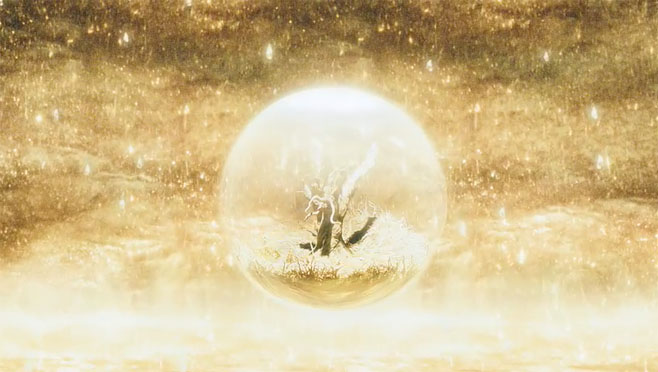
Admirably ambitious and running the emotional gamut from syrupy to sublime, Darren Aronofsky’s The Fountain is a resolutely uncommercial big-think sci-fi piece that I expect will strongly divide audiences. (My guess is, you’ll either love the film or turn on it in the first half-hour.) I found it a bit broad at times, particularly in the early going, and I definitely had to make a conscious decision to run with it. That being said, I thought The Fountain ultimately pays considerable dividends as a stylish, imaginative, and melancholy celebration of the inexorable cycle of life, from birth to death ad infinitum. In its reach, The Fountain at times suggests 2001, and even if that reach probably exceeds its grasp by the end, it should still be applauded for so fearlessly tackling such heady themes, box office be damned. And if nothing else, The Fountain will not only make you contemplate the meaning of it all, but contains several haunting images, like scraps of a fever dream, that will resonate long after the movie’s over. All in all, not bad for ten bucks.
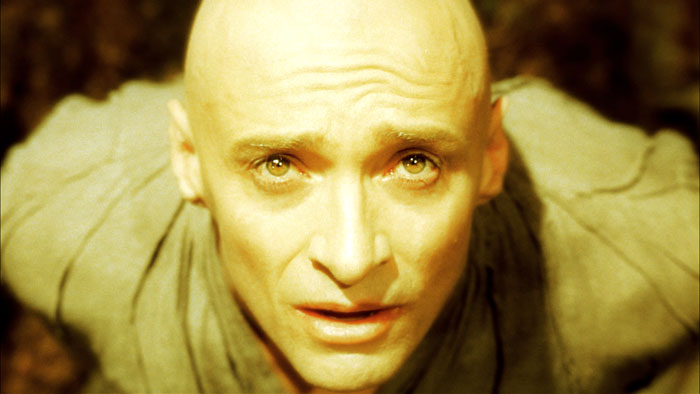
Like Requiem for a Dream and especially Pi, The Fountain is more about mood than plot, per se. Nevertheless, we begin in the sixteenth century, with a scruffy conquistador (Hugh Jackman, having a banner year) paying respects to what appears to be his beloved (Rachel Weisz) before embarking on a suicide mission against a Mayan temple. Before we’re fully acclimated to what’s going on, we’ve leapt to the twenty-sixth century (No, no Twiki), where that conquistador is now a bald, tattooed, Tai Chi practicing monk, traveling across the cosmos with an ailing tree and suffering visions from an age long hence. After a few bewildering minutes here, we find ourselves in our present, where neuroscientist Tom Creo (Jackman) is struggling against time to develop a cure for his wife Izzy (Weisz), before she succumbs to a brain tumor. As The Fountain progresses and we switch back and forth through these three timelines, a picture slowly coalesces of a man-out-of-time (no, not him either), determined beyond all bounds of hope or reason to defeat death and defend his one, true love from its thrall.
In all honesty, The Fountain suffers from some clunky moments in the early going, particularly when Weisz is forced to deliver exposition regarding Mayan beliefs about the Tree of Life, Xibalba (the Mayan underworld), and the Orion Nebula. And some, such as former Slate writer David Edelstein, couldn’t seem to get past the Clint Mansell score, which — as in Pi and Requiem — is hypnotic-bordering-on-intrusive. But, once you get past the somewhat unwieldy set-up, I found the movie’s themes considerably more sophisticated and less banal than most reviewers are giving it credit for. The romance here is pushed front-and-center, sure, but I found The Fountain moving less as a simple love-conquers-all tale than as an eloquent Zen meditation on mortality. (As one character puts it in the film, “Death is the road to awe.”) If matter is neither created nor destroyed, then, in a way, we are all immortal — the elements that make us up were around since the Big Bang and will continue to be around, reconstituted in other forms, long after we’re dead (“in the stars above, in the tall grass, and the ones we love,” to paraphrase a poet when he contemplated a similar plight to Jackman’s.) Indeed, in this fashion, each of us — made up of a combination of matter that, however briefly, has achieved sentience — is the universe trying to express itself. That is no small thing.
Moreover, in The Fountain (and akin to Jacob’s Ladder), Jackman’s character ultimately isn’t fighting to save his love as much as fighting his fear and despair over loss, not only of Weisz but of himself, his own ego: in short, his fear of death. As Weisz’s character says several times over, “I’m not afraid anymore.…Finish it.” Jackman’s Creo is afraid, so he won’t or can’t. “Without accepting the fact that everything changes, we cannot find perfect composure,” writes Shunryu Suzuki in Zen Mind, Beginner’s Mind. “But unfortunately, although it is true, it is difficult for us to accept it. Because we cannot accept the truth of transiency, we suffer.” To my mind, this suffering, and the overcoming of it, lies at the heart of Aronofsky’s The Fountain. I thought the richness of both its vision and its ideas helps it elide over a lot of the pacing and exposition problems in the early going. So, in sum, go see The Fountain: I’m not sure you’ll like it — it’s very possible you’ll love it — but I’m willing to bet, either way, that it’ll stick with you.
[One addendum/caveat/boast: As it happens, I saw The Fountain Monday night at a very private screening/cocktail affair. (How’d I get in? Long story…basically, Aronofsky and I have a mutual friend.) I’ve admitted earlier to being an inveterate celebrity hound, and in terms of celeb-spotting this was manna from Heaven. Of maybe 40-50 attendees, 10-15 were instantly recognizable folk: Not only Aronofsky, Jackman, Weisz, and Ellen Burstyn (also in the film), but a gaggle of other high-profile celebs: Bowie(!), Lou Reed, Mike Myers, Iman, Helena Christiansen, Ben Chaplin, Elizabeth Berkeley, etc. So, I’m almost positive I’d have liked and recommended The Fountain regardless, but I’m forced to admit (re: would like to brag) that I saw it under more-than-ideal circumstances. (Yes, I played it cool despite being famestruck, but I’d be lying if every so often in the first half-hour of the film I found myself thinking “Am I really sharing an armrest with Famke Janssen right now? How bizarre.” Not very Zen of me, I know, but sometimes I’m just a material guy.)]
A Cold Day in the Park.
The Hobbit Nazguled?
“This outcome is not what we anticipated or wanted, but neither do we see any positive value in bitterness and rancor. We now have no choice but to let the idea of a film of The Hobbit go and move forward with other projects…We got to go there – but not back again…” In an e-mail to The One Ring, PJ and Fran say they’re off The Hobbit due to outstanding and unresolved matters regarding their lawsuit against New Line, who want to move on the project now before they lose the rights. MGM (who owns the distribution rights) says it ain’t over yet, but, my, it’s not looking good.
Call to Order.
Ready for another year at Hogwarts? The new teaser for Harry Potter and the Order of the Phoenix which I mentioned on Friday is now online.
Fragile Bond.
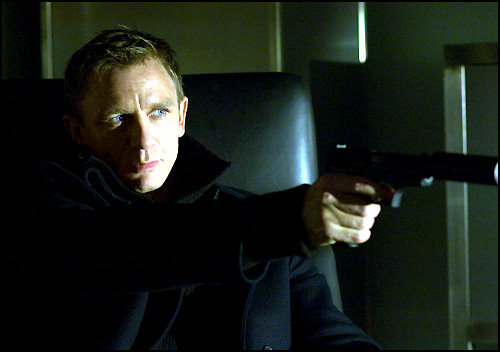
To be honest, I’ve never been a huge fan of Bond movies, since, however good the Connery (and Lazenby) years were, the James Bond franchise has been in a state of ignominious disrepair for, lo, decades now. From the heights of Goldfinger and On Her Majesty’s Secret Service, Bond films long ago lapsed into self-parody, and became less about hard-edged cloak-and-dagger supersleuthing and more about rinky-dink deus-ex-machina gadgetry and ribald puns aimed at teenagers. (Ok, some of the early Moore flicks are decent, such as The Man with the Golden Gun, and I remember liking Moonraker, For Your Eyes Only and A View to a Kill when I was a kid. But having seen FYEO again recently, kids were pretty much their target audience by then.) So, I’m happy to say that Casino Royale, a.k.a. Bond Begins, is one of the best Bond movies in decades, easily eclipsing any of the abysmal Timothy Dalton or Pierce Brosnan flicks. What’s more, there’s nary an explosive ballpoint pen or invisible car in sight. Instead, Bond’s gotten back to basics: Casino Royale is the first Bond film in ages driven by character rather than stereotype. It’s like meeting England’s most famous spy all over again.
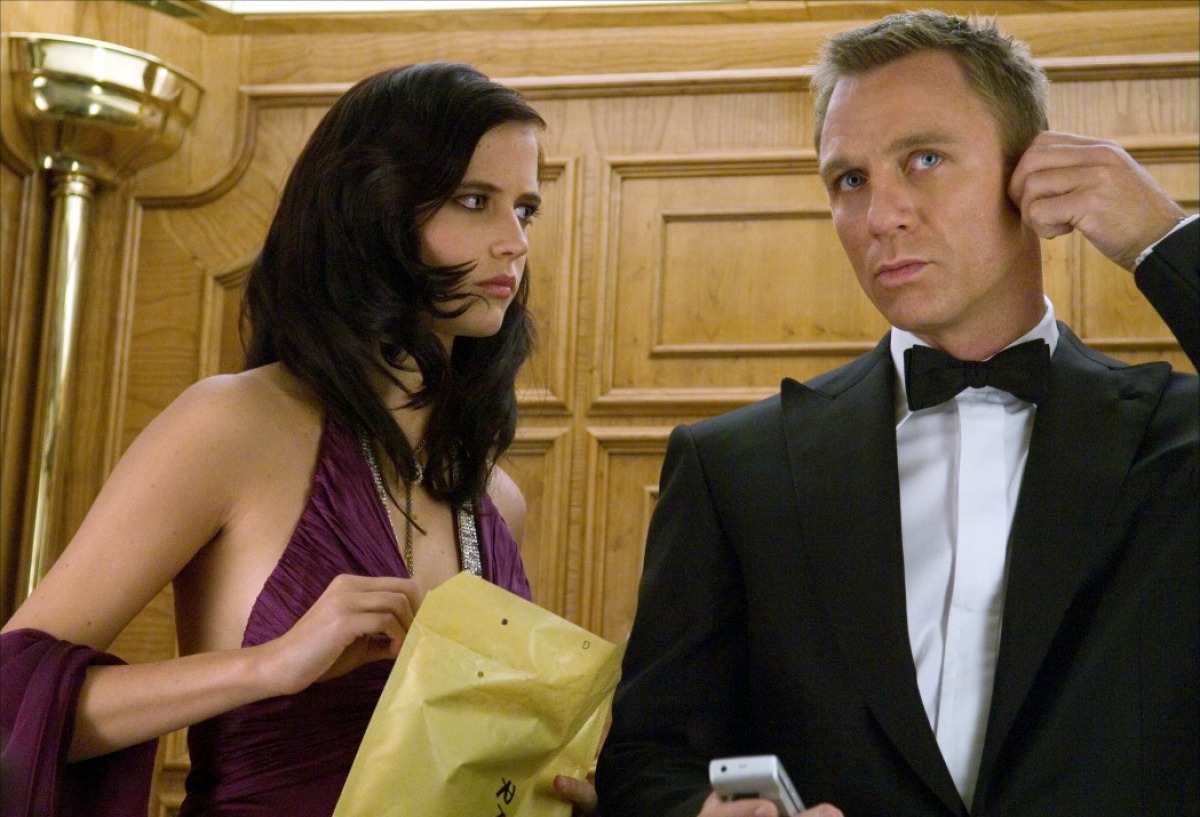
Not to say this isn’t a Bond film. Within the first ten minutes we’ve already traveled to Prague, Uganda, and Madagascar to witness various scenes of espionage and intrigue. And, however realistic Casino Royale is to the usual Bond drek (Tomorrow Never Dies, The World is Not Enough, etc. etc.), it’s still set in the Bond-verse, where guns go “click” at exceedingly appropriate times and choice parking spaces are always available in front of scenic villas and vistas. Nevertheless, Casino Royale plays it downbeat more than most — Here, the recently minted 00, with the aid of beautiful accountant Vesper Lynd (Eva Green), must defeat the sinister LeChiffre (a memorable Mads Mikkelsen), a financier of terrorism in over his head, in a high-stakes game of Texas Hold ‘Em (?!) in Montenegro. (The switch from baccarat to poker is, alas, a mistake — For one, you half-expect Bond to be playing paunchy guys wearing ironic trucker hats, not tuxedo’ed supervillains. For another, the poker hands get increasingly ridiculous. I don’t want to give the game away, but it doesn’t speak to Bond’s savvy as a poker player to have him win with the hands he’s given.)
Still, Casino Royale succeeds in no small part because of Daniel Craig’s fine, layered perfomance as 007. Unlike the cartoon Bond of Moore-through-Brosnan, Bond here actually seems something close to a human being. As Craig plays him, he’s an arrogant bruiser with a ruthless streak, a guy — unlike any Bond since Connery — you could actually see bedding someone one minute and killing them the next. (Exhibit A: The scene with the knife, after the bad beat. Have we ever seen Bond this murderous?) Moreover, Bond not only endures here some of the agonies regularly inflicted on him in the books (but rarely in the movies), he also is given compelling reason (in an admittedly slow-paced third act) for his later remorseless womanizing, as following the book and its memorable last line. I’ve written before that I’d rather see another Bourne than another Bond. Well, with Craig at the wheel of Bond’s Aston Martin, I hereby rescind that statement…Welcome back, 007. (I’ll admit to being partial to Craig, tho’ — not only for Layer Cake, but because the world’s long past due for a blonde-haired, blue-eyed Bond. Our kind hasn’t exhibited this sort of badassery on film since poor Steve McQueen died and Newman/Redford got old. Ok, you could make a case for Tyler Durden, but generally we’ve been relegated to Zabka-ness for the past three decades.)