
It’s a good day for a change.
Haunting the Web Since 1999

It’s a good day for a change.
“‘I’m here tonight to say a few words about an American hero I have come to know very well and admire very much — Sen. John McCain. And then, according to the rules agreed to by both parties, John will have approximately 30 seconds to make a rebuttal.'” Now here’s a prez worth hugging…On the eve of his inauguration, Sen. Obama publicly makes nice with his former adversary, John McCain.
And, apparently it’s not just for show: According to the NYT, the president-elect has been trying to forge a bond with McCain (and his No. 2, Lindsey Graham) since soon after the election. “Mr. Obama arrived for their Chicago meeting on Nov. 16 with several well-researched proposals to collaborate on involving some of Mr. McCain’s favorite causes, including a commission to cut ‘corporate welfare,’ curbing waste in military procurement and an overhaul of immigration rules.“
Hey, rapprochement is good, bipartisanship is good. And working Senators McCain and Graham (and, I’d presume Maine’s moderates, Snowe and Collins) is simply smart politics. Still, when push inevitably comes to shove on Iraq, health care, and a host of other issues, hopefully the president-elect will remember to dance with who brung him.

Given what little I know about what’s going on, that’s basically my view of it as well. On the one hand, Israel is responding to an untenable security situation — Hamas rockets being fired into neighborhoods and cities — that we wouldn’t tolerate for a second. (In fact, we invaded Iraq on a much flimsier security pretext.) Still, it’s hard to shake the feeling that Israel is trying to run the table right here right now, in the twilight moments of the Dubya presidency, because they know they have carte blanche from 43 to do what they will. And I suspect this particular neocon-run advance, like all the rest of ’em in recent years, is doomed to failure — if anything, I’d wager, it’s just swelling the ranks (and the coffers) of Hamas.
Regardless, the Obama administration and Secretary of State Clinton are going to have their work cut out for them. I’m not one who believes particularly that conflicts with roots in millennia-long religious strife can get “solved” in one or two US presidential terms. But let’s at least hope, under their watch, we can start to achieve the type of broader range of discussion about the Israeli-Palestinian conflict that you can find in…say, Israel. It’s both embarrassing and extremely counterproductive for our nation to be seen — and to continually be used — as a knee-jerk diplomatic dupe that will always blindly support policies initiated by the most conservative factions in Israeli politics.
Two recent and choice Columbia-related links by way of Ted at The Late Adopter:
“Lincoln is important to us not because of his melancholia or how he chose his cabinet but because of his role in the vast human drama of emancipation and what his life tells us about slavery’s enduring legacy…In the wake of the 2008 election and on the eve of an inaugural address with ‘a new birth of freedom,’ a phrase borrowed from the Gettysburg Address, as its theme, the Lincoln we should remember is the politician whose greatness lay in his capacity for growth.” In The Nation and on the 200th anniversary of Lincoln’s birth, Eric Foner evaluates the continuing legacy of the 16th president.
“Economic orthodoxy — which gave high priority to balanced budgets and fiscal restraint — remained a powerful force in the 1930s, even as its limitations became increasingly obvious. Similar arguments can still be heard today…The New Deal was least successful when it was least aggressive–when it let concerns about fiscal prudence override the urgent need to pump enormous sums of money into a moribund economy.” And, over in TNR, Alan Brinkley notes what the Obama administration can learn from the New Deal.
Update: “Most Americans, I suspect, if asked whether they would prefer a president with strong principles or one who prefers pragmatic politics, would choose an idealist over a realist in a flash. But almost all successful politicians combine principle with pragmatism constantly.” In a TNR piece that ties the two above together quite well, Prof. Brinkley speculates on the fatal flaw in Dubya’s make-up: certitude. “For whatever reasons…Bush has seemed to be comfortable only when he could make quick and firm decisions, however complicated the issue, and then move on. Admitting mistakes or changing course seems almost contrary to his nature.“
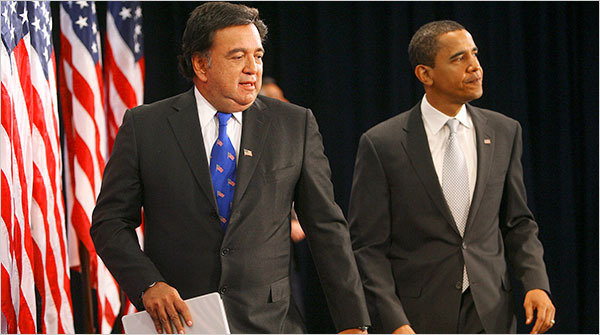
In the latest round of pre-inaugural musical chairs, Virginia governor Tim Kaine is new head of the DNC, former Clinton chief of staff Leon Panetta is in at CIA…
…and Governor Bill Richardson is out at Commerce. “‘Given the gravity of the economic situation the nation is facing,’ the governor said, ‘I could not in good conscience ask the president-elect to delay for one day the important work that needs to be done.’” [Official Statements.] Um, ok…but how has the situation on the ground changed in the past month or so? It doesn’t seem like this investigation into a possible pay-to-play deal in New Mexico snuck up on anyone, and, at least according to Mother Jones, Richardson may have a history of this potentially sordid behavior. One would think Gov. Richardson could have rejected the offer of Commerce when it was first presented to him, not so very long ago.
At any rate, with Richardson now looking suspect, that means two of our 2008 Dem Final Four — the other, of course, being John Edwards — were harboring potential general-election-killing scandals that they didn’t see fit to tell anyone about. (That number rises to two and a half if you count the recent brouhaha involving developer Robert Congel and the Clinton foundation, but that one sounds iffier to me, in part because Congel donated money well after the potential favors were bestowed.) Really, what’s wrong with these people? Is it too much to ask that these so-called statesmen take their own shadiness into account before playing dice with our future?
Well, one would hope this and Blagojevich’s recent antics will further press on our party the need for comprehensive lobbying, ethics, and campaign finance reform, and soon. These may be state-level scandals, but they’re also indicators of a broken system that’s awash in — and often only responds to — money. And, now that we’ll soon be running both ends of Pennsylvania Ave. again, the last thing we need is to follow the GOP down their low road of avarice and ignominy.
“We hope the new vice president will not reverse his commitment to the Senate’s constitutional authority.” Uh, the new one? What about the old one? First it was Karl Rove discovering the virtues of executive transparency. Now the walrus and the carpenter of Dubya apparachiks, Johns “Bomb Iran” Bolton and “Torture at will” Yoo respectively, actually have the temerity to sing the praises of congressional oversight in foreign policy. “If Mr. Obama were to submit either of these agreements for approval by a simple majority of the House and Senate, his actions would pose a serious challenge to American principles of law and democratic governance.” Oh, a “serious challenge” to law and democracy, eh? These assholes have no shame.
“‘An automated rendezvous does all sorts of things for your missile accuracy and anti-satellite programs,’ said John Sheldon, a visiting professor of advanced air and space studies at Maxwell Air Force Base in Alabama. ‘The manned effort is about prestige, but it’s also a good way of testing technologies that have defense applications.‘” In order to keep pace with the increasingly proficient Chinese space program, President-elect Obama may be considering retying NASA to the Pentagon, “because military rockets may be cheaper and ready sooner than the space agency’s planned launch vehicle, which isn’t slated to fly until 2015…Obama has said the Pentagon’s space program — which spent about $22 billion in fiscal year 2008, almost a third more than NASA’s budget — could be tapped to speed the civilian agency toward its goals as the recession pressures federal spending.”
Hmm. On one hand, I would think making NASA yet another fiefdom of the Pentagon would greatly facilitate its ability to lock down the funding it needs for various exploratory endeavors, recession or no. And if the types of conveyance vehicles NASA needs are basically sitting around gathering dust in some Pentagon-owned warehouse next to the ark of the covenant, well then it only makes sense to combine the two programs. No need to reinvent the, uh, rocket.
On the other hand, putting the brass in charge is probably going to have deleterious effects on the types of projects NASA pursues in the future. And, in a perfect world, there’s something to be said for having a civilian space program completely outside the purview of the military. In fact, now that i think about it, won’t combining the Pentagon and NASA space programs cut back on the types of international cooperation that have guided our efforts in space in recent years? Given the current economic climate, I guess this is the best way for NASA to continue pursuing its goals in the short term. Still, there could well be trouble ahead.
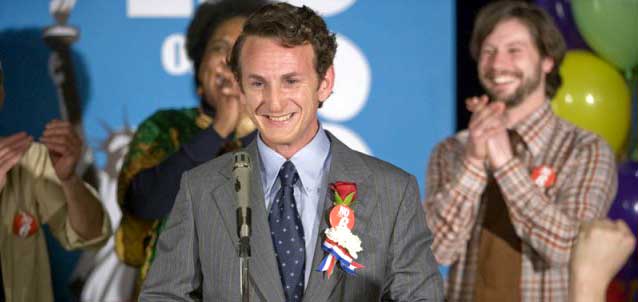
“My name is Harvey Milk, and I want to recruit you.” So began the oft-repeated speel of the San Francisco city supervisor and “Mayor of Castro Street,” who, in 1977 and after several attempts, became the first openly gay official elected to office in the US. But, seven years before those heady days, Milk (Sean Penn) was just a 40-year-old insurance man (and Republican, even), living a closeted life of quiet desperation in NYC. After a chance encounter and illicit proposition becomes an impromptu birthday party, Milk and new beau Scott Smith (James Franco) fall in love, talk about starting over, and decide to go West. Life is peaceful there…or is it? Even as Milk’s camera shop in the gay-friendly Castro district becomes a salon of artists, thinkers, and free spirits, bigotry is rampant even in the streets of San Francisco, and the cops at best turn a blind eye to — and at worst actively participate in — antigay violence. No more, says Milk. Taking a page from the ethnic political machines of an earlier century, he organizes Castro’s gays and lesbians into first a protest movement and then an organized voting and boycotting bloc. And when a redistricting plan emphasizing community self-rule in San Francisco is put into effect, Milk becomes an actual, legitimate political wheeler-and-dealer, with all the benefits and aggravations attending. (For more on the man and the movement, see the 1984 documentary The Times of Harvey Milk, now on Hulu for free.)
But, even as Harvey Milk rises to power in San Fran, a parallel movement stirs amid the churches and suburbs of Orange County. Led by former beauty queen, singer, and orange juice shiller Anita Bryant, the ever-so-Christian “Save Our Children” campaign gathers steam across the nation in its quest to roll back what meager protections gays and lesbians have managed to establish over the years. And when conservative state senator John Briggs (Denis O’Hare, seemingly forever destined to play assholes) brings the fight west in the form of Proposition 6, an initiative that would ban gays and lesbians from public schools, the battle for California is on. And even as Milk becomes the poster boy against Prop 6 and for recognizing gays and lesbians as full citizens and fellow human beings, he has to contend with trouble on the homefront — not only in his personal life (his new boyfriend Jack (Diego Luna) is more than a little erratic) but in his political backyard, where supervisor Dan White (Josh Brolin), from the Catholic, working-class district next door, is starting to act increasingly unstable. (But, I guess this is what happens when society is so permissive as to let a man get all hopped up on twinkies.)
Which reminds me: A word of appreciation for Josh Brolin’s work here. Sean Penn is garnering kudos across the board, and a likely Oscar nod, for his portrayal of Milk, and they’re very well-deserved. It’s really an astonishing transformation Penn accomplishes here — not so much because he’s playing someone who’s gay (homosexual), but because he’s playing someone who’s gay (happy).This is the same guy who sulked through Mystic River?) And, while Brolin will likely — and, imho, justifiably in the end — get edged out for Best Supporting Actor by Heath Ledger for The Dark Knight, his work here suggests he’s got some serious chops. At first it seems as if Brolin will just be coasting on his recent Dubya impression — another good-natured, hard-hearted conservative fratboy for the resume. Then, just as you think Brolin’s endangering himself in terms of typecasting, it’s suggested Dan White might also be a deeply repressed closet case. (I tend to find the argument that all frothing-at-the-mouth homophobes are in reality trapped in the closet to be too simplistic by half, but apparently there’s some grounding for it in White’s story. In any case, Brolin underplays it beautifully ) As Milk progresses, we begin to sense other reasons why White is such a strange and ultimately homicidal bird — he’s envious of Harvey, he feels personally screwed over by him, he’s something of a friendless wonder, he’s not the brightest bulb on the tree anyway, he feels trapped by, and powerless before, the authority figures in his life (his wife, his cop buddies, his church). Brolin lets all of this play out without tipping his hand in any one direction. It’s a subtle, complex, and very worthwhile performance, and it’s a testament to the film’s heart that it extends such empathy even to its ostensible antagonist.
Speaking of empathy, this isn’t at all a surprise coming from Gus Van Sant, always a very humanistic director, but it should be noted regardless: When it comes to full recognition of gays and lesbians, Milk laudably practices what it preaches. Jonathan Demme’s Philadelphia was good for its time, but nowadays (it’s on heavy rotation on AMC) it gives off a distinctly Guess Who’s Coming to Dinner? vibe. And, as I said when it came out, Ang Lee’s Brokeback Mountain often seemed “as somber, restrained, and delicate as Kabuki theater.” By contrast, the couples of Milk are passionate — both physically and emotionally — messy, flawed, and alive. Of course, there have been other well-rounded depictions of gays and lesbians in film in the past — in Van Sant’s earlier work, in the films of other gay directors like Todd Haynes, John Cameron Mitchell, and Kimberly Peirce, and in countless others. Still, Milk feels like an event of sorts. Unlike many of its forebears, it’s a mainstream Oscar-caliber movie that just takes its characters’ sexuality at face value and without apology. In that sense, it feels like a film whose time has come.
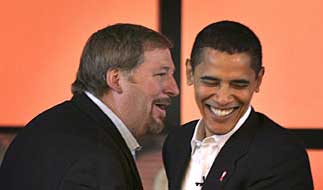
Which brings us to that Wal-Mart of spirituality, Rick Warren, who as you all know will be delivering the invocation at Obama’s inauguration this month, and who has said all manner of intemperate things about gays and lesbians (as well as jews, pro-choice voters, and others) in the past, even going so far as to campaign for Prop 8 in California two months ago.
Now, when the Rick Warren pick first came out, I didn’t say anything here for two reasons. One was deeply selfish: That was the week I was finishing up my speechwriting app, and it didn’t seem like the most opportune time to be too critical of the administration around here at GitM. (In the end, it didn’t matter anyway, of course.) More importantly, though, I am — and still partly remain — of the mind that the bigger picture needs to be kept in mind here. If it keeps the right-wing fundies relatively happy and docile, and helps them to buy into the notion of a post-partisan Obama presidency, then Rick Warren can give all the one minute ceremonial speeches he wants, so long as Obama ultimately shows himself a friend to gay and lesbian rights in his presidential actions.
But, there’s a sequence in Milk that brought me around a bit. When Dan White mentions the “issue” of gay rights in one crucial scene, Harvey replies: “These are not issues, Dan. These are our lives we’re fighting for.” And, put that way, the calculus changes. To straight progressive folk such as myself, one can easily — too easily — get to thinking of gay rights as an “issue” among many. But, for gays and lesbians all around the country, this is their lives. And, when considered thusly, the president of these United States — least of all a president who ran and won on a campaign of hope — should not be legitimizing bigotry, such as that continuously expressed by Warren without apology, in any kind of forum, let alone the most portentous and culturally significant inauguration in at least fifty years, perhaps ever.
In an eloquent column last week, the NYT‘s Frank Rich articulated basically where I stand on Obama’s decision at this point: His choice of Warren is “no Bay of Pigs. But it does add an asterisk to the joyous inaugural of our first black president. It’s bizarre that Obama, of all people, would allow himself to be on the wrong side of this history.” Let’s hope that Obama doesn’t follow in the footsteps of the last Democratic president, who very quickly started backpedaling on gay rights once in office, vis a vis “Don’t Ask, Don’t Tell.” And, while I’m sure he’s pretty busy these days, the president-elect (apparently a movie buff of sorts) could do worse than spend a few hours to reflect on the story of another community-organizer who believed in the transformative power of hope, who carried the hopes of his constitutents into higher office…and who faced unflinching and unwavering contempt from an irreconcilable opposition once he got there.
“The good news is that, seven years after the Sept. 11 attacks and nearly three years after the resumption of full-scale war with the Taliban, we are finally beginning to formulate a strategy — and we have officers in place who think strategically. As history shows, however, smart generals and shrewd strategists don’t necessarily yield victory — especially in Afghanistan.”
As the incoming administration correctly looks to reprioritize Afghanistan, Fred Kaplan summarizes the current situation in our “other” war, and the potential pitfalls ahead. “[T]here is a paradox: More U.S. troops are needed to provide security to the Afghan people; but these troops may, at the same time, fuel the insurgency — which will require more troops, and on the cycle goes.”
So, can you guess who TIME’s Person of the Year for 2008 turned out to be?
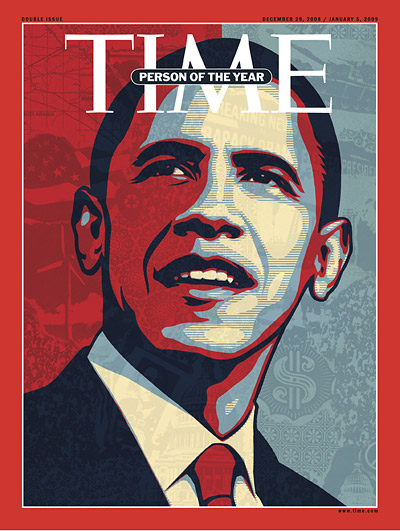
Not a huge surprise of course. Regardless, in honor of the occasion, and since now seems as good a time as any to fire up the 2008-in-retrospect train, below are some of the longer GitM essays on President-elect Obama over the past year and change. (And if you’re really a glutton for punishment, and want to relive all the debate coverage or somesuch, there’s always the election 2008 archives.)