Blue Sky Mining.

“One of the bill’s co-sponsors, Rep. Edward J. Markey (D-Mass.), said: ‘The American people wanted change in our energy and climate policy. And this is the change that the people are overwhelmingly asking for.’ He called it ‘the most important energy and environment bill in the history of our country.‘” After much wrangling and a half-hearted GOP attempt at filibuster (which is only a prerogative of the Senate), the House passes the Waxman-Markey climate bill, 219-212. (Eight Republicans voted for it, 44 Dems opposed.) The “cap-and-trade” bill “would establish national limits on greenhouse gases, create a complex trading system for emission permits and provide incentives to alter how individuals and corporations use energy.” [Key provisions.]

There is some concern that the bill has been watered down too much out of political necessity: “While the bill’s targets may seem dramatic, they are in fact less than what the science tells us is required to avoid catastrophic warming. The 2020 target in particular is far too weak and quite easy and cheap for the country to meet with efficiency, conservation, renewables and fuel-switching from coal to natural gas.

Still, environmentalists remain hopeful. “It is worth noting that the original Clean Air Act — first passed in 1963 — also didn’t do enough and was subsequently strengthened many times.” And, while the bill — which (sigh) gives away 85% of the new emission allowances (the heart of the “cap-and-trade” market hopefully soon to emerge) to interested parties — looks to “set off a lobbying feeding frenzy,” groups like the NRDC seem to agree that “[t]his is the best bill that can actually get through committee.”

Of course, now the bill has to get through the Senate, where the usual lions lie in wait. “”Senator Inhofe of Oklahoma said ‘It doesn’t matter,’ he declared flatly, ‘because we’ll kill it in the Senate anyway.'” And even some Dems are fatalistic about its prospects. “Mississippi Rep. Gene Taylor (D) voted against the measure that he says will die in the Senate. ‘A lot of people walked the plank on a bill that will never become law,’ Taylor told The Hill after the gavel came down.” Looks like Sen. Reid has his work cut out for him.
Forty Years and Counting.

“The cultural climate is far different today, besides. Now, roughly 75 percent of Americans support an end to Don’t Ask, and gay issues are no longer a third rail in American politics. Gay civil rights history is moving faster in the country, including on the once-theoretical front of same-sex marriage, than it is in Washington. If the country needs any Defense of Marriage Act at this point, it would be to defend heterosexual marriage from the right-wing ‘family values’ trinity of Sanford, Ensign and Vitter.”

The NYT’s Frank Rich reflects on the gay rights movement on the 40th anniversary of Stonewall. “No president possesses that magic wand, but Obama’s inaction on gay civil rights is striking. So is his utterly uncharacteristic inarticulateness…It’s a press cliche that ‘gay supporters’ are disappointed with Obama, but we should all be.

The Serpent on the Staff.

“As a society, we trust doctors to be more concerned with the pulse of their patients than the pulse of commerce. Yet the American Medical Association is using that trust to try to block a robust public insurance option as part of health reform. In fact the A.M.A. now represents only 19 percent of practicing physicians…Its membership has declined in part because of its embarrassing historical record: the A.M.A. supported segregation, opposed President Harry Truman’s plans for national health insurance, backed tobacco, denounced Medicare and opposed President Bill Clinton’s health reform plan.

And don’t forget Sheppard-Towner: In his column this week, Nicholas Kristof take aim at the powerful American Medical Association. “‘They’ve always been on the wrong side of things,’ Dr. Scheiner told me, speaking of the A.M.A. ‘They may be protecting their interests, but they’re not protecting the interests of the American public.‘”

A Brooklyn Scorcher.

“It’s worth remembering how Vincent Canby began his review on June 30, 1989, in the New York Times: ‘In all of the earnest, solemn, humorless discussions about the social and political implications of Spike Lee’s Do the Right Thing, an essential fact tends to be overlooked: it is one terrific movie.’

In The Root, Henry Louis Gates reflects on the 20th anniversary of Do the Right Thing, and checks in with Spike Lee on the film. “None of us back then could possibly have imagined all that has transpired for our people, and for this country, in the intervening two decades: a black prince and princess so elegantly sitting up in the White House, and their very first date was in a movie theater in 1989, watching–what else? Do the Right Thing.

Hoop Dreams in the District.

“The games are fluid. There’s a good energy on the court. People talk on defense. When Salazar finally gets in, it’s obvious he is actually pretty athletic, and he has a lot of hustle. He’s not easy to cover. Someone yells, ‘Who’s got Secretary?’” By way of a college friend, ESPN looks at Pres. Obama’s “Power Game,” and the ensuing newfound popularity of hoops in DC. (Apparently, in the Big Game, they don’t call fouls, but rather chalk them up as “enhanced defensive techniques necessary to Keep Our Lane Safe.” [Rimshot] Thanks, I’ll be here all week, be sure to tip your waiters.)

Anyway, the last time I lived in DC it was generally pretty easy to find a court on a weekend — We usually set up shop on either end of Adams-Morgan (or later, after I moved to VA, right down by the King Street metro), and the other folks playing/waiting to play were locals of some variety, not just aspiring politicos. I did occasionally play in one “power game” of sorts back then, which involved a number of folks from a liberal-minded journal of some repute. It was probably the most Type-A athletic endeavor I’ve ever been involved in, and that’s coming from a guy who played high school sports in the South and spent four years among Ivy League rowers. With all due respect, I prefer the random pick-up games, I think.

Tehran v. Twitter.

“‘The Iranian government must understand that the world is watching,’ Obama said in a written statement. ‘We call on the Iranian government to stop all violent and unjust actions against its own people.’

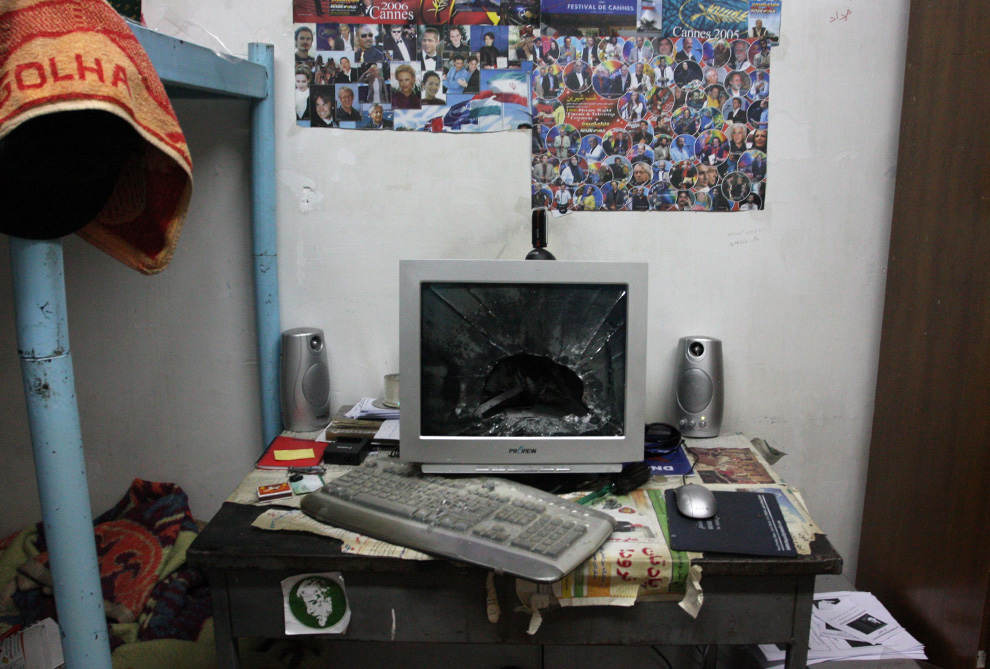
As protests — and violence — escalate in Tehran after last week’s dubious election returns, the world increasingly looks to social networking sites to ascertain what’s really going on in the streets. The revolution may not be televised, but — so far at least — it seems to be managing quite well with Twitter: “This is a country where you have tens of thousands of bloggers, and these bloggers have been in a situation where the Internet has been filtered since 2004. Anyone worth their salt knows how to find an open proxy [to get around government firewalls and filters], knows how to work around censorship…The Iranian government, by filtering the Internet for so long, has actually trained a cadre of people who really know who to get around censorship.

Update: Over at Salon, Iranian-American journalist Hooman Majd (who’s making the rounds — I saw him on the Lehrer News Hour yesterday as well) argues that the role of social networking has been vastly overstated: “More people have access to the Internet in Iran than other Middle Eastern countries but often it’s dial-up, it’s slow, they don’t do it like we do all day long…The depiction of the Internet revolution isn’t quite accurate. We’re putting our own image onto Iran. Of course there are people Twittering from the demonstrations; they’re just not representative of the vast majority of Iranians. What was so heartwarming about this whole thing is that the Iranian people stood up in mass and said you can’t take this away from us.

42 Doin’ Work.

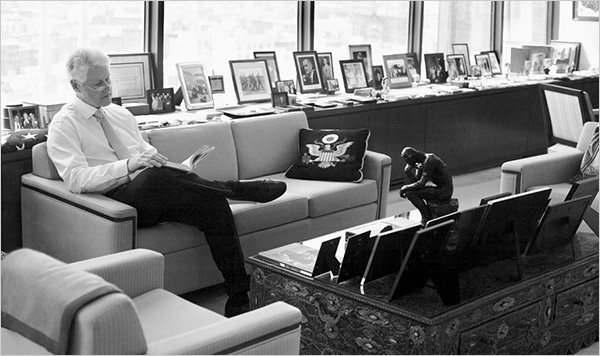
“If there is part of him that secretly covets Obama’s job, he is burying it inside. ‘I like my life now,’ he said. ‘I loved being president and it’s a good thing we had a constitutional limit or I’d have made the people take me out in a pine box, probably. But we had a constitutional limit and I knew that in the beginning. And so when I left, I had to go out and create another life. And I did it, and I love doing it.’

In a wide-ranging piece in the NYT Magazine, Peter Baker checks in on the post-presidency of William Jefferson Clinton. Among the topics discussed: Election 2008 fallout — Obama is forgiven, Kennedy and Richardson are not — and Clinton’s retrospective view of his own administration’s economic policy in light of the “Great Recession.” “He added: ‘If you ask me to write the indictment, I’d say: “I wish Bill Clinton had said more about derivatives. The Republicans probably would have stopped him from doing it, but at least he should have sounded the alarm bell.”‘

Roberts et al, meet Sotomayor.

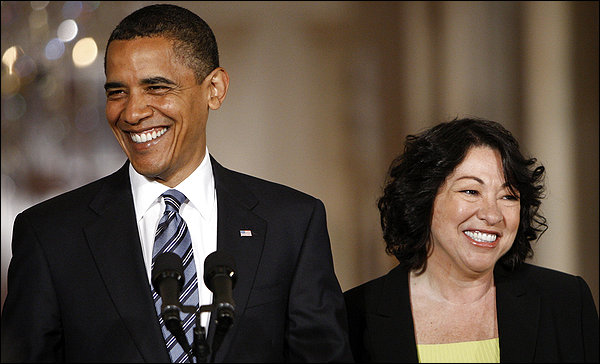
“I chose to be a lawyer and ultimately a judge because I find endless challenge in the complexities of the law. I firmly believe in the rule of law as the foundation for all of our basic rights…Mr. President, I greatly appreciate the honor you are giving me, and I look forward to working with the Senate in the confirmation process.” Hearkening back to the pragmatists once again — “For as Supreme Court Justice Oliver Wendell Holmes once said, the life of the law has not been logic, it has been experience” — President Obama chooses Judge Sonia Sotomayor as Souter’s replacement on the Court. [Wiki]

Naturally, conservatives are getting their opposition ducks in a row (with some help from Jeffrey Rosen’s recent dubious hit piece in TNR.) “But some Senate GOP officials privately conceded that, barring a major stumble, the judge will probably be confirmed with relative ease. ‘You don’t have to be a rocket scientist to figure out that we need to tread very carefully,’ said John Weaver, a Republican political consultant who advised Sen. John McCain (R-Ariz.) for years. ‘The only way we’ll find ourselves in a political predicament is if we don’t treat her with the same respect that other nominees received.’” Yeah, good luck with that.

In any case, early word on Judge Sotomayor is that she is very far from the liberal activist of right-wing nightmare, but rather a “highly capable technocrat,” and exactly the sort of hypercompetent and moderate — perhaps to a fault — pick one would expect from this president. “‘She’s a lawyer’s lawyer,’ said Paul Smith, a partner at Jenner & Block who participated in the call…She’s a cautious lawyer…who was a corporate lawyer herself…She reads statutes narrowly.

Not this time, Luthor.

“Any legitimate terror suspect, she said, would almost certainly be held in remote, high-security ‘supermax’ federal prisons, which are already home to convicted terrorists like British shoe bomber Richard Reid and Zacarias Moussaoui, the alleged 20th hijacker of the Sept. 11, 2001, terrorist attacks. That’s what these prisons are designed for.” The WP’s Dan Froomkin surveys the most recent idiocy being spouted by Republicans — as well as FBI director Robert Mueller and far too many Senate Democrats: that moving detainees from Gitmo into maximum security prisons would represent a clear and present danger to the republic. (As always, see also Glenn Greenwald on this ridiculous subject.)

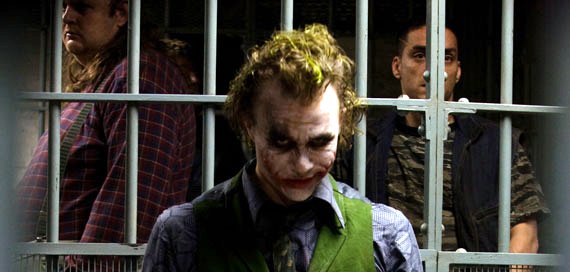
I’m unclear as to what the GOP thinks will happen if we move these detainees into our regular prison system (other than that it’ll probably be harder to waterboard them.) What kind of fantasyland do these yokels reside in? These detainees aren’t Lex Luthor or the Joker. They have no vast army of misguided goons waiting to help them in the Big House. (In fact, I think they’ll find they don’t have much in common with your run-of-the-mill hard time lifer.) Nor have they concocted any diabolical master plans to escape from these extremely secure institutions. Newsflash: Those supercriminal types you read about in comics don’t actually exist. (And, while we’re debunking conservative fantasies, forget what you saw Jack Bauer do: “ticking time bomb” scenarios don’t in fact happen either, and, even if they did, torture is in no way effective as a means of obtaining the information you’d need. Not that its efficacy matters anyway, because it’s a war crime regardless.)

Absurd. Blatantly absurd. And altogether irritating that, once again, too many Democrats in Congress are not only taking these inchoate lunacies seriously, but grimly echoing them as if there’s even a modicum of sound reasoning going on here. Can these conservatives and their Dem enablers distinguish between the Real World and their bizarre, half-baked realm of nightmares anymore? At this point, I half-expect Chuck Grassley and Harry Reid to tell me they’re imprisoning Zubadayah, Khalid Sheikh Mohammed, et al in a pane of glass and shooting them into the far reaches of space. I mean, it worked for General Zod in Superman II, right?

Onward, Christian Soldiers.

“To paraphrase Al Pacino in ‘Godfather III,’ just when we thought we were out, the Bush mob keeps pulling us back in. And will keep doing so. No matter how hard President Obama tries to turn the page on the previous administration, he can’t. Until there is true transparency and true accountability, revelations of that unresolved eight-year nightmare will keep raining down drip by drip, disrupting the new administration’s high ambitions.” In today’s NYT, Frank Rich makes the case for a full investigation into Dubya-era crimes (as, in a switch, does Maureen Dowd — with some unattributed help from TPM’s Josh Marshall.)

Also linked in Rich’s piece is a damning profile of Donald Rumsfeld’s tenure at Defense by GQ’s Robert Draper, which happens to include these bizarre and, diplomatically speaking, blatantly idiotic Christian-minded cover sheets created especially for Dubya’s briefings. “This mixing of Crusades-like messaging with war imagery, which until now has not been revealed, had become routine…At least one Muslim analyst in the building had been greatly offended; others privately worried that if these covers were leaked during a war conducted in an Islamic nation, the fallout–as one Pentagon staffer would later say — ‘would be as bad as Abu Ghraib.’ But the Pentagon’s top officials were apparently unconcerned about the effect such a disclosure might have on the conduct of the war or on Bush’s public standing…Rumsfeld likely saw the Scriptures as a way of making a personal connection with a president who frequently quoted the Bible.