The Progressives Made Us Do It.

“‘We’ve spent countless hours over the last few days in consultation with senators who’ve shown a genuine desire to reform the health-care system,’ Reid said. ‘And I believe there’s a strong consensus to move forward in this direction.'” Yer damn skippy. The Senate health care reform bill will include an opt-out public option, mainly because Senate progressives demanded it. “Reid and the leadership faced this basic math: There is only one Snowe and there are 60 members of the Democratic caucus. If just a few Democrats abandoned the bill, it would fall short even with Snowe’s support.

Also worth reading, Nate Silver’s concise ten-point summation of why a public option made the Senate bill. Note #1: “The tireless, and occasionally tiresome, advocacy on behalf of liberal bloggers and interest groups for the public option. Whatever you think of their tactics — I haven’t always agreed with them — the sheer amount of focus and energy expended on their behalf has been very important, keeping the issue alive in the public debate.” Keep up the good fight, y’all. This ain’t over yet.

Update: To wit, Senator Lieberman is up to his old antics: “I told Senator Reid that…if the bill remains what it is now, I will not be able to support a cloture motion before final passage. Therefore I will try to stop the passage of the bill.” Let’s remember. Lieberman — who played this same game back in 1994 — was allowed to keep his chair last November mainly on the pretense that he wouldn’t hold up important Democratic legislation. One would think this counts.

A Republic Needs No Subjects.

“The Obama administration has clung for so long to the Bush administration’s expansive claims of national security and executive power that it is in danger of turning President George W. Bush’s cover-up of abuses committed in the name of fighting terrorism into President Barack Obama’s cover-up.” In an editorial applauded by Salon‘s Glenn Greenwald, the NYT calls out the Obama administration for their appalling and Dubyaesque record on civil liberties.

As Greenwald well notes: “All of this vividly underscores a vital point. There is simply no way that a person with even the most minimal levels of intellectual integrity could have objected to these actions during the Bush years yet defend them now that Obama is doing them, or even refrain from objecting just as loudly.

See also Sen. Feingold’s recent and angry post on dKos this month (coupled with this statement on the Senate Judiciary committee) on the hamstringing of his attempts to revise the Patriot Act. Far too many ostensible civil libertarians in the Democratic Party have been rolling over for this administration since January — The time for giving the benefit of the doubt has passed. On this — and other crucial issues before us — it’s time to put this admin’s feet to the fire and hold the president to his word.

“I’m a Scorpion, It’s My Nature.”

From the California Nurses Assoc., the largest nurses union in the country: ‘Our legislators should respond to this bullying and stop coddling a useless industry whose sole function is to make enormous profits from the pain and suffering of patients while providing little in return.’ From the AARP: The AHIP report is not ‘worth the paper it’s written on.'”

Wow, who saw this coming? The insurance industry turns against health care reform — even the middling Senate Finance Committee version put forth by Max Baucus — by publishing an obviously bogus report that prophesies of impending rate-increase doomsday should reform pass. Hmm, well. I’m just gonna throw this out here, but I think it can be reasonably assumed from the start that any industry making money hand-over-fist from a broken system would eventually turn against meaningful reform of that system. So, maybe next time we shouldn’t give away the store to keep these swine at the negotiating table? Just a thought.

Anyway, the insurance industry isnt the only strange bedfellow (inadvertently) making the case for the public option of late. Both Bill O’Reilly and FOX’s Shepard Smith have made impassioned pleas for the public option recently. And — though they’ve been backpedaling like mad ever since — both Bill Frist and Bob Dole have called out their party for desperate and heedless obstructionism in recent days. So, even though we’ve taken the long way to get here for no particularly good reason, I feel confident right now that the public option is very much back in play.

Dog Woof, Cats Meow, Wags Tweet.

Hey all. As we approach the decade mark next month, the readership around here at GitM continues to dwindle, which is primarily my fault for not updating as much as I’d like. Nonetheless, if and when it gets quiet ’round here, I encourage you to also check out my Twitter feed, which is easier to update in the midst of more frantic weeks like last one. (Memo to myself: Columbus Day, and three-day-weekends in general, will mean a lot of speechifyin’ in Congress’ home districts.)

Yeah, I was skeptical about Twitter earlier in the year, but I’m definitely coming around. Within an hour of news of President Obama’s Nobel prize win, for example, (which I’m neither here nor there about — it seems goofy, yeah, but I was already down on Nobel anyway), there were dozens of wry and amusing quips going around the twitterverse. My favorite two were variations on “Obama, I’mma let you finish but Bono has been working his ass off for this!” and “Uh…did the Nobel committee just miss the fact that Obama bombed the f**king moon?!”

Another good example: the Baucus committee tanking the public option in late September brought on a similar flurry of bon mots: “Senators should be required to make the little cash register ‘ka-ching!” noise when they vote.” “Well the insurance Industry is looking forward to its Baucanalian Orgy.” “75% of Americans support #publicoption, but only 35% of the Senate Finance Cmittee support it.” “Health care industry must pay capital gains on Senate Finance Committee members this year as investment is cashed out.” Etc., etc.

Its immediate posting benefits aside, Twitter has definitely grown on me as a fertile hothouse environment for exactly this sort of choice, top-shelf snark.

Prevent Defense.

“‘We must recognize that these detention policies cannot be unbounded,’ he said at the time. ‘They can’t be based simply on what I or the executive branch decide alone.’” The Obama administration backs away from the new preventive detention law they’ve been floating in recent months. This is a clear victory for civil liberties advocates, but, as The Prospect‘s Adam Serwer makes plain, only a partial one: “‘It may be one of the better results we could hope for, but in reality indefinite detention continues,’ said Michael W. Macleod-Ball, Chief Legislative and Policy Council for the ACLU’s Washington Legislative Office. ‘That’s antithetical to the American justice system.‘”

Indeed, the administration’s fallback position is one long held by Dubya — that the authority for preventive detention already exists in the post-Sept. 11 blank check written by Congress. That’s not change we can believe in. See also Glenn Greenwald today on this and recent developments on the state secrets front: “[T]he Obama administration has proven rather conclusively that tiny and cosmetic adjustments are the most it is willing to do. They love announcing new policies that cast the appearance of change but which have no effect whatsoever on presidential powers.

In the NY Review of Books, meanwhile, Garry Wills takes the long view of all this: “[T]he momentum of accumulating powers in the executive is not easily reversed, checked, or even slowed. It was not created by the Bush administration. The whole history of America since World War II caused an inertial transfer of power toward the executive branch…Sixty-eight straight years of war emergency powers (1941-2009) have made the abnormal normal, and constitutional diminishment the settled order.

Wills concludes his essay on a worthy, if fatalistic, grace note that holds for a lot of ideals in this troubled age: “Nonetheless, some of us entertain a fondness for the quaint old Constitution. It may be too late to return to its ideals, but the effort should be made. As Cyrano said, ‘One doesn’t fight in the hope of winning’ (Mais on ne se bat pas dans l’espoir du succes).

CIA: Please don’t torture our torturers!

Attorney General [Eric] Holder’s decision to re-open the criminal investigation creates an atmosphere of continuous jeopardy for those whose cases the Department of Justice had previously declined to prosecute.” An “atmosphere of continuous jeopardy?” Well, boo frickin’ hoo: Seven former CIA heads try to bigfoot President Obama (and not AG Holder, where jurisdiction resides) into stopping the — already purposefully hamstrung — investigations into Dubya-era CIA torture.

As usual, Salon‘s irreplaceable Glenn Greenwald is already on top of it: “Do leaders of organizations in general ever believe that their organizations and its members should be criminally investigated and possibly prosecuted for acts carried out on behalf of that organization?…What these CIA Directors are urging would be completely improper. In fact, one could plausibly argue that where (as here) the DOJ determines that serious crimes might have been committed and an investigation needed, it would constitute obstruction of justice for the President to intervene by quashing any possibility of prosecution.

Thud.

“‘Our health-care system is simply unsustainable,’ the Montana Democrat said during a news conference today at which he appeared without any other lawmaker. ‘It’s time to act.’” Well, at least we agree on that much. After frittering away a month trying to appease obvious GOP irreconcilables, Sen. Max Baucus finally releases the Senate Finance health reform bill. [Here it is.] Key components include co-ops, a tax on “cadillac” insurance plans (which still doesn’t make much sense to me), cheapo catastrophic insurance for people under 25, and, of course, no public option.

Suffice to say, it’s not up to snuff, and many important folks aren’t particularly happy. “On the House side, the Baucus proposal falls very, very short…Sen. Russ Feingold (D-Wisc.) was disappointed by the Baucus bill, calling it ‘health care reform in name only.’” Said Rep. Anthony Weiner of the failed attempts at bipartisanship: “The Senate and the president to some extent have been like a child looking for a unicorn. I don’t see it.Nor is HCAN amused.

Update: Whatever you think of the Baucus bill, one thing is clear: Despite what they’re saying now, the Republicans got what they wanted…just ask Kent Conrad.

Regulators, Mount Up.

“Unfortunately, there are some in the financial industry who are misreading this moment. Instead of learning the lessons of Lehman and the crisis from which we are still recovering, they are choosing to ignore them. They do so not just at their own peril, but at our nation’s. So I want them to hear my words: We will not go back to the days of reckless behavior and unchecked excess at the heart of this crisis, where too many were motivated only by the appetite for quick kills and bloated bonuses. Those on Wall Street cannot resume taking risks without regard for consequences, and expect that next time, American taxpayers will be there to break their fall.

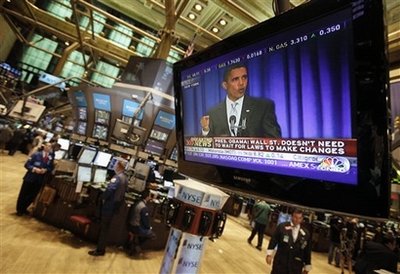
In the bowels of Wall Street and one year after the collapse of Lehman Brothers, President Obama outlines his vision for financial regulatory reform, including a new Consumer Financial Protection Agency and stronger accountability and oversight in the existing regulatory regime. [Transcript.]

But — see also health care — some wonder if the President is going far enough: “The problem with concentrating on the banking system is that it allows the administration to present an overly optimistic assessment of its actions…Taking credit for stabilizing the financial system after feeding it with massive amounts of federal money is like a teacher bragging about turning around the academic performance of a failing student after handing them all the answers to the big tests.

Continues economist Nomi Prins, in an analysis that dovetails quite tellingly with the health-care situation:”A strong CFPA is a sensible plan…This proposal has drawn the most ire from the banking community, so you know it’s good…But Obama’s reforms do not strike deeply enough. The banking crisis has been subdued, not fixed, because of enormous amounts of government assistance. Ignoring that fact, and failing to overhaul the sector, leaves us open to another crisis. And the next round will be worse, because there is now so much more federal money invested in the banks.

Mr. Wendell.

“With this history, you can rest assured that the insurance industry is up to the same dirty tricks, using the same devious PR practices it has used for many years, to kill reform this year, or even better, to shape it so that it benefits insurance companies and their Wall Street investors far more than average Americans.” Former head of corporate communications at CIGNA, Wendell Potter, the health insurance industry equivalent of Russell Crowe in The Insider, explains in Salon what his former employers are up to, and why our republic appears to be in a spot of trouble:

“During my 20 years in corporate communications and public affairs, I participated in the steady growth and influence of largely invisible persuasion — and at a time when newsrooms are shrinking and investigative journalism seems to be vanishing. The number of PR people long ago surpassed the number of working journalists in this country…The clear winners as this shift occurs are big, rich corporations and other special interests. The losers are average Americans, most of whom are completely unaware how their thoughts and actions are being manipulated to achieve corporate goals on Capitol Hill.

Stuck in the Middle with You.

“That large-heartedness – that concern and regard for the plight of others – is not a partisan feeling. It is not a Republican or a Democratic feeling. It, too, is part of the American character. Our ability to stand in other people’s shoes. A recognition that we are all in this together; that when fortune turns against one of us, others are there to lend a helping hand. A belief that in this country, hard work and responsibility should be rewarded by some measure of security and fair play; and an acknowledgment that sometimes government has to step in to help deliver on that promise.

As I’m sure you know, President Obama delivered his health care reform address to Congress last night. [Transcript.] My thoughts on it are mixed.

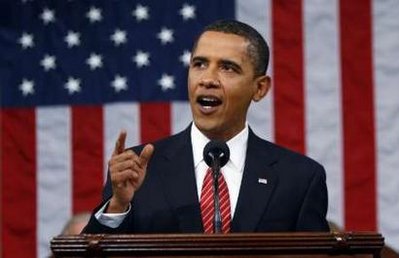
On one hand, speaking in terms of rhetoric, style, and delivery, this was an amazing speech, his best since the campaign days. While it’s an open question how long its effects will linger, the address clearly and decisively helped move the reform ball forward. And the emotional closer, featuring Ted Kennedy’s heartfelt final words to the President, was incredibly moving. In sum, it’s the exemplary address we knew Obama had in him on this issue, and he brought it home perfectly.

But, all that being said, I can’t shake the nagging feeling that [a] the policy being outlined last night didn’t quite jibe with the wonderful speech, and, as all too common of late, [b] the president far too readily threw his left flank — the very people who sweat blood and tears to get him elected — under the bus.

To take the second part first, Obama early on indulged in an irritating and textbook case of Beltway false equivalence by setting himself up as the sensible middle between those cuh-rrrrazy single-payer types on the left and the free market fundies on the right. (“There are those on the left who believe that the only way to fix the system is through a single-payer system like Canada’s…“) Uh, yes, and not so long ago, Mr. President, you were among them. I feel like I’ve said this several times recently, but painting the left as dingbats to shore up one’s centrist bona fides is a pretty tired parlor trick at this point, and it never gets any less insulting.

As an aside, on the way into work yesterday, I — and everyone else around the Metro — was accosted by guys in Grim Reaper costumes and bullhorns, telling us all, basically, that violence will erupt and we will all die if this health care bill passes. Y’know, there’s a term for telling people they’ll be killed if a political event happens — We call it terrorism. (As it turns out, there’s a term for wearing a hood while telling people they’ll be killed too.) Well, imagine my surprise to hear — from the president I’ve vocally supported for two years now — that me and my fellow clowns on the left are just as part of the health care problem as these jokers are on the right. I have to admit, it kinda tempers the enthusiasm.

And then there was the discussion of the public option. Yes, the President did make a case for the public option in last night’s remarks: “[A]n additional step we can take to keep insurance companies honest is by making a not-for-profit public option available in the insurance exchange…It would also keep pressure on private insurers to keep their policies affordable and treat their customers better.” In addition, the President correctly pointed out, “It’s worth noting that a strong majority of Americans still favor a public insurance option of the sort I’ve proposed tonight.

But what the President giveth, the President also taketh away. The public option was clearly brought up in the speech after the non-negotiable section. (“While there remain some significant details to be ironed out, I believe a broad consensus exists for the aspects of the plan I just outlined.“)

Indeed, in case we missed the point, President Obama later made it clear: “To my progressive friends, I would remind you that…[t]he public option is only a means to [an] end – and we should remain open to other ideas that accomplish our ultimate goal.

He then went on to float two “compromise” ideas that, for all intent and purposes, are public option killers: (1) a trigger and (2) co-ops. (“For example, some have suggested that that the public option go into effect only in those markets where insurance companies are not providing affordable policies. Others propose a co-op or another non-profit entity to administer the plan.“)

The trigger notion — the idea that if the insurance companies don’t fix the problem themselves, a public option would then be “triggered” into existence — is in effect, as one progressive well put it, a threat made with an unloaded gun. It’s kabuki theater, pure and simple, because everyone knows that Congress never pulls the trigger in question. (See also the cost of prescription drugs in Medicare Part D.) As Slate‘s Tim Noah recently ably pointed out, triggers are used all the time as “compromise” fodder, and what they really mean is we’re going to pretend to have addressed the problem and let things go on as they have. And, really, how much worse would insurance companies have to fail before this trigger kicked in? We’re talking about health care reform right now because the system is already broken.

As for co-ops, there’s a good reason they are the compromise that the insurance industry tends to favor. Most likely, they’ll be too small, weak, and scattered to bring real competition to the market.

So, granted, we don’t have a final bill yet, and there are many strong advocates of a public option in the House who will continue to fight for it. But, if the public option is as expendable to the administration as it seemed last night, then we may have some problems.

To wit, if a health care reform bill passes that has an individual mandate (i.e. everyone has to buy insurance), limited subsidies (to keep costs down), and no public option, than what’s basically happening is this: People are being forced to buy insurance they likely still can’t afford from the very private companies that are making vast amounts of coin from the current, broken system. If this sounds like a huge boon for private insurance companies, it is. (One might even start to think they had a hand in writing the legislation.) Yes, a larger risk pool should make health insurance cheaper — but without a public option keeping rates honest, what guarantee do we have that these savings would be passed on to the consumer?

Along those lines, President Obama also made the case last night for a tax on premium plans to help pay for reform. (“This reform will charge insurance companies a fee for their most expensive policies, which will encourage them to provide greater value for the money – an idea which has the support of Democratic and Republican experts.“) But, again, without a robust public option holding the private industry’s feet to the fire, what will stop said insurance companies from just passing these costs down the line, in the form of higher premiums across the board?

(I’ll confess to being confused about this element of the plan anyway. The article I just linked on this premium plan tax says: “The hope is that employers would buy cheaper, less generous coverage for employees, thereby reducing the overuse of medical services.” Uh…cheaper, less generous coverage for employees? That’s a good thing? And I’m by no means an expert on these matters — far from it — but is “the overuse of medical services” really the main problem afflicting our health care system? It sounds a bit to me like “too many notes.”)

All of which is to say that I really hope the substance of the final plan matches the beauty of last night’s rhetoric. Now, I understand the counter-arguments: As Paul Begala recently reminded us, the Social Security Act of 1935 had serious problems too, and look how that turned out. The great is the enemy of the good. Politics is the art of the possible, etc. etc.

I don’t disagree with any of that. But I also believe that leadership is the art of expanding the horizons of the possible. (Cue RFK: “Some men see things as they are and say why. I dream things that never were and say why not.“) We always knew that the President is a master of oratory, and that he would move us all with his eloquence when the time came. But, in setting their sights so low on this bill, the administration, in my view, have come close to squandering both the historical moment and the president’s once-in-a-generation gift.

A historical puzzle lingers over the entire health care reform enterprise at the moment: How is it, with a Democratic House, a filibuster-proof Democratic Senate, and a Democratic president, that the proposal for health care reform on the table basically remains to the right of Richard Nixon? (See also: The Family Assistance Plan.)

Well, the short answer, imho, is lack of meaningful campaign finance and lobbying restrictions. (A key problem that’s about to get a whole lot worse.) But I would also argue in favor of another cause. For decades now, Democrats have tried to find that safe happy moderate middle, while Republicans — flaks, representatives and presidents alike — have willfully and consistently pushed that center to the right. The president’s address, however magnificent and even moving at times, felt like another step in the same old vicious cycle. And at this crucial historical moment, I strongly believe it would be a better demonstration of “our American character” if we Dems — and this administration — showed the courage of our convictions in words and deed.