Drill Baby…Spill.


‘There’s no way to wash the oil out of a Spartina marsh,’ said Thomas Shirley, a professor at Texas A&M University’s Harte Research Institute for Gulf of Mexico Studies. Spartina, or cordgrass, is the dominant plant in these marshes. ‘It’s just a big sponge.” Several weeks after the President embraces coastal offshore drilling, reversing a notable campaign pledge — 11 dimensional chess! — the Fates conspire to remind us all why this might not be a very good idea. Along with the 11 missing (and presumed dead) workers, “Secretary of State Hillary Rodham Clinton suggested that cleanup efforts could end up costing billions of dollars.

Well, I say “the Fates,” but it sounds like Halliburton may have royally screwed up also. But, hey, maybe they’ll acquire another no-bid clean-up contract for their troubles. And speaking of our old friends on the right, it seems the “Drill Baby Drill!” camp has gone mysteriously silent…for now. [Image via Boston’s Big Picture.]

Update: “The problem with the April 20 spill is that it isn’t really a spill: It’s a gush, like an underwater oil volcano. A hot column of oil and gas is spurting into freezing, black waters nearly a mile down, where the pressure nears a ton per inch, impossible for divers to endure. Experts call it a continuous, round-the-clock calamity, unlike a leaking tanker, which might empty in hours or days.” It’s even worse than it sounds, and that’s assuming the wellhead isn’t lost. [Track the spill here.]

HCR: Where’s My Stuff?

Since I was talking to old friends on Facebook yesterday and realized once again that few folks outside of DC have a good sense of what’s actually in the recently passed health care bill, here’s a handy interactive graphic that delivers the what-for for the first year. There’s also a handy embed code there for wider distribution (but sorry, the death panel protocols are still classified. You’ll learn them when they come for you.)

The Nuclear Option: Ignorance.

If there were any doubts that Sarah Palin is a total idiot, she settled them with that single statement….Tip to Sarah Palin: Obama may have some vulnerabilities, and you may have some strengths, but command of the issues doesn’t fall in either category.” As the up traffic here in DC, Slate‘s Fred Kaplan beats back some of the dumber GOP attacks on Obama’s nuclear policy, while Joe Conason tries to explain what Ronald Reagan really thought about nukes.

Sigh…Pick any issue these days, and for far too many of the GOP opposition, the question seems to come down to whether they’re out-and-out venal or just incompetent. Sadly, the answer seems to be yes.

The Failure at the Crack.

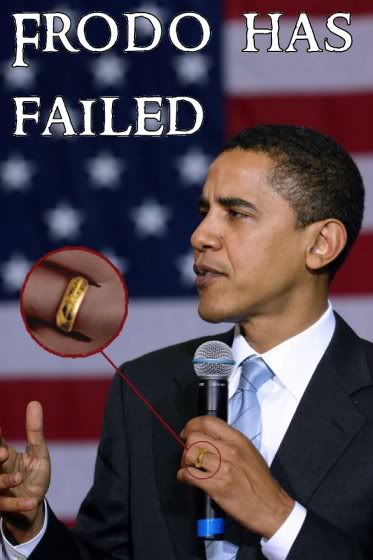
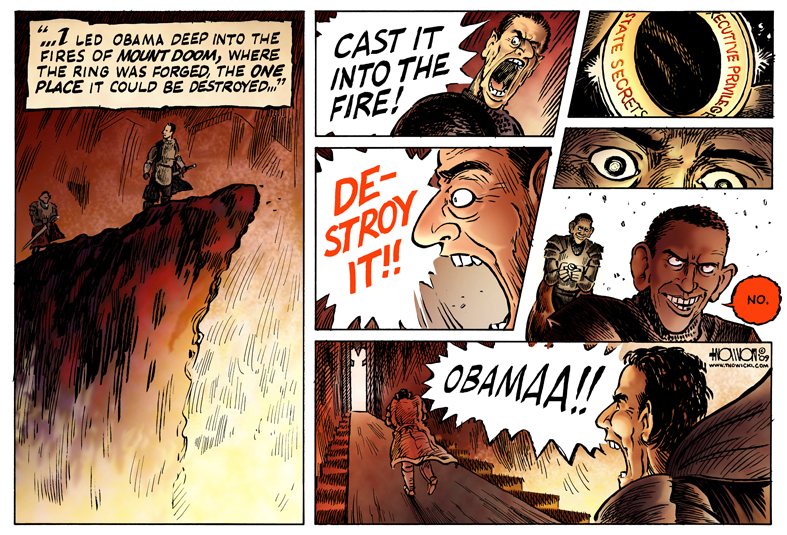
Another very busy week at work, and haven’t had time to do a real update. But, in the meantime, via @Normative and since today is Tolkien Reading Day (i.e. the day Isildur’s Bane was destroyed and Sauron fell), here’s a great editorial cartoon on the dangers of the ring on the executive power front. (I presume that’s meant to be Russ Feingold in the Elrond role.) The Hearts of Men are easily corrupted, and the Ring of Power has a will of its own…

Here’s to our Health.

“As our colleague John Lewis has said, ‘We may not have chosen the time, but the time has chosen us.’ We have been given this opportunity, an opportunity right up there with Social Security and Medicare: health care for all Americans. I urge my colleagues in joining together in passing health insurance reform — making history, making progress, and restoring the American dream.”

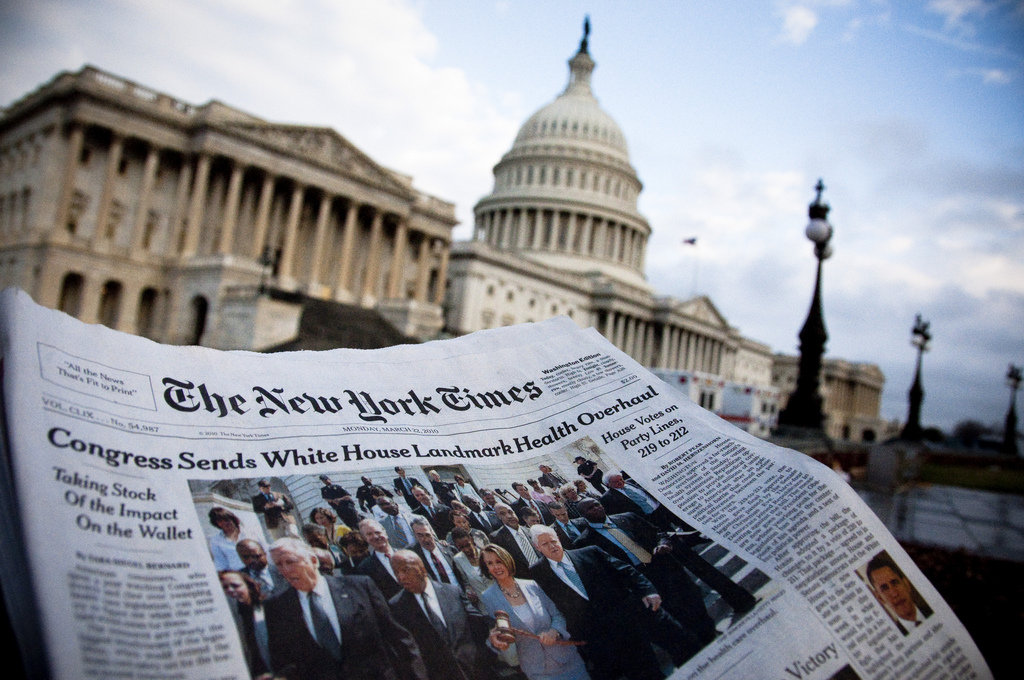
So, as you may have heard, the House passed the health care bill 219-212 late last night. It was a long and busy weekend, and a long and busy week is ahead, formulating the death panels and whatnot. Still, we’ve been talking about this bill since I got here last July, so it feels quite good to finally get this done. Now, let’s make it better. (Pic via here.)

Update: Here’s what goes into effect right away, and here’s what it means for you.

On Jobs and the Jobless.

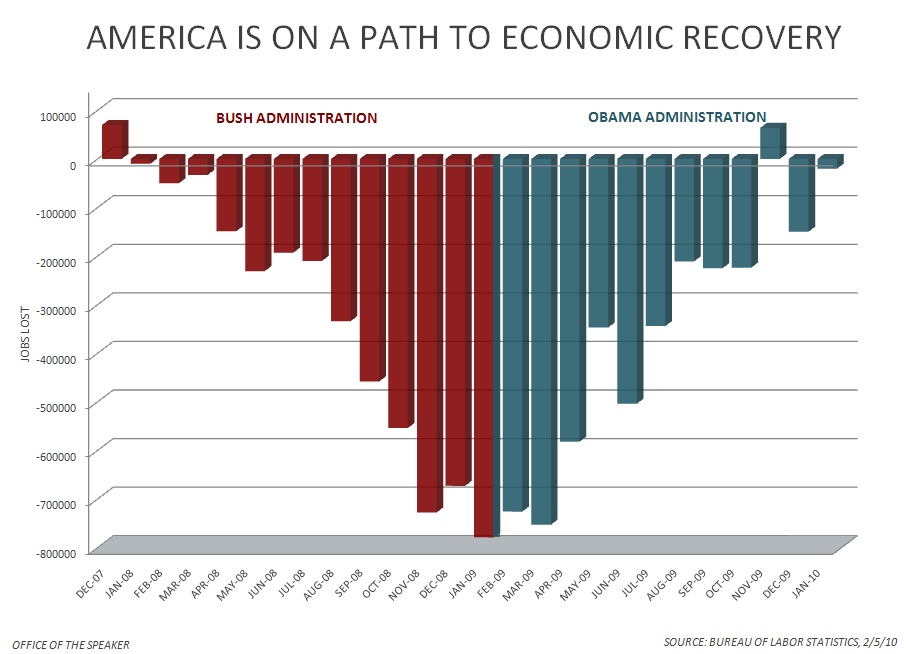
Via Speaker Pelosi’s official website, some much-needed perspective on the jobs situation under Dubya and Obama respectively (so far). Next time anyone of the (Keynesian-challenged) Republican persuasion starts to rant and rave about the stimulus, this might be a good graph to keep in your back pocket.

Of course, this is not to say we’re anywhere near the clear on the jobs front. Not only is there some frightening new data around about the length of unemployment in this downturn, The Atlantic‘s Don Peck makes a compelling case about how this new jobless era will transform America: “The unemployment rate hit 10 percent in October, and there are good reasons to believe that by 2011, 2012, even 2014, it will have declined only a little…The worst effects of pervasive joblessness–on family, politics, society–take time to incubate, and they show themselves only slowly. But ultimately, they leave deep marks that endure long after boom times have returned.

Partial Eclipse.

“The troubled and expensive Ares I rocket that was to replace the space shuttle to ferry humans to space will be gone, along with money for its bigger brother, the Ares V cargo rocket that was to launch the fuel and supplies needed to take humans back to the moon. There will be no lunar landers, no moon bases, no Constellation program at all.” As expected (and feared) earlier this year, the Obama administration’s proposed NASA budget for the next five years cancels any and all plans to go to the moon anytime soon. “‘We certainly don’t need to go back to the moon,’ said one administration official.

Sigh.

Ok, first off, the administration official who uttered the last sentence should be filed away next to Mr. Left of the Left and Ms. Pajamas as people who should no longer speak for the White House in any capacity whatsoever. Full stop, end of story. Putting my speechwriter cap on for a second: In most any political situation, ridiculing the dreams of an entire generation does not make for particularly good messaging.

Anyway, anonymous WH official aside, NASA administrator Charles Bolden sounded a better note about all this: “We’re not abandoning anything. We’re probably on a new course but human space flight is in our DNA. We are not abandoning human space flight by any stretch of the imagination. We have companies telling us they’re excited to get humans off this planet and into orbit. I think we’re going to get there and perhaps quicker than we would have done before.

And, to be clear, the administration’s NASA budget increases the agency’s funding by $6 billion over the next five years. The new budget ups research and development spending into cheaper heavy launch mechanisms, emphasizes more robotic exploration missions and observational experiments into climate change, extends the life of the ISS (although, with only five more shuttle missions remaining, other nations will have to help service it), and works to promote the various commercial space enterprises moving along right now.

All of this is well and good, but it would be nice to see some recognition of the civic importance of manned space flight by this administration. In their words, NASA is scrapping Constellation on account of it being “over budget, behind schedule, and lacking in innovation due to a failure to invest in critical new technologies.” And, given that we still had a lot of the expenditures before us, I suppose now was as good a time as any to kill the program if it’s not the right direction to go in.

That being said, how many more times are we going to do this? We keep stopping and starting and stopping and starting our post-Shuttle plans for space, so that now, after five final shuttle missions this coming year, we will longer have the capability anymore as a nation to send men and women into orbit. “If implemented, the NASA a few years from now would be fundamentally different from NASA today. The space agency would no longer operate its own spacecraft, but essentially buy tickets for its astronauts.Forty-one years after we first reached the moon, that’s just plain sad.

Ultimately, the central finding of the Augustine commission’s final report, released this past October after extensive study of NASA’s current situation, is a sound one: “The U.S. human spaceflight program appears to be on an unsustainable trajectory. It is perpetuating the perilous practice of pursuing goals that do not match allocated resources.” In other words, we’ve been trying to talk the talk without walking the walk. If we’re going to get serious about manned space flight, we need to stop piecemealing NASA and start making manned exploration a funding priority.

In total, the agency is slated to get $100 billion over the next five years. To put that number in perspective, that’s less than a fifth of our defense budget for 2011 alone, and that’s going by the most conservative numbers around — NASA’s five-year budget could be closer to a tenth of next year’s defense spending. (For its part, the Augustine commission set a price tag of $3 billion a year to get serious about manned exploration.)

If we had put anywhere near that kind of money into exploration and R&D over the years, would we now be in this position, where we face the Hobson’s choice of replicating expensive 50-year-old launch tech or being completely grounded as a nation? The lack of thinking about our long-term priorities sometimes is staggering to me. I’ve said this before, but I still believe it holds true: Short of possibly genomic research and advances in AI, nothing we do right now will matter more centuries or millennia hence than establishing a presence off-world…if we even have that long. Not to get all Jor-El up in here, but we really have to start getting serious about this.

SotU: The “Fetal Position” Fallacy.

I know that we haven’t agreed on every issue thus far, and there are surely times in the future when we will part ways. But I also know that every American who is sitting here tonight loves this country and wants it to succeed. That must be the starting point for every debate we have in the coming months, and where we return after those debates are done. That is the foundation on which the American people expect us to build common ground.

They do? I thought they expected change we can believe in. But worn-out nods to an elusive, ephemeral, and, given the current GOP, often undesirable bipartisanship does not constitute such. In any event, so concluded the President’s State of the Union address last Thursday. This is old news at this point, so I’ll keep it brief. Suffice to say, while it got better as it went along, I thought the speech was merely ok, and often troubling. Throughout the evening, the president’s remarks had that excessively-poll-tested, small-bore feel that conjured up grim odors of 1995 and 1996. Throw on a flannel and fire up the Pulp Fiction soundtrack, y’all: One year into the Obama era, are we already back to V-chips and school uniforms?

Part of the president’s problem is that the Senate is looking like the elephant’s graveyard of progressive-minded legislation right now. The president called for an energy reform bill. The House went out on a limb to pass one last June. The president called for a financial reform bill. The House passed one in December. The president called for a new jobs bill. The House also passed one in December. All of these bills, and many, many others, are languishing in the Senate right now, as Sen. Reid and others try to figure out how to somehow get something — anything! — passed with a larger majority than Dubya ever enjoyed.

The Senate issue aside, there were other problems in the President’s speech, including far too many nods and feints in the direction of ridiculous deficit peacocks like Judd Gregg and Evan Bayh. First off, at the risk of sounding like Dick Cheney, I tend to think that deficits are troubling, but, even in the best of times, they shouldn’t really be the foremost driving concern of our government policy. If we run a deficit to invest in education now, we’ll save money down the road and improve Americans’ quality-of-life to boot. (Put in somewhat ugly fashion, it’s invest in schools now or prisons later.)

And that being said, right now is emphatically not the best of times. We know exactly what happens when you cut spending too quickly after a virulent recession — It was called the 1937 Roosevelt recession, and it would be flagrantly idiotic to repeat it. Just because the GOP doesn’t seem to understand basic Keynesian economics doesn’t mean we should follow them down the rabbit hole of flat-earth thinking, just so we can look bipartisan.

No, the problem with deficits isn’t necessarily the running of a deficit. It’s the running-up of massive deficits for patently stupid reasons — like, say, prosecuting a war of choice in Iraq, or doling out excessive tax breaks to multi-millionaires. And that’s why some of the President’s nods in that direction were so irritating last Thursday. Calling for a spending freeze on discretionary spending, without touching the exorbitant “security-related” budget (cute euphemism, that), is kabuki theater at best. And at worst, you’re balancing the books at the expense of our most vulnerable citizens. (I tend to agree with Candidate Obama on this issue anyway.)

Similarly, this deficit commission which the president plans to foist on Congress by executive order after the Senate killed it, is, again, at best kabuki theater and at worst trouble. It’s clear to everyone involved that the entire point of this commission is CYA: i.e, to create political cover for raids on entitlement spending, while once again ignoring the grotesquely swollen defense budget. (Altho’, to be fair, Secretary Gates has at least tried to rein in growth in this sector.) In other words, this commission will basically just be a chance for deficit peacocks to pretend they’re Serious People and “make tough decisions,” while in fact the one really tough idea that actually needs to be tackled — reining in defense spending — will be completely avoided.

In any event, all this discussion of the deficit ignores the larger problem. Obviously, one of the president’s biggest charges coming into office was to restore economic sanity after eight years of Dubyaite excess. That being said, people were not looking to President Obama for this sort of deficit tsk-tsking and small-bore, fiddling around the margins. You’d think we Dems would have learned this by now. But curling up into a fetal position and mouthing moderate GOP-lite bromides will not stop the Republicans from kicking us, ever.

We have a Democratic president, an 18-seat majority in the Senate, and a 79-seat majority in the House. In short, we Dems need to keep thinking big or we will pay dearly at the polls this November. Perhaps the dysfunction of the Senate is the central problem Obama faces right now, but his speech nonetheless suggests that we’re getting dangerously close to Eisenhower Republican territory now, and not even in the good “the military-industrial complex is completely frakked” kinda way. Without vision, the people perish. So too will our party, if we keep up with this thin gruel, triangulation schtick. At the advice of the careerist DLC-types over the years, we have tried this path several times over — Put simply, it does not work.

When Suddenly a Debate Broke Out.

“The whole thing basically went like that: Republican asks obnoxious question rooted in Glenn Beck-ian talking points; Obama swats it away, makes the questioner look silly, and then smiles at the end. It got so bad, in fact, that Fox News cut away from the event before it was over.”

My issues with the SotU notwithstanding, the president’s sallying back-and-forth with House Republicans on Friday clearly indicate that, whatever our problems are within the party, the GOP are just not ready for prime-time right now. (I also get the sense that this will mark the definitive end of the Republican’s goofy “teleprompter” meme.) [Full transcript.]

To his credit, the president made his political opponents seem like the blatantly hypocritical ideologues they in fact are. Which begs the “common ground” question once again: Why should we try to meet the “Party of No” halfway, particularly when we know that they move the goalposts every single time you try to take them seriously?

Lo, Here Comes the Flood.


“The Court today rejects a century of history when it treats the distinction between corporate and individual campaign spending as an invidious novelty born of Austin v. Michigan Chamber of Commerce, 494 U. S. 652 (1990). Relying largely on individual dissenting opinions, the majority blazes through our precedents, overruling or disavowing a body of case law…The Court’s ruling threatens to undermine the integrity of elected institutions across the Nation. The path it has taken to reach its outcome will, I fear, do damage to this institution.

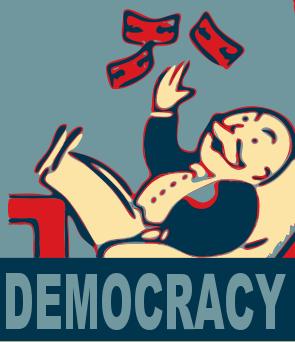
Well, it was a nice republic while it lasted. In a 5-4 decision, the Supreme Court finally hands down its Citzens United verdict, and it is ugly. [Full Text] Basically, the distinction between corporations and individuals has been erased, and, by the already dubious proposition that money is speech, unlimited corporate expenditures in campaigns is now just good, old-fashioned government. Welcome to the new Lochner era, y’all.

By the way, this is a much, much bigger deal than Scott Brown or the effing Edwards baby. Not that you’d know that from watching the news right now.

Update: More reactions:

Fred Wertheimer, Democracy 21: “Today’s Supreme Court decision in the Citizens United case is a disaster for the American people and a dark day for the Supreme Court…With a stroke of the pen, five Justices wiped out a century of American history devoted to preventing corporate corruption of our democracy.

Bob Edgar, Common Cause: “The Roberts Court today made a bad situation worse. This decision allows Wall Street to tap its vast corporate profits to drown out the voice of the public in our democracy. The path from here is clear: Congress must free itself from Wall Street’s grip so Main Street can finally get a fair shake.

Robert Weissman, Public Citizen: “Shed a tear for our democracy…Money from Exxon, Goldman Sachs, Pfizer and the rest of the Fortune 500 is already corroding the policy making process in Washington, state capitals and city halls. Today, the Supreme Court tells these corporate giants that they have a constitutional right to trample our democracy.

Sen. Russ Feingold (D-WI): “[T]his decision was a terrible mistake. Presented with a relatively narrow legal issue, the Supreme Court chose to roll back laws that have limited the role of corporate money in federal elections since Teddy Roosevelt was president. Ignoring important principles of judicial restraint and respect for precedent, the Court has given corporate money a breathtaking new role in federal campaigns. Just six years ago, the Court said that the prohibition on corporations and unions dipping into their treasuries to influence campaigns was ‘firmly embedded in our law.’ Yet this Court has just upended that prohibition, and a century’s worth of campaign finance law designed to stem corruption in government. The American people will pay dearly for this decision when, more than ever, their voices are drowned out by corporate spending in our federal elections.

President Obama: “With its ruling today, the Supreme Court has given a green light to a new stampede of special interest money in our politics. It is a major victory for big oil, Wall Street banks, health insurance companies and the other powerful interests that marshal their power every day in Washington to drown out the voices of everyday Americans. This ruling gives the special interests and their lobbyists even more power in Washington–while undermining the influence of average Americans who make small contributions to support their preferred candidates. That’s why I am instructing my Administration to get to work immediately with Congress on this issue. We are going to talk with bipartisan Congressional leaders to develop a forceful response to this decision. The public interest requires nothing less.

Slate‘s Dahlia Lithwick: “Even former Chief Justice William H. Rehnquist once warned that treating corporate spending as the First Amendment equivalent of individual free speech is ‘to confuse metaphor with reality.’ Today that metaphor won a very real victory at the Supreme Court. And as a consequence some very real corporations are feeling very, very good.