
“Sweet steel! Come forth from out your sheath, And glist’ning, speak your powers; Rip up the organs of my breath, And draw my blood in showers!” Historians learn more about Abraham Lincoln’s Reznor period with the discovery of his long-rumored suicide poem, published in 1838 (when Abe was 29.)
Prisoners of Carrey, Gangs of LA.
Also missed during my own private blackout: New trailers for Lemony Snicket’s A Series of Unfortunate Events (Haven’t read the books, but know enough to know that this shouldn’t be such a Jim Carrey vehicle) and Martin Scorsese’s The Aviator (Looks intriguing, although the Old Hollywood stuff looks like more fun than the planes.)
1600 Pennsylvania’s Room 101.
I missed most of the recent discoveries about Dubya’s pro-torture policy changes during my cable outage, but Value Judgment has birddogged a nice Washington Post editorial that sums up the story so far. “There is no justification, legal or moral, for the judgments made by Mr. Bush’s political appointees at the Justice and Defense departments. Theirs is the logic of criminal regimes, of dictatorships around the world that sanction torture on grounds of ‘national security.’“
Return of the Dominar.
Lots of promo shots from the Farscape mini-series have made it online of late, and so far the Peacekeeper War looks like quality vintage ‘Scape, right down to Einstein Harvey. I may have to break the Sci-Fi boycott for this.

No man can serve two masters
, but he can hang them on the wall. I finally got around to picking up and framing my M.Phil, the boon of the orals experience, yesterday. Unfortunately, it may take a PhD to figure out — or care about — the difference between a Master of Arts in History and a Master of Philosophy in History. But, hey, two pieces of paper with my name on them…that’s gotta mean something, right?
On the Comeback Trail.
Booyah…We’re finally getting close to a release date for the RotK:EE: December.
Gipperpalooza.
So…you might’ve missed this little story in all the D-Day hullabaloo, but apparently former President Ronald Reagan died. Due to my cable issues, I’ve thankfully missed much of the canonization and hagiography of the past few days, although I’m sure the GOP will repeat it all at their upcoming convention anyway.
I know it’s bad form to speak ill of the recently deceased, so I’ll let others handle straightening the record about Ronnie’s not-so-stellar presidency. But, given all the revisionist history out and about at the moment, I do think this is a good time to consider the thesis of Reagan’s America by Garry Wills:
| Much of Garry Wills’s argument in Reagan’s America can be encapsulated by George Costanza’s advice to Jerry Seinfeld, prior to Jerry’s being polygraphed about his Melrose Place viewing habits: “It’s not a lie if you believe it.” Over and over again, Wills scrutinizes the tales and myths told by Reagan about himself in his private speeches, public addresses, and autobiography, and finds them to be embellished, exaggerated, and – more often than not – patently false. And therein lies his uncanny appeal for so many people: Reagan’s myths are America’s myths…As Wills puts it, “the truth about [America’s] actual behavior, whether on the old frontier or the new, is as threatening to our sense of identity as the terrorist himself.” (452) And because Reagan believes so thoroughly in his own American myths, many Americans could join him in believing them as well…[Wills writes,] “Visiting Reaganland is very much like taking children to Disneyland…It is a safe past, with no sharp edges to stumble against. The more visits one makes to such a past, the better is one immunized against any troubling cursions of a real [American past.] If capitalist ‘conservatism’ canoot be rooted in the real past it works to obliterate, then it will invent a deracinating past, a nostalgia for the new, a substitute history to lull us in the time machine that travels on no roads, reaching goals no one could plan.” (459-460)
In sum, “Reagan gives our history the continuity of a celluloid Mobius strip. We rides its curves backwards and forwards at the same time, and he is always there.” (440) Put differently, the appeal of Ronald Reagan for so many is that he offers us a simulacrum of American history that is both appealingly mythic and appallingly untrue. |
Well, at the very least, the effusive eulogizing going on right now may help topple barriers to stem-cell research. And, no matter what one’s political persuasion, I think we can all agree that helping to eliminate scourges like Alzheimer’s Disease would make a wonderful asset to Ronald Reagan’s legacy.
Back in Business?
For apparently no reason, my cable Internet access has returned, a day before the second Time Warner technician visit. A temporary reprieve? Let’s hope not…At any rate, if it gets quiet around here again in the next few days, you’ll know why. In the meantime, I’m feeling way behind on the news.
June 6, 1944.
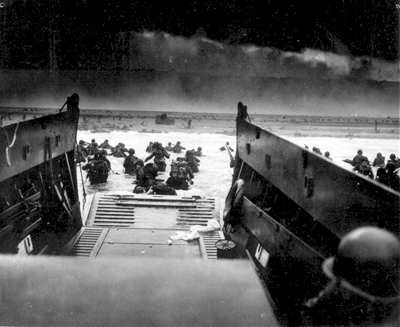
“People of Western Europe: A landing was made this morning on the coast of France by troops of the Allied Expeditionary Force. This landing is part of the concerted United Nations’ plan for the liberation of Europe, made in conjunction with our great Russian allies …I call upon all who love freedom to stand with us.” – Dwight Eisenhower
Technical Difficulties.
Well, between Tenet’s resignation and Reagan’s end, my cable modem picked an eventful few days to give up on me. More to come next week, after the Time Warner technicians have ascertained and corrected the problem.