
Alas, the Bush campaign drops ‘turning a corner’. That’s too bad. It was so tone-deaf and Hoover-esque that I’d hoped Dubya would keep saying it right through to November.
Up From Theory.
“The problem of theory was never the philosophy it drew on but the absence of a public forum to criticize it, expand it for intelligent adults, and correct it. The return of the linking intellectuals — adept in philosophical thought but not beholden to the academy — could restore a heritage of speaking to the public about the professors, and, more importantly, could get the professors speaking honestly and intelligibly to us.” Mark Greif, an old college friend of mine, discusses the Death of Theory in The American Prospect. Compared to most other academic disciplines, American historians seem to have side-stepped the worst excesses of echo-chamber theorizing…but it can seem a different world not all that far away.
Positively Clintonian.
“Although parts of the book are dull, the memoir as a whole is a rewarding and revealing portrait of an endlessly fascinating man. Those who write histories of Clinton and his time — as many people, of course, will do — will find this memoir an essential starting point.” Also in the new Prospect (which, I know, is getting a lot of links today), Alan Brinkley takes a gander at Clinton’s My Life.
Ninjas, Black.
“Clinton says in 1999 to General Hugh Shelton, ‘You know, it would scare the s**t out of al-Qaeda if suddenly a bunch of black ninjas rappelled out of a helicopter into the middle of their camp,’ 189.” N+1 indexes the 9/11 Commission Report, so you can get straight to the good parts.
Pass it On.
“You are the heirs of one of the country’s great traditions — the progressive movement that started late in the l9th century and remade the American experience piece by piece until it peaked in the last third of the 20th century…Its aim was to keep blood pumping through the veins of democracy when others were ready to call in the mortician…While the social dislocations and meanness that galvanized progressives in the 19th century are resurgent, so is the vision of justice, fairness, and equality. That’s a powerful combination if only there are people around to fight for it. The battle to renew democracy has enormous resources to call upon – and great precedents for inspiration.”
By way of a friend of mine, Bill Moyers recounts the Progressive Story of America. The whole thing’s worth a read…and I for one think it’s great to hear the Progressives get their due. (Along the same lines, this month’s Prospect has a special report entitled “A New Progressive Era?”, with contributions from, among others, Sean Wilentz, James MacGregor Burns, and John Podesta.) Progressives take a lot of flak in the Academy, some justified (they were silent on lynching and generally really lousy on race), some not (ridiculous amounts of ink has been spilled lambasting them for being middle-class, bureaucratic, and/or unSocialist.)
Bring in Da’ Noise, Bring in Da’ Funk.
Two fanboy icons get the Remix treatment…First, Tyler Durden gets all Tekken up in here with Fight Club: The Game. (Hmm, sadly, it looks Ikea-Nesting-Instinct-lame.) Meanwhile, Kirk & co. get their funk on in this strange ad for the Star Trek Original Series DVD. Well, it’s definitely more fun than an Odd-numbered Trek.
Vice City.
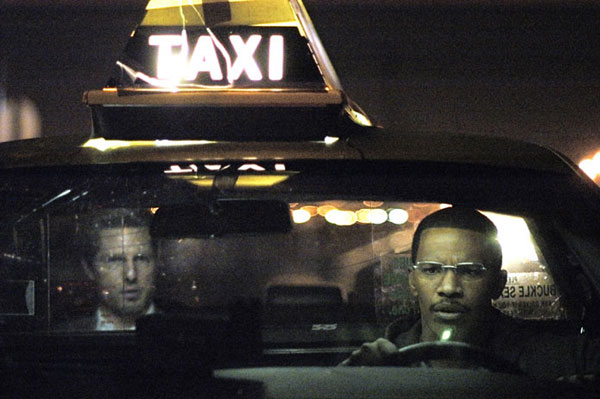
Although the swing is nowhere near as severe, Michael Mann’s Collateral also had a bit of a Code 46 problem: Highly promising at first, it ultimately backslides into a much less appealing and much more ham-handed film. Now, Collateral still ends up being a decently enjoyable night at the movies, but the flaws of the final third definitely hurt the overall experience.
All’s well that starts well…the film has a great sense of place, and both Tom Cruise and Jamie Foxx are very good throughout. (Despite what many of the reviews say, by the way, Cruise has played a villain before…he was Lestat, and he actually turned out to be pretty good.) And there’s some nice supporting work by Before Night Falls‘s Javier Bardem and The Ladykillers‘ Irma Hall. (Mark Ruffalo seemed slightly miscast as the cop, and he may well be approaching the Stiller Threshold for overexposure in 2004, but he was solid enough.) For the first ninety minutes or so, as Max and Vincent discuss their respective philosophies while making their bloody rounds across the City of Angels, the film (much like Heat) feels like a strangely moody and contemplative Grand Theft Auto mission.
But, when Max’s cab stops for two Very Highly Symbolic Coyotes crossing the street, trouble bells started ringing. And sure enough, soon thereafter, Collateral lapses into over-the-top, nonsensical cheese. The eject moment came for me when Tom Cruise, previously unwilling to venture into one nightspot to retain his anonymity, starts firing away haphazardly in a Chinatown disco. (I guess this is the only club in America without video cameras.) And from then on, the movie takes too long to do too little…the last few set pieces unroll sluggishly, and could all have been cut down by several minutes. By the overblown final moments, I’m sorry to say, I had pretty much checked out. All in all, Collateral is definitely worth two hours of air conditioning, but as for its larger pretensions…Mission Failed.
Lost in Translation.
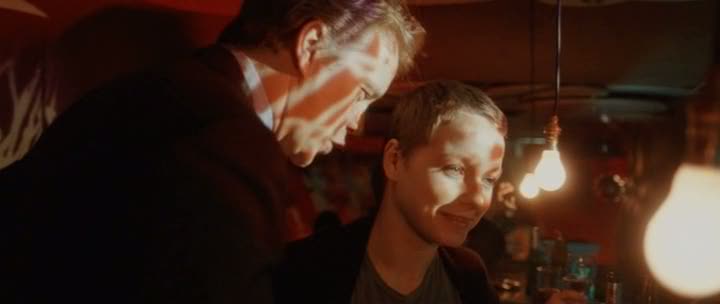
Well, for the first twenty-five minutes or so, when Tim Robbins and Samantha Morton were wandering around a picturesque, slightly-futuristic Shanghai, I thought Michael Winterbottom’s Code 46 might turn out to be quite good, perhaps a slightly better version of Wim Wender’s Until the End of the World. After all, some of the cinematography in the early going (Shanghai hotels, Morton under a strobelight) was very impressive, and I liked the way the movie just went for it…immersing you in this world of the future without taking the time to explain all that much.
But, right about the time this very unlikely couple consummate their evening, the film starts slipping off the rails, and it’s a long way down. For one, the more you hear about this particular future dystopia — the Sphinx corporation, critical travel “papelles”, empathy viruses, Code 46, etc. — the less sense it makes. If people could read minds just by, um, becoming infected with a virus (as Tim Robbins has and does), then why wouldn’t everyone do it? And why would the rest of the characters be so consistently amazed by his ability, if it’s simply off-the-shelf? Similarly, while at first the global NewSpeak, incorporating elements of French, Spanish, Chinese, and other languages into English, seems like a neat idea, it eventually just sounds ridiculous. Si, it’s true…ultimately, every hombre and femme ends up sounding a bit like a dinner-party Hercule Poirot, until you start wondering if it’s possible to get your dinero back.
But, however weak the premises of this sci-fi vision, the real problem here is in the “love” story. Tim Robbins and Samantha Morton can both be appealing actors elsewhere, but here they seem all wrong for each other. He’s too lanky and she’s too fetal, and together they exude zero chemistry. More problematically [Spoilers to Follow], once the “Code 46” genetic aspect of the story kicks in and the two implausibly venture off to Neo-Dubai, their romance degenerates into some twisted sci-fi rumination on Oedipal complexes that’s at turns head-scratching and rather dull, despite featuring one of the most ghastly and unerotic sex scenes in recent memory. (Trust me, if you thought Meryl Streep pawing Liev Schreiber’s chest hair in The Manchurian Candidate was creepy, you ain’t seen nothing yet.) At any rate, as the last few moments hammered the subtext into the ground and Coldplay started crooning over yet another excessively fond shot of Morton, I had to concede that Code 46, however visually promising at first, turned out to be a bad, bad film. And, given how much fun Winterbottom’s 24 Hour Party People was, that’s disappointing, n’est-ce-pas?
Dirty Deeds Done Dirt Cheap.
With visions of the 2000 primary perhaps dancing in his head, John McCain asks the White House to repudiate the recent Swift Boat Veterans garbage. (Naturally, they didn’t.) The real ugliness begins.
Born in the USA.
A few days out of date now, but still worth reading: Bruce Springsteen on the need for regime change. “It is through the truthful exercising of the best of human qualities – respect for others, honesty about ourselves, faith in our ideals – that we come to life in God’s eyes. It is how our soul, as a nation and as individuals, is revealed. Our American government has strayed too far from American values. It is time to move forward.”