Lung Shadows.


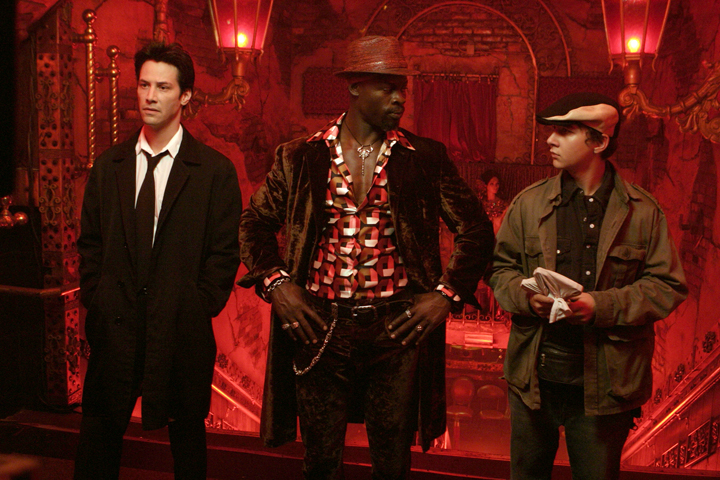
At first, after the early director troubles and the casting of Keanu, I wouldn’t have given Constantine a snowball’s chance in Hell. But, while I can definitely see how it might come off as long-winded, somewhat inscrutable, and mostly boring to folks who hadn’t read the comics, I found the movie a surprisingly good adaptation of the source material. Much more atmospheric than your average February release comic book film, Constantine is a well-thought-out, well-constructed (if occasionally overlong) B-picture. As Keanu might say, “Whoa.”

I haven’t read Hellblazer much in the past decade, but what I remember most about the early adventures of John Constantine were (a) his frequent conversations and complicated pacts with the various demilords of Heaven and Hell, and (b) the absurdly short life-spans among his worldwide network of demonologists, clairvoyants, freaks, and hangers-on. To its credit, Constantine gets both details exactly right, with Tilda Swinton, Gavin Rossdale, Djimon Hounsou, and Peter Stormare playing otherworldly nobility to great effect (although I think I preferred Viggo’s take on Lucifer in The Prophecy), and Max Baker and Pruitt Taylor Vince (born to play a Constantine sidekick) layering on the eccentricities thick as unlucky compadres of the man of the hour.

When Constantine falters, it’s mainly in the long, protracted scenes between Keanu and Rachel Weisz, the latter of whom plays twins (one the love interest, the other the McGuffin.) The two (or three, whatever) don’t have much chemistry, and they stop the film cold occasionally in the middle hour. Also, the depiction of the Underworld, which basically resembles Sarah Connor’s nuclear nightmare in T2, has that cheap FX-house look to it, and fails to capture the wry malevolence often seen in DC’s comic-book Hell (for example, in the various torments visited upon Alan Moore’s Anton Arcane in Swamp Thing, or, in a creepy vision that I’ve never escaped, when Grant Morrison’s Kid Eternity encountered his teddy bear in the throes of agony, pleading for respite and demanding vengeance for his abandonment.)

Still, despite these lapses, I found Constantine for the most part an enjoyable and sequel-worthy adaptation, and an auspicious sign for fanboy cinema in 2005. Perhaps this’ll even bode well for FF…Nah.

New Looks, New Voices.

With spring just around the corner, old blog stalwarts Lots of Co. and Do You Feel Loved? (and, for that matter, even the ghastly-retro AICN) get spiffy new redesigns. And, if you stop by GitM mainly for the politics, I have two newly-born blogs of note for you. My Columbia colleague Ted Wilkinson (currently working on a dissertation on Pat Brown) has set up shop over at The Late Adopter, and Ben Kirby, an old friend and political hand from DC, is now posting at The Spencerian. All of the above are well worth checking out.

The Circus is in Town.

“Of Dylan’s many achievements, the most fundamental was his hitching together of the folk-lyric tradition and Western modernism, connecting them at the point where their expressive ambiguities met…Dylan did not do this to prove a point; he was naturally omnivorous, and he intuited the connection without worrying about pedigree.” Sent to me by All About George, Luc Sante surveys recent Dylan literature for the NY Review of Books. Speaking of which, tickets for Bob’s upcoming five-night stand at the Beacon Theatre go on sale this morning at 10am. In a perfect world, I’d go to all of ’em (while catching a matinee of Hitchhiker’s on that Friday, April 29.) But, financial constraints being what they are, I’ll probably settle on either 2 or 3 shows. We’ll see.

Of Divided Mind.

You may well have seen it by now — I caught it before Constantine, along with the Hitchhiker’s trailer, but, if not, Keanu, Winona, Downey, and Woody get animated in the Waking Life-ish trailer for Richard Linklater and Philip K. Dick’s A Scanner Darkly. Haven’t read the story, but I’m impressed by the look.

The Proud Highway’s End.

“And that, I think, was the handle—that sense of inevitable victory over the forces of Old and Evil. Not in any mean or military sense; we didn’t need that. Our energy would simply prevail. There was no point in fighting—on our side or theirs. We had all the momentum; we were riding the crest of a high and beautiful wave. So now, less than five years later, you can go up on a steep hill in Las Vegas and look West, and with the right kind of eyes you can almost see the high-water mark—the place where the wave finally broke and rolled back.”

R.I.P. Hunter S. Thompson 1937-2005. Ugh, this is terrible news. Yes, his writing had been inconsistent in recent years, but Thompson at his take-no-prisoners best was a brilliant, lacerating voice that pierced through the platitudes and hypocrisy of so much of this world. This final succumbing to the Fear and Loathing, especially at this dark political hour when we need him most, is tragic.

I had several links to catch up on after my trip, but frankly right now my heart isn’t in it. Godspeed, HST.

On the Road Again.

Hey y’all…I just got back from last weekend’s escapades, and, poof, I’ll be gone again as of this afternoon. This time it’s off to Boston and Cambridge for some freelance work meetings and dissertation research, with perhaps an hour or two to check out the ole campus environs. At any rate, hopefully I’ll be back here posting again on Sunday. So, until then. Update: I’m back and, other than the ubiquitous, inescapable Red Sox victory gear in every nook and cranny, Beantown and Harvard don’t seem to have much changed since my last trip in ’98. It was nice to see the Square still graced by Tommy’s, the Hong Kong, the Cellar, and most of my other old collegiate haunts.

Abe Lincoln and the World of Tomorrow.

“Bob Rogers, BRC’s founder and chairman…draws two circles, labeled ‘scholarship’ and ‘showmanship,’ on a sheet of yellow paper. The circles overlap, but only slightly. That tiny slice of shared space, he says, is where the museum needs to be.” By way of Dangerous Meta, the Washington Post examines the mild controversy surrounding high-tech exhibits at the Abe Lincoln library. If BRC is consulting a sizable number of outside historians on the scholarship, as they seem to be doing, then what’s the problem? Gimmicks like Tim Russert introducing 1860 campaign ads are a bit facile, sure, but if they help get more laypeople intrigued in Lincoln’s life and times (and don’t unduly misrepresent the history), I’m all for it. Besides, my feeling is, if historians don’t get behind such efforts, they’re going to happen anyway, and with much less historical rigor to them.