
“We’ve written a western with a lot of violence in it. There’s scalping and hanging…it’s good. Indians torturing people with ants, cutting their eyelids off.” Uh…ok. The Brothers Coen tease their next project after Burn After Reading, a violent spaghetti western. “It’s a proper western, a real western, set in the 1870s. It’s got a scene that no one will ever forget because of one particular chicken.” So…does this mean A Serious Man is tabled?
Citizen Plain.
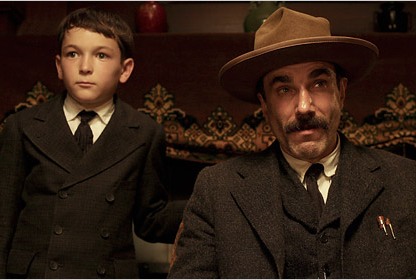 In the opening sequence of Paul Thomas Anderson’s passionate but flawed There Will Be Blood, it is 1898, and a man named Daniel Plainview (Daniel Day-Lewis), alone and driven, casts himself into a dark, dusty hole and hews mineral wealth from the surrounding rock. After suffering a nasty leg injury therein, Plainview hauls himself out of the deep recess through sheer grinding will and, in an act of Herculean exertion rivaling the endgame of Touching the Void, crawls across the sun-baked earth on his back, precious nuggets of silver in hand. This sweating, teeth-gnashing endeavor is an apt metaphor for Anderson’s film. There Will Be Blood looks beautiful, and it has moments of poetry in it. But, like Plainview (and The Assassination of Jesse James, another transplanted 70’s western out this year), it also wears its ambition on its sleeve, and it strains so hard to seem an instant movie classic that it eventually loses its way. (The mostly atonal and distracting Jonny Greenwood score, reminiscent of The Shining, unfortunately doesn’t help.)
 Now, in the interest of full disclosure, Paul Thomas Anderson is a director I’ve never warmed to. I thought Boogie Nights was decent but overlong and I had a visceral dislike for both Magnolia and Punch-Drunk Love. (I haven’t seen Hard Eight.) Still, while I think this is Anderson’s best and most accomplished film, and it’s probably worth sitting through for the first third regardless, There Will Be Blood eventually bogs down in some of the usual PTA indulgences. In addition, Daniel Day-Lewis never gives a bad performance and is typically magnetic here, but he also gets more actorly and mannered as the film progresses, and is loonily over-the-top in Blood‘s disastrously misconceived closing moments. (That being said, I wouldn’t be surprised if “I drink YOUR milkshake!” gets some run in the cultural lexicon of useful and memorable movie quotes.) In short, There Will Be Blood is a good film, in some ways even a very good one. But it’s not the landmark masterpiece many reviewers are making it out to be, and it slips into murk well before the end.
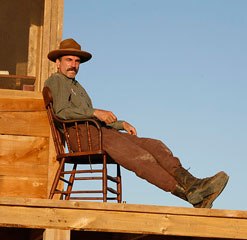 Straying rather far from the Upton Sinclair tome that inspired it, Blood is, in effect, a character study about the dehumanizing consequences of naked ambition. (If that sounds like Citizen Kane, you’re on the right track. PTA is borrowing from Welles, Malick, and Kubrick rather than Altman or Scorsese this time ’round.) After the 1898 prologue, we pick up Daniel Plainview’s story a few years later: He’s moved from silver to oil and has been successful enough to hire on a few workers, one of whom has brought his infant child with him on the dig. Alas, tragedy — a pretty common occurrence in the turn-of-the-century oil business, it seems — strikes at the workplace, and the child becomes Plainview’s. By 1911, this now ten-year-old boy (Dillon Freaser) has become a valuable part of the family business — He’s the silent partner Plainview uses to soften his pitch when dealing with locals or landowners. In any event, the oilman (as he prefers to be known) one day gets a tip from a traveler (Paul Dano) about a town where the black gold literally seeps from the ground. Soon, the Plainviews set up shop in this California hamlet, named Little Boston, and start buying up the place. But standing in his way is another ambitious soul, the evangelical preacher Eli Sunday (also Paul Dano), and he doesn’t want a rival for the town’s admiration. There’s only room for one Great Man in Little Boston…but will his symbol be the Derrick or the Cross?
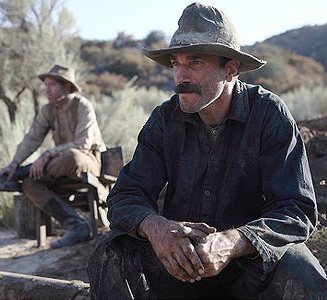 So, as you can see, what we have here is John D. Rockefeller versus Elmer Gantry, commerce versus religion, another virulent intersection of the black gold, texas tea and that old-time fundamentalist religion. But don’t go in expecting Syriana in Progressive Era California just yet. In fact, Blood turns out to be barely political at all. (Somewhere, Sinclair sighs.) Anderson puts several interesting ideas and characters in play, and the first third of the movie is absolutely gripping stuff. But, unfortunately, once all the derricks are in a row, Anderson doesn’t seem to know what to do with them. And so, right around the time Plainview’s first rig goes up in flames, There Will Be Blood begins to stall out. There are some clever reversals in the oilman-churchman balance of power thereafter (the baptism scene, for example), but the movie doesn’t really go anywhere. Instead, for most of the rest of the film, PTA goes back to his well and focuses once again on his pet issue, the meaning and importance of family. (See also Magnolia, Boogie Nights, and, from what I’ve heard, Hard Eight.) He brings a long-lost half-brother (Kevin O’Connor) into the story, has Plainview take extreme umbrage at any suggestion he’s a deadbeat dad, and starts dwelling on the brewing discord and enmity between father and son. (Also a major factor in Oil!, although it’s done rather differently.) Of course, Anderson can be forgiven for concentrating on what most interests him, and plenty of very good directors — maybe even all of ’em — have a tendency to keep ruminating on the same thematic content. Still, given how intriguing There Will Be Blood plays for its first hour, it’s a significant letdown to see PTA fall back into the same old, same old.
 Unfortunately, once the spell of Blood is broken, other bad habits of Anderson’s start becoming harder to ignore. Clearly good about giving actors room to breathe (maybe too much room, given DDL’s going off the rails in the final reel here), Anderson can also be distractingly showy (the Scorsese steadicam business in Boogie Nights, for example.) He has a tendency to beat quirky ideas into the ground (Exodus 8:2, the harmonium in Punch-Drunk Love), can hinge a sequence on some really lousy dialogue (“I’m silently judging you“), and often lets scenes meander for several beats too long (anything involving the quiz show in Magnolia.) These tics are more subdued in There Will Be Blood than in any of Anderson’s previous movies, but they become manifest as the film loses focus, and well up with explosive force in the last act. Set in 1927, with Plainview now a wealthy but dissolute drunk in his own Xanadu and Sunday an Aimee Semple McPherson of sorts, the final showdown between our two antagonists is a misfire on multiple levels. Not to give the story away, but the scene relies on far too many suspensions of disbelief. (Why would Sunday come to Plainview, of all people? Would Sunday really not get it beforehand? And, how the heck did he lose money in the stock market in 1927? Note this site: “From 1926 to 1929, the market indices moved up nearly 400%.“) Worse, both Day-Lewis and Dano start blatantly overacting. (Somebody please take that plate of chicken away.) And, what with the bowling alley and milkshakes and whatnot, the last act of There Will Be Blood even comes across as downright silly. It’s an ignominious end for a film that, for its first hour or so, had all the makings of a masterpiece. But, sadly, the gears end up grinding too loudly on this rig, and, just as pride goeth before a fall, it all eventually comes to a crash. Oil is a tricky business.
Tortured Reasoning.
“The grim truth is, not much has changed. The Bush administration continues to limit our basic freedoms, conceal its own worst behavior, and insist that it does all this in order to make us more free.” As a follow-up to her 2006 list of civil liberties violations, Slate‘s Dahlia Lithwick surveys The Bush Administration’s Top 10 Stupidest Legal Arguments of 2007.
Desktop Timesuck.
Just in case you were lacking for things to do this New Years’ Eve, two rather addictive online games: First up, Desktop Tower Defense, which my family spent a good deal of time on over the Christmas break. Second, Travelpod’s Traveler IQ Challenge, a test your geography knowledge sorta thing. So long, Spider Solitaire.
Figwit, get an eyepatch.
Wait, what? Maybe I’m just late to the plastic pantomime, but my sister informed me over the holidays that Bret McKenzie of Flight of the Conchords was previously Figwit(!) Strangely enough, I’d never made that mental connection. In any case, in honor of one of my two favorite new shows of 2007 (the other being Mad Men), here’s one of the funnier television moments of the year: Jemaine as Bowie (Ashes, Labyrinth.) It is quite freaky, isn’t it?
Nothing halfway ’bout the Iowa way.
“‘I’ve never seen anything like it,’ Gov. Chet Culver, a Democrat who has not endorsed anyone in the race, said in an interview in his office on Friday. ‘The get-out-the-vote efforts are going to be the best ever.’” As Iowa looms next Thursday and the polls still suggest a virtual dead heat, the Dem candidates ready the ground troops. (Zogby has Clinton at 31% to Obama’s 27% and Edwards’ 24%. McClatchy puts Edwards in front with 24%, followed by Clinton at 23% and Obama at 22%.) “The developments reflect the tightness of the race…and the dynamics of an unusual contest where so few people vote: about 125,000 in the Democratic caucus of 2004. Aides to the candidates said this contest could be determined by a swing of as few as 1,000 voters.“
A Death in Pakistan.
Benazir Bhutto, 1953-2007. It seems all too many christmases of late has been marked by grim news on the global front, from the devastating tsunami to the botched Saddam execution. This year, obviously, it was the assassination of the former prime minister who, while no angel, nevertheless embodied for many hopes for a stable, democratic Pakistan. Her murder — in the military stronghold of Rawalpindi, no less — further destabilizes a nuclear-armed nation already teetering on the brink, and roils significantly the Dubya administration’s fatally flawed approach to the country. Let’s just hope Bhutto isn’t remembered as the next Franz Ferdinand.
A Hard Walk’s Run.
 Charles, Cash, Curtis, Dylan, Strummer…Given the glut of rock biopics and documentaries we’ve seen in recent years, it’s well past time that influential musical chameleon Dewey Cox got his due. Unfortunately, just as James Mangold’s Walk the Line felt too staid and conventional to capture the true appeal of the Man in Black, Jake Kasdan’s Walk Hard: The Dewey Cox Story — which I saw in the days before Christmas — never really gets inside the head of the Giant Midget. Sure, it covers most of the important facts about his life — the childhood tragedy, the struggle with smell-blindness, the breakout single, the dark f**king middle period, the LSD decade, the selling out. But, while John C. Reilly does what he can as Cox (and the resemblance is admittedly uncanny), I never felt while watching Walk Hard that Kasdan actually “got” the man or his music…or his monkey or giraffe, for that matter. Given his famous father and his earlier affiliation with Freaks & Geeks, Kasdan seemed like he would be the guy to do Cox justice, but this is sadly a missed opportunity. It’s just too bad Todd Haynes was busy with I’m Not There…Once again, nearly fifty years after the fact, Zimmerman will be walking-hard away with all Dewey’s laurels.
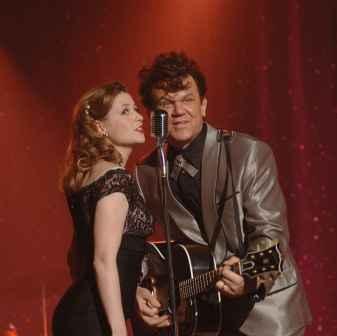 Kasdan’s take on Dewey’s story begins just before Cox’s final performance at the Lifetime Achievement Awards — You may remember Eddie Vedder’s memorable tribute speech, and the Jewel/Lyle Lovett/Jackson Browne/Ghostface Killa mash-up of “Walk Hard” got a lot of radio run over that summer — before flashing back to that defining moment in the White Indian’s life as a boy, the famous accidental cleaving-in-two of his prodigy brother. (“I’m cut in half pretty bad, Dewey.“) Rallying to his brother’s fallen musical standard, the teenage Dewey soon finds himself thrown out of the house, married young (to Edith, as played by SNL’s Kristen Wiig), and working as a busboy at a local black club, where he one day wows the crowd with a version of his early hit, “(Mama) You Got to Love Your Negro Man.” Soon thereafter, he lands a band and a record contract, and after the cutting of “Walk Hard,” the rest is history: Cox buys a monkey, lapses into a vicious drug habit, falls for his voluptuous backup singer Darlene Madison (Jenna Fischer), gets clean, lapses into another vicious drug habit…well, you know the rest.
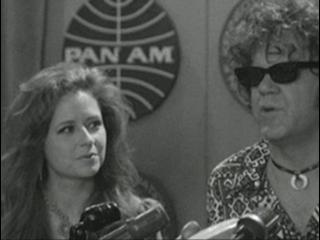 Ok, ok, let’s go ahead and break the fourth wall. As a played-straight parody of the rock biopic genre, Walk Hard is admittedly uneven most of the time. But, it makes for a relatively amusing two hours if you’re in the mood for it. It’s nowhere near as funny as the original Airplane or Top Secret, but I’d say it holds its own with the Hot Shots flicks, and it’s miles above Scary Movie and its ilk. Yes, the film can be unfocused and scattershot (There’s even a decently funny recurring gag involving the kitchen sink.) A lot of the jokes seem like leftovers from the last Will Ferrell script, and, like Trey Parker and Matt Stone’s Team America, Walk Hard occasionally follows the beats of its object of parody so closely that the movie loses its edge. Still, there are definitely some quality moments therein, from Tim Meadows trying not to seduce a naive Dewey into a marijuana habit to Cox meeting Buddy Holly (Frankie Muniz, inspired casting) and the Fab Four (Surprisingly, Justin “Mac Guy” Long is far and away the funniest as George, while Jack Black’s Paul is woefully bad and Paul Rudd’s John is just…strange.)
 At any rate, I’m not going to give all the jokes away here, suffice to say that Cox’s black-and-white Dylan period tickled my funny bone the most. Dewey does two Dylanesque ditties here: The first, “Royal Jelly”, is a gloriously inscrutable poetic epic a la “Desolation Row” (“Mailboxes drip like lampposts from the twisted birth canal of the coliseum, rimjob fairy teapots mask the temper tantrum, O say can you see ’em?“) [See it live.] The other, “Let Me Hold You (Little Man)“, is an un-PC The Times They Are A Changin’ screed directed at the injustice faced by all the, uh, little people. (“Let me hold you, midget man, pretend that you’re flying in space. Let me hold you, little man, so the dog will stop licking your face.“) High art it’s not, and I can’t recommend rushing out and seeing it or anything. But, for a few solid chuckles over the course of two hours, Dewey Cox and Walk Hard deliver the goods decently enough. Someday — perhaps soon, given that Forgetting Sarah Marshall, Pineapple Express, and Drillbit Taylor are all due next year — the helium will probably leak out of the Judd Apatow comedy factory’s balloon. But Cox, thankfully enough, isn’t the canary in the coalmine just yet.
Third of a Century.
As of today, I’m 33. More to come soon — for now, I have to return a rental car (I’m back in NYC) and then, as per the birthday norm, hit up the cineplex…most likely for There Will Be Blood. See y’all in a few.
Christmas on Earth.
