The Ambient Bones.

As discovered while tracking down the first three Coraline posters above: In an intriguing meeting of the minds, it seems Peter Jackson has locked down the very talented Brian Eno to score The Lovely Bones for him.

For a possible taste of things to come, you really can’t go wrong with “By this River” (or anything off of 1977’s Before and After Science, for that matter) or “And Then So Clear,” from 2005’s Another Day on Earth.) As these two songs suggest, Eno will no doubt come up with something appropriately ethereal, evocative, otherworldly, and beautiful for Jackson’s long-awaited adaptation.

The Conchords Fly Again.

Bret? Present. Jemaine? Present. Murray and Mel? Present. Figwit? Present. Ziggy-era Bowie? Present. The novelty-music paparazzi? Present. All the ladies in the world? Present. It sounds like everyone who’s anyone is present and accounted for, so cue the second season premiere of Flight of the Conchords, now on FunnyorDie through the 21st (and appearing on HBO beginning January 18.) I haven’t watched it yet, but i believe I’ll do so directly.

The Man of the Hour.

So, can you guess who TIME’s Person of the Year for 2008 turned out to be?

Not a huge surprise of course. Regardless, in honor of the occasion, and since now seems as good a time as any to fire up the 2008-in-retrospect train, below are some of the longer GitM essays on President-elect Obama over the past year and change. (And if you’re really a glutton for punishment, and want to relive all the debate coverage or somesuch, there’s always the election 2008 archives.)

  • Progressivism, a Born Loser?, “Progressivism Continued” — November 2007. Wherein the case is made that [a] Obama is more progressive than he is liberal and that [b], contra friend and colleague David Greenberg, that’s exactly what America needs right now.
  • IA-Day | GitM for Obama” — January 2008. An overview of the Democratic field as it stood the morning of the Iowa caucus, and an endorsement of Barack Obama.
  • The Future Begins Now,” “Iowa By the Numbers” — January 2008. On Senator Obama’s victory in the Iowa caucuses.
  • Barack Obama and the Generation Gap” — January 2008 — A plea to Baby Boom voters, borrowing heavily from my man Bob Dylan, to get behind Sen. Obama.
  • Greenberg: Missing the Thread” — January 2008. Arguing, again with friend David Greenberg, that there is much more to Obama’s candidacy than just the “Great White Hope.”
  • The Great Need of the Hour” — January 2008. An excerpt from then-Senator Obama’s MLK day speech.
  • Yes, We Can,” “Oh Carolina!” — January 2008. Excerpts from Sen. Obama’s speech, and parsing Obama’s victory, in my home state of South Carolina.
  • A President Like My Father,” It is Time Now for Barack Obama” — January 2008. Excerpts from Caroline and Ted Kennedy’s respective endorsements of the Senator.
  • “Empty Suit…with a Stovepipe Hat” — January 2008. The Tribune‘s Eric Zorn makes the Lincoln v. Seward comparison explicit.
  • Lakoff on the Dem Divide” — January 2008. Linguist and political theorist George Lakoff endorses Obama.
  • Showtime | Barack Obama for President” — February 2008. A round-up of Obama endorsements, and primary news thus far, on Super Tuesday.
  • We’re Going the Distance” — February 2008. Parsing the Super Tuesday results.
  • Obama Endorses La Follette” — February 2008. In Wisconsin, Obama rhetorically tips his hat to the progressives of yesteryear.
  • Dodd Comes Forward” — February 2008. Senator Chris Dodd becomes the first former primary opponent to endorse Obama.
  • We are Hope Despite the Times” — March 2008. Michael Stipe endorses Obama.
  • Stepping Back for the Big Picture” — March 2008. On the state of the race during the six-week Pennsylvania lull.
  • A More Perfect Union” — March 2008. On Senator Obama’s “Race in America” speech.
  • Our Five Year Mission” — May 2008. Barack Obama and others respond to the fifth anniversary of “Mission Accomplished” in Iraq.
  • So Happy Together… | It’s On.” — May 2008. The McCain-Obama general election unofficially begins.
  • The Lesson of the Ring” — June 2008. Some closing thoughts on the seemingly never-ending 2008 Democratic primary.
  • The Nominee” — June 2008. Excerpt from Sen. Obama’s nomination-clinching victory speech.
  • The Bygones are Bygones” — June 2008. Senators Obama and Clinton make peace.
  • Obama: Don’t Tread on Me” — June 2008. Thought on and excerpts from Sen. Obama’s “patriotism” speech in Independence, MO.
  • Wir sind alle Berliners” — July 2008. On Sen. Obama’s summer world tour and speech in Berlin.
  • That’s Me in the Corner…” — August 2008. On Sen. Obama’s visit to Chesapeake, VA, which I attended.
  • The Ticket” — August 2008. Sen. Obama chooses Joe Biden as his running mate.
  • Wow,” “Obama: The Main Event” — August 2008. Reflections on my visit to Denver, and Sen. Obama’s nomination speech.
  • Astride the Mad Elephant” — October 2008. On the sad turn taken by the McCain campaign.
  • Barack Obama for President” — November 2008. The closing argument for Sen Obama, on election day.
  • 44,” “Thoughts after the Quake” — November 2008. Early reflections on the election of Barack Obama.
    Phew, what a long, strange trip it’s been! Of course, in all the important ways, we’re only just getting started.

  • My (Vampire) Bodyguard.

    If you’re looking for a quality film before the coming holiday deluge (or, if you’re like me, and can pretty much tell from afar that Twilight likely won’t be your bag), look no further than Tomas Alfredson’s taut, eerie vampire flick Let the Right One In, which I caught over last weekend. A Swedish import that combines elements of the age-old vampire mythos with My Girl, My Bodyguard, and Morrissey (hence the title), Let the Right One In moves and feels like a particularly well-crafted Stephen King short story (or perhaps a bleaker version of one of Guillermo del Toro’s Spanish Civil War fairy tales), and definitely makes for a compelling nightmare before Christmas if you’re in the mood for it. Just make sure you’re nice — but not too nice — to any kids you meet along the way to the theater.

    As Let the Right One In opens, we find ourselves in a run-down apartment complex in deepest, darkest seventies Sweden, where dreams die hard amid the endless snowdrifts, there’s never enough vodka to go around, and even the very occasional blood-red flower can’t enliven the grim and ubiquitous combination of freezing winter weather and cookie-cutter architecture. Here we meet Oskar (Kare Hedebrant), a lonely, preternaturally blonde young lad from a broken home, who spends his days getting picked on by the school bullies and his nights playing with a knife and plotting revenge. It’s on one of these nocturnal escapades that Oskar encounters Eli (Lina Leandersson), a lissome 12-year-old girl (“more or less“) who’s just moved in from parts unknown, on the complex jungle gym. Pleasanties are exchanged, a Rubik’s Cube is passed back and forth, and, by that innocent alchemy of childhood, a strong friendship forms between these two outsiders.

    But, as you probably guessed, there is more to Eli than meets the eye, much more. She’s only out at night. She’s astonishingly agile at times. She’s always underdressed for the unforgiving Swedish cold. Oh, and she occasionally dispatches her “father” Hakan (Per Ragnar) to retrieve gallon-buckets of warm human blood from unsuspecting victims. (Hakan’s role — is he really Eli’s dad, or her Renfield, or is he just suffering from [rimshot] “Stockholm Syndrome”? — is never fully spelled out, but the story takes on a darker cast if you go in one particular direction with it.) So, yes, Eli, we discover, is a nightfeeder, a Nosferatu, a vampyrer, as the Svenska say. But, really, when you get right down to it, who is Oskar to judge? Everybody’s got problems.

    I don’t want to say too much more about Let the Right One In, as there’s not a lot of story there, to be honest. (In fact, if anything, the movie could’ve benefited from more of a third act — I think most people will expect the jag it takes then to have happened a good hour beforehand.) Where the film really succeeds is as a mood piece. On one hand, like that flower budding in the dead of winter, Let the Right One In tells the story of an impossible friendship blooming in seemingly the deadest of dead-ends. At the same time, bad things seem to happen to anyone — be it Hakan or the woman who survives one desperate attack (two, if you count cats) or the gaggle of alcoholics and losers usually fed upon — caught up in Eli’s wake, so why should Oskar’s fate be any different?

    The film is an adaptation of a book by John Ajvide Lindqvist, and at times it feels as naturalistic, character-driven, and hyperliterary an endeavor as In the Bedroom or Little Children. There’s definitely some gore here and there, but as with the best horror stories, Let the Right One In is most frightening in the realm of ideas, and for what it doesn’t ultimately show or explain. (And, while I can’t be entirely sure, I have strong suspicion that it’s considerably more suspenseful — and undoubtedly less hormonal — than the recent Stephenie Meyer adaptation currently in a theater near you.)

    A Measure of Darkness.

    “‘We’ve discovered this incredible dark energy, we don’t understand what the hell it is,’ said Lawrence Krauss, a physicist at Arizona State University. ‘It’s extremely small, extremely weak, and it’s so close to being zero, it’s just a total mystery why it should have this small value and not be zero.” While they’re still not entirely sure what in fact they’re looking at, Harvard-Smithsonian astrophysicists announce they’ve found another way to measure and quantify “dark energy”, a.k.a. the repulsive “cosmological constant” force causing the universe to expand rather than contract. “This is a much-needed confirmation that the earlier work was correct, the astronomers said, comparing it to football referees examining a controversial play with multiple camera angles.

    As an added bonus, the results announced today also seem to confirm Einstein’s general theory of relativity. “‘It’s never been proved right on the scale of the observable universe,’ Spergel said.

    Wilde and Garrett Log On.

    Best start working on your frisbee skills: Casting for Joseph Kosinski’s Tron 2.0 or (TR2N) begins, with Olivia WIlde of House and Beau Garrett of Turistas joining the returning Jeff Bridges back in the original matrix. “Wilde will play a worker in the virtual world who tries to help fight Master Control Program, the villainous intelligence protocol that was the nemesis in the original film. Garrett will play a siren in the virtual world.” Hmm, ok. Can we get David Warner in here somewhere? I know Sark is dead and all, but it seems like Ed Dillinger, the big bad of the first film, might well’ve made a backup, and Warner always adds a touch of class to the proceedings.

    A Shoe of Contempt.

    “I didn’t know what the guy said, but I saw his sole.” Say what you will about the 43rd president — and, no doubt, the history books will — the man has cat-like reflexes for his age. The story of the weekend was, of course, the shoe incident in Baghdad, which ended up clearly overshadowing Dubya’s remarks and reason for his visit — the signing of a Status of Forces agreement — and serving as an exclamation point of sorts for the president’s, shall we say, fraught relationship with the nation and people of Iraq. I have to give him credit, tho’ — Bush not only handled the incident with agility, aplomb and a surprising amount of sang-froid, but generally struck the right tone about it afterward. “Okay, everybody calm down for a minute. First of all thank you for apologizing on behalf of the Iraqi people. It doesn’t bother me. And if you want some — if you want the facts, it’s a size 10 shoe that he threw. (Laughter.) Thank you for your concern, do not worry about it.”

    In the wake of the biggest shoe-related world incident since Nikita Khrushchev (or perhaps Richard Reid), there’s been some discussion of late about the legitimacy of shoe-throwing as a form of political protest. (Throwing shoes into machines, a.k.a. “sabot-age,” is already generally considered a no-no.) It’s not hard to understand, or even empathize with, the anger that drove Muntadar al-Zaidi to this act of protest. Here’s a journalist who’s been covering airstrikes and Abu Ghraib, who has seen the “collateral damage” of this war-of-choice firsthand, and who himself was briefly arrested by American security forces at one point. That being said, to my mind, any attempted act of physical violence against the president — even something as seemingly innocuous as shoe-throwing — cannot be countenanced. Now, I’m not saying the guy needs to rot in jail for the rest of his life — far from it — but let’s not start pretending that that this form of protest is “ok.” It’s not. End of story.

    Plus, keep in mind that a horrible situation was averted by Bush here just by his underreacting estimably to the incident. I don’t think it’s a stretch to think that al-Zaidi may have put his life in danger by making a threatening lunge at the president. The Secret Service are — and have to be — a hair-trigger bunch. Ok, al-Zaidi was only armed with a shoe…anybody ever heard of Amadou Diallo? All too often, tragedy results from a simple misunderstanding of intentions. Mr. al-Zaidi made his point, no doubt…but it was still a stupid and dangerous stunt, by any reckoning.

    And besides, It’s all fun and games until somebody loses an eye.

    Canadian Bacon.

    Times are tough, bub. In a clear sign that the economic downturn is affecting actors and celebrities as much as it is ordinary working people, Danny Huston and Liev Schreiber pay off their mortgages alongside Hugh Jackman in the new trailer for Gavin Hood’s X-Men Origins: Wolverine. Ok, I kid, this doesn’t look completely terrible. But some of the shots here — particularly Jackman walking away from the explosion, hanging on to that chopper, or otherwise engaged in wire-fu — definitely have that C-movie, Punisher: War Zone feel to them. And after the directorial switcheroo that brought about the lamentable X3: The Last Stand (which has an equally overburdened title, come to think of it — what’s with the colons?), I’m not all that inclined to look charitably on Fox’s handling of this property anymore.

    Fanboy-wise, I had mostly checked out of X-Men by the time they began revisiting Wolvie’s origin every other year — most of the stuff I do remember involved Kitty Pryde and feudal Japan — so I can’t really speak to what’s going on in this clip in terms of comic continuity. That being said, I’ve always thought the cajun mutant cardslinger Gambit (here, Friday Night Lights‘ Taylor Kitsch, no pun intended) was a pretty goofy, throwaway character, n’est-ce-pas, mes amis? It is interesting to see (I think) Emma Frost pop up for a second, but, again, I’m much more familiar with the character in her old, Hellfire Club incarnation, before she pulled a Magneto somewhere along the line and got retconned into a X-member. (And I always thought, movie-wise, they should’ve cast Rosamund Pike for the White Queen, particularly in her ice-castle incarnation from the otherwise-completely-forgettable Die Another Day.)

    The Situational Ethicists.

    [Obama] should have, right from the beginning, been more forthcoming.” Uh…what? Former White House consigliere Karl Rove, he of the missing e-mails and the congressional contempt citation, takes it upon himself to lecture the incoming Obama administration on issues of transparency vis a vis the Blagojevich situation, which is a bit like listening to Dirty Harry tsk-tsk someone for not following standard police procedure. I’m sorry, Karl, but you don’t have much credibility when it comes to the “forthcoming” department. Not. at. all.

    The larger story here, of course, is the Republican attempt to ascribe nefarious deeds to the Obama team when it’s patently clear, from the transcripts and otherwise, that the incoming administration’s hands are clean in the Blagojevich matter. We’ve seen this movie several times before during the Clinton era, when conservatives, abetted by the lazy groupthink tendencies of certain scandal-hungry media outlets, conspired to create full-blown, prolonged investigations out of Whitewater and the like. Let’s hope we’re all a little bit wiser to the origins of such manufactured controversies nowadays.

    Whose Line is It, Anyway?

    “People you love will turn their backs on you. You’ll lose your hair, your teeth, your knife will fall out of its sheath, but you still don’t like to leave before the end of the movie.” Couple that sentiment by Cake with a more famous passage from Shakespeare — “All the world’s a stage, and all the men and women merely players” — and you’ve got a decently good starting point for approaching Charlie Kaufman’s wildly ambitious, often poignant, occasionally inscrutable, and ultimately somewhat uneven Synecdoche, New York. The film has been garnering breathless raves from some corners (Ebert is a particularly big fan), while other reputable critics have utterly loathed it. I’m closer to the positive camp — I don’t think the movie works at times, and it definitely takes some digressions that don’t cohere with everything else going on (the bizarre Hope Davis and “George C. Scott in Hardcore” tangents, for example)…but so does life, I guess, right?

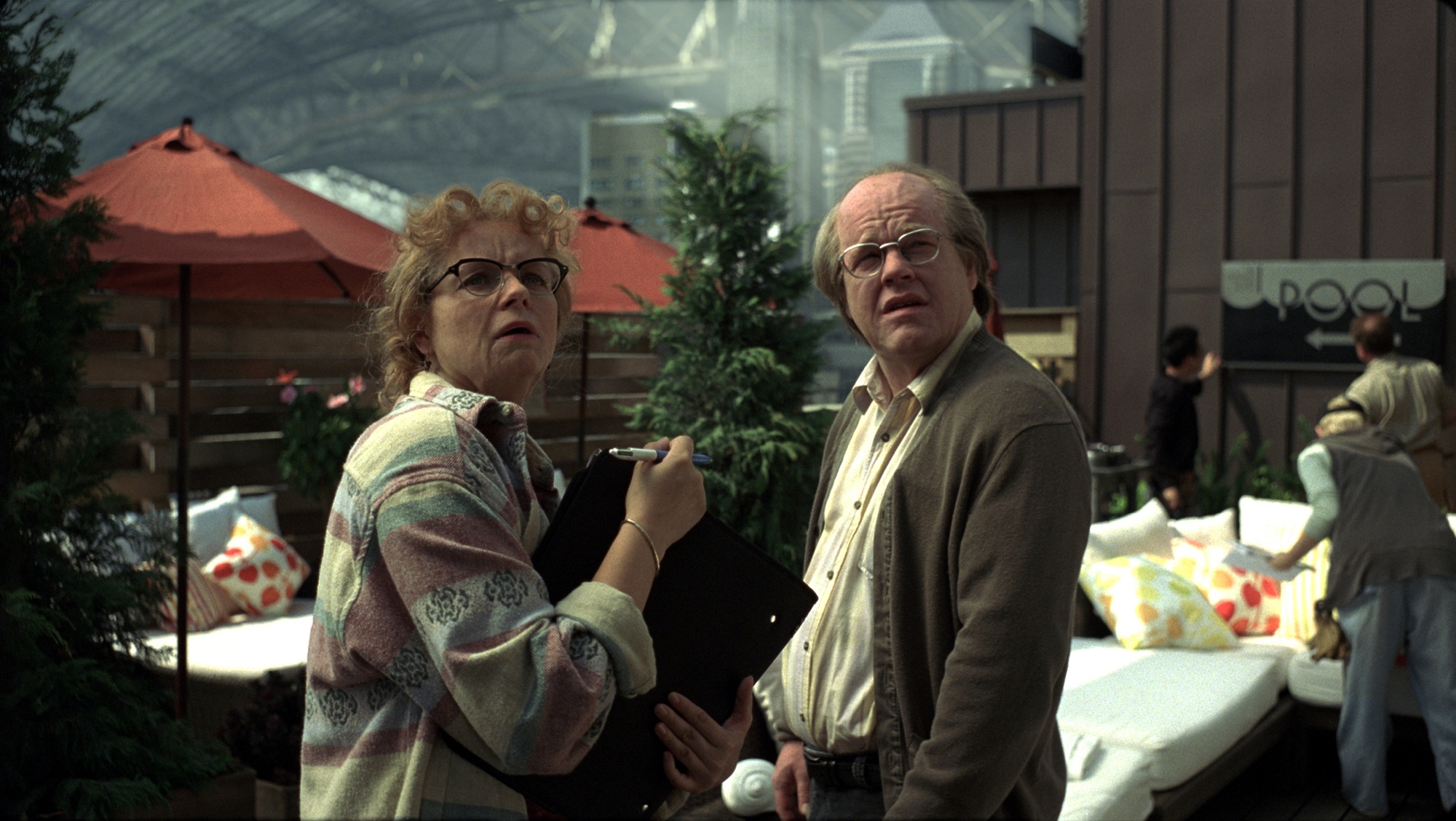
    At its start, we meet our protagonist, playwright Caden Cotard (Philip Seymour Hoffman), near the end of the rope. He’s a struggling, mostly miserable theater director in Schenectady, New York, with an increasingly distant artist wife (Catherine Keener), a distracted. self-promoting therapist (Davis), and a rash of new and rather disturbing health problems. (In short, Hoffman is about as happy in Schenectady as he was in Buffalo.) The only bright spots in his day, basically, are his adorable, inquisitive daughter Olive (Sadie Goldstein) and his half-hearted flirtations with Claire (Samantha Morton), the buxom girl who runs the box office, and Hazel (Michelle Williams), his lead actress in a youthful reimagining of Death of a Salesman. Depression, thoughts of (and worries about) infidelity, useless bouts of therapy, clinical hypochrondria, dwelling on mortality…If this all is starting to sound like a more expressionistic version of your standard-issue Woody Allen film so far, you’re in the right ballpark, at least for the first forty minutes or so. (And I mean that in the best way possible.)

    But then, things get stranger. As Caden’s wife Adele lights off to Germany with Olive in tow, and Caden manages to lock down a MacArthur genius grant for his next project, Synecdoche begins to venture deeper into Kaufman territory. Caden relocates to NYC, manages to negotiate an impossibly-large warehouse as his new theater space, and begins work on his magnum opus, a play that — through hundreds of thespians acting out daily victories and defeats — tries to recreate, and thus comment on, every facet of our quotidian existence. But where does the play stop and life begin? Caden soon finds he needs to cast an actor (Tom Noonan) to play himself directing, as well as actresses to portray the various women in his life. (In a clever bit of casting, Emily Watson ends up playing faux-Morton, which makes perfect sense given that they’re respectively the Dylan McDermott and Dermot Mulroney of indy British cinema.) And, later, when it seems individual identities might be getting in the way of the abstract universalism of the piece, well, maybe it’s time to just recast or rewrite Caden Cotard completely, don’t you think? It’s fine with him, to be honest — He’s gotten pretty damn sick of playing himself anyway.

    I’ve told you before, this is not a play about dating, it’s about death,” argues one character in Synecdoche near its conclusion. Caden demurs. “‘It is a play about dating. It’s not just a play about death. It’s about everything: dating, earth, death, life, family, all that.‘” Well, to be honest, that may be part of the ultimate problem here. Kaufman’s exquisite earlier effort, Eternal Sunshine of the Spotless Mind, is pretty much just a movie about dating (ok, and love, and loss, and memory…but bear with me here), and it’s all the more focused and moving because of it.

    By contrast, Synecdoche is kinda all over the place, and gets increasingly sprawling and messy as it goes on. The film is sometimes too clever by half and sometimes needlessly maudlin, and it barely keeps one foot on the ground in any event. Still, I definitely admired the degree of difficulty here, and applaud Kaufman for even attempting to say something profound and meaningful about the human condition, when most films just want me to feel satisfied that all the Act 2 loose ends were cleared up by Act 3. (Wow, those two crazy cats who met-cute in Act 1 got back together? Who woulda thunk it?) In that regard, I’m very glad I saw this movie — even if, as with, say, Primer, I’m pretty sure a lot of what was going on eluded me the first viewing — and I find my thoughts still returning to it several weeks later. While you may find Synecdoche boring and/or bewildering, and you may even end up hating it, I’m willing to bet dollars-to-donuts you haven’t seen a movie like it in quite some time, if ever.