
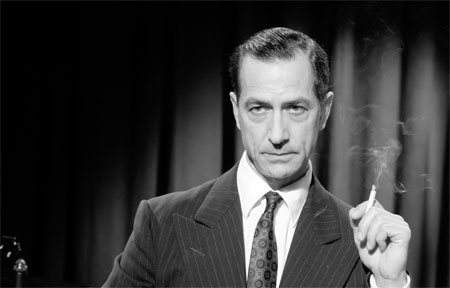
Exhuming McCarthy.


While perhaps a bit too black-and-white in terms of the history, George Clooney’s Good Night, and Good Luck is nevertheless a somber and captivating paean to Edward R. Murrow, his televised expose of Joe McCarthy, and, by extension, the Pioneer Days of Television Journalism. (In this last regard, it’s somewhat reminiscent of the excellent Clooney-produced live TV version of Fail Safe a few years ago.) It’s also assuredly a smoother, subtler, and more accomplished bit of muckraking than, say, Tim Robbins’ recent and lamentably over-the-top Embedded. Once again displaying the surprisingly strong directorial sense he exhibited in Confessions of a Dangerous Mind, Clooney also benefits here from a smartly written script which refuses to talk down to its audience, the crisp black-and-white cinematography, and quality performances across the board. As a result, what could have been an above-average History Channel documentary is instead a powerful and intelligent work of cinema that’s easily one of the better films out this year.

Admittedly, as Jack Shafer pointed out in Slate, Good Night, and Good Luck is rather narrowly focused, and works better as an impassioned and articulate morality play than it does as sound history. The Murrow of this film is saintly to a fault (although David Straitharn ameliorates this with a sardonic and multifaceted performance that may well get some nods come award time.) And there’s very little historical context offered herein, either for the origins of the McCarthy hysteria or for the Wisconsin Senator’s ultimate downfall, which had more to do with picking a fight with the army than with the Murrow broadcast.

That being said, I really like the way Clooney uses archival footage in this film. For one, Clooney was clever to follow Murrow’s example and let Joe McCarthy hoist himself on his own petard. Having the real McCarthy excoriate Murrow as the “leader of the jackal pack” gives the film a sense of history (and menace) that an actorly turn couldn’t have provided. For another, Clooney, who definitely appears to have done his homework, is unafraid to cut to real historical footage — the Annie Lee Moss hearings, for example — for extended periods, and just let the inherent drama of the real proceedings speak for itself. As a result, the history feels alive and contemporary, no mean feat when so many other historical films seem to use the past as merely exotic window dressing. Could the film have been more nuanced in its appraisal of both Murrow and McCarthyism? Undoubtedly. (Then again, nuanced appraisals weren’t exactly McCarthy’s strong point, either., nor is it a long suit of his current defenders.) But on the whole, Good Night, and Good Luck is, I think, a worthy exercise in historical filmmaking, and one with some obvious relevance in light of today’s entertainment-addled, sideshow-obsessed news media.

Movie-wise, there are a few small problems. I think the GN, & GL should have done either more or less with Robert Downey, Jr. and Patricia Clarkson as Wershbas Joe and Shirley — their particular plight doesn’t tie in to the rest of the story very well. And, while Ray Wise is good as the broadcaster-at-wits-end Don Hollenbeck, he’s also typecast in my mind — I kept expecting him to break into the Leland Palmer dance. All in all, though, Good Night, and Good Luck manages to enliven both the staid television studios of Fifties CBS and this historical moment with smoky jazz, languishing cigarettes, and ominous shadows. As the show says, see it now.
American Problems, Kryptonian Solutions.

“Even a criminal like myself is shocked that millions are not able to get health insurance and cannot pay for basic surgery. Who are these power brokers that allow the pigpen to become wormy and filthy? I demand your very lives, but I am not such an imbecile as to institutionalize suffering and poverty. You have my assurance that this shall change swiftly.” Three years to go and the 2008 slate is already filling up. For the Dems: Hillary, Biden, Bayh, Warner, and Feingold. For the GOP: Frist, McCain, and Brownback. And, although Chris Walken first seemed to have the Indy vote locked up (let’s face it, Cthulhu‘s missed His shot), word is the inimitable General Zod is now coming on strong. Hmmm. I could definitely see him pulling a Stockdale at some point in the debate. (By way of LinkMachineGo.)

Bipartisan Backlash.

“We are Americans, and we hold ourselves to humane standards of treatment of people no matter how evil or terrible they may be. To do otherwise undermines our security, but it also undermines our greatness as a nation.” Behind Sen. John McCain, who knows as well as anyone why we must set limits on our interrogation policies, the Senate votes 90-9 to rebuke the White House and constrain future interrogation abuses at Gitmo, Abu Ghraib, and around the world. For his part, Catkiller Frist earlier tried to smother the amendment, but ultimately ended up voting for it. Wouldn’t want a vote for torture on our 2008 transcript now, would we?

Karl Marked.

There is no reason for Rove to make this appearance unless he and his counsel believe he is at serious risk of indictment. None.” On the day after former White House procurement chief David Safavian is indicted on five counts of lying and obstruction of justice, Karl Rove decides to testify for a fourth time before the grand jury delving into the felonious unmasking of Valerie Plame (presumably to stave off his indictment, or that of someone above him.) So…Rove, Safavian, Libby, Abramoff, Frist, DeLay…how many investigations and indictments can the GOP leadership rack up? Is the whole rotten edifice of GOP corporate cronyism threatening to topple? One can only hope.

Harriet the Spy?

“She may turn out to be the greatest thing since Antonin Scalia, but when will we know that?” Two days after the Harriet Miers pick, and despite news reports accentuating her strong evangelicism, conservatives are still openly perturbed by the choice (George Will is particularly livid.) As for how she stands on the issues, we still know very little, other than her mixed record on gay rights and probable pro-life stance. (Well, presumably, she’s also pro-lottery.) Nevertheless, it sounds like she’s probably already got Harry Reid’s vote.

House of Shame.

“Thus began [in 1994] what historians will regard as the single most corrupt decade in the long and colorful history of the House of Representatives…[N]ever before has the leadership of the House been hijacked by a small band of extremists bent on building a ruthless shakedown machine, lining the pockets of their richest constituents and rolling back popular protections for ordinary people” By way of Cliopatria, Newsweek‘s Jonathan Alter surveys the corruption of Boss DeLay’s ring, with an eye to history. Update: And, wouldn’t you know it, Boss DeLay has been indicted again, this time for money laundering.

Round 2: Miers.

In the early morning, Dubya chooses White House Counsel Harriet Miers as the next Supreme Court nominee. (Searching far and wide again, I see.) Well, let the vetting begin. On the plus side, the fundies seem perturbed, and she has some Dem donations in her past. On the other hand, she’s a rabid Bush loyalist, calling him “the most brilliant man she had ever met.” (Get out much?) Update: The Weekly Standard‘s Bill Kristol is disappointed, depressed, and demoralized by the Miers pick, while Legal Times was already unenthused about her. Update 2: Slate‘s Dahlia Lithwick and Emily Bazelon are similarly nonplussed: “Can anyone really imagine that she’d be the nominee if she weren’t a woman and the president’s friend and loyal adviser? Cronyism and affirmative action: It’s a nasty mix.

Leakin’ Libby & Ramblin’ Rove.

“As the CIA leak investigation heads toward its expected conclusion this month, it has become increasingly clear that two of the most powerful men in the Bush administration were more involved in the unmasking of operative Valerie Plame than the White House originally indicated.” Bringing the somewhat bizarre recent revelation of Judith Miller’s source to bear on the story, the Washington Post surveys the roles of Karl Rove and Scooter Libby in Plamegate. “[Lawyers with inside info] surmise that [Special Prosecutor Patrick] Fitzgerald is considering whether he can bring charges of a criminal conspiracy perpetrated by a group of senior Bush administration officials..”

Empire Falls.

(Ring-)Breaking news: As with two of his Texas cronies, John Colyandro and Jim Ellis, Boss DeLay has been indicted on criminal conspiracy charges this morning, in connection with the grand jury probe into money laundering at TRMPAC. (TRMPAC itself was indicted a few weeks ago.) As a result, DeLay will be forced to step down as Majority Leader, to be replaced by (corrected, after a possible last-minute switcheroo) Roy Blunt of Missouri. (Of course, even if he beats this indictment, Boss DeLay is also being investigated by federal authorities for his role in the Casino Jack story.)

In 1994, the Republican Contract with America stated that the GOP would “restore accountability to Congress [and] end its cycle of scandal and disgrace.” Today, with the Republicans controlling both sides of Congress and the Oval Office, their leader in the House has been indicted as a criminal, their leader in the Senate is under dual investigations for insider trading, and the top moneyman in the White House was arrested only last week for lying and obstruction. (And that’s not even counting the inquiries into footsoldiers like Casino Jack Abramoff and Randy “Duke” Cunningham, or the continued investigation into Karl Rove’s role in Plamegate.) Simply put, the GOP leadership have broken their promise and embarrassed the nation with their rampant cronyism and illegality. It is time for them to go.

Update: While a vituperative Boss DeLay calls the chargesone of the weakest, most baseless indictments in American history,” (now that‘s a bold statement), the GOP look to Roy Blunt of Missouri (who will share power with Dreier) as their new leader.

Dubya’s 2nd Round Draft Pick.

“I will pick a person who can do the job. But I am mindful that diversity is one of the strengths of the country.” As the Roberts nod goes to the full Senate (my thoughts on Roberts below), Dubya hints at a woman and/or minority justice for O’Connor’s seat. With these parameters in mind, Salon‘s Tim Grieve surveys the most likely choices. Among them are faces familiar — Edith Clement, Priscilla Owen, and Janice Rogers Brown, for example — and unfamiliar, such as Maureen Mahoney, the “female John Roberts.” (And, of course, there’s always Gonzales, although his star seems to have dimmed.)