
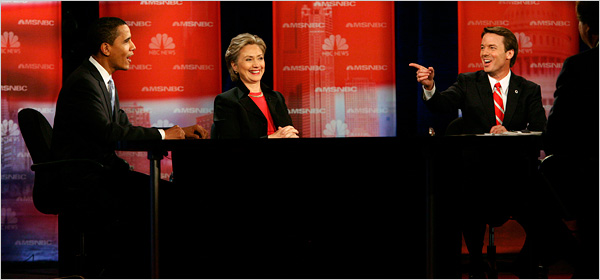
Back from the Brink.

Despite the best efforts of Tim Russert, who asked rinky-dink meta-questions about the past week for most of the first segment, the Democratic debate in Los Vegas was a pause for breath tonight, with Barack Obama, John Edwards, and Hillary Clinton all going out of their way to dial back the heat and try to bridge the identity politics chasms that have yawned open of late. As such, with all three candidates on their best behavior and looking to avoid direct confrontations that might get nasty, it was the type of debate that made the party and all three contenders look good, but also probably didn’t change very many votes.

From where I sat — and this will surprise exactly no one — I thought Barack Obama came off the best of the three. He seemed gracious in his call to move past last week’s racial firestorm and deflected the — many — attempts by Russert to re-inject race into the debate. He offered the only funny moments of the evening (Brian Williams thinking he was in LA notwithstanding) and seemed convincing and natural. And, perhaps most importantly, he displayed a command of policy specifics and a capacity for nuance, which once again belies the argument that he’s just a oratorical Hope machine. He seemed, in a word, presidential. (Although I do wish, when asked when he’d first decided to run for president, he’d simply said “kindergarten.”)

John Edwards was as good and on-message as always, but it didn’t seem like he managed to do anything tonight that would be a game-changer. (Then again, in an atmosphere of such explicit convivality as tonight, Edwards’ central message — I will fight for you! — didn’t have much of a chance to gain traction anyway. That being said, he did manage to trump Clinton’s dubious “35 years of experience” claim by announcing that “for 54 years I’ve been fighting with every fiber of my being.” 54 years of fighting? Hey, let’s not forget those nine months in the womb, there.) Edwards also brought up one of the first campaign finance questions we’ve heard in awhile — one in which Obama announced he’d ultimately be for public financing, which made me happy — but due to the moderators not seeming to understand their own rules, it never got around to Senator Clinton, where it was likely — and should have been — directed.

Hillary Clinton came across better tonight than she did in New Hampshire, and, to her credit, she also did her part to uphold the truce (at least in public.) But — again, not a shocker here — I still found her dismayingly evasive on several questions: on Robert Johnson (do you believe his ridiculous clarification or do you think his comments were “out of bounds”?), on whether her opponents were qualified (she couldn’t just say yes?), on the bankruptcy bill (you voted for it in 2001 but was glad it didn’t pass?), and of course, on the politics of fear question, to take a few examples. But, as always, she had done her homework, she smartly went after Dubya a few times, and she had the talking points ready to attack on the Yucca Mountain question. (Without meaning to dismiss the important issue at hand, it’s safe to say “Yucca” is apparently Nevadan for “ethanol.”)

So, at any rate, I’d say Obama came off the best tonight, but Edwards and Clinton were both solid as well. (And I would presume supporters of the other two candidates would say the same, with perhaps the names rearranged.) More than anything, tonight was a chance for tempers to cool and for the party to show it was ready — despite the best efforts of Mr. Russert — to discuss matters of substance again. Still, with Nevada this Saturday and South Carolina right around the corner, I wouldn’t expect the next debate to be so congenial.

Clinton’s Detroit Hustle.

Sigh…what manner of shadiness is this? As with the Nevada caucus lawsuit, it now seems Senator Hillary Clinton’s campaign is threatening to change the rules in Michigan. Last September, when Michigan and Florida tried to jump the gun on their primary process, all major candidates — including Clinton — pledged not to campaign there, and the DNC later stripped both states of their delegates. In accordance with the pledge, Barack Obama and John Edwards removed their names from the ballot (as did Joe Biden and Bill Richardson)…but Hillary Clinton did not. And so, today Michigan voters had the chance to vote Clinton or “Uncommitted” in a theoretically meaningless primary.

But now Senator Clinton seems to be looking to alter the deal. (Pray she doesn’t alter it any further.) From Salon‘s Tim Grieve: The Clinton camp now “seems to be hinting that it may fight to have delegates from Michigan and Florida seated at the convention after all. ‘The people of Michigan and Florida have just as much of a right to have their voices heard as anyone else. It is disappointing to hear a major Democratic presidential candidate tell the voters of any state that their voices aren’t important…Sen. Clinton intends to be president for all fifty states.‘” Once again, when in doubt, change the rules. One hopes the DNC stands firm on this issue, or this convention could get nasty.

Update: Speaking of the Nevada caucus lawsuit, President Clinton embarrasses himself further by vocally backing the attempt to remove casino caucus areas. Said the president: “Why ‘make a special rule only for these workers. For the rest of you other workers, tough luck. I think the rules ought to be the same for everyone,’ he said.I repeat: “Going back to last spring, every presidential campaign was involved in setting up the unusual casino caucus sites while state party officials and the Democratic National Committee ironed out the details.” Where was this outrage in the many months before the Culinary Union’s endorsement of Obama? Unbelievable. Update 2: Clinton also referred to Obama as the “establishment” candidate (in this union case) who’d only provide the “feeling of change.” Sigh…I’m getting the feeling of more of the same.

Update 3: Some angry teachers respond to the suit filed by their union: “These at-large locations were approved back in March of 2007, and no one raised any concerns about them for nearly a year…This lawsuit is all about politics…[T]hey’re using our union to stop Nevadans from caucusing for Senator Obama.” Meanwhile, the DNC files a motion to intervene on behalf of the State Party (i.e. against the suit), and Sen. Reid remains conspicuously silent. Update 4: Bill Clinton angrily backs the suit again…while offering misleading statements about it. (The problem with the “five times”…uh, obfuscation…is explained here.)

Payne was Prescient.

“It’s like my mom says, ‘The weak are always trying to sabotage the strong.’” While contemplating the Democratic primary race, Slate‘s Andy Bowers uses a monologue by Election‘s Tracy Flick to eerie effect.

Are you experienced? Uh…

“Clinton’s claim to superior experience isn’t merely dishonest. It’s also potentially dangerous should she become the nominee. If Clinton continues to build her campaign on the dubious foundation of government experience, it shouldn’t be very difficult for her GOP opponent to pull that edifice down. That’s especially true if a certain white-haired senator now serving his 25th year in Congress (four in the House and 21 in the Senate) wins the nomination. McCain could easily make Hillary look like an absolute fraud who is no more truthful about her depth of government experience than she is about why her mother named her “Hillary.Dennis Kucinich has more government experience than Clinton. (He also has a better health-care plan, but we’ll save that for another day.)”

So…now that we’ve (hopefully) stepped back from the abyss of identity politics, where does that leave us? Ah, yes, hope vs. experience. Well, drawing on this NYT story of several weeks ago, Slate‘s Tim Noah argues that Clinton’s claims of superior experience just don’t hold up, and particularly once you factor in John McCain. “Oh, please. Thirty-five years takes you back to 1973, half of which Hillary spent in law school, for crying out loud. I don’t mean to denigrate her professional experience…But in government, Clinton’s chief role over the years has been that of kibitzer.Update: Speaking of Dennis Kucinich, he’s back in tomorrow’s Nevada debate. Update 2: Nope, he’s out again, by decision of the Nevada Supreme Court.

Obama: Let’s Move On.

Saying he was “concerned about the tenor of the race in these past few days,” Senator Barack Obama moves to quell some of the arguing over identity politics this past week.

Concerning Sen. Clinton’s LBJ history lesson: “‘I don’t think it was in any way a racial comment,’ Obama told ABC News. ‘That’s something that has played out in the press. That’s not my view.’ But, he said, the comment was revealing about her political character. ‘I do think it was indicative of the perspective that she brings, which is that what happens in Washington is more important than what happens outside of Washington,’ he said. He said he believes the quote betrays a belief on her part, ‘that the intricacies of the legislative process were somehow more significant than when ordinary people rise up and march and go to jail and fight for justice.’ He called that a ‘fundamental difference’ between them.

Concerning Bill Clinton’s fairy tale: “[A]gain, Obama looked past the racial controversy. Instead, Obama directed his response to the dispute over whether opposition to the Iraq War was consistent. (Clinton has since reiterated that is what he meant when he invoked the ‘fairy tale’ line.) ‘Both he and Sen. Clinton have been spending a lot of time over the past month trying to run down my record,’ Obama said. ‘What particularly distresses me is this notion that I wasn’t against the war from the start. This is coming from a former president who suggests that he was and nobody can find any record of it,’ he said.

A great, classy response. The Clinton strategy only really works if you play along. As my old employer, James Carville, was wont to put it, “Don’t waste your time wrestling with a pig. You just dirty, and the pig loves it.” (And, just to avoid confusion and just as McCain with Romney, I’m not calling the Clintons porcine, even if they have engaged in some swinish political tactics of late. It’s a figure of speech.)

Update: Senator Obama continues in the same vein at a press conference this evening. Speaking of a possible Bradley effect in New Hampshire, Senator Obama said: “I don’t think that’s what was going on…as I understand it, basically there was a big shift in undecided’s going towards Sen Clinton, particularly among women in the last minute. And keep in mind there was a big gap, a gender gap that cut both ways — I won among men and she won among women — there were more men than women who voted. If it had been a racial issue, there’s no reason why that would have been something that was unique to women as opposed to men, so I don’t’ think that is the case.

Update 2: Speaking yet again of Clinton’s “fairy tale” rant, it seems another — substantive — deception has emerged from Clinton’s remarks (and Hillary’s statement on MtP.) Did you notice how they both keep mentioning anti-war opponent Chuck Hagel? “[T]he talking point appears to misconstrue the facts.”

Update 3: Sen. Clinton seconds the call for truce, although she then somehow failed to get word to Charlie Rangel.

Clinton’s Racial Provokatsiia.

We seem to be at the point where there are now two credible possibilities. One is that the Clinton campaign is intentionally pursuing a strategy of using surrogates to hit Obama with racially-charged language or with charges that while not directly tied to race nonetheless play to stereotypes about black men. The other possibility is that the Clinton campaign is extraordinarily unlucky and continually finds its surrogates stumbling on to racially-charged or denigrating language when discussing Obama.TPM‘s Josh Marshall ponders the last week in politics, while going on to defend Clinton’s “fairy tale” remark as untinged by race. (I would agree — I found it dismaying for other reasons, which I’ve explained twice, and which The Nation‘s David Corn also finds reprehensible — the Rovian swift-boating of Senator Obama’s stance on the Iraq war.)

Another commenter at TPM aptly characterized what the Clintons have been doing here (the “rope-a-dope” strategy I outlined in the comments the other day.): “I think that the Clintons’ anti-Obama strategy is more subtle than commentators are realizing. It is in the nature of a ‘provokatsiia’, as the Russians say…Such comments are a provocation, waving a red cloak in front of the Obama people. When they respond angrily with charges of racism, suddenly they look like Jesse Jackson redux…just the kind of angry, militant black folks who scare white people…The whole point was to get the Obama people to respond angrily, which they did. Clintons win.” And we all get dirty.

Update: “Is it possible that accusing Obama and his campaign of playing the race card might create doubt in the minds of the moderate, independent white voters who now seem so enamored of the young, black senator? Might that be the idea?” The Post‘s Eugene Robinson sees a similar strategy at work.

Update 2: As does Margaret Carlson: “While it isn’t clear from whose sleeve the card was pulled, it is likely it wasn’t from the person with the most to lose. If Hillary Clinton’s campaign had taken only one shot at Obama, it might have been blown off as a mistake. But four shots constitutes a pattern.

Update 3: As does the New York Times: “By the time the campaigns got to New Hampshire, the Clinton team was panicking…It was clearly her side that first stoked the race and gender issue.

The Obama Record: Consensus.

In Washington, Obama continued to work on ethics issues, teaming up with fellow Democrat Russ Feingold after a series of national scandals surrounding GOP lobbyist Jack Abramoff. Their legislation required more disclosure of pork-barrel spending and the ‘bundlers’ who collect large campaign contributions. James Thurber, director of American University’s Center for Congressional and Presidential Studies, says Obama deserves much of the credit for the cleanup. ‘I think he was one of the major forces behind the provisions that came out in the act,’ says Thurber, who testified to Congress on the issues. ‘He held meetings, a lot of cross-party ones. He was trying to find support where he could.’” A thoughtful Newsweek piece by Richard Wolfe and Karen Springen examines the consensus-building nature of Obama’s leadership in both the Illinois and U.S. Senate. “Hillary Clinton says Obama’s ethics reforms left too many loopholes…Yet Clinton herself was one of 20 Democrats who rejected the Office of Public Integrity idea.

Greenberg: Missing the Thread.

In the Washington Post, Rutgers historian David Greenberg calls Barack Obama the “great white hope”, and argues that his broad-based appeal amounts to little more than “a fantasy of easy redemption…Inspiring and exhilarating as it is, Obamamania allows us to sidestep the hardest challenges, at least for now.” Now, Greenberg is a friend and colleague with whom I’ve disagreed in the past. Still, with all due respect, this is about as wrong as I’ve ever seen him, and, by putting so much argumentative emphasis on race, this article veers dangerously close to being the historian’s version of the “imaginary hip black friend” argument of earlier in the week. My quick response, originally posted over at Cliopatria, is below.

The problem for me with Greenberg’s piece is that he too readily dismisses the ideological appeal of Obama’s candidacy in one sentence. “On the contrary, Obama’s ideology, insofar as he has articulated it, seems to be a familiar, mainstream liberalism, heavy on communitarianism. High-minded and process-oriented, in the Mugwump tradition that runs from Adlai Stevenson to Bill Bradley, it is pitched less to the Democratic Party’s working-class base than to upscale professionals.

I consider Greenberg a friend and an excellent historian, but as I’ve written before, I disagree with him fundamentally on this point. Obama’s language of civic-minded progressivism cannot be dismissed so readily. It’s a huge part of his appeal, bigger — to my mind — than the simple fact of his race. And by sloughing off Obama’s ideological appeal so quickly, Greenberg is then forced to overstate significantly the racial nature of Obama’s candidacy, and make extremely dubious claims about we Obama supporters looking for “easy redemption.”

Also, I’m by no means a reflexive Clinton-hater, although I do feel the past week in American politics has tarnished their legacy considerably. Still, I would not concur with Greenberg that Clinton managed to “formulate a viable and vital new liberalism.” The restoration of fiscal sanity in 1993 notwithstanding, by the middle of his first term, Clinton liberalism was in full rout, and it pretty much has been ever since. The remaining six Clinton years were spent mainly just triangulating madly to stay afloat.

Putting race aside — if we can still manage to do that after the past few days — Obama’s rhetoric calls for a repairing of the civic fabric and a progressive-minded style of governance that dreams big. And that — not easy fantasies of racial reconciliation — is what people are responding to. Without vision, the people perish…and, frankly, school uniforms and V-chips just aren’t going to cut it anymore.

Update: See also TNR’s Noam Scheiber.

You’re biased! No, really, you are.

“If you are unprepared to encounter interpretations that you might find objectionable, please do not proceed further…I am aware of the possibility of encountering interpretations of my IAT performance with which I may not agree. Knowing this, I wish to proceed with either the Democratic Candidates task or the Republican Candidates task. As the 2008 Democratic primary season degenerates into a Clintonian morass of identity politics and invective, now seems as good a time as any to test your own internal bias with an Implicit Association Test. (For more info, Slate’s Jay Dixit covered the test and it social implications a few years ago.)

As for me, I took it three times. At first, my reptile-brain displayed a bias for Hillary Clinton, with Barack Obama and John Edwards exactly tied below her, and Bill Richardson lagging considerably behind. (My apologies, Governor Richardson. I think it might be because you look older than the rest of the candidates. At least, I hope that’s the reason.) The second time I took it involved just the candidate’s names, and it was completely inconclusive — all four were tied exactly in the center of the chart. The third time — perhaps because I was growing more used to the interface — Barack Obama was up high, followed by Edwards, followed by Clinton followed by Richardson.

Edwards Steps In.

“‘As someone who grew up in the segregated South, I feel an enormous amount of pride when I see the success that Senator Barack Obama is having in this campaign,’ said Edwards. He then added, with a laugh: ‘Some days I wish he was having a little less success.” In South Carolina, John Edwards gives his take on recent events. ““I must say I was troubled recently to see a suggestion that real change that came not through the Rev. Dr. Martin Luther King but through a Washington politician. I fundamentally disagree with that…Those who believe that real change starts with Washington politicians have been in Washington too long and are living a fairy tale.