
Some recent trailers of a political bent: Sen. Tom Cruise urges stay the course, journalist Meryl Streep harbors doubts, and guidance counselor Robert Redford soapboxes like it’s going out of style in the full trailer for Redford’s Lions for Lambs, also with Peter Berg, Derek Luke, and Michael Pena. Or, if you take your Meryl dark, Reese Witherspoon’s Arabic husband falls awry in the CIA secret prison system (or does he?) in the more compelling trailer for Rendition, also with Streep, Jake Gyllenhaal, Peter Sarsgaard, Alan Arkin, J.K. Simmons, and Omar Metwally. Elsewhere, an Afghani emigre (Khalid Abdalla) ventures home, into the realm of the Taliban, to honor the last wish of a childhood friend in Marc Forster’s version of Khaled Hosseini’s The Kite Runner. And, for more historically-minded muckraking, Ed Harris, Helen Mirren, Harvey Keitel, and Bruce Greenwood join alums Nicolas Cage, Diane Kruger, Jon Voight, and Justin Bartha in unlocking the hidden mysteries of the presidency in the trailer for National Treasure 2: Book of Secrets. (A totally cheesy b-movie, to be sure, but I enjoyed the first one more than the ponderous Da Vinci Code.)
Category: Cinema
In Jupiter’s House.
The lovely Carla Gugino (Sin City, Spy Kids, late of Entourage) joins Zack Snyder’s Watchmen as Sally Jupiter, a.k.a. the original Silk Spectre. A solid choice (although she doesn’t really look related to Malin Ackerman.)
Orders of the Phoenix.
In today’s trailer bin, a double dose of Joaquin: Cop Mark Wahlberg and nightclub impresario Phoenix try to live up to the expectations of their father (Robert Duvall) on either side of the law in the new trailer for We Own the Night, also with Eva Mendes. (It lost me about the time “Heart of Glass” stopped.) And the lives of Phoenix and wife Jennifer Connelly are overturned by a hit-and-run involving Mark Ruffalo in this look at Reservation Road, also with Mira Sorvino. (This looks better, but both of these trailers give away far too much.)
Bourne Slippy.

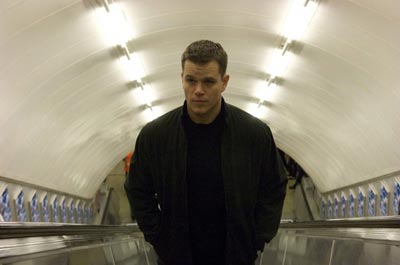
If you see him, say hello, he might be in Tangier. Or Paris, Madrid, London, New York, Moscow…uh, sir, we have Jason Bourne popping up all over the grid here. Shall I put it on One? As you have likely heard, Paul Greengrass’ The Bourne Ultimatum — which I caught last Friday — is a top-notch surveillance thriller that’s easily in keeping with the high standard of excellence put down by Doug Liman in Identity and particularly Greengrass himself in Supremacy. In fact, if there’s a downside to this smart, visceral action flick, which is as excellent as any one can hope for, it’s that it serves to remind us how amazing a Greengrass Watchmen might’ve been. After Bloody Sunday, United 93, and the Bournes, all films characterized by their in-your-face immediacy and gripping visual realism, the man seems incapable of making a bad movie. In any case, he brought the goods here — The Bourne Ultimatum doesn’t have much of a plot, but frankly it doesn’t need one. Like Yen in the suitcase, Jason Bourne is “the Modern Man, disconnected, frightened, paranoid for good reason.“…or at least the Modern Man as he’d aspire to be, if he could speak eight languages fluently, kick all kinds of ass with a library book, and always stay two steps ahead of the great Eye in the Sky.
As Ultimatum begins, we’re back in Moscow at the end of the last film: Bourne (Matt Damon) is on the run from Russian police (as a result of his bravura car chase with Karl Urban), he’s still walking with that limp (suffered from jumping off a bridge in…Amsterdam, was it?), and he’s still confused, amnesic, and obsessive about his origins as a lethal global assassin. So, when he begins experiencing flashbacks involving paunchy government bureaucrats — one of whom speaks with a well-known, recognizable croak — and an abusive interrogation involving hoods and waterboarding, Bourne, like a Frankenstein’s monster of the surveillance age, sets out anew on his mission to discover and confront his creators. (Uh, why doesn’t he just eliminate the middleman and head for Dick Cheney’s office?) In this quest for self-knowledge, Bourne is inadvertently aided by a crusading Guardian reporter (Paddy Considine, of In America and Hot Fuzz), who’s discovered that the super-secret government agency known as Treadstone may have been superseded by a new “sharp end of the stick,” Blackbriar. As you might imagine, this leak does not sit well with VIPs at Langley, so the CIA director (Scott Glenn, more craggy than ever) dispatches suits old (Joan Allen, returning as Pamela Landy) and new (David Strathairn, exuding intelligence in the Chris Cooper/Brian Cox role) to track down and eliminate the source, the reporter, Bourne, and anyone else who gets in their way. And thus the game is on…but who’s the cat and who’s the mouse here? This particular superspy wasn’t Bourne yesterday.
The rest of the film involves Bourne on the run, engaging and evading his would-be captors as much as possible in various scenic vistas around the globe. Yes, you could argue that we’ve seen this all before in the first two films — the CIA suits chattering away in vaguely menacing organizational jargon, the occasional hand-to-hand fisticuffs, the crunchy car carnage — Ultimatum definitely follows a template: Edgar Ramirez shows up in the Clive Owen/Karl Urban role, and Julia Stiles is back as Julia Stiles (and, I’m happy to say, does her best work of the series.) Or one might quibble that Bourne is a bit overpowered — even notwithstanding his superior reflexes, astounding peripheral vision, and brilliant gamesmanship, Bourne’s most powerful weapon might be his ability to induce convenient pangs of conscience among his adversaries at just the right time. But, the play’s the thing, and Greengrass succeeds in making Ultimatum an almost completely immersive experience regardless. Shadowy conversations are filmed from behind the shoulder, drawing attention to furtive eyes and pained grimaces. Observation cameras trace dangerous lines of sight across chaotic crowds, relentlessly seeking out their suspect. And, when the action breaks out…hoo boy. (I think I might’ve preferred the car chase in Supremacy to the very good one here, but there’s a fight in Morocco at one point that is a flat-out doozy.) By the final shot, which not brings the story full circle but recalls a haunting image of Franka Potente’s Marie from II and III, it’s clear that Greengrass is firing on all cylinders right now. I was already impressed with him, but Bourne further suggests that Greengrass is among the very best directors working today — Let’s hope he shares with us more surveillance intel in very short order.
Save the Aisle Seats.
As seen on AICN, thousands of vintage movie reviews from episodes of the Siskel & Ebert Show (and, ok, the Ebert & Roeper Show) are now available online for perusal. Some fascinating time capsules here, and it’s good to see the late Gene Siskel again. (Ebert lost a good deal of respect in this corner when he ultimately picked the pedestrian milquetoast Richard Roeper to fill Siskel’s seat. Somebody more combative, more knowledgable, or more interesting — heck, or somebody with decent taste in movies — would’ve been preferable.)
Vicious Mood Swings.
 Right around the midpoint of Steve Buscemi’s uneven, ultimately disappointing Interview, the first of three American remakes of films by the slain Dutch director Theo Van Gogh (the other two will be directed by Stanley Tucci and John Turturro), Buscemi’s beleaguered, world-weary, and increasingly drunk journalist bemoans the state of his notes for his article on Sienna Miller’s catty, self-entitled celebrity-of-the-moment: “This tape is just ten minutes of us bickering at each other!” Uh, Steve, it’s more like 85 minutes. A very brief scene at the opening notwithstanding, the entire movie consists of this eponymous interview, meaning that Buscemi and Miller are bickering, cajoling, pleading, seducing, and threatening each other for the entire film’s run. This wouldn’t necessarily be a bad thing — I came in to the movie expecting a theaterish two-person character study (with possible archetypal overtones about the overlapping worlds of media and entertainment): Add one pompous reporter, one self-infatuated actress, and simmer. But, while the beginning is engaging, the ending is decent, and the film is well-made and well-acted throughout, Interview lost me in the middle going. These two characters turn on a dime too quickly too often: They go from at each other’s throats to in each other’s arms and back over and over again, and it just doesn’t feel plausible. This is mainly a fault of the writing, which — while clever — also feels stilted and unnatural. Buscemi the actor and director comes up aces here, but Buscemi the writer (along with David Schecter) frankly could’ve used a later deadline.
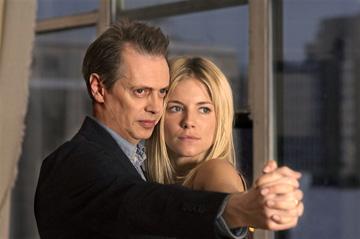 The plot, in a nutshell, has already been described: Pierre (Steve Buscemi) is a hard-drinking, pill-popping political journalist who, as the result of being on the outs with his editor, has been assigned a celebrity puff piece in New York on the same day Very Important Indictments are being handed down in DC. (As we discover in the film’s opening moments, he also has a shell of a brother wasting away at a mental hospital. Based on later revelations, this inclusion may be important, or it may just be a red herring — I chalked it up to a need to humanize Pierre before we watch him rant and rave his way through the rest of the evening.) The celebrity in question is Katya (Sienna Miller), the It Girl of the hour for her sexual escapades and breast reduction surgery as much as for her horror film and soapy TV drama (neither of which Pierre took the trouble to screen beforehand. He considers the subject matter — and the subject — beneath him.) The official interview, at a trendy downtown restaurant, starts and ends badly. But, on the way home, an accidental bump on the head, perhaps precipitated by Katya’s winning smile, gets our two antagonists bottled up in her spacious Tribeca loft, where the “real” interview begins to unfurl…
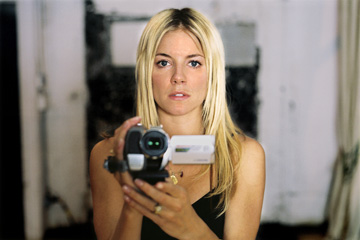 The remainder of this epic interview consists of seventy or so minutes of intensive, convulsive, verbal wrestling within this deluxe apartment in the sky: Buscemi’s snake to Miller’s mongoose (or is it Buscemi’s mongoose to Miller’s snake? Either way it’s bad — I don’t know animals.) Their sparring is intermittently entertaining, to be sure, but it zigs and zags too often to feel anything close to real. And, while Buscemi and Miller both do excellent work in the roles as written, other parts of the story just don’t hold up. At one point, Buscemi becomes fascinated with some morbid paragraphs he finds (surreptitiously) in Katya’s diary. But, frankly, it’s the type of gloomy woe-is-me fluff everybody had written at some point in a journal, and it doesn’t really make sense that it’d pique his interest so. And to help explain away the reason why neither Pierre or Katya disengage from this disastrous conversation much earlier, they’re given an unwieldy, simplistic Freudian connection — he looks like her wayward dad (her dad is John Waters?), she reminds him of his deceased daughter — that comes off as groan-inducing more than anything else. The last few beats of the movie help bring the story into focus, but by then the damage is done — I’d stop thinking of either character as real people, or as anything other than writerly conceits. For all intent and purposes by then, the Interview was over.
(Death) Racing Straight-to-Video.
Tyrese Gibson, Jason Statham, and Joan Allen are cast in a forthcoming remake of the 1975 cult film Death Race 2000, to be helmed by (notorious hack) Paul W. S. Anderson. Uh, Joan Allen? That’s “Judi Dench in The Chronicles of Riddick” weird. Update: Al Swearingen’s in too.
Compass Golden?
Even more Comic-Con riches: A new, extended, walk-you-through-the-plot trailer for The Golden Compass is now online, and it looks…well, to be honest, it looks pretty darn good! Big ups to the art direction and casting people — Iorek (the polar bear), the daemons (particularly Miss Coulter’s twisted golden monkey), and the main players (Lyra, Lord Asriel, Mrs. Coulter, Lee Scoresby) all look note-perfect.
The Rite of Springfield.
 I’m not about to give away the splendid opening sequence of The Simpsons Movie, suffice to say it includes a hilarious JFK homage and culminates with Homer (Dan Castellaneta) declaring something to the effect of “Why would anyone want to pay for a movie you can see for free on TV? Everyone in this theatre is a sucker!” Well, true, but this is The Simpsons, after all. And while this movie basically just plays out like a longer episode of the long-running, award-winning, much-beloved TV show, there are much worse ways to spend eleven bucks and 90 minutes of your time than an extended visit to Springfield. I caught this movie at a Friday afternoon matinee, and it basically felt like watching TV in a very big living room, with lots and lots of friends over, all enjoying themselves to the fullest. So, if you have any fondness at all for the Simpsons clan (and I presume that includes most of America, if not the western world), definitely check out the flick — You know what you’re getting, sure, but the getting is good from opening logo to closing credits. (And if you’re of the mind that the show has lost a step in recent seasons, have no fear — this is the primo, vintage stuff.)
 At the start of The Simpsons, life continues in Springfield much as it has this past age — Homer is still an amiable oaf; Marge a long-suffering homemaker; Bart an anarchic terror; Lisa, an earnest intellectual; Maggie a silent enigma. But developments soon arise which threaten to shake the very foundations of this small-town American idyll: Grandpa Abe Simpson experiences what might have been a religious epiphany during Rev. Lovejoy’s Sunday service, Lisa realizes the nearby lake is lurching toward ecological catastrophe, Bart takes a second look at neighbor Ned Flanders as father material, and Homer adopts a pig. And, just as Lisa tries to warn the (rather disinterested) town — in her presentation, “An Irritating Truth” — about the dangers of overpolluting the local loch, Homer, in the throes of donut addiction, disposes of his new pet’s droppings in said lake, precipitating a Malcolm Gladwell-ish tipping point that immediately turns the waters black and causes the EPA (yes, this is the first movie since Ghostbusters where the EPA are the villains) to seal off the town in a large, unbreakable, transparent dome. As you might imagine, the town doesn’t take too kindly to their new total and utter isolation, and when a trail of (rather obvious) clues lead back to the culprit…well, let’s just say “D’oh!”
 There’s more to the story from there, including definitive proof that this Springfield isn’t in Alaska. (In fact, it borders Ohio, Nevada, Maine, and Kentucky.) But all of it is in general keeping with what you’ve come to expect from the television show: jokes, witticisms, and sight gags delivered at rat-a-tat speed in sly, warm-hearted and/or vaguely misanthropic fashion. (My favorites include the aforementioned opener, a sight gag involving Moe’s bar and the Springfield church, “You’re the five people I’ll meet in Hell!”, Santa’s Little Helper’s subtitles, and most anything involving Kent Brockman, Hans Moleman, Capt. McAllister, Comic Book Guy, or Professor Frink.)
The devastatingly funny South Park: Bigger, Longer, Uncut upped the ante for the big screen by really reveling in the no-holds-barred vileness that’s often only alluded to on the show. But, other than a brief bit of full-frontal nudity, Otto with bong in hand, and Marge swearing (frankly, as out of character as it was for Mrs. Weasley in Hallows), The Simpsons Movie mostly just feels like TV writ large (There’s even a FOX commercial at one point.) But, again, to my mind, that’s not a bad thing — If it ain’t broke and all. I do kinda wish that the movie had been less family-centered and held more for Springfield’s large and splendid supporting cast to do. (For one, shouldn’t Mr. Burns have been behind the big plot? Where were Apu, Principal Skinner, and Groundskeeper Willie? And, as I said of the trailer, why isn’t McBain president? Then again, I’m a fanboy like that.) But, I’m guessing the show will be on again this Sunday (and then some) if I need a Simpsons fix, and, as Maggie notes in the credits, there’s always room for a sequel…
Man of Iron.
Also from Comic-Con, director Jon Favreau reveals an extensive (You-tubed) trailer for Iron Man. I’ve never been a huge fan of the comic, to be honest, but this looks much better than I anticipated (and the cast — Robert Downey, Jr., Terrence Howard, Gwyneth Paltrow, Jeff Bridges — is solid regardless.)