Cogburn’s Crossing.

I missed this when it first broke back in March, but it seems the Coens have caught the remake bug, and are re-making True Grit, with Jeff Bridges in the John Wayne role. (No word on who’s playing Kim Darby.)

“Not a traditional remake, the Paramount film will be more faithful to the Charles Portis book than the 1969 pic…while the original film was a showcase for Wayne, the Coens’ version will tell the tale from the girl’s p.o.v.” Interesting…and it pretty much has to pan out better than the Coens’ last remake.

The Journey is the Reward.

“Corridors make science-fiction believable, because they’re so utilitarian by nature – really they’re just a conduit to get from one (often overblown) set to another. So if any thought or love is put into one, if the production designer is smart enough to realise that corridors are the foundation on which larger sets are ‘sold’ to viewers, movie magic is close at hand.” By way of Lotta, Den of Geek‘s Martin Anderson sings the praises of the sci-fi corridor. Lots of great eye-candy here.

Oscar Gets Preferential Treatment.

“‘Instead of just marking an ‘X’ to indicate which one picture they believe to be the best, members will indicate their second, third and further preferences as well,’ Academy President Tom Sherak said. ‘PricewaterhouseCoopers will then be able to establish the Best Picture recipient with the strongest support of a majority of our electorate.

Along with their recently-announced move to ten Best Picture nominees, the Academy of Motion Picture Arts and Sciences moves back to a preferential voting system. “The system has long been used in the round of voting which determines the nominees in most categories, but it has not been used on the final ballot for Best Picture since 1945.

Avengers, Defenders, Mousketeers.

“‘We believe that adding Marvel to Disney’s unique portfolio of brands provides significant opportunities for long-term growth and value creation,’ said Disney President and Chief Executive Robert A. Iger.” Spidey, meet the Mouse: Disney buys Marvel for $4 billion.

And, in very related news, Fox announces another Fantastic Four reboot, with — true to Fox form — the hackmeisterly Akiva Goldsman at the helm. “Though Marvel Entertainment owns and finances properties like ‘Iron Man’ and ‘Thor,’ Fox controls ‘Fantastic Four’ in perpetuity — as long as it continues making the films. Fox has the same arrangement on Marvel Comics properties ‘X-Men,’ ‘Daredevil’ and “Silver Surfer.

We Always Get our Goat.

Ewan MacGregor learns a Jedi mind trick or two from George Clooney (and, seemingly, Lt. Lebowski) in the new trailer for Grant Heslov’s The Men Who Stare at Goats, also with Kevin Spacey, Stephen Root, Robert Patrick, and (the suddenly ubiquitous) Stephen Lang. Between the stellar cast and the broad Coenesque sensibility on display, I have high hopes for this one.

State of Play.

Some folks in this film would probably call me a right bleedin’ tosser (and much, much worse) for starting off this post as such. But Armando Iannucci’s hilarious In the Loop, which I caught Sunday morning, has only one real flaw — It feels like it’s coming out a few years too late. This faux-documentary-style disquisition into Britain and America’s joint lead-up to war in the Middle East, and the shrewd, venal bureaucrats who got us there, can’t help but feel very 2003. (Which is not to say Washington politics is now a beacon of optimism and good faith in the Obama era, only that the political zeitgeist has shifted some since the events depicted here.)

But, that one small caveat aside — and to be fair, In the Loop is apparently based on a British TV show (The Thick of It) that was more timely (and is going in the Netflix queue) — this is a gut-bustingly funny film. I honestly can’t remember the last time I laughed so hard in a theater. (Alas, it was probably 21 Grams, and that was for all the wrong reasons.) True, given that this is a sharp-edged, basically anti-Dubya political satire that goes out of its way to reward pop-culture geekery (Frodo, Ron Weasley, and the White Stripes are all used as epithets at one point or another), I’m probably as close to a target audience for this sort of movie that’s out there. Nevertheless, if your sense of humor runs anywhere from squirmathons like The Office UK or Curb Your Enthusiasm to sardonic political comedies like The Candidate or Bob Roberts to the current-events commentaries of Stewart and Colbert, this movie is a must-see. (And if you don’t find hyperarticulate Scotsman Peter Capaldi spewing forth rococo profanities funny just yet, you probably will after watching In the Loop.)

Iannucci’s film begins with another day in the life of Malcolm Tucker (Capaldi), the tough-as-nails, take-no-guff director of communications at 10 Downing St. (Think Rahm Emanuel, but funny.) This particular morning, Tucker quickly becomes enraged by the latest slip-up by the seemingly ineffectual Minister for International Development, Simon Foster (Tom Hollander, best recognized in America from the Pirates sequels.) To wit, Foster responded to a direct press question about an impending Mideast conflict by blurting out that “war is unforeseeable.” This is not “following the line,” as Tucker puts it, but after a stern rebuke, the Minister — and his communications team, new guy Toby (Chris Addison) and competent veteran Judy (Gina McKee) — only compound the error. Foster gets completely lost in the thicket at a follow-up press avail, and soon manages to mangle his way through to an even more unwieldy soundbite: “To walk the road of peace, sometimes we need to be ready to climb the mountain of conflict.” (Tucker’s livid response to this policy breach: “You sound like a f**in’ Nazi Julie Andrews.“)

Nonetheless, this sort of Zen pronunciamento is exactly the sort of thing the big boys in Washington want more of, even if no one (least of all Foster) seems to know what exactly he was driving at. Soon both the Hawks (represented by a Rumsfeldian David Rasche) and the Doves (mainly State Dept. deputy Mimi Kennedy and peacenik general James Gandolfini) think they’ve found an ace-in-the-hole in the confused minister. Meanwhile, this being Washington, a town that’s “like Bugsy Malone, but with real guns,” there’s another tier of shenanigans brewing under the principals. State Dept. aide Liza Weld (Anna Chlumsky) has penned a career-killing memorandum — soon acronymed, in DC fashion as “PWIP PIP” — that outlines the few pros and many cons of the imminent war. And Foster’s new man Toby has managed to inadvertently leak the real name of the War Committee to his friend at CNN — naturally, it was the committee with the most boring-sounding title.

Throw in a few more byzantine political subplots — more aides, committees, leaks, and whatnot — and simmer, and you have what amounts to the smartest, funniest political satire I’ve seen in a good long while. This is also clearly a movie that will reward repeat viewing, and I could see In the Loop someday being quoted as often and as lovingly in certain circles as The Big Lebowski. It may not be everyone’s cup of bile, I suppose, but if you’re generally a reader of this site, I’m guessing you’ll probably enjoy it as much as I did. So, if this movie is still playing in your area, go check it out…or brave the unholy wrath and frightening verbiage of Mr. Tucker. War may be “unforeseeable” — your enjoyment of In the Loop is not.

Your Lonely Souls.

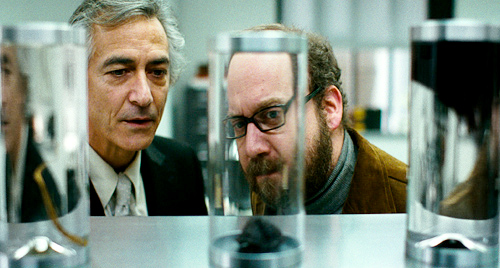
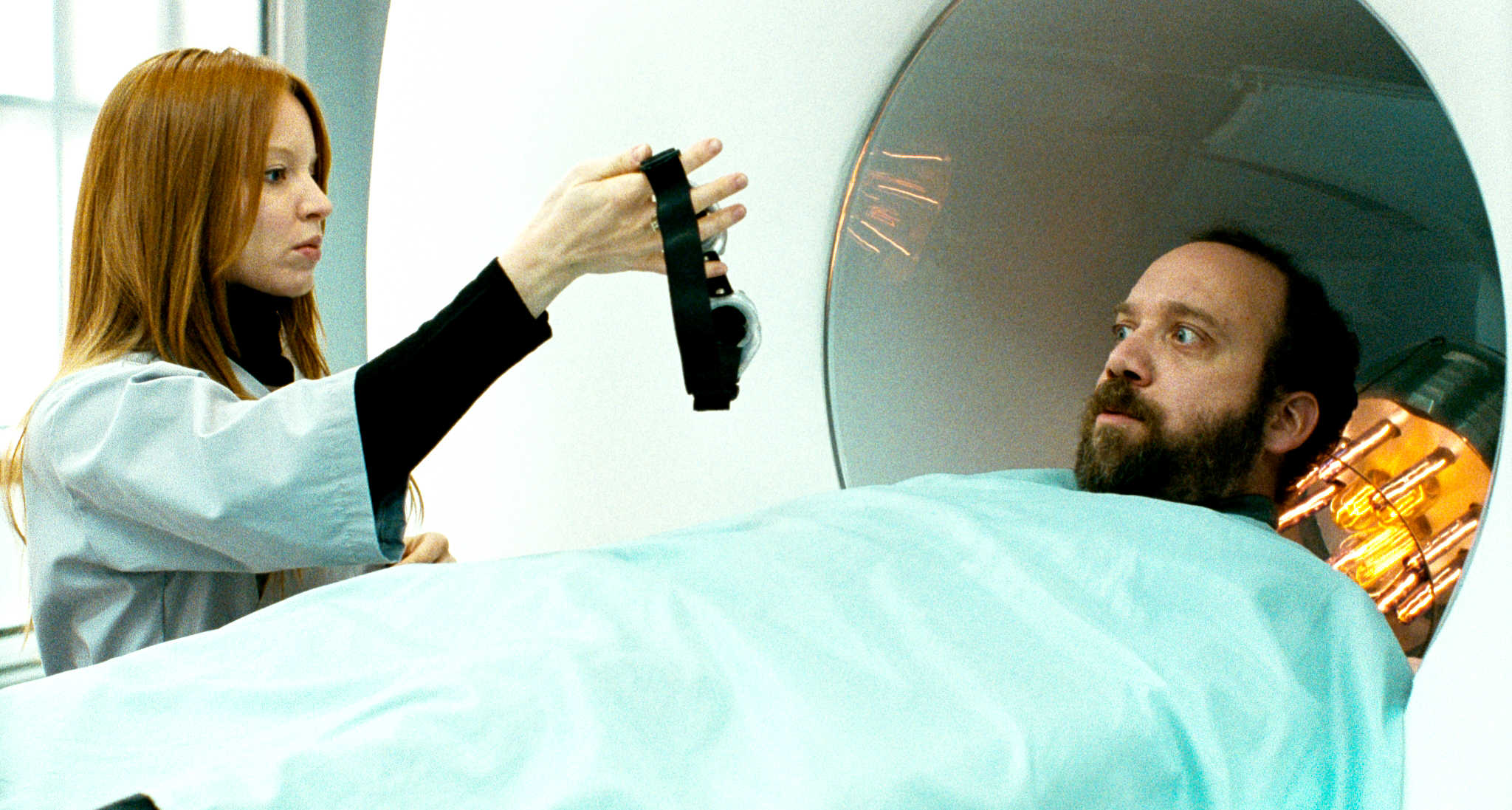
After Friday’s Basterds came a Saturday morning expedition to Sophie Barthes’ minor-key Cold Souls. I was sold on this film as soon as I heard about the sci-fi premise — once again there’s some weird science for sale in and around New York City — and it’s worth a rental at least, particularly if you’re a fan of Paul Giamatti. But Cold Souls also feels vaguely underwritten: The ideas it puts in play are more interesting than the execution, and it’s hard not to think of the movie as just another well-meaning but flawed act of Existential Schlub Theater, a la Charlie Kaufmann’s Synecdoche, New York.

So what’s the score here? Well, world-renowned screen thespian Paul Giamatti (Paul Giamatti) has lately been pouring his heart andsoul into a Broadway production of Chekhov’s Uncle Vanya, and it’s killing him even worse than that John Adams gig back in the day — he lies awake nights, brain and stomach churning. So, after being clued into a New Yorker story about a Roosevelt Island firm that temporarily stores souls, Paul takes the plunge. Without even telling his wife (Emily Watson, bestowing her indie imprimatur), he takes a cable car over to yonder island, listens to the sales pitch from the eminently reasonable Dr. Flintstein (David Straithairn), and gets his chickpea-sized soul (or at least 95% of it) extracted from his person.

As you might expect, this has some strange side effects — The soulless Paul, for example, is completely impervious to the charms of a cute bunny (I mean that literally, although the extremely underused Lauren Ambrose doesn’t seem to have much of an effect on him either.) He’s also now a terrible actor — Without his broken soul propelling him along a dark and agonizing path, Giamatti’s Vanya flies over Russian pathos and lands somewhere in the Borscht Belt. But, when Paul heads back to Roosevelt Island to get his soul back…well, his complication has developed a little complication. For it turns out there is a brisk black market going on in the soul business, and Giamatti’s personal chickpea has been sent via mule (Dina Korzun) to St. Petersburg, where it’s being used by a beautiful Russian soap star (Katheryn Winnick) who now believes herself in possession of Al Pacino’s actorly chops. (Al Pacino has a soul?) Meanwhile, the avuncular Dr. Flintstein suggests, perhaps Giamatti could just pick a soul out of the black market catalog…word is Russian poets are going cheap these days…

There’s a lot to admire in Barthes’ Souls — It’s nothing if not clever throughout, and there are definitely a few chuckles to be had. Every member of the cast here is pretty darned good, particularly Giamatti and Watson, who manage to make a compelling, multi-dimensional marriage come across with very few lines. And I admired that the movie had thought through some of the second-level ramifications of a soul commodities business — black markets, for example.

All that being said, Cold Souls ultimately feels like something of a non-starter. As with The Brothers Bloom, a third act in Russia feels meandering and purposeless. The glimpses we do eventually get of people’s soul-landscape — a sort of Mark Romanek afterworld of out-of-focus children and creepy oldsters — are, frankly, less interesting than the ideas that were already put into play. And there’s just not much there there. In the end, the movie is better at the set-up than the follow-through. Cold Souls is worth watching on IFC some day, but, like poor Paul Giamatti after the operation, it ends up feeling curiously hollow.

Operation: Mindcrime.

Also in front of Basterds this weekend, with The Wolf Man and Avatar — the early teaser for Christopher Nolan’s Inception, with Leonardo di Caprio, Marion Cotillard, Joseph Gordon-Levitt, Ken Watanabe, Ellen Page, Cillian Murphy, Michael Caine, and Tom Berenger. Previously described as a “contemporary sci-fi actioner set within the architecture of the mind,” the movie arrives Summer 2010.

Swatting at Nazis.

A weekend chock-full of movies on this end, beginning with a Friday night outing to Quentin Tarantino’s striking, rambling Inglourious Basterds. I’ve been down on pretty much everything QT has done over the past decade — Kill Bill, Vol. 1, Kill Bill, Vol. 2, Death Proof — but Basterds at last feels like a movie by the writer-director who gave us Reservoir Dogs, Pulp Fiction, and the underappreciated Jackie Brown. To be honest, it’s hard to say whether Tarantino has finally reversed his decade-long slide into his own solipsistic, homage-heavy universe (which is the three-dollar way of describing his recent tendency to disappear up his own ass), or — more likely — that QT’s riffing on European film as much as 70’s exploitation flicks here makes this movie feel broader than the last few forays. Nevertheless, for whatever reason, Basterds works, and it is a welcome return-to-form.

Perhaps part of the reason I enjoyed the film was that I went in with egregiously low expectations. Particularly with Hostel director Eli Roth skulking about the premises — he’s Donny Donowitz, a.k.a. the “Bear Jew,” a Boston-born basterd who likes to go yahd on Nazi skulls with his Louisville Slugger — I went in thinking that this movie would basically be two and a half hours of grisly torture porn — or , in other words, the ear scene from Reservoir Dogs over and over again, made “ok” because the victims are Nazis. But Inglourious Basterds is both broader and more subtle than that. Yes, there’s some of that going on — particularly in Chapter 2 — but it’s handled much more expertly than I feared. (Nor are the victims in question just cartoon Nazis out of Raiders of the Lost Ark, but multi-dimensional individuals in a huge spot of trouble.)

And, in any case, the Basterds are really a small part of the film as a whole. Borrowing liberally from The Good, The Bad, and The Ugly at the start, the movie begins in 1941 France with the interrogation of a French farmer (Denis Menochet) who may or may not be harboring his Jewish neighbors. His interlocutor is the courtly SS Colonel Hans Landa (Christophe Waltz, a bit over-the-top but probably a shoo-in for a Supporting Actor nod) who, in a wide-ranging conversation about milk, hawks, pipes, and paperwork, methodically picks apart the poor dairy farmer like a boy pinning down a butterfly. Then, we meet the Basterds, the elite unit of Jewish soldiers — led by “Aldo the Apache” Raine (Brad Pitt, also playing it broad) — who are kicking ass and taking manes all across Europe. Their dastardly exploits have even caught the attention of the German High Command — including the Fuhrer himself (Martin Wuttke), who wants them dead, like, yesterday. (Speaking of which, the early scenes in the FHQ, with Hitler throwing a tantrum over the Basterds, felt a lot like how I’d imagine a WWII-era Captain America film might pan out.)

Minister of Propaganda Joseph Goebbels (Sylvester Groth), meanwhile, is more interested in getting his newest propaganda film — A Nation’s Pride, about the Sgt. York-like heroics of one German sniper (Daniel Bruhl) — the grand opening it deserves in Nazi-occupied Paris. To that end, and on the advice of said sniper (who’s a bit smitten with the proprietor), he looks to book the premiere at a theater run by a melancholy French beauty named Emmanuelle Mimieux (Melanie Laurent). But Emmanuelle, it turns out, is in fact named Shoshanna — we met her earlier in the film — and she more than most has a score to settle with these godawful Nazis. And, like Herr Goebbels, she knows a thing or two about using the cinema to make a dramatic statement…

I haven’t even mentioned the German actress/double-agent Bridget von Hammersmark (Diane Kruger), or the dashing British film critic-turned-lieutenant, Archie Hicox (Michael Fassbender), or Hugo Stiglitz (Til Schweiger), the expert Nazi-killer sprung by the Basterds for bad behavior, or military mastermind Gen. Ed Fenech (Mike Myers, distracting but getting to live out his Peter Sellers dream some more), the man with a plan to knock out the German High Command in one fell swoop. Yes, this film is a truly baroque creation. It’s more a collection of loosely-related setpieces, to be honest, and some work better than others (A vignette involving a rendezvous-gone-south in a basement pub is a masterpiece of slowly-ratcheting suspense; the scene where Shoshanna is forced to eat dinner with a gaggle of Nazis feels ten minutes too long.)

Although most of the speaking here is conducted in French, German, or really-bad Italian (it’s all lovely to listen to, by the way — the musicality of QT’s dialogue definitely carries over into other languages), this is a Tarantino movie through and through. We have the long, meandering conversations punctuated by staccato bursts of violence. (See also: Any other Tarantino film.) We have the throwback homage-ridden score (Mostly Morricone, but David Bowie’s “Cat People” shows up in a truly odd spot.) We have the random digressions on “Pop Culture According to QT.” (There’s an extended riff on King Kong here that momentarily took me out of the film.) We have an obvious lapse into foot fetishism (the Cinderella scene, which, imho, doesn’t make much sense given what happens later.) There are, of course, several Mexican standoffs. It’s all very Tarantino, alright.

And we have the powerful ending, which I won’t give away in detail here. [Warning: This rest of this review is spoilerish.] As several characters say in Chapter 5, “the shoe’s on the other foot now.” And it is — After the tension-wracked first chapter, Basterds completely inverts the usual Cat-and-Maus relationship inherent to almost all movies of this genre. The political economy of IB is hardly what you’d call Zen, and if “turn the other cheek” is your moral touchstone, then the ending is deplorable in many ways. (Even Tarantino seems to think so, given that we the audience have basically the same reaction to Basterds as the Nazis do to A Nation’s Pride.) That being said, it’s a weirdly and undeniably intoxicating thing to see the Jewish Basterds being the guys holding the guns for once, and to witness their disembodied, cackling Avenging Angel exult in a vengeance long denied.

After all its Eurocinema-meets-The Dirty Dozen twists-and-turns, Inglourious Basterds ends up being a sort of a Leni Riefenstahl film for the Jews. And, well, propaganda it may be, but you don’t have to be a Tarantino-level foot fetishist to find it at least somewhat refreshing, even exhilarating, to see that boot on the other heel for once.


Hungry Like the Wolf.

Another big teaser today: Benicio Del Toro struggles with an ancient curse in the first trailer for Joe Johnston’s remake of The Wolf Man, also with Anthony Hopkins, Emily Blunt, Geraldine Chaplin, and the inimitable Hugo Weaving. The February release date gives me pause, but this actually looks better than I expected.