
Two fanboy icons get the Remix treatment…First, Tyler Durden gets all Tekken up in here with Fight Club: The Game. (Hmm, sadly, it looks Ikea-Nesting-Instinct-lame.) Meanwhile, Kirk & co. get their funk on in this strange ad for the Star Trek Original Series DVD. Well, it’s definitely more fun than an Odd-numbered Trek.
Category: Cinema
Vice City.
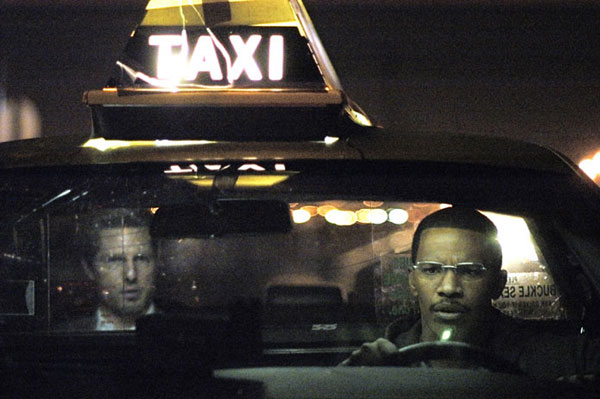
Although the swing is nowhere near as severe, Michael Mann’s Collateral also had a bit of a Code 46 problem: Highly promising at first, it ultimately backslides into a much less appealing and much more ham-handed film. Now, Collateral still ends up being a decently enjoyable night at the movies, but the flaws of the final third definitely hurt the overall experience.
All’s well that starts well…the film has a great sense of place, and both Tom Cruise and Jamie Foxx are very good throughout. (Despite what many of the reviews say, by the way, Cruise has played a villain before…he was Lestat, and he actually turned out to be pretty good.) And there’s some nice supporting work by Before Night Falls‘s Javier Bardem and The Ladykillers‘ Irma Hall. (Mark Ruffalo seemed slightly miscast as the cop, and he may well be approaching the Stiller Threshold for overexposure in 2004, but he was solid enough.) For the first ninety minutes or so, as Max and Vincent discuss their respective philosophies while making their bloody rounds across the City of Angels, the film (much like Heat) feels like a strangely moody and contemplative Grand Theft Auto mission.
But, when Max’s cab stops for two Very Highly Symbolic Coyotes crossing the street, trouble bells started ringing. And sure enough, soon thereafter, Collateral lapses into over-the-top, nonsensical cheese. The eject moment came for me when Tom Cruise, previously unwilling to venture into one nightspot to retain his anonymity, starts firing away haphazardly in a Chinatown disco. (I guess this is the only club in America without video cameras.) And from then on, the movie takes too long to do too little…the last few set pieces unroll sluggishly, and could all have been cut down by several minutes. By the overblown final moments, I’m sorry to say, I had pretty much checked out. All in all, Collateral is definitely worth two hours of air conditioning, but as for its larger pretensions…Mission Failed.
Lost in Translation.
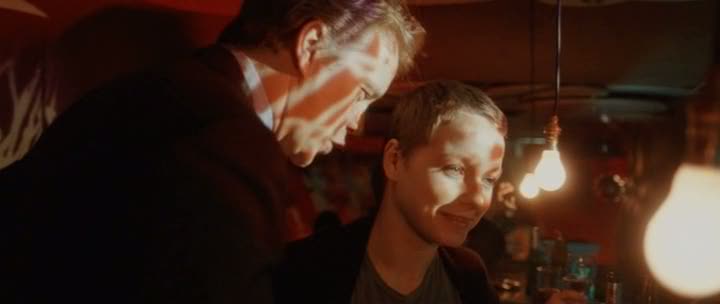
Well, for the first twenty-five minutes or so, when Tim Robbins and Samantha Morton were wandering around a picturesque, slightly-futuristic Shanghai, I thought Michael Winterbottom’s Code 46 might turn out to be quite good, perhaps a slightly better version of Wim Wender’s Until the End of the World. After all, some of the cinematography in the early going (Shanghai hotels, Morton under a strobelight) was very impressive, and I liked the way the movie just went for it…immersing you in this world of the future without taking the time to explain all that much.
But, right about the time this very unlikely couple consummate their evening, the film starts slipping off the rails, and it’s a long way down. For one, the more you hear about this particular future dystopia — the Sphinx corporation, critical travel “papelles”, empathy viruses, Code 46, etc. — the less sense it makes. If people could read minds just by, um, becoming infected with a virus (as Tim Robbins has and does), then why wouldn’t everyone do it? And why would the rest of the characters be so consistently amazed by his ability, if it’s simply off-the-shelf? Similarly, while at first the global NewSpeak, incorporating elements of French, Spanish, Chinese, and other languages into English, seems like a neat idea, it eventually just sounds ridiculous. Si, it’s true…ultimately, every hombre and femme ends up sounding a bit like a dinner-party Hercule Poirot, until you start wondering if it’s possible to get your dinero back.
But, however weak the premises of this sci-fi vision, the real problem here is in the “love” story. Tim Robbins and Samantha Morton can both be appealing actors elsewhere, but here they seem all wrong for each other. He’s too lanky and she’s too fetal, and together they exude zero chemistry. More problematically [Spoilers to Follow], once the “Code 46” genetic aspect of the story kicks in and the two implausibly venture off to Neo-Dubai, their romance degenerates into some twisted sci-fi rumination on Oedipal complexes that’s at turns head-scratching and rather dull, despite featuring one of the most ghastly and unerotic sex scenes in recent memory. (Trust me, if you thought Meryl Streep pawing Liev Schreiber’s chest hair in The Manchurian Candidate was creepy, you ain’t seen nothing yet.) At any rate, as the last few moments hammered the subtext into the ground and Coldplay started crooning over yet another excessively fond shot of Morton, I had to concede that Code 46, however visually promising at first, turned out to be a bad, bad film. And, given how much fun Winterbottom’s 24 Hour Party People was, that’s disappointing, n’est-ce-pas?
Red Dragon, Black Wizard.
In Harry Potter casting, Ralph Fiennes is cast as Voldemort for Goblet of Fire. Ok, I guess…but to be honest, I expected someone older. Terence Stamp, perhaps?
The Da Robbins Code.
In a nice surprise, I just realized after watching the trailer for Michael Winterbottom’s sci-fi romance Code 46, starring Tim Robbins and Samantha Morton, that the film opens Friday. Sorry, Open Water, but you may have just gotten shunted from the weekend line-up. Update: Saw it. All I can say is, Open Water, my bad.
Prince of Gotham, son of Krypton.
The first pics of Ken Watanabe as Ras Al Ghul in Batman Begins have been posted on a Japanese site. And, if you prefer your Caped Crusader with a side of Supes, the fan trailer for World’s Finest (by Sandy Collora, the guy who made the somewhat goofy Batman: Dead End short running around awhile back) is now also available. Yeah, the acting’s pretty substandard here, but I have to say, I sorta prefer the Collora cowl to the rubber suit look they’re going with in Chris Nolan’s film.
The Doom of Man.
Word is Julian McMahon of Nip/Tuck will be Victor Von Doom in the forthcoming Fantastic Four. Never seen Nip/Tuck myself, but his headshot looks the part.
Gotham Gas Guzzler.
For the Batman completists out there, AICN obtains some digital footage of the Batmobile in action. Looks like it might have a bit of a rollover problem.
The Village Idiot.
 Having completed my chores in timely fashion this past Sabbath morn, I decided to undertake a sojourn in M. Night Shyamalan’s The Village, in spite of my apprehension over The Curse of William Hurt and The Mel Gibson Film Which We Do Not Much Enjoy. As you perchance have ascertained, it seems the goodly people of this nonsensical village have experienced some difficulty with the strange and mysterious residents in the nearby woods. Alack, Number Six is nowhere to be found, and Goody Ellen Ripley seems too engaged sweeping and darning at the present time to handle the marauders in her usual efficacious manner. This is highly unfortunate, for M. Night Shyamalan’s The Village is an exceedingly drab and silly place, whose full terribleness can only adequately be described in spoiler-filled invisitext (Note: invisitext turned off — it’s been 15 years):
Hoo boy…grab your torches and pitchforks, village people, cause we’ve got a really lousy film on our hands. (Ok, Van Helsing and Riddick were worse, but they harbored fewer delusions of grandeur…this film is just a pretentious bore.) As a refresher, I liked Sixth Sense, was intrigued by Unbreakable, and loathed Signs, and this one’s probably just as bad as Mel Gibson’s run-in with the water-and-door-averse aliens. Even though the plot twists in this bad boy can be seen a mile away, they still don’t make any sense. As with Signs, this is a film so lame I can only wrap my mind around it in numbered point form:
1) First off, the whole Elders bit. Is it really possible not to see this coming? What other explanation could there be for those big black cabinets in every house? I understand that these Villagers were not exposed to Scooby Doo, but how strikingly incurious could they be?
2) Along those lines, if you call a shed “The Old Shed That Is Not To Be Used” in any human society, no more than a week would pass before some enterprising youth started skulking around it. And why are the creatures called “Those We Shall Not Speak Of” anyway, when everyone is incessantly speaking about them? Surely some other nomenclature would take off at some point.
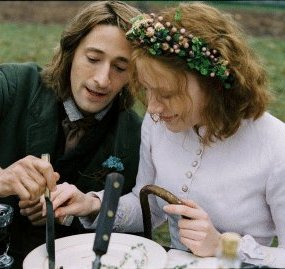 3) How come not a single Village soul has ever attempted to beat back the not-so-frightening wicker creatures with a block of wood or a stick of fire or something? Hasn’t anyone ever wondered why the Elders never seem to be around when the creatures come out?
4) What is this clipped faux-nineteenth century argot everybody’s speaking in? It’s embarrassing (although A.O. Scott made an excellent point when he noted that this is how William Hurt sounds all the time. Perhaps this actually makes sense.)
5) After our worst fears about the Scooby Doo Elders have been confirmed, why would Shyamalan think the blind girl’s encounter in the woods would be scary in the slightest? The only real question was whether it was Brendan Gleeson or Adrien Brody in the costume.
6) What vested interest would the government have in protecting this village from fly-overs, poachers, etc.? Nada, zip, zero. We already have Colonial Williamsburg.
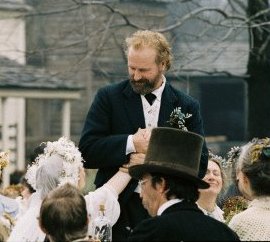 7) Whatsmore, I find the political economy of this film somewhat repellent. Is the urge to create a rigid, backward-looking, and authoritarian society — where everyone knows everyone else’s business (except of course, the Big Business), where the only people of color are Red, and where the only trouble around is Adrien Brody the Village Idiot — really as worthy and benign as Shyamalan makes it out to be? These people are nutjobs, but they’re portrayed as humanists. If anything, the end of the film makes it seem as if this noble way of life will and should go on. There’s no real critique made at all of the Elder’s impositions, only of its misuse by Jealous Brody.
8) Speaking of which, village idiot? Blind girl who sees auras? C’mon now. You’re not even trying.
9) I see very well how Shyamalan might have intended this as a Twilight Zone meditation on terrorism, what with fear-mongering and color codes and all that. But, if that’s the case, then the film should not have been constructed as a Sixth Sense thriller rife with plot twists in the last third (particularly when the plot twists are so glaringly obvious). It should have shown its cards up front and then attempted to explore this allegory a little more creatively.
In sum, with Goody Weaver and Mssrs. Brody and Gleeson as residents of this unfortunate village, I had thought my brief stay in these woods might be more relishable. As it is, I am headed for the towns and shall not return.
Red States, Blue States, Altered States.
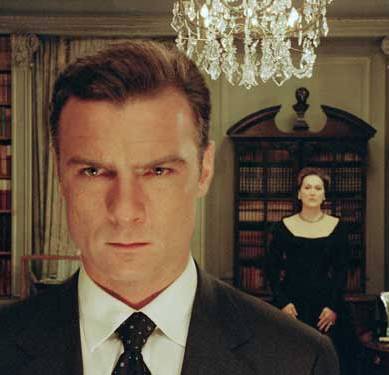 While remakes of film classics are generally a lousy idea (Exhibit A: Gus Van Sant’s Psycho), George W. Bush’s America seems a more than apt time and place for Jonathan Demme to re-tackle The Manchurian Candidate. And, while there’s no scene herein as memorable as the brainwashing in the original 1962 film, the Denzel version actually turned out to be a decent night at the movies, despite a failure to capitalize fully on the potential of the source material and the histrionics of Meryl Streep.
For those looking for quality Bush-bashing from this project, there are some nods in your direction. This version of the film takes place in a post-9/11 election year when “security” is definitely the watchword of the electorate. And Manchurian Global, the new Big Bad for these post-Communist times, clearly “Harkens” to Halliburton and its ilk. Unfortunately, however, most of the politics in this movie aren’t very well thought-out. For example, this would seem a perfect cinematic vehicle to skewer the newsmedia for its inane and/or atrocious political coverage these days. But almost all of the political scenes here — conventions, talk shows, speeches, and whatnot — come off half-baked and unrealistic. Liev Schreiber is undoubtedly a good actor, but it’s hard to imagine him winning a congressional seat as portrayed here, much less the vice-presidency. Speaking of which, the convention backroom scene at the beginning seemed woefully out of date, as by now it should be clear to anybody that any political party worth its salt would have picked a ticket before their Big Show. In sum, most of the politics here seem like plot points to move the story along, when with just a little more tweaking they could have made for some really devastating satire.
 Still, The Manchurian Candidate is an entertaining ride, in no small part due to several quality performances. The characters from the original Candidate are scrambled in this version, but remain more or less intact, with Denzel as Sinatra, Liev Schreiber as Lawrence Harvey, Kimberly Elise as Janet Leigh, and Meryl Streep as Angela Lansbury. (Alas, no Queen of Diamonds.) All in all, I’d say most of this bunch do a solid job (particularly an almost-unrecognizable Jeffrey Wright as Cpl. Melvin)…with the very notable exception of Meryl Streep. I’m not sure what she was going for here — some sort of uber-Karen Hughes or something, I guess — but she’s more over the top than Hoo-ah Al Pacino in Scent of a Woman. At one point in the middle third, she even out-JonVoights Jon Voight, which I didn’t know was possible. While everyone else seems to be working hard to make the film seem remotely plausible, despite all the talk of implants and such (i mean, why bother with implants when you can just throw up a malleable dupe like Dubya?), Streep seems to be just playing it for camp. (It didn’t help that her first speech, in the aforementioned smoke-filled room scene, is completely hamhanded and improbable…however the choice of a veep goes down, I highly doubt it goes down like this.)
All in all, The Manchurian Candidate is worth seeing, but it’s nowhere near the league of the original. Which is too bad, really, because I think with just a little more effort, this could have been quite something.