
Curiouser and curiouser…The Village‘s Bryce Dallas Howard joins Spiderman 3 as none other than Gwen Stacy, Peter Parker’s doomed childhood sweetheart. I find this somewhat strange, since they’d basically turned Kirsten Dunst’s Mary Jane Watson into Gwen Stacy in the first film (#6). (Plus, they’ve switched hair-colors, but ah well.)
Category: Cinema
By Any Other Name.
Byrne. Rose Byrne. Word is that’s who been tapped to play the next Bond girl (“Vesper Lynd”) opposite Daniel Craig in Casino Royale. (Prior to this gig and Sofia Coppola’s upcoming Marie Antoinette, she was in Troy, Wicker Park, and I Capture the Castle.) But who’s playing Moneypenny?
Tear Off Your Own Head.
(It’s a doll revolution.) By way of Quiddity comes this rather creepy trailer for Steven Soderbergh’s recent side project, Bubble, a tale of love and murder amid the plastic baby parts.
Dead Man Writing.
“When we think about the authoritarian world that Orwell painted, the catchphrases are one thing, but when you read the book again, the specifics and relevance for now are stunning.” Apparently, Tim Robbins is thinking of bringing 1984 to the screen (again). Hmmm…I dunno. I enjoy Bob Roberts and Dead Man Walking, but thought Embedded was way over the top. And it’d be really hard to make a better or more faithful adaptation than the Michael Radford version with John Hurt and Richard Burton.
Golden Year.
As you probably saw, the Golden Globe winners were announced, with Brokeback Mountain (Best Picture, Director, Screenplay) and Walk the Line (Best Picture, Best Actor, Best Actress, all on the Comedy-Musical side) cleaning up. (Other winners included Philip Seymour Hoffman for Capote, Felicity Huffman for Transamerica, George Clooney for Syriana, and Rachel Weisz for The Constant Gardener) With the exception of Weisz, no real surprises. I’d like to have seen Jeff Daniels take something home for The Squid and the Whale, but Phoenix was a fine choice too.
Conqueror Worms.
Is there life after Serenity? Well, it depends what you call life…Firefly‘s Capt. Malcolm Reynolds (Nathan Fillion), now a small-town sheriff, faces down gruesome space slugs in the trailer for James Gunn’s horror-comedy Slither, also featuring Elizabeth Banks and the inimitable Michael Rooker. (Slightly bawdier trailer here.)
From Gollum to Igor.
Even more fanboy prestige for The Prestige: AICN reports that Gollum/Kong creator Andy Serkis has joined the cast of Christopher Nolan’s version, as an assistant to Nicola Tesla (David Bowie). He joins Bowie, Christian Bale, Hugh Jackman, Scarlett Johansson, and Michael Caine.
Hidden Costs.
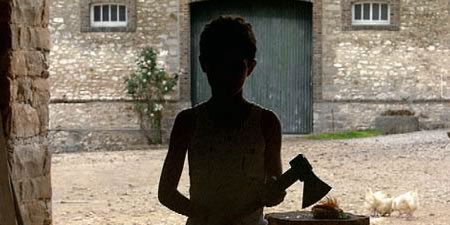
The second half of last night’s double-feature, Michael Haneke’s Cache, offered a moral universe in many ways diametrical to that of Match Point — here, even the long-buried sins of the upper crust are eventually exposed before the Great Eye. As I said in the 2005 round-up, last year was a banner year for politically-minded movies, and Cache, both an unsettling thriller of personal surveillance and a timely rumination on First World comforts and complicity in an age of terror, definitely ranks among them. With its inordinately protracted (and sometimes intentionally confusing) shots and its refusal to answer many of the questions it poses (including the plot device driving the film), Cache isn’t going to be everyone’s cup of tea, and I’m sure some will write it off as just a pretentious and inscrutable foreign film. Nevertheless, I thought Cache was well worth seeing. It’s a film that, both visually and politically, will put you ill at ease.
Cache begins with a long, steady image of a Parisian street, held throughout the very slowly typed-out credits and beyond. Well after the normal amount of time our movie-conditioned eye allots for a basic establishing shot (by now, Tony Scott would have had an embolism), the image is suddenly paused, and then rewound. As it turns out, we’ve been viewing a tape, one featuring –and sent to — the home of the Laurents, along with a scrawled picture of a child vomiting blood. (Yes, it starts like Lost Highway, but they’re very different movies.) Georges (Daniel Auteuil), the host of his own popular Charlie Rose-ish television show, is nonplussed by this bizarre tape, and his wife Anne (Juliette Binoche), a successful book agent, is driven to distraction, particularly as more cassettes (with more information) arrive, and it becomes increasingly clear that Georges has some sense of why this is happening. Soon, for the sake of his wife and 12-year-old son Pierrot (Lester Makedonsky), Georges is forced to follow the path prescribed by these strange missives, and to confront a dark moment in his past that he, his parents, and arguably his nation have purposefully forgotten.
What that dark moment is is for you to discover, although it’s one that (as political analogy — it doesn’t work quite as well in terms of straight narrative) hearkens to the French-Algerian conflict and, more broadly, the war on terror and the hidden costs and benefits of colonialism. Georges rages and fumes throughout the movie, insisting over and over that he and his family are being terrorized. But by whom, and for what? Is Georges really blameless, and, that question aside, are his responses appropriate? Some very brief flashes of didacticism aside (for example, the scene involving CNN), Cache generally posits troubling questions about national memory, the dividends of empire, and the state of the world today without telling us how to feel about them.
Another layer of unease in the film involves the aforementioned camerawork. Cache returns to that exterior view of the Laurents’ home several times, and we never know if we’re watching “just” an establishing shot or indulging in the stalker’s-eye-view. (The likely answer, a la Rear Window, is that we’re doing both.) This goes for almost every scene in the film, and the cumulative experience of “stalking” the Laurents for two hours adds to the apprehension and foreboding of Cache. We begin to feel complicit in this crime of surveillance, just as, in time, we come to feel complicit in the Laurents’ sins. (Sure, the question of “the gaze” is a hoary staple of any Film 101 class — still, Haneke manages here to move past arthouse histrionics and create something that feels genuinely creepy.)
Finally, as I said above, Cache is disarmingly open-ended, particularly by the “explain-everything-several-times” standard we’re used to. Yes, one character’s arc is made clear, I think, by his/her womb-like retreat from the world, and that maddening last shot, if you caught the action (screenshot spoilers here), does suggest a possible answer to the cassette issue. But, ultimately, the bullet-points of the thriller story aren’t all that important. The plot mechanics of Cache may remain hidden, but the unsettling impressions of guilt and complicity it leaves linger in plain sight.

Point of No Return.
 It’s a good time to live in New York: Not only are the Knicks suddenly playing winning basketball again, but Match Point is, as rumored, a return to form for that consummate Manhattanite (and unabashed Knicks fan), Woody Allen. Mining the same misanthropic vein as Crimes and Misdemeanors, the movie nevertheless feels — aside from a few nods to Allen’s usual high-culture influences and the occasional Annie Hall-ish quirk by Emily Mortimer — unlike anything Woody’s done in years. Gone are the Upper East Side setpieces (we’re in London this time) and that quintessential Allen stammer. (Heck, Ewan Bremner, a British Allen analogue if there ever was one, is in this movie and even he’s not doing it.) Instead, we’re left with an increasingly dark amorality play about ambition, adultery, and the considerable, if not terrifying, role of blind luck in organizing the universe.
Unfortunately, Match Point suffered from one of those three-minute summary-type trailers. If you’ve seen it, you probably already know more than you want about the story. If you haven’t, here’s the abbreviated version: Chris Wilton (Jonathan Rhys Meyers, more believable as a tortured soul than a romantic lead), a former tennis pro who gives lessons at the club by day and reads Dostoevsky by night, befriends Tom Hewett (Matthew Goode) one of his more dissolute upper-crust students, and, over opera and cocktails, wins the heart of Tom’s sister Chloe (Emily Mortimer). Soon, with his good graces and acquired cultural literacy, Chris has managed to seduce the whole Hewett family, including Tom and Chloe’s father (Brian Cox, surprisingly not chewing the scenery) and mother (Penelope Wilton, surprisingly — to me — not chewing on flesh.) But, trouble arises in the second set when Chris meets a kindred spirit in Tom’s fiancee, the vampish American Nola (Scarlett Johansson, better-than-usual). Soon, Chris finds himself laying his new life on the line in order to get closer to Nola, with potentially disastrous results…
 As the paragraph above attests, Match Point is in part a tale of scheming class climbers skulking about London’s higher social echelons, a conceit that still paid dividends in Henry James’ day but may seem relentlessly dated now, at least as it’s presented by Allen. And, indeed, what with the high-culture name-drops (Strindberg, Sophocles) and all the old-money accoutrements favored by the Hewetts, this often seems like London by way of Merchant-Ivory more than any real place on the globe. But, I think this stylization is forgivable, particularly since, ultimately, Woody is hunting bigger quarry than class and its pretensions anyway. Giving away the details of the third act would be a crime, but Allen aficionados won’t be surprised to find that Chris eventually finds himself wrangling with an — or the — existential dilemma. And it’s with this final act that the film itself leaps a notch and joins the upper ranks of Allen’s oeuvre. Who knows? Perhaps Woody just got lucky this time. After all, chance favors the prepared mind…or are we all just fortune’s fools?
Out of Sight, Out of Mind.
Another director update: Steven Soderbergh, late of The Good German, talks Che and Ocean’s 13, and David Fincher, currently completing Zodiac, has picked up, yes, still another serial killer flick, Torso, about the latter days of Elliot Ness as a crimefighter in Cleveland.