
The Longest Yard and 50 First Dates director Peter Segal picks up the reins for Shazam!, the forthcoming Captain Marvel movie. You know the comic-film revival is starting to overextend itself when the old Fawcett characters start getting their own flicks. Who’s next, Spy-Smasher?
Category: Cinema
It’s Good Enough for V.
“People should not be ‘fraid of cookie. Cookies should be ‘fraid of people.” Guy Fawkes, meet Crazy Harry. By way of my sister, experience Jim Henson’s uncompromising vision of the future, C for Cookie.
Jack’s Back.
The forthcoming film version of All the King’s Men, which disappeared like the ghost of Cass Mastern last fall, gets a new release date: September 22, 2006. Tell it to the Judge.
Halls of Montezuma.
Have Darren Aronofsky’s The Fountain and Mel Gibson’s Apocalypto started a trend? Antonio Banderas signs on to Conquistador, a biopic of Hernando Cortes.
Miller’s (School) Crossing.

When I read in multiple interviews that writer-director Rian Johnson found his inspiration for the film Brick in the Coens’ Miller’s Crossing — which with Brazil and Amadeus holds the top spot in my all-time (non-fanboy) film list — my interest was piqued. And, to be sure, Dode, Tug, and the Pin of Brick bear more than a passing resemblance to Bernie Bernbaum, the Dane, and Johnny Caspar of Crossing. (In fact, some aspects of Brick, such as the mass of flunkies waiting in the hall and Brendan’s glasses (a.k.a. Tom’s hat), seem like direct lifts from the Coens’ film.) Still, ultimately the Prohibition-era Midwest of Crossing serves as a more plausible and fertile environment for Dashiel Hammett‘s tough guys and dangerous dames than does the sun-and-drug-drenched California high school here. Brick is worth seeing — It gets points for innovation, and for having the good taste to lift from a really great movie. But it’s also slow and uneven at times, and in its worst moments is somewhat reminiscent of Bugsy Malone. In a way, Brick also reminded me of Bubba Ho-Tep — an imaginative conceit that looks great on paper, but one that loses something in the execution. (That being said, and as some AICN reviewers noted, I could see this becoming a cult hit of Donnie Darko-ish proportions, particularly among high schoolers.)
So, what’s the rumpus? Brendan (Joseph Gordon-Levitt) is a high school loner forced to turn shamus when, after heeling him three months earlier for the in-crowd of dopers and jocks, his former twist (Emile de Ravin) shows up on ice. With his ally the Brain (Matt O’Leary) backing his play — namely by keeping an eye on the vice-principal’s office for him — Brendan starts digging around the high school underground to see what shakes. Along the way, he encounters a couple of filles fatale (Nora Zehetner, Meagan Good), a local drug lord — with a (maltese) falcon-headed cane, no less — (Lukas Haas), and some irate muscle (Noah Fleiss) who may or may not be chiseling on the side. Will Brendan get to the bottom of it all, and find some measure of belated justice for his dead ladyfriend? Or will he gum it, and end up just another broken-hearted yegg shuffling through fourth period study hall?
If you’re a noir aficionado who enjoys watching actors Hammiett-it-up, Brick is a treat most of the time. But, to be honest, some of the kids — not Gordon-Levitt or Haas, who are both very good — stumble over the period dialogue, and when they do, the whole artifice of this enterprise is exposed. Transplanting Hammiett into high school seems like a great idea, and at times the juxtaposition is really funny: Brendan tells an untrustworthy dame “If you need me, you know where I eat lunch” and warns the asst. vice-principal (Richard Roundtree), “If you’ve got a problem with me, write me up or suspend me — I’ll see you at the parent conference.” But, in the end, I think Brick should have gone farther with it. By having so much of the story revolve around a murder, a crime boss, and a totally absurd amount of hard drugs, Johnson is kinda cheating — this story isn’t really about high school at all. Brick would’ve been more satisfying, I think, if Brendan had just ended up navigating the interstices among high school social cliques as Tom Reagan does the Irish and Italian mob in Crossing. (Robert Cormier’s The Chocolate War comes to mind as a template for how that might’ve worked.) But in having teenagers speak in Hammiett’s argot, while in no way acting like teenagers, Brick ends up feeling more like a pastiche or a film school exercise than it really should. I’d say it’s worth seeing, but ultimately Brick feels more clever than it does entertaining, and, all in all, I ended up admiring the attempt made here more than actually enjoying the film.
Homerian Epic.
The Superman-themed teaser for The Simpsons Movie premieres online, with a street date of July 27, 2007. Excellent.
Cronenberg’s Calendar.
“It doesn’t exist, and we’ve been trying to get the IMDb to take the damn thing off.” With A History of Violence behind him, director David Cronenberg talks about several projects he is — and isn’t — working on.
World in his Eyes.
“I saw one of the greatest films of my life not so long ago, and I’ve now seen it four times. For me it’s one of those movies above everything in the Oscars, and there were some great movies, but it was in a class by itself, way above all of it, and that was ‘The New World,’ Terrence Malick’s movie…I don’t know why it completely disappeared. In 10 years it will be a classic and everybody will say, ‘That was the movie that mattered in 2005.'” By way of Matt Zoller Seitz, Wings of Desire and Until the End of the World director Wim Wenders absolutely adores The New World.
Lucky Number?
It looks like the rumors are true, and Steven Soderbergh’s Ocean’s Thirteen is a go, with everyone returning (except possibly Julia Roberts and Catherine Zeta Jones) to shoot this summer for a 2007 release. Also joining in the fun this go ’round is Ellen Barkin, who will have something to do with Matt Damon’s character.
Turn You Inside Out.
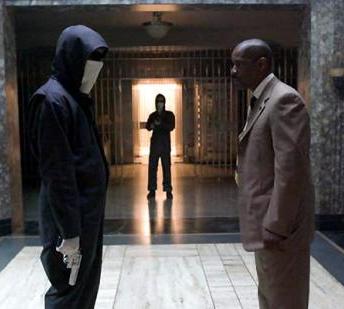 Hearkening to the halcyon days of Dog Day Afternoon and Serpico, Spike Lee’s Inside Man is a clever contraption indeed — a sleek, intelligent, well-acted NYC heist flick whose central scheme is more about subterfuge, cunning, and misdirection than technical gimmickry. (In too many films in the genre — The Score, or Ocean’s 11, for example — the robbers seem to be spending more on state-of-the-art equipment than they’d actually make in the grift.) To be sure, there are some implausibilities throughout, including pretty much all of Jodie Foster’s character and [Spoilers] the idea that Christopher Plummer would keep that Nazi paperwork lying around for sixty years, and the film’s last half-hour takes too long to put the story to bed. That being said, for the most part Inside Man is a slick caper film that offers both legitimately surprising twists and the satisfaction of seeing parts of a well-crafted scheme fall into place like tumblers in a lock. In the immortal words of Hannibal Smith, “I love it when a plan comes together.”
Is that a spoiler? Well, no, not really. The movie (and the trailer) begin with Dalton Russell (Clive Owen, charismatic as ever) telling us he has conceived and executed “the perfect bank robbery.” Very soon thereafter, we watch Russell and three accomplices, dressed as painters, walk into a ritzy downtown Manhattan bank, bar the doors, and take hostage of the 20-30 unfortunate New Yorkers therein. Soon, led by detectives Keith Frazier (Denzel Washington, in top form) and Bill Mitchell (the always-excellent Chiwetel Ejiofor) as well as a by-the books captain (Willem DaFoe), the NYPD surround the bank, and a protracted stand-off begins. Meanwhile, the bank’s president (Christopher Plummer) adds an X-factor to the equation by hiring a Fixer of sorts (Jodie Foster, as good as anyone could be in this goofy role) to resolve the situation to his own satisfaction. With the board thus set, the rest of the film involves the pieces moving — We watch the heist unfold over the course of a New York City day and night, punctuated by clips of Washington and Ejiofor interrogating the bank hostages after the fact.
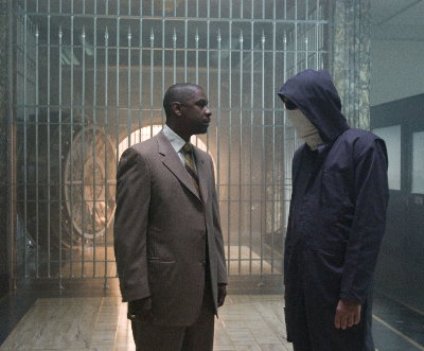 Of course, this isn’t just a well-crafted crime film, but a Spike Lee joint, and it resonates in the details. (In its own way, I’d say this is as strong as Lee’s last movie, The 25th Hour.) As Salon‘s Stephanie Zacharek notes in her positive review, “Inside Man is a movie that practices what Crash preaches.” It may be considered bizarre and even Oscar-noteworthy for people of different races and backgrounds to interact in the hermetically-sealed car-culture of Los Angeles, but New Yorkers have been colliding up against each other for some time now. And — unlike in Crash — Lee gets the feel right. (This is his thematic territory, after all.) Particularly noteworthy in this regard are the scenes involving a Sikh bank teller (Waris Ahluwalia) whom the robbers send out with their demands. On sight of turban, the cops immediately treat him like a terrorist bomber, and Ahluwalia manages to sound both terrified and fed up at the same time with the post-9/11 indignity of it all. True, some of the plot mechanics in Inside Man could be considered contrived, but, Jodie Foster’s corporate ninja notwithstanding, at least here the people seem real. (2nd Crash link via Listen Missy.)